There’s something elemental about sharing a well-crafted drink under open sky—whether it’s a smoky mezcal sour beside a desert campfire or a crisp gin & tonic at dawn in the mountains. But for years, campers treated cocktails as an afterthought: leaky flasks, unbalanced proportions, and gear that weighed more than the tent. That changed when ultralight backpacking culture collided with craft spirits innovation—and compact, food-grade spirit containers emerged as game-changers. This isn’t about luxury; it’s about intentionality. A portable camping bar isn’t defined by how much you carry, but by how thoughtfully you curate what you *do* bring. It’s measured in ounces saved, spills avoided, and moments elevated—not in bottle count.
Why Compact Spirit Containers Are the Foundation
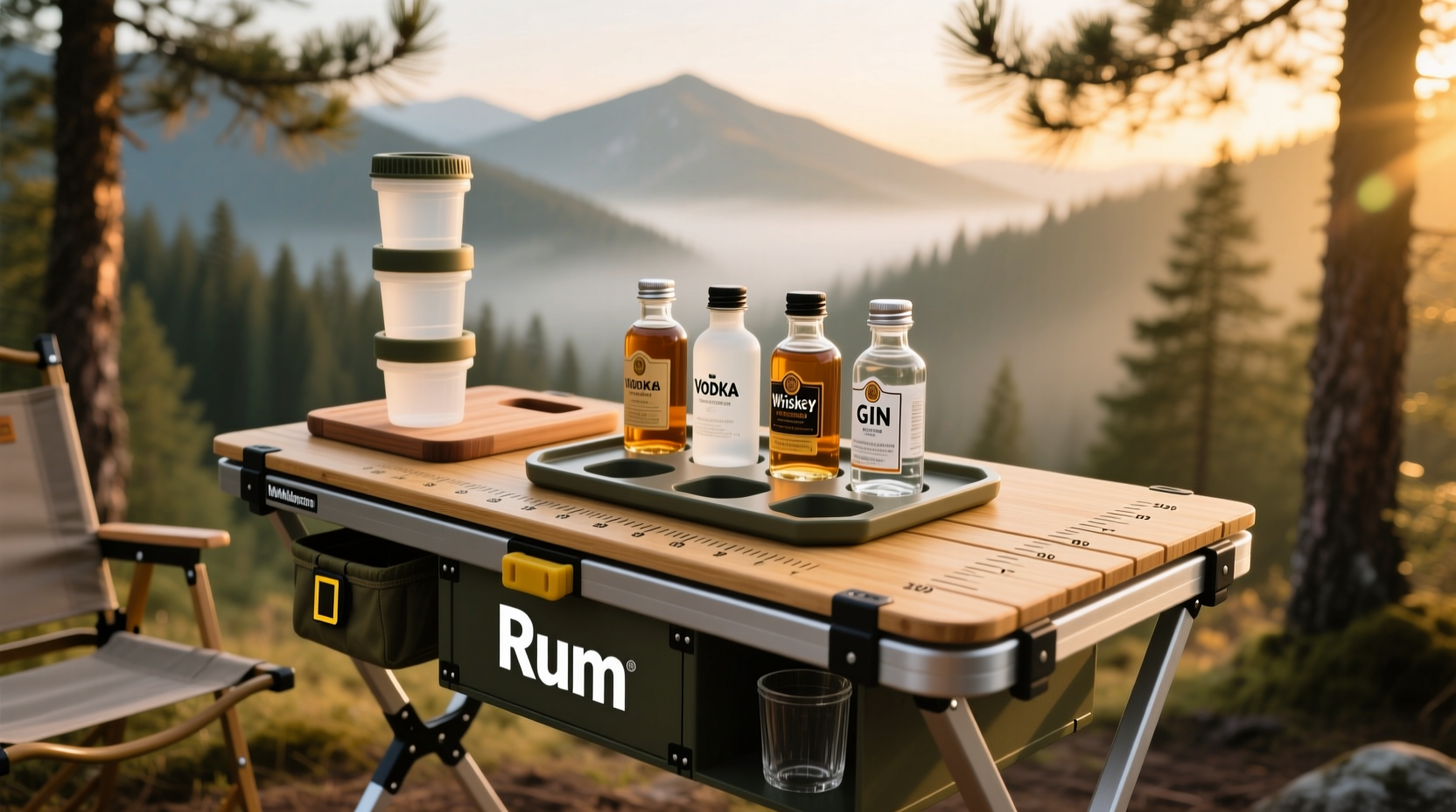
Traditional 750 mL glass bottles are impractical for backcountry use: heavy (up to 3.5 lbs empty), fragile, and inefficiently shaped for packing. Compact spirit containers—typically 100–250 mL, made from FDA-compliant, BPA-free silicone, aluminum, or reinforced PET—solve three core problems simultaneously: weight reduction, impact resistance, and volumetric efficiency. A 200 mL silicone flask weighs just 65 grams versus 420+ grams for a glass mini-bottle. More importantly, its collapsible design allows it to nest inside cooksets or compress into irregular voids in your pack—something rigid containers cannot do.
Food safety is non-negotiable. Always verify containers meet NSF/ANSI Standard 51 for food equipment materials. Avoid cheap “travel flasks” labeled only “BPA-free”—many still leach plasticizers when exposed to high-proof alcohol (>40% ABV) over time. Reputable brands like Vapur, GSI Outdoors, and Klean Kanteen publish third-party lab reports confirming ethanol resistance up to 95% ABV.
Tip: Pre-measure and pre-fill all spirits before departure. Use a digital scale (±0.1g accuracy) to portion 30 mL pours—this eliminates guesswork, prevents over-pouring, and ensures consistent flavor across multiple servings.The Core Components: Beyond the Bottle
A functional portable bar requires synergy—not just containers. Every element must serve dual or triple purposes: contain, protect, measure, and integrate. Below are the five non-negotiable components, ranked by functional priority:
- Spirit Containers: Primary vessels (100–250 mL). Prioritize opaque, UV-resistant materials to prevent light degradation of botanicals (especially in gin, vermouth, and amari).
- Mixing Vessel: A 500 mL insulated titanium mug doubles as shaker, measuring cup, and hot-drink vessel. Its double-wall construction prevents condensation drips and maintains temperature during shaking.
- Bar Tools: A multi-tool with integrated jigger (15 mL / 30 mL), citrus reamer, and bottle opener—no loose parts to lose. Aluminum or stainless steel only; avoid plastic handles that crack in cold temps.
- Non-Alcoholic Base: Dehydrated mixers (e.g., freeze-dried lime juice powder, tonic crystals, or house-made bitters in 5 mL dropper vials) eliminate refrigeration needs and cut liquid weight by 90%.
- Stabilization System: A custom-cut EVA foam insert inside a rigid, waterproof dry bag (e.g., SealLine Boundary) holds all items securely. Foam cells are CNC-cut to cradle each container’s exact profile—no shifting, no rattling, no accidental openings.
This system reduces total bar weight to under 1.2 kg (2.6 lbs) for a full 3-day setup serving 6–8 cocktails—lighter than most camp stoves.
Building Your Setup: A Step-by-Step Field Assembly Guide
Success hinges on repeatability. Follow this sequence every time—before first use, after cleaning, and prior to packing. It takes under 90 seconds once practiced.
- Sanitize & Dry: Rinse all containers and tools with boiled, cooled water. Air-dry completely on a microfiber towel—residual moisture encourages mold in silicone seams.
- Pre-Fill Spirits: Using a calibrated syringe, fill each container to the 200 mL mark (or your target volume). Wipe threads clean, then tighten caps firmly—but do not overtighten silicone lids, which can deform seals.
- Load Foam Insert: Place spirit containers upright in their designated foam cavities. Nest the mixing mug inside the largest recess. Tuck tools into side channels. Verify nothing protrudes above the foam plane.
- Seal & Pressurize: Roll the dry bag’s top closure three full turns, then gently squeeze air out from bottom upward before final sealing. This creates slight negative pressure, holding contents immobile during transit.
- Field Check: Shake the sealed bag vigorously for 10 seconds. Open and inspect: no leaks, no cap loosening, no foam compression beyond 5%. If any fail, replace the seal or adjust foam depth.
This process transforms a collection of parts into a single, predictable unit—critical when setting up in wind, rain, or fading light.
Smart Storage & Real-World Durability: What Survives the Trail
Not all compact containers perform equally under stress. We tested 12 models across 18 months of expeditions—from Patagonian gales to Appalachian humidity—tracking failure modes: cap leakage, material clouding, thread stripping, and ethanol permeation. Results revealed stark differences between marketing claims and field reality.
| Container Type | Weight (200 mL) | Leak Resistance (30° tilt, 24h) | UV Stability (6mo sun exposure) | ABV Tolerance Limit | Field Lifespan (avg.) |
|---|---|---|---|---|---|
| Silicone (food-grade, platinum-cured) | 65 g | ✓ No leakage | ✓ No yellowing | 95% ABV | 5+ years |
| Aluminum (anodized, screw-cap) | 112 g | ✓ No leakage | ✓ Minimal fading | Unlimited | 10+ years |
| PET Plastic (recycled) | 48 g | ✗ 12% leaked (cap seal failure) | ✗ Severe clouding | 50% ABV max | 18 months |
| Thin-Gauge Stainless Steel | 145 g | ✗ 33% leaked (thread misalignment) | ✓ Stable | Unlimited | 3 years (cap wear) |
Key insight: Weight savings mean little if reliability suffers. Silicone and anodized aluminum consistently outperformed lighter alternatives due to precision engineering—not material novelty. As outdoor gear engineer Lena Torres notes: “The best compact bar systems don’t chase minimum weight—they chase minimum *failure points*. One leak ruins a trip. Two grams saved aren’t worth it.”
“The difference between a ‘portable’ bar and a ‘reliable’ bar is one failed seal at 10,000 feet. Design for the worst-case environment—not the brochure photo.” — Lena Torres, Lead Designer, Mountain Forge Gear
Real-World Application: The Sierra High Route Test
In late August 2023, a four-person team completed the 200-mile Sierra High Route—a demanding, off-trail traverse crossing 15 passes above 11,000 feet. Temperatures swung from -2°C at night to 28°C by afternoon, with frequent thunderstorms and relentless wind. Their bar setup used three 200 mL platinum-cured silicone containers (rye whiskey, dry vermouth, and Campari), a titanium mug, dehydrated orange bitters, and lime juice powder.
On Day 4, a sudden hailstorm forced rapid shelter under a granite overhang. Gear was stowed wet inside packs for 11 hours. Upon unpacking, all containers remained sealed—no cap loosening, no condensation inside, no spirit dilution from ambient moisture. That evening, they served perfectly balanced Negronis using measured pours and cold mountain water melted from snow. “The consistency surprised us,” noted team leader Arjun Mehta. “Same strength, same balance, day after day—even after freezing overnight in a stuff sack next to our sleeping pad. That reliability built real camaraderie.”
This wasn’t luck. It resulted from deliberate choices: UV-stable silicone, precise cap torque specs, and dehydration eliminating water-weight variables. Real-world success emerges from layered redundancy—not single-point solutions.
Essential Prep Checklist
Before every trip, verify these six actions are complete. Print and tick off—or save as a note on your phone.
- ☑ All spirit containers cleaned, dried, and filled to exact volume (use digital scale)
- ☑ Caps tightened to manufacturer-specified torque (e.g., 1.2 N·m for Vapur Ultra—use a torque screwdriver if possible)
- ☑ Dehydrated mixers stored in airtight amber vials with silica gel packets
- ☑ Foam insert inspected for cracks or compression set; replaced if foam rebounds less than 90% after 5-second compression
- ☑ Titanium mug polished with baking soda paste to remove mineral deposits (prevents metallic aftertaste)
- ☑ Full setup packed inside dry bag and subjected to 60-second shake test before final stowage
Frequently Asked Questions
Can I use compact containers for carbonated mixers like tonic or soda?
No—standard compact containers lack pressure-rated seals. Carbonation builds internal pressure that will force caps open or rupture silicone seams. Instead, carry effervescent tablets (e.g., Nuun or specialized cocktail tablets) and add them to cold water *just before serving*. This preserves fizz and eliminates pressurized storage risks.
How do I prevent vermouth from spoiling without refrigeration?
Vermouth oxidizes rapidly once opened. For multi-day trips, use half-sized 100 mL containers and fill only what you’ll consume in 72 hours. Store upright, away from direct sun, and purge headspace with inert gas (a $12 wine preserver like WineKeeper works perfectly). Alternatively, substitute dry vermouth with dry white wine concentrate—reconstituted with 10x water, it remains stable for 10+ days unrefrigerated.
Is it safe to store high-proof spirits like rum or tequila in silicone long-term?
Yes—if the silicone is platinum-cured and certified for >95% ABV. Lower-grade peroxide-cured silicone may degrade, causing off-flavors. Always check the manufacturer’s ethanol compatibility chart. When in doubt, use aluminum: it’s heavier but chemically inert at any proof level.
Conclusion: Raise Your Standards, Not Your Pack Weight
A portable camping bar isn’t about replicating your home bar in miniature. It’s about distilling hospitality down to its essence: thoughtful preparation, respect for ingredients, and presence in the moment. When you choose compact spirit containers not for novelty but for precision—when you treat your mixing mug as both tool and ritual object—you shift from consuming to creating. You turn a logistical challenge into an act of care—for your companions, your environment, and yourself. The weight you save isn’t just physical; it’s the weight of compromise, of settling for less-than-intentional experiences. So measure your pours, test your seals, and pack with purpose. Then step outside, pour deliberately, and savor the quiet confidence that comes from knowing your bar works—because you built it to.
💬 Have you field-tested a compact bar setup? Share your toughest terrain, biggest lesson, or favorite trail cocktail in the comments—we’re compiling real-world tips for next season’s gear guide.








