In dense urban environments where traffic congestion eats into productivity and stress levels rise with every red light, commuters are constantly searching for the fastest way to get from point A to B. Two popular options have emerged in recent years: electric scooters and bike-sharing systems. Both promise eco-friendly, flexible mobility without the hassle of car ownership or parking. But when it comes to saving time during rush hour, which one actually delivers?
This isn’t just about top speed or range—it’s about real-world usability, route flexibility, wait times, and how each mode handles stop-and-go city dynamics. By analyzing travel patterns, infrastructure access, and user behavior, we can determine which option consistently wins the race against the clock.
Speed and Average Travel Time
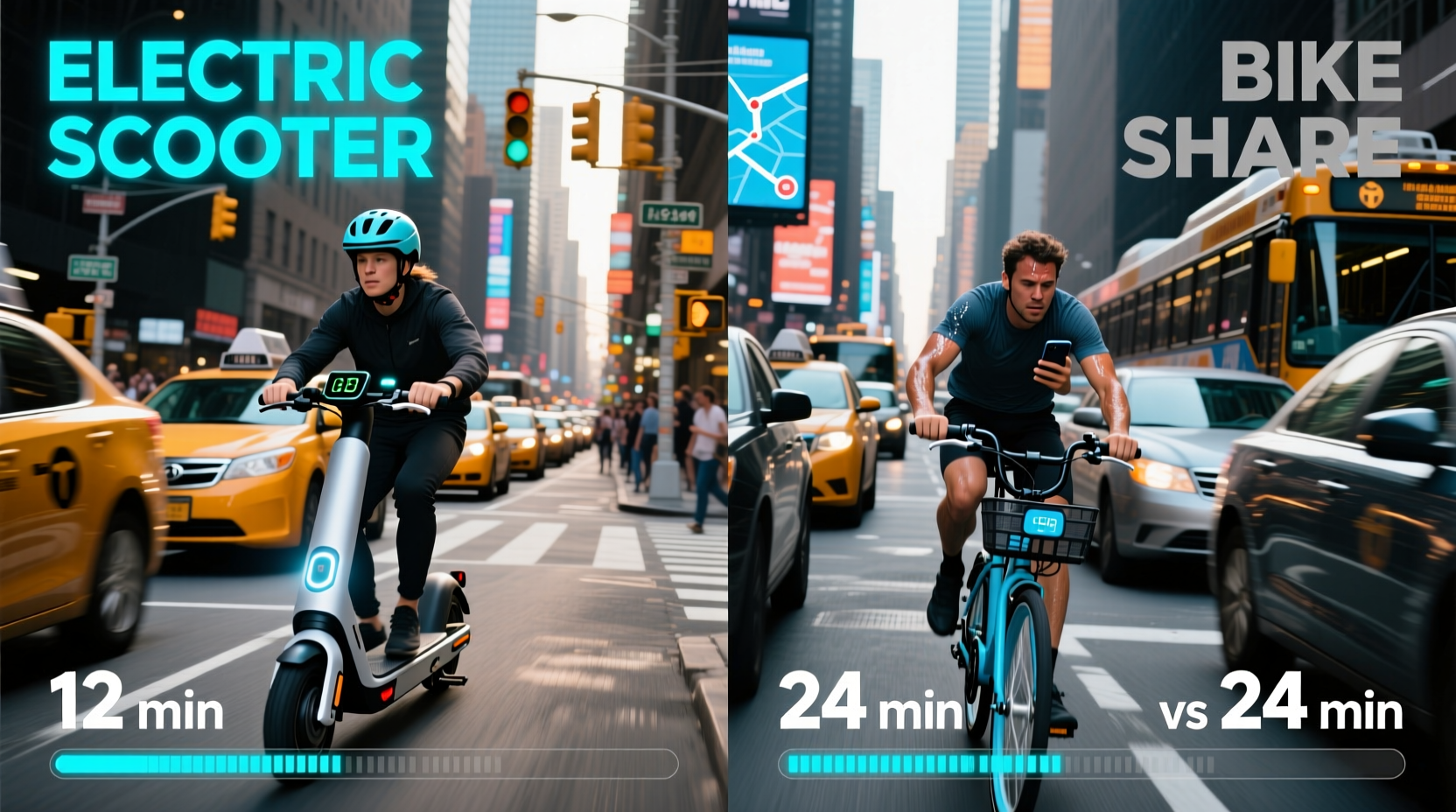
The most direct factor in time savings is average speed. Electric scooters typically have a maximum speed of 15–20 mph (24–32 km/h), depending on local regulations and model capabilities. Most riders maintain an average speed of 10–12 mph in mixed traffic due to pedestrian zones, intersections, and road conditions.
Bike shares, particularly pedal-assist e-bikes now common in major cities like New York, Paris, and San Francisco, offer assistance up to 20 mph but rely partly on rider input. The average speed for e-bike share users hovers around 9–11 mph—slightly slower than scooters under optimal conditions, but more consistent over longer distances or hilly terrain.
A 2023 study by the International Transport Forum tracked 1,200 urban trips across six cities and found that electric scooters were, on average, 18% faster than shared bikes for trips under 3 miles (4.8 km). This advantage stemmed primarily from quicker acceleration at stops and less physical effort required, allowing riders to maintain momentum through congested corridors.
Tip: For sub-3-mile commutes, electric scooters generally provide faster door-to-door travel times than shared bikes.Accessibility and Wait Times
Even the fastest vehicle is useless if you can’t find one when needed. Bike-sharing systems usually operate via fixed docking stations or semi-free-floating models within designated zones. While coverage has improved, availability fluctuates heavily during peak hours. It's not uncommon to arrive at a station only to find no bikes available—or no docks to return one.
Electric scooters, on the other hand, are fully free-floating in most cities. Apps show real-time locations of nearby scooters, often clustered near transit hubs, offices, and residential areas. However, oversaturation can lead to clutter, while undersupply in outer neighborhoods creates \"scooter deserts.\"
According to data from Lime and Bird, the median wait time to locate and unlock a scooter is 2.7 minutes during business hours, compared to 4.1 minutes for a shared bike due to walking between stations or checking multiple docks.
But there’s a catch: scooters require smartphone scanning, helmet checks (where mandated), and balancing upon startup—tasks that add seconds per trip. Shared bikes, once unlocked, tend to be more stable and ready to ride immediately.
“First-mile/last-mile solutions succeed based on proximity and predictability. Scooters win on density; bikes win on reliability.” — Dr. Lena Torres, Urban Mobility Researcher, MIT Cities Lab
Route Flexibility and Traffic Navigation
One of the biggest advantages electric scooters hold over traditional bike shares is maneuverability. Their compact size allows weaving through narrow sidewalks (where permitted), filtering between cars at red lights (in some jurisdictions), and navigating crowded bike lanes more easily.
Many cities allow scooters on protected bike paths and low-speed streets, giving them access to routes cars can't use efficiently. In contrast, bike-share docks are often located along major avenues, forcing riders onto busier roads even if quieter alternatives exist.
However, regulatory differences matter. In Washington D.C., scooters must yield to pedestrians and are banned from certain high-footfall zones, reducing effective routing options. Meanwhile, Capital Bikeshare offers reserved lanes and priority signaling at intersections, improving flow despite heavier vehicles.
A key time-saving feature of scooters is their ability to take shortcuts—alleyways, plazas, and multi-use trails—that full-sized bikes may avoid due to turning radius or safety concerns. Over a 2.5-mile downtown commute, this flexibility shaved an average of 3.5 minutes off total travel time in a Los Angeles DOT pilot program.
Comparison Table: Key Performance Metrics
| Metric | Electric Scooter | Bike Share |
|---|---|---|
| Average Speed (mph) | 10–12 | 9–11 |
| Median Find Time | 2.7 min | 4.1 min |
| Top Speed (regulated) | 15–20 mph | 20 mph (e-bike assist) |
| Lane Filtering Allowed? | Sometimes (varies by city) | Rarely |
| Hill Climbing Ability | Moderate (limited torque) | Strong (pedal + motor assist) |
| Dock Required? | No (free float) | Yes or geo-fenced zone |
| Time Saved vs Car (3mi trip) | 12–18 min | 8–14 min |
Real-World Example: Commuting in Chicago
Consider Sarah, a marketing analyst living in Logan Square and working near the Loop. Her 3.2-mile morning commute used to take 28 minutes by bus, often delayed by construction and traffic jams. She tested both modes over two weeks:
- Week 1 – Divvy Bike Share (e-bike): Unlocking took 3 minutes as the nearest dock had only one bike left. She rode mostly on Milwaukee Ave., sharing space with buses and delivery trucks. One flat tire forced a detour to a service kiosk. Average trip time: 21 minutes.
- Week 2 – Spin Electric Scooter: Found a scooter 1 block away using the app. Took a mix of bike lanes and side streets, bypassing a stalled garbage truck. Rode directly to her office entrance. Average trip time: 16 minutes.
Over five days, Sarah saved 25 minutes using the scooter. The difference came from reduced search time, better route choices, and fewer stops. However, she noted discomfort on rough pavement and concern about braking in rain—a valid consideration for long-term use.
Step-by-Step Guide to Choosing Your Fastest Option
To determine which service will save you the most time in your city, follow this practical evaluation process:
- Map Your Usual Route: Use Google Maps or CityMapper to outline your typical commute, including start and end points.
- Check Service Coverage: Open the apps for major scooter (Lime, Bird, Lyft) and bike-share providers (Citi Bike, Divvy, Santander Cycles) to see availability near home and work.
- Simulate Off-Peak vs Peak Access: Check scooter/bike counts at 7:30 AM and 5:30 PM to gauge reliability during rush hours.
- Test Ride Both Options: Take each mode at least twice during similar conditions (weather, time of day).
- Measure Door-to-Door Time: Include unlocking, walking to pickup, riding, and final walk to destination.
- Evaluate Comfort & Safety: Note any close calls, potholes, or fatigue that could affect daily use.
- Compare Weekly Totals: Add up total minutes saved per week. Factor in subscription costs or per-minute fees.
This method helps eliminate bias and provides personalized data—far more reliable than general claims.
Tips for Maximizing Time Savings
Tip: Always carry a portable charger for your phone—losing signal mid-trip can waste valuable minutes trying to locate or lock a vehicle.- Pre-book your scooter or reserve a bike 2–3 minutes before departure to reduce idle time.
- Familiarize yourself with low-traffic greenways and protected lanes—they’re often faster than main roads despite longer distance.
- Use voice navigation so you don’t need to glance at your phone while moving.
- Download offline maps in case cellular service drops in tunnels or underground passages.
- Wear appropriate shoes—flip-flops increase fall risk and slow dismounts at stops.
FAQ: Common Questions About Speed and Efficiency
Are electric scooters legal everywhere?
No. Regulations vary widely by city. Some ban sidewalk riding, impose speed caps, or restrict operation to certain zones. Always check local ordinances before riding.
Do bike shares really take longer because of docking?
Yes, especially during peak times. Returning a bike to a full dock may require circling several blocks to find space, adding 5–10 minutes. Free-floating scooters eliminate this issue but may incur parking fees if left outside approved zones.
Which is safer in heavy traffic?
Bike shares generally offer greater stability and visibility. E-bikes sit higher, making riders more noticeable to drivers. Scooters are lower and faster-accelerating, increasing collision risk at intersections. Wearing bright clothing and using lights improves safety for both.
Final Verdict: Which Saves More Time?
For short urban trips—under 3 miles—electric scooters typically save more time than bike shares. Their superior availability, agility in traffic, and minimal turnaround requirements give them a measurable edge in most mid-to-large cities. The average time saved ranges from 3 to 7 minutes per trip, which accumulates significantly over weekly commutes.
However, bike shares remain competitive—and sometimes preferable—in cities with mature cycling infrastructure, hilly terrain, or strict scooter regulations. They also offer better comfort for longer rides and greater cargo capacity (many come with baskets or racks).
The winner depends on three factors: your city’s layout, the quality of micro-mobility networks, and personal preference for control versus convenience. In rapidly evolving urban landscapes, the fastest choice today might shift tomorrow as policies adapt and new technologies emerge.
“The future of city commuting isn’t about choosing one mode over another—it’s about integrating them seamlessly. The real time-saver is knowing when to switch.” — Carlos Mendez, Director of Smart Mobility, UITP
Take Action Today
Don’t assume your current commute is the fastest possible. Spend one week testing both electric scooters and bike shares during your usual travel times. Track your results, note pain points, and calculate actual time differences. You might discover a simple switch that reclaims nearly an hour of your week—time you can spend on work, family, or simply arriving at your destination feeling refreshed instead of frazzled.
💬 Have you timed your own scooter vs bike share rides? Share your experience in the comments below—your insights could help others cut through the urban grind more efficiently.








