
For the average homeowner tackling weekend repairs, assembling furniture, or hanging shelves, two tools often dominate the conversation: the cordless drill and the impact driver. Both are compact, battery-powered, and essential in modern toolkits—but they serve very different purposes. Choosing the wrong one can lead to stripped screws, damaged materials, or unnecessary frustration. Understanding the key differences between a cordless drill and an impact driver ensures you’re equipped with the right tool for your home DIY tasks.
Understanding the Core Differences
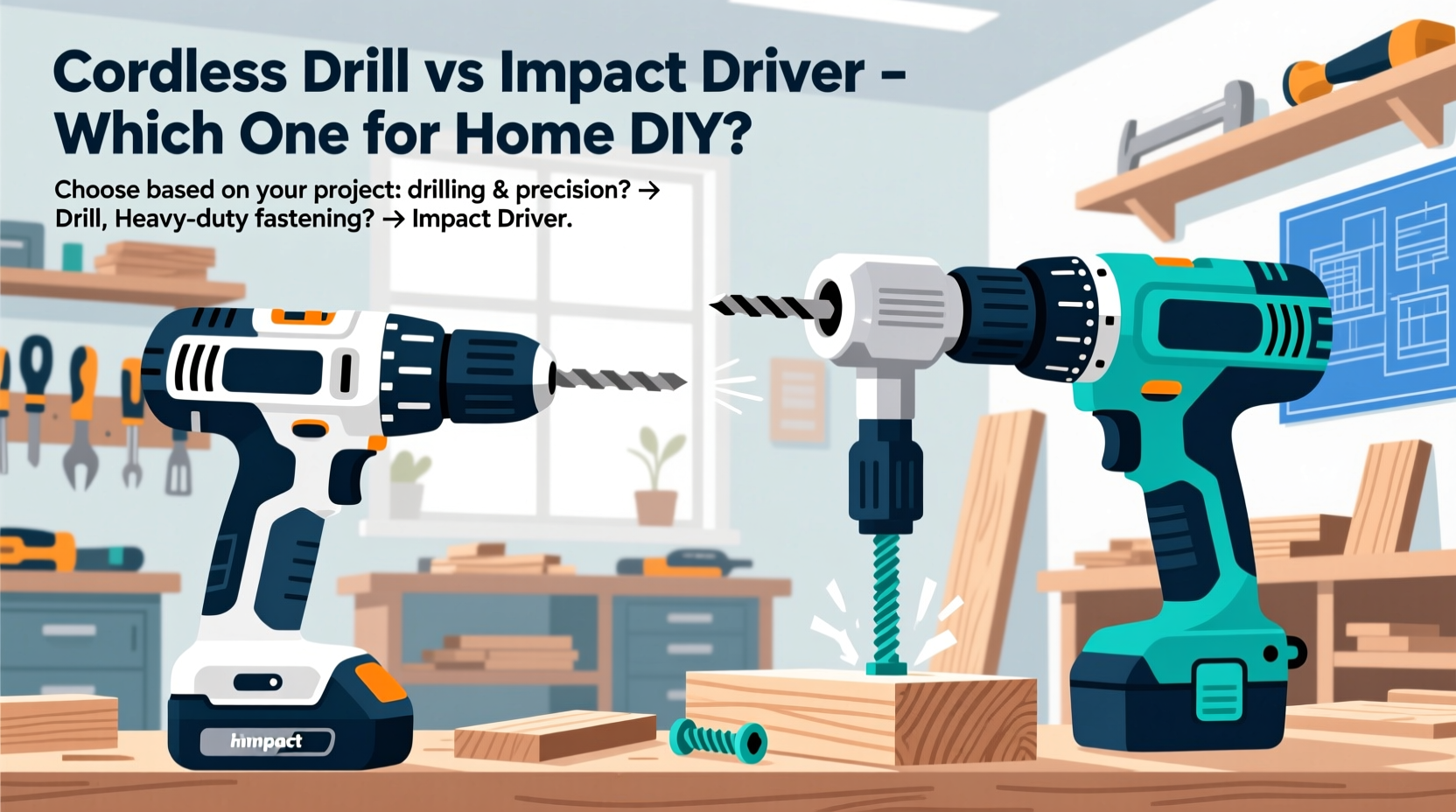
At first glance, a cordless drill and an impact driver may look similar—both are handheld, powered by lithium-ion batteries, and feature trigger controls. However, their internal mechanics, torque delivery, and intended applications diverge significantly.
A **cordless drill** is designed primarily for drilling holes and driving screws with consistent rotational force (torque). It offers variable speed control and often includes a clutch mechanism that disengages once a set torque level is reached, preventing over-tightening and material damage.
An **impact driver**, on the other hand, delivers rotational force combined with sudden bursts of concussive energy—like a hammer behind the motor. This allows it to generate far higher torque than a standard drill, making it ideal for driving long screws, lag bolts, or working with tough materials like hardwood or metal.
Tip: If you're only doing light screwdriving or drilling into drywall or wood, a cordless drill is more than sufficient. Reserve the impact driver for heavy-duty fastening jobs.Performance Comparison: Torque, Speed, and Control
Torque—the rotational force a tool generates—is where these two tools differ most. While drills typically offer 300–600 inch-pounds of torque, impact drivers can exceed 1,500 inch-pounds. That extra power comes at the cost of finesse.
| Feature | Cordless Drill | Impact Driver |
|---|---|---|
| Primary Function | Drilling holes & light-to-medium screwdriving | High-torque fastening (screws, bolts) |
| Torque Output | 300–600 in-lbs | 1,000–1,800+ in-lbs |
| Speed (RPM) | 0–1,500 RPM (variable) | 0–3,000 RPM + impacts per minute |
| Chuck Type | Keyed or keyless 3-jaw chuck (holds bits securely) | Hex collet (1/4\") – accepts hex-shank bits only |
| Clutch | Yes – prevents over-driving | No – continuous force until release |
| Size & Weight | Larger, heavier due to chuck and gearing | Compact, lightweight, easier to maneuver in tight spaces |
The lack of a clutch in impact drivers means they don’t automatically stop when resistance increases. This makes them powerful but less precise for delicate work. A cordless drill’s clutch allows you to set how tightly a screw is driven, protecting both the screw head and the material—especially important when working with softwoods or drywall.
Common Home DIY Use Cases
Not every project requires brute strength. Knowing what each tool excels at helps avoid mistakes and inefficiencies.
When to Use a Cordless Drill
- Hanging pictures and shelves: Drilling pilot holes in drywall or wood and driving small screws.
- Assembling flat-pack furniture: Driving multiple Phillips or square-head screws with consistent depth.
- Installing door hinges or cabinet hardware: Requires precision and moderate torque without damaging wood surfaces.
- Drilling into masonry (with hammer function): Many cordless drills come with a hammer mode for light concrete or brick work.
When to Use an Impact Driver
- Building decks or outdoor structures: Driving long deck screws or lag bolts into pressure-treated lumber.
- Framing or subfloor installation: Where high-torque fastening is needed quickly and repeatedly.
- Working with metal studs or roofing: Requires sustained force to penetrate tougher materials.
- Removing stubborn screws or bolts: The hammering action helps break loose rusted or overtightened fasteners.
“Most homeowners overestimate the need for an impact driver. For 80% of household tasks, a good cordless drill with a clutch is safer and more versatile.” — Mark Reynolds, Residential Carpenter & Tool Instructor
Mini Case Study: Renovating a Laundry Room
Consider Sarah, a DIY enthusiast renovating her laundry room. Her project includes mounting a heavy-duty shelving unit, installing a new washer hookup panel, and anchoring a folding dryer to the wall.
She begins with her cordless drill to pre-drill holes in the stud walls and attach wooden cleats for the shelves. The variable speed and clutch allow her to drive screws flush without splitting the wood. When attaching the metal dryer bracket, she encounters resistance—standard screws won’t seat properly. Switching to her impact driver, she powers through the metal frame with ease, using its high torque to secure the unit safely.
This scenario illustrates the complementary nature of both tools. Had Sarah used only an impact driver from the start, she might have stripped screw heads or cracked the wood. Relying solely on a drill would have made the metal fastening task slow and frustrating.
Step-by-Step Guide: Choosing the Right Tool for Your Project
Follow this decision-making process before reaching for your tool belt:
- Assess the material: Is it drywall, wood, metal, or masonry? Soft materials favor drills; dense materials may require impact drivers.
- Check the fastener type: Small screws (under 2 inches) usually don’t need an impact driver. Long structural screws or lag bolts do.
- Determine access and space: Tight corners benefit from the compact size of an impact driver, but only if high torque is needed.
- Evaluate frequency of use: If you’ll rarely drive heavy fasteners, investing in an impact driver may not be cost-effective.
- Test with a pilot hole: Always drill a pilot hole in hardwood or near edges to prevent splitting—regardless of which tool you use.
Can You Use One Tool for Everything?
Many manufacturers now offer combo kits that include both a cordless drill and an impact driver, sharing the same battery platform. This flexibility is ideal for homeowners who want versatility without buying separate systems.
While adapters exist—such as hex-to-chuck attachments that let you use drill bits in an impact driver—they compromise performance and safety. Impact drivers aren’t designed for sustained drilling, especially in masonry or metal, and the excessive torque can damage smaller drill bits or overheat them.
Likewise, using a cordless drill for heavy fastening may stall the motor or strip screw heads, particularly when driving into dense materials without proper lubrication or pilot holes.
Essential Checklist for Homeowners
Before purchasing or using either tool, run through this checklist:
- ✅ Do I need to drill holes regularly? → Prioritize a cordless drill.
- ✅ Will I be building decks, fences, or framing? → Consider adding an impact driver.
- ✅ Am I working mostly indoors with lightweight materials? → A drill is likely sufficient.
- ✅ Do I already own one tool? → Evaluate whether your current tool covers 90% of your needs before buying another.
- ✅ Are batteries interchangeable between tools? → Opt for brands with shared platforms (e.g., DeWalt 20V MAX, Milwaukee M18).
- ✅ Do I value precision over raw power? → Choose a drill with adjustable clutch settings.
Frequently Asked Questions
Can I use an impact driver to drill holes?
Technically yes, but only in soft materials like wood or plastic and with caution. Impact drivers lack the controlled rotation and centering ability of drills. They should never be used for precision drilling or in masonry, tile, or metal—where a dedicated drill (or hammer drill) is required.
Is an impact driver necessary for home DIY?
Not for most homeowners. If your projects involve assembling furniture, hanging shelves, or minor repairs, a cordless drill will handle everything. An impact driver becomes valuable only when tackling larger construction projects requiring repeated high-torque fastening.
What battery voltage should I choose?
For general home use, 12V to 18V tools are ideal—lightweight and powerful enough for most tasks. Higher voltages (20V+) are better suited for contractors or frequent users. Stick to one brand’s ecosystem to maximize battery compatibility across tools.
Final Recommendation: Start with a Cordless Drill
For the vast majority of home DIYers, a quality cordless drill is the smarter first investment. It’s more versatile, easier to control, and capable of handling the wide range of light to medium tasks encountered around the house. Look for models with at least two speed settings, a ¾-inch keyless chuck, and a 15-position clutch for maximum adaptability.
If you later expand into deck building, garage organization systems, or structural repairs, then adding an impact driver to your collection makes sense. By pairing both tools—and understanding when to use each—you gain professional-level efficiency without overspending or overcomplicating your toolkit.
“The right tool isn��t always the most powerful one. It’s the one that matches the job.” — Lena Patel, Home Improvement Educator
Conclusion
Deciding between a cordless drill and an impact driver isn’t about which is “better”—it’s about matching the tool to your typical projects. For everyday home maintenance and light construction, the cordless drill reigns supreme in versatility and control. The impact driver shines in specialized, high-demand scenarios where raw driving force outweighs precision.
You don’t need both to get started. Begin with a reliable cordless drill, master its settings, and assess your evolving needs. When the time comes, adding an impact driver can elevate your capability—but only if your projects demand it.
🚀 Ready to upgrade your toolkit? Start with a 12V or 18V cordless drill from a trusted brand, and share your go-to tool combination in the comments below!








