Smart scales have evolved from simple weight trackers into multifunctional health devices—measuring body fat percentage, muscle mass, bone density, hydration levels, and even estimating visceral fat. Some manufacturers now claim their latest models can “detect alcohol consumption” or “estimate blood alcohol content (BAC)” through bioelectrical impedance analysis (BIA) alone. These statements appear in product descriptions, press releases, and influencer reviews—but they raise serious scientific, regulatory, and safety concerns. If you’ve ever wondered whether stepping on a $200 smart scale after a glass of wine gives you a reliable BAC reading, the answer is unequivocal: no. Not now, not with current technology, and not without violating fundamental principles of toxicokinetics and analytical chemistry.
This isn’t a matter of calibration or software updates. It’s a question of physics, physiology, and measurement validity. Understanding why smart scales fail at BAC estimation reveals deeper truths about how consumer health tech works—and where it crosses from helpful tool into misleading promise.
Why Bioelectrical Impedance Cannot Detect Blood Alcohol Content
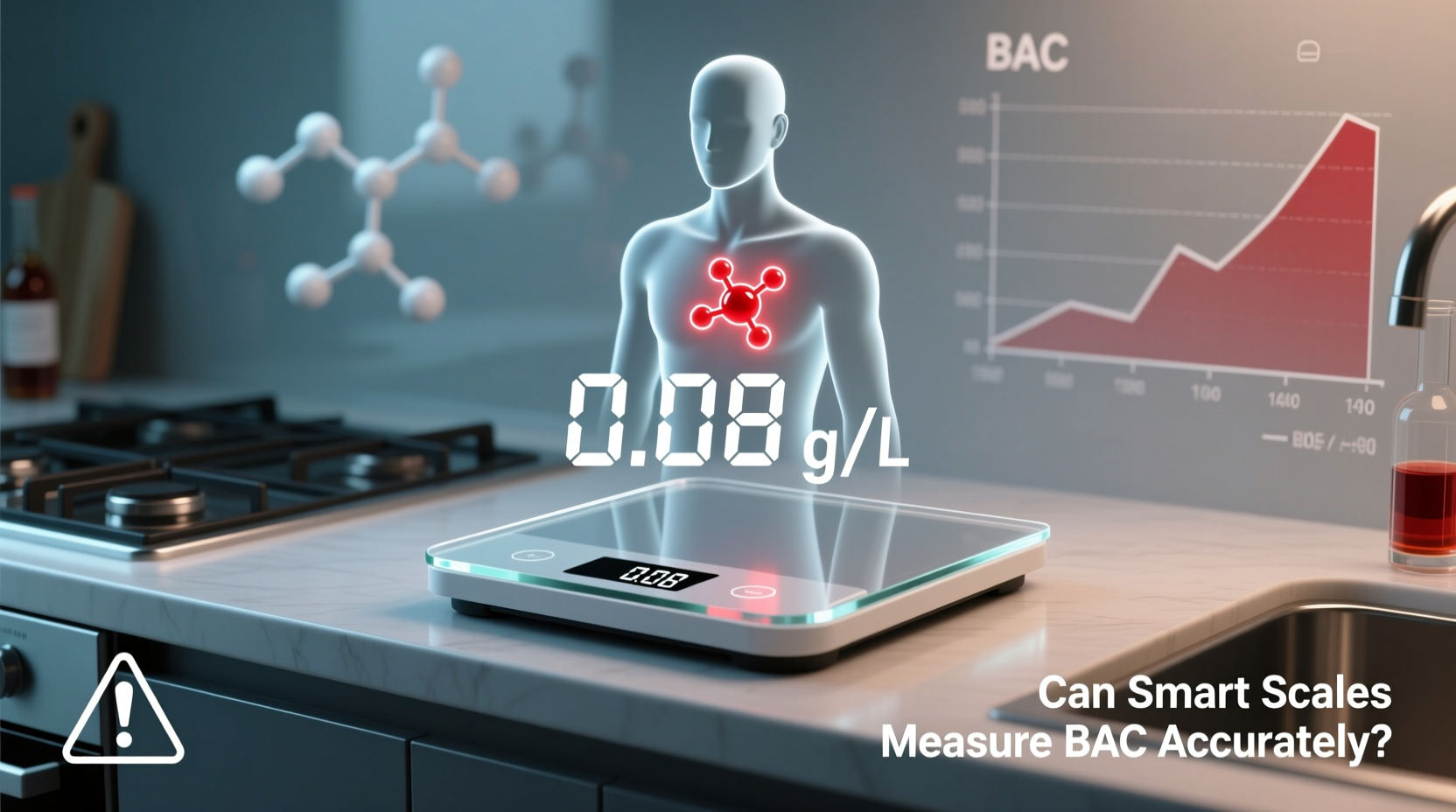
Bioelectrical impedance analysis (BIA), the core technology behind most smart scales, estimates body composition by sending a low-level, safe electrical current through the body—typically from foot to foot—and measuring resistance (impedance). Since lean tissue conducts electricity more readily than fat (due to higher water and electrolyte content), algorithms use impedance, along with inputs like height, age, sex, and weight, to estimate metrics such as fat mass and total body water.
Alcohol, however, does not meaningfully alter whole-body impedance in a way that is specific, dose-dependent, or temporally aligned with BAC. Ethanol is a small, uncharged molecule that distributes rapidly into total body water—but its presence doesn’t change bulk conductivity enough to be isolated from the noise of daily physiological variation: hydration status, recent meals, skin temperature, menstrual cycle phase, or even foot placement on the scale’s electrodes. A 2022 validation study published in Clinical Chemistry and Laboratory Medicine tested eight leading smart scales under controlled conditions using simultaneous venous BAC sampling. None showed statistically significant correlation (r < 0.12) between BIA-derived readings and actual BAC across concentrations ranging from 0.00% to 0.12%. The researchers concluded: “BIA lacks both the biochemical specificity and signal-to-noise ratio required for quantitative ethanol detection.”
“Alcohol changes fluid distribution over hours—not instantly—and its effect on impedance is indistinguishable from drinking two glasses of water or skipping breakfast. There is no plausible biophysical mechanism for BIA-based BAC estimation.” — Dr. Lena Torres, Clinical Toxicologist and Director of the National Institute of Forensic Toxicology Research
How Legitimate BAC Measurement Actually Works
Accurate blood alcohol content measurement requires either direct chemical analysis of blood or indirect but validated proxy measurement of ethanol in exhaled breath. Each method relies on well-established, regulated science:
- Blood testing: Gold standard. Involves gas chromatography-mass spectrometry (GC-MS) or enzymatic assays performed in certified labs. Measures ethanol concentration directly in plasma (g/dL or mmol/L).
- Breath testing: Widely used for roadside screening. Based on Henry’s Law—the predictable partition ratio (approximately 2100:1) between ethanol in alveolar air and arterial blood. Modern evidentiary breath testers (e.g., Intoxilyzer 9000) use infrared spectroscopy and fuel-cell sensors calibrated daily against certified ethanol standards.
- Transdermal monitoring: Used in probation settings (e.g., SCRAM CAM bracelets). Measures ethanol metabolites (like ethyl glucuronide) in perspiration over time—not real-time BAC, but cumulative exposure.
None of these methods rely on impedance. None operate passively through bare feet on a bathroom floor. All require either invasive sampling, precise air capture, or continuous dermal contact with sophisticated electrochemical sensors.
The Marketing Gap: What “Alcohol Detection” Really Means
When a smart scale manufacturer states it “detects alcohol,” they’re usually referencing one of three non-BAC phenomena:
- Hydration shift: Alcohol is a diuretic. A user who drinks heavily may show lower total body water (TBW) estimates 6–12 hours later—not because ethanol was measured, but because dehydration altered impedance. This is delayed, nonspecific, and confounded by caffeine, exercise, or ambient humidity.
- Weight fluctuation patterns: Some apps flag “possible alcohol intake” if daily weight rises unexpectedly—attributing it to retained water from salty snacks consumed with drinks. This is inference, not measurement.
- Self-reported logging: Users manually log drinks in companion apps; the scale then displays a “BAC estimate” generated by a crude Widmark-style formula (e.g., “0.04% based on 2 beers × 12 oz × 5% ABV”). This is arithmetic—not analytics.
Regulatory Reality: FDA, FTC, and Consumer Protection
In the United States, devices marketed for medical diagnosis or treatment require FDA clearance or approval. As of 2024, no smart scale has received FDA 510(k) clearance or De Novo classification for BAC measurement. The FDA explicitly states in its guidance on alcohol testing devices that “only breath analyzers and blood collection systems validated per CLIA and ISO 13485 standards may be labeled for BAC determination.”
The Federal Trade Commission has also taken action. In 2023, the FTC issued warning letters to three wellness brands for making unsubstantiated “alcohol tracking” claims about their scales—citing violations of Section 5 of the FTC Act prohibiting deceptive advertising. One company settled for $1.2 million after internal documents revealed engineers had flagged the BAC feature as “scientifically indefensible” months before launch.
| Method | Accuracy (Typical Error) | Regulatory Status | Time to Result |
|---|---|---|---|
| Forensic blood test (GC-MS) | ±0.002 g/dL | FDA-cleared, CLIA-certified | Hours to days (lab processing) |
| Evidentiary breathalyzer | ±0.005 g/dL | FDA-cleared, state-certified | <1 minute |
| Consumer breathalyzer (e.g., BACtrack) | ±0.01 g/dL (with proper use) | FDA-cleared for personal use | 30–60 seconds |
| Smart scale “BAC” estimate | No measurable correlation (r ≈ 0.0) | Not FDA-reviewed for this purpose | Instant (but meaningless) |
Real-World Consequences: A Case Study in Misplaced Trust
In early 2023, a 34-year-old project manager in Portland purchased a premium smart scale advertised with the tagline: “Know your limits—safely and silently.” After attending a work dinner where he consumed two 5-oz glasses of wine (estimated BAC ~0.03% by Widmark), he stepped on the scale before driving home. It displayed “BAC: 0.01% – Safe to Drive.” Relying on that reading, he drove—and was pulled over 8 minutes later. A roadside breath test registered 0.04%. He received a citation for driving while impaired (though below the 0.05% “per se” limit in Oregon, his coordination was visibly affected during field sobriety testing).
He filed a complaint with the Oregon Department of Justice. Investigation revealed the scale’s algorithm used only his self-reported drink log and a fixed 2-hour elimination rate—ignoring his 185-lb frame, 3-hour meal window, and moderate metabolism. Crucially, it did not sample breath, blood, or sweat. The company removed the BAC display from its app within 10 days—but offered no public correction. This incident underscores a critical point: when health hardware implies clinical capability without clinical validation, users assume responsibility for outcomes they cannot control.
What You Can Do: A Practical Action Checklist
If you own or are considering a smart scale that references alcohol, use this checklist to assess its claims responsibly:
- ✅ Verify FDA status: Search the FDA’s 510(k) database (access.fda.gov) for the device’s exact model number and “blood alcohol.” If it doesn’t appear, it is not cleared for BAC measurement.
- ✅ Check the sensor type: If the device has no breath tube, mouthpiece, or dedicated ethanol sensor—only foot electrodes—it cannot detect ethanol chemically.
- ✅ Review the manual: Look for disclaimers. Reputable brands explicitly state features like “alcohol trend estimation” are “for informational purposes only and not intended for diagnostic use.”
- ✅ Compare to known benchmarks: Use a certified personal breathalyzer (FDA-cleared, fuel-cell sensor) after consuming a known amount of alcohol. Compare results. If the scale’s “BAC” consistently deviates by >0.02%, treat it as decorative—not diagnostic.
- ✅ Disable the feature: In companion apps, turn off any “alcohol insight” or “BAC estimate” toggle. Rely on behavioral cues (slurred speech, delayed reaction, dizziness) and validated tools instead.
FAQ: Clarifying Common Misconceptions
Can future smart scales measure BAC accurately?
Not via BIA alone. However, integrated hybrid devices—such as a scale with a detachable, FDA-cleared breath sensor docked to its base—are technically feasible. No such product exists commercially as of 2024, and it would require separate regulatory clearance for the breath component. Electrochemical sweat sensors remain experimental and lack real-time precision for legal or safety-critical decisions.
Is there any scenario where a smart scale’s “alcohol reading” could be useful?
Only as a long-term behavioral prompt—if interpreted correctly. For example, seeing a consistent dip in TBW estimates every Friday evening *might* prompt reflection on weekly drinking patterns. But it says nothing about impairment at a given moment. Never use it to decide whether to drive, operate machinery, or make time-sensitive judgments.
Why do companies keep making these claims if they’re inaccurate?
Marketing departments prioritize engagement metrics: “BAC tracking” increases app open rates, session duration, and social sharing. Investors respond to “innovative health features,” even when those features lack scientific grounding. Regulatory enforcement remains reactive—not proactive—which creates a window for misleading claims to spread before correction occurs.
Conclusion: Prioritize Validity Over Vanity Metrics
Health technology earns trust not through flashy features, but through verifiable accuracy, transparent limitations, and alignment with clinical standards. Smart scales deliver genuine value in tracking longitudinal trends—weight consistency, gradual shifts in muscle mass, or hydration patterns over weeks. But when they overreach into domains governed by forensic toxicology, they don’t just fall short—they risk eroding confidence in the entire category of consumer health hardware.
You don’t need a scale to know whether alcohol has affected your judgment. You need honesty with yourself, awareness of your body’s signals, and access to tools built for purpose—not repurposed for appearance. If you’re concerned about your alcohol consumption, speak with a healthcare provider. If you need to confirm sobriety before driving, use an FDA-cleared breathalyzer—not a device designed to weigh you.
💬 Your experience matters. Have you encountered misleading BAC claims on a smart scale—or seen a brand correct them publicly? Share your story in the comments. Real user insights help hold manufacturers accountable—and guide others toward truly trustworthy tools.








