
For basketball players—from weekend warriors to semi-professionals—carrying your gear efficiently and comfortably matters. Whether you're heading to the gym, an outdoor court, or a tournament, your bag is more than just an accessory; it’s a functional extension of your routine. The debate between using a basketball backpack versus a sling bag comes up frequently in locker rooms and online forums. Each has strengths and weaknesses, but the best choice depends on your lifestyle, load size, and personal preferences.
This guide breaks down both options with real-world insights, practical comparisons, and expert-backed recommendations so you can make an informed decision without guesswork.
Capacity and Gear Organization
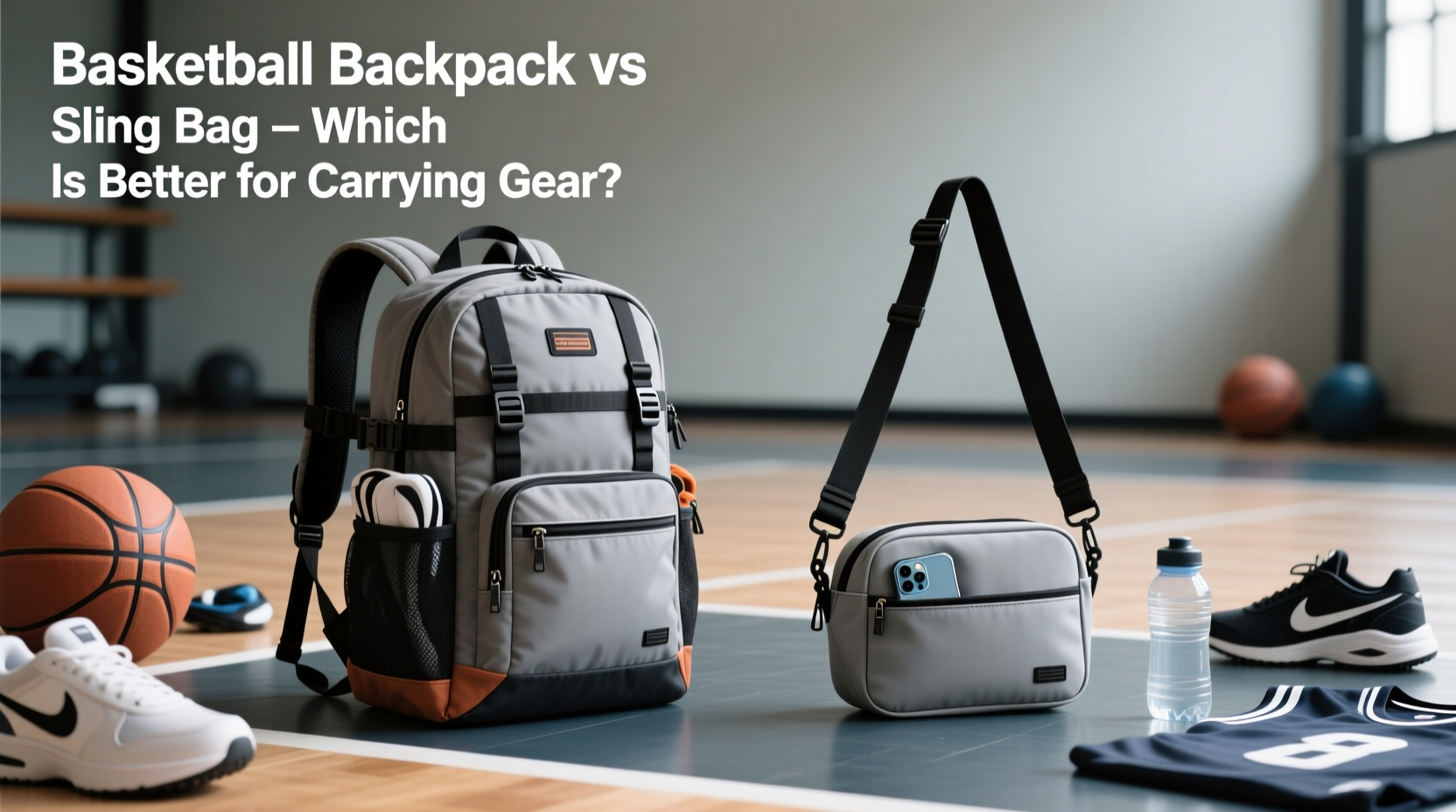
The amount of equipment you carry plays a major role in determining whether a backpack or sling bag suits you best. A typical basketball player might need space for:
- Basketball shoes (often bulky)
- A change of clothes or jersey
- A water bottle or hydration pack
- Towels, socks, and accessories like wristbands
- A basketball (if not playing at a facility that provides one)
- Electronics such as headphones or a phone charger
Backpacks generally offer superior storage volume. Most feature multiple compartments, ventilated shoe pockets, and dedicated laptop sleeves—ideal for players who transition from work or school directly to the court. High-end models like the Nike Brasilia Team Backpack or Under Armour Undeniable 4.0 provide over 30 liters of space, enough to carry everything without overcrowding.
Sling bags, on the other hand, are compact by design. They typically range from 5 to 12 liters, making them suitable for minimalists who only bring essentials: a ball, a small towel, and maybe a drink. Their single main compartment and front zip pocket limit organizational flexibility, especially when trying to separate sweaty clothes from clean ones.
Tip: If you regularly carry more than three items, a backpack will save you stress and disorganization.Comfort and Load Distribution
Carrying weight comfortably over time is critical—especially if you walk, bike, or take public transit to games or practices.
Backpacks use two shoulder straps and often include padded back panels and chest/waist stabilizers. This allows even weight distribution across your upper body, reducing strain on any single point. When properly adjusted, a loaded backpack feels balanced and secure during movement.
In contrast, sling bags rest on one shoulder and across the torso. While they’re lightweight and easy to throw on quickly, they concentrate all weight on one side. Over time, this can lead to postural imbalance, shoulder fatigue, and discomfort—particularly with heavier loads like wet shoes or full-sized basketballs.
“Uneven load distribution from single-strap bags may contribute to muscular asymmetry over time, especially in active users.” — Dr. Lena Torres, Sports Physiotherapist
That said, sling bags excel in short-distance scenarios. Need to grab your ball and head to the local park? A sling lets you move freely and access your gear fast. But for anything beyond 15–20 minutes of walking or standing, a backpack remains the healthier long-term option.
Comparison Table: Backpack vs Sling Bag
| Feature | Basketball Backpack | Sling Bag |
|---|---|---|
| Typical Capacity | 25–40 liters | 5–12 liters |
| Weight Distribution | Even across shoulders and back | Concentrated on one shoulder |
| Ventilation & Shoe Storage | Dedicated ventilated compartments | Rarely available |
| Durability (Material Quality) | Heavy-duty polyester, reinforced stitching | Lighter materials, less structural support |
| Access Speed | Moderate (zippers, multiple layers) | Fast (single strap, front opening) |
| Best For | Players with full gear, frequent travel | Minimalists, casual pick-up games |
Real-World Scenario: Two Players, Two Choices
Consider Marcus and Jamal, both high-level amateur players in their late 20s.
Marcus plays three times a week—twice at a downtown gym after work and once in a weekend league. He carries cleats, compression wear, a hoodie, protein shaker, towel, and his own basketball. He walks 15 minutes to the gym and takes the subway home. After six months of using a sling bag, he developed recurring left shoulder tightness. Switching to a backpack with lumbar support reduced discomfort and made commuting easier.
Jamal, meanwhile, lives near a neighborhood outdoor court. He plays 4–5 times a week but only brings a basketball, a water bottle, and a spare pair of shorts. He values speed and mobility. His compact sling bag weighs next to nothing and stays out of his way while shooting or running drills. For him, the backpack would be overkill.
Their experiences highlight a key truth: context determines what “better” means.
Step-by-Step: Choosing Your Ideal Bag
- Inventory your gear. List every item you routinely bring to play.
- Weigh your total load. Use a household scale to estimate combined weight. Anything over 8 lbs favors a backpack.
- Assess your commute. Do you walk, drive, or use transit? Longer distances increase the need for balanced carrying.
- Evaluate sweat separation needs. If you carry damp clothes or shoes, look for ventilated compartments found in most backpacks.
- Test access frequency. Will you open your bag multiple times (e.g., for drinks, towels)? Backpacks offer more secure zipping.
- Try both styles. Visit a sports store and wear each type loaded with similar weight to feel the difference.
Checklist: Features to Look For
- ✅ Ventilated shoe compartment (backpack)
- ✅ Padded shoulder straps with adjustable fit
- ✅ Durable, water-resistant fabric (e.g., 600D polyester)
- ✅ External water bottle holder
- ✅ Separate interior pockets for electronics or keys
- ✅ Reflective details for night visibility
- ✅ Easy-to-clean lining (especially important for sweaty gear)
Frequently Asked Questions
Can I carry a basketball in a sling bag?
Some larger sling bags can fit a size 6 or 7 basketball diagonally, but it often distorts the shape of the bag and makes it awkward to close securely. Most standard slings are too small. Backpacks with wide main compartments handle basketballs much more effectively.
Are sling bags bad for posture?
When used occasionally with light loads, sling bags pose little risk. However, regular use with heavy or unbalanced contents can lead to muscle imbalances, neck strain, and altered gait patterns. Alternating shoulders or switching to a backpack reduces these risks.
Do backpacks get stolen more often in public spaces?
Statistically, no. Theft risk depends more on behavior than bag type. That said, backpacks are harder to monitor when worn. Always keep valuables in inner pockets and remain aware of surroundings. Some players prefer slings because they can keep them in front in crowded areas—a valid situational strategy.
Final Verdict: Which Is Better?
There is no universal winner. For most serious players who carry full gear, travel distances, or prioritize long-term comfort, the basketball backpack is clearly superior. It supports better ergonomics, offers greater organization, and withstands daily wear more reliably.
But the sling bag holds its ground as a smart option for casual players, urban athletes with ultra-light loads, or those who value agility and simplicity. It’s not about which is objectively better—it’s about alignment with your routine.
Ultimately, the best bag disappears into your day. It doesn’t cause pain, slow you down, or force you to leave something behind. Whether you choose a rugged backpack or a streamlined sling, let function guide form.
💬 What’s your go-to basketball bag? Share your experience and help others find the perfect fit for their game.








