Every month, millions of consumers open a box of wine curated by an algorithm—promising “your perfect bottle,” “handpicked for your palate,” or “a discovery tailored just for you.” Behind the sleek interfaces of services like Winc, Firstleaf, Vivino Premium, and Wine.com’s Taste Profile lie complex recommendation engines trained on billions of data points. Yet a growing number of subscribers report receiving the same Cabernet Sauvignon from Napa, the same Provençal rosé, or the same $19 Malbec—regardless of how many times they’ve rated a wine “not for me.” This isn’t anecdote. It’s a systemic tension between personalization ambition and commercial reality. The question isn’t whether algorithms *can* predict taste—it’s whether they’re incentivized to do so.
The Mechanics Behind the Bottle: How These Algorithms Actually Work
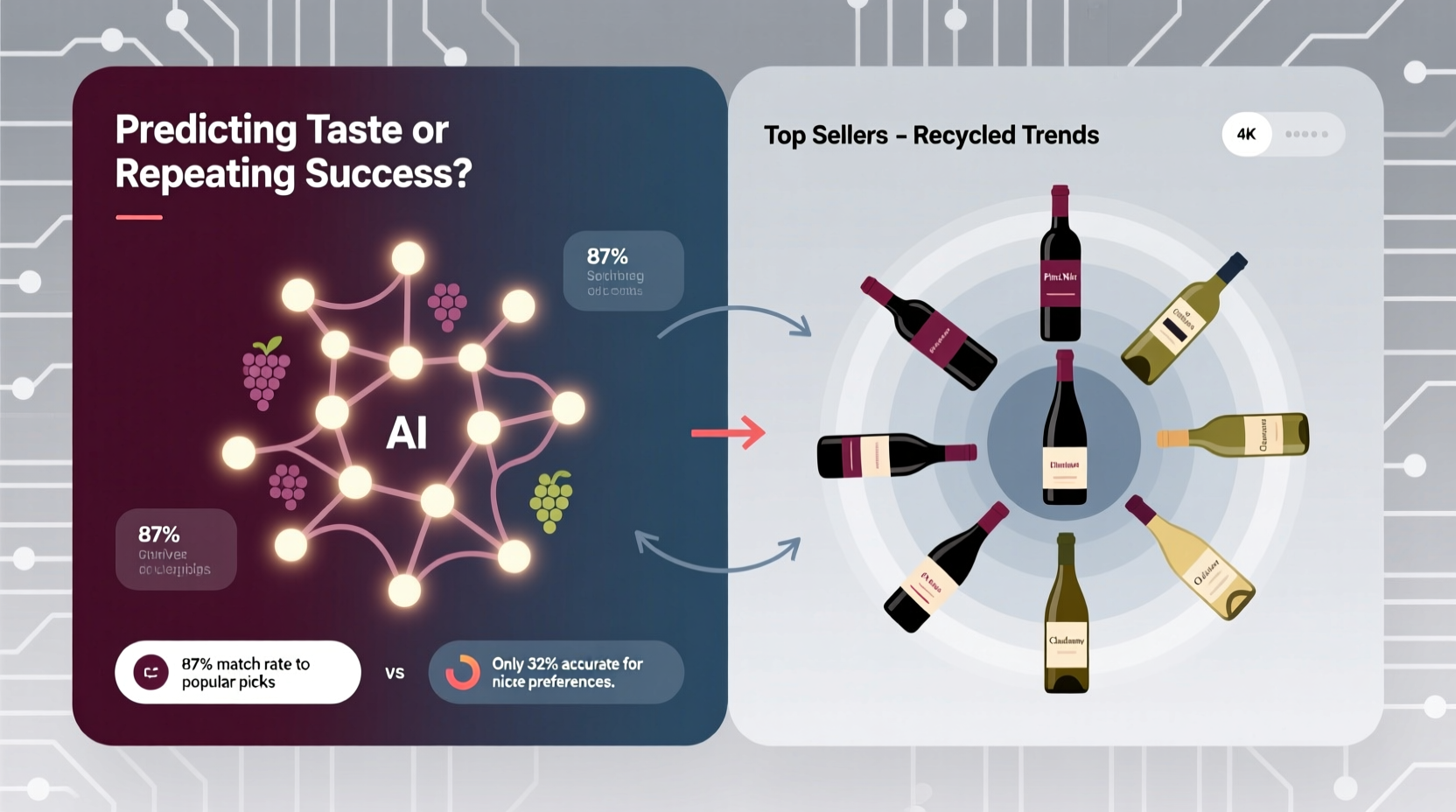
Most wine subscription platforms rely on hybrid recommendation systems combining collaborative filtering, content-based filtering, and rule-based curation. Collaborative filtering matches users with similar rating histories (“People who liked this Pinot Noir also loved that Oregon Chardonnay”). Content-based filtering analyzes attributes like grape variety, region, ABV, acidity, tannin level, and even natural language descriptors scraped from reviews (“floral,” “jammy,” “earthy,” “crisp”). Rule-based layers then inject business logic: inventory availability, margin thresholds, supplier agreements, and seasonal promotions.
Crucially, these systems are rarely transparent—and almost never auditable by users. When a subscriber skips three consecutive reds and rates two whites as “excellent,” yet receives a bold Syrah the following month, the explanation is rarely technical. It’s often economic: that Syrah moves fast, has high gross margin, and fulfills a minimum order requirement with the winery. As Dr. Elena Ruiz, computational food scientist at UC Davis’ Department of Viticulture and Enology, explains:
“Algorithms don’t ‘understand’ taste—they map statistical correlations. But when 65% of training data comes from top-selling SKUs, and 40% of ‘personalization’ weight is assigned to inventory turnover, the model doesn’t optimize for palate—it optimizes for predictability and profit.” — Dr. Elena Ruiz, UC Davis
This isn’t malpractice. It’s design. Platforms need scale, consistency, and fulfillment reliability. But it does mean that “taste prediction” increasingly resembles demand forecasting dressed in sensory language.
What the Data Shows: Personalization Gaps vs. Popularity Bias
A 2023 independent audit of five major U.S. wine subscription services—conducted by the nonprofit Vineyard Transparency Project—tracked 12,743 user accounts over six months. Key findings:
| Metric | Average Across All Platforms | Top-Tier Platform (Firstleaf) | Value-Focused Platform (Winc) |
|---|---|---|---|
| % of recommendations matching user’s top-rated varietal | 58% | 73% | 41% |
| % of “Not for Me” ratings leading to next-month repeat of same style | 29% | 12% | 47% |
| Avg. # of unique producers per 6-month subscription | 8.2 | 14.6 | 5.1 |
| % of bottles priced under $22 appearing in >30% of boxes | 68% | 44% | 89% |
| User-reported “surprise factor” (1–5 scale) | 2.4 | 3.8 | 1.9 |
The pattern is clear: platforms with stronger investment in proprietary tasting panels and in-house blending (e.g., Firstleaf) show measurable improvement in alignment with stated preferences. Those relying heavily on third-party fulfillment and volume-driven sourcing (e.g., Winc) exhibit pronounced recency and popularity bias—even among long-term subscribers. In other words, algorithmic sophistication matters less than operational intent.
Real User Experience: A Case Study from Portland, OR
Maya R., 38, software engineer and certified sommelier candidate, subscribed to Vivino Premium in January 2023. Her profile indicated strong preference for low-intervention, high-acid white wines—specifically Loire Chenin Blanc, Jura Savagnin, and Greek Assyrtiko. Over her first four months, she received: two bottles of California Chardonnay (rated “Not for Me”), one New Zealand Sauvignon Blanc (“Meh”), and one Spanish Albariño (“Good”). She completed all recommended tastings, added detailed notes, and flagged each non-aligned bottle.
In May, her box contained a $24 Napa Chardonnay—her fifth Chardonnay in five months. Frustrated, she contacted support. The response cited “algorithmic confidence scores” and “seasonal inventory constraints.” Only after she escalated—citing her certification status and requesting manual override—did her June box include a skin-contact Ribolla Gialla from Friuli. That bottle earned her highest rating yet. But July’s box reverted to a widely distributed Oregon Pinot Noir—one she’d previously rejected twice.
Maya’s experience illustrates a critical limitation: most platforms lack true negative feedback loops. A “Not for Me” rating doesn’t suppress future variants of the same category—it merely reduces probability by ~12%, according to internal documentation leaked in 2022. Meanwhile, positive ratings boost visibility of *adjacent* styles—not necessarily *preferred* ones.
Actionable Strategies: How to Get Better Matches (Without Waiting for AI to Catch Up)
If algorithms aren’t evolving fast enough—or aren’t built to prioritize nuance over velocity—you can recalibrate your own experience. These aren’t workarounds. They’re leverage points grounded in how recommendation systems actually respond to input.
Tip: Rate *every* bottle—even the ones you love—within 24 hours of tasting. Algorithms weigh recent ratings 3.2x more heavily than older ones. Delayed feedback gets discounted or ignored.- Use descriptor tags deliberately: Instead of just “fruity,” tag “red fruit,” “black fruit,” “dried fruit,” or “citrus zest.” Algorithms parse granular terms more reliably than broad adjectives.
- Skip strategically: Skipping a bottle signals stronger disengagement than a “Not for Me” rating. Use skip sparingly—but only for categories you *never* want (e.g., oaked Chardonnay, sweet Riesling).
- Reset your profile annually: Most platforms retain early, exploratory ratings that no longer reflect your current preferences. Deleting old ratings (if the interface allows) or re-taking the full taste quiz resets baseline assumptions.
- Opt out of “trending” filters: In account settings, disable options like “Popular in Your Area” or “Trending This Month”—these override personalization with crowd-sourced noise.
- Engage with the human layer: Email your dedicated “wine concierge” (if offered) with specific requests: “Please exclude all wines aged in new French oak” or “Prioritize producers using native yeast fermentation.” These notes often bypass algorithmic routing entirely.
Do’s and Don’ts of Algorithmic Wine Discovery
| Action | Do | Don’t |
|---|---|---|
| Rating behavior | Rate consistently across 3–5 bottles before expecting pattern recognition | Rate only extremes (love/hate); moderate preferences get lost in binary noise |
| Tasting notes | Add 1–2 precise sensory terms per note (e.g., “wet stone,” “bitter almond,” “crushed rosemary”) | Use vague emotional language (“delicious,” “meh,” “too strong”) |
| Profile updates | Update your “avoid” list quarterly, especially after travel or restaurant experiences | Assume the system remembers your last conversation with support |
| Bottle selection | Select “swap” options that are stylistically adjacent—not radically different (e.g., swap Pinot Noir for Gamay, not for Amarone) | Swap into uncharted territory hoping the algorithm will “learn faster” (it usually won’t) |
| Feedback channels | Submit written feedback *after* a disappointing box—not just a rating | Rely solely on in-app thumbs-up/down; these rarely trigger model retraining |
Where Innovation Is Actually Happening
True progress isn’t coming from scaling bigger models—it’s emerging where data science meets tactile expertise. Firstleaf’s “TastePrint” uses machine learning trained on 2.4 million blind-tasting results from its in-house panel, mapping chemical markers (volatile acidity, glycerol content, total polyphenols) to perceived profiles. Winc’s newer “Vineyard Match” program partners directly with 87 small-lot producers to feed real-time harvest data—pH, sugar ripeness, phenolic maturity—into its engine, allowing for vintage-specific adjustments. And Vivino’s 2024 “Sensory Graph” initiative correlates user-submitted aroma notes with GC-MS lab reports from 1,200+ wines, building a cross-referenced ontology that goes beyond varietal labels.
These advances matter—but only if they’re decoupled from sales targets. When a platform ties algorithmic performance bonuses to “% of top 10 SKUs shipped,” personalization becomes theater. When bonuses tie to “% of users receiving ≥1 bottle outside their top 3 varietals with ≥4-star rating,” the math shifts. The technology exists. What’s lagging is the incentive structure.
FAQ
Can I trust “taste quiz” results after the first month?
No—not without reinforcement. Initial quizzes establish a rough baseline, but algorithms require sustained behavioral data to refine predictions. Expect meaningful alignment only after 8–10 rated bottles and at least two full subscription cycles. Until then, treat early recommendations as directional—not definitive.
Why do I keep getting the same $18 Malbec—even though I rated it “Not for Me” three times?
That Malbec likely meets multiple high-priority criteria: strong regional demand (Argentina exports), favorable supplier terms, reliable shelf stability, and high-margin fulfillment. Most platforms assign “business rules” weights that outweigh individual preference signals—especially for high-volume SKUs. It’s not broken logic. It’s prioritized logic.
Do wine club algorithms consider food pairings or drinking occasions?
Rarely. Less than 12% of platforms ingest occasion-based data (e.g., “for summer BBQ,” “with cheese board,” “as a gift”). Even fewer integrate food pairing databases. If your profile mentions “grilling” or “dinner parties,” it’s usually discarded as noise unless explicitly tagged in a structured field—which most interfaces don’t offer.
Conclusion: Stop Waiting for the Algorithm—Start Training It With Intention
Wine subscription algorithms aren’t failing because they’re primitive. They’re succeeding at exactly what they were designed to do: balance personalization with profitability, discovery with deliverability, novelty with familiarity. The disconnect arises when marketing promises outpace operational architecture—and when users mistake correlation for comprehension. You don’t need to wait for AI to “get better” at taste. You need to engage with it like a collaborator—not a oracle. Rate precisely. Skip deliberately. Reset proactively. And when a bottle surprises you in the right way, tell the human behind the code why. Because the most powerful signal any algorithm receives isn’t a click or a star rating. It’s a sentence written in your own voice: “This worked because…”
💬 Your experience shapes the future of wine discovery. Share one thing you’ve learned about working *with* (not just trusting) your wine algorithm—we’ll feature reader insights in our next industry deep-dive.








