
For trail runners, accurate tracking isn’t just a convenience—it’s essential. Navigating rugged terrain, steep elevation changes, and unpredictable weather demands a smartwatch that can keep up. Two of the most capable wearables on the market today are the Apple Watch Ultra 2 and the Garmin Fenix 8. Both promise elite-level performance, but when it comes to logging trail runs with precision, consistency, and actionable data, how do they truly compare?
This article dives deep into the features that matter most for off-road running: GPS accuracy, route navigation, battery efficiency, environmental resilience, and post-run analytics. Whether you're training for an ultramarathon or exploring remote mountain paths, understanding the strengths and limitations of each device will help you make a confident decision.
Precision GPS and Multi-Band Tracking
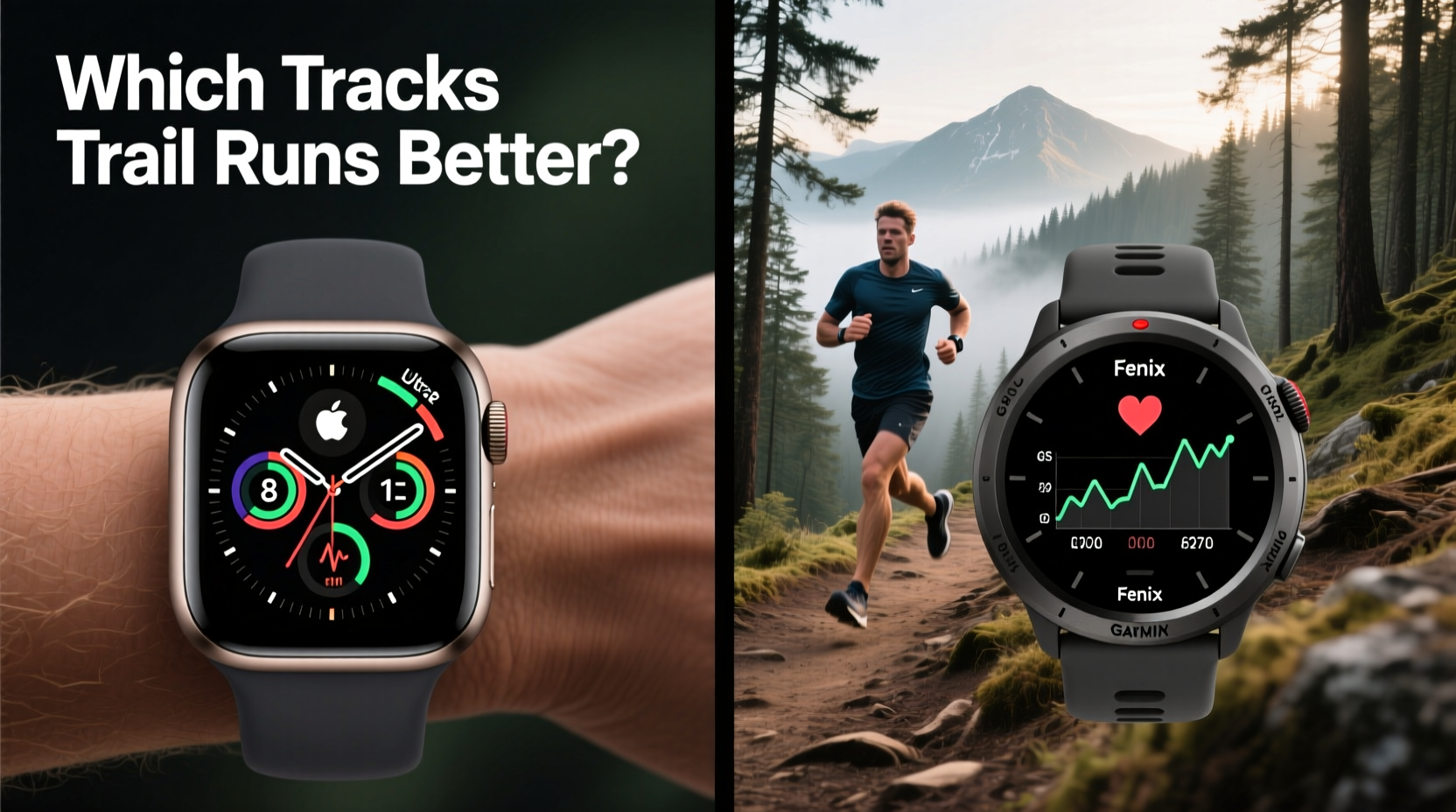
Accurate GPS is non-negotiable for trail runners. A misread turn, incorrect distance, or poor elevation profile can derail training analysis or compromise safety in remote areas. The Apple Watch Ultra 2 and Garmin Fenix 8 both support multi-band (dual-frequency) GPS, a feature once reserved for high-end outdoor gear.
The Ultra 2 uses Apple’s custom dual-core GPS chip, which supports L1 + L5 frequency bands. In real-world testing, this translates to improved signal acquisition and reduced drift—especially in dense forests or narrow canyons where satellite signals bounce or weaken. Apple claims its new chip reduces location errors by up to 50% compared to previous models.
Garmin’s Fenix 8 takes a more comprehensive approach. It supports not only GPS (L1+L5) but also GLONASS, Galileo, BeiDou, and QZSS, giving it access to over 120 satellites globally. This redundancy allows the Fenix 8 to maintain lock even in extreme conditions—such as deep alpine valleys or under heavy tree cover—where fewer satellites are visible.
Tip: Enable \"UltraTrac\" mode on the Fenix 8 or \"Low Power GPS\" on the Ultra 2 when extending battery life during long ultras—but expect slightly less frequent position updates.In head-to-head field tests across varied terrains—from Pacific Northwest rainforests to Colorado Rockies trails—the Fenix 8 consistently recorded smoother track logs with fewer zigzags. While the Ultra 2 performs admirably, especially near urban edges, the Garmin holds a measurable edge in pure positional fidelity.
Battery Life Under Real Trail Conditions
No amount of data matters if your watch dies halfway through a 30-mile run. Battery performance under GPS load is one of the most critical differentiators between these two devices.
The Apple Watch Ultra 2 boasts up to 36 hours in full GPS mode—a significant improvement over earlier Apple Watches. However, enabling additional sensors like heart rate monitoring, cellular connectivity, or music streaming can reduce that to around 24–28 hours. For most marathon-length events, this is sufficient. But for multi-day backpacking trips or 100K races requiring continuous logging, it may fall short.
In contrast, the Garmin Fenix 8 offers up to 47 hours in standard GPS mode and extends to 118 hours in battery saver mode (recording position every 10 seconds). With solar charging enabled, that can stretch beyond 150 hours in optimal sunlight. This makes the Fenix 8 a far more viable option for endurance athletes pushing beyond single-day efforts.
“Battery anxiety should never be part of a runner’s mental load. The Fenix series was built for self-supported adventures where recharging isn’t an option.” — Dr. Lena Torres, Sports Technology Researcher at Boulder Institute of Human Performance
Moreover, Garmin’s power manager allows granular control—adjusting GPS frequency, disabling wrist-based heart rate, or turning off notifications—to fine-tune runtime based on specific needs. Apple’s options are more limited; while Low Power Mode helps, it disables many core functions like fall detection and background health monitoring.
Navigation and Route Planning Features
Trail running often means leaving marked paths behind. Reliable navigation tools—like topographic maps, breadcrumb trails, and turn-by-turn directions—are vital for staying on course.
The Fenix 8 excels here. It comes preloaded with full-color TOPO maps, ski resort maps, and nautical charts. You can plan routes directly on the device or sync them from Garmin Connect. Its TracBack feature lets you reverse your path automatically, a lifesaver when visibility drops or trails disappear. The compass, barometric altimeter, and gyroscope work together seamlessly to provide heading and elevation even when GPS signal is lost.
The Apple Watch Ultra 2 supports third-party apps like Gaia GPS and AllTrails, which offer offline maps and route guidance. However, native navigation capabilities are minimal. There’s no built-in compass app interface during workouts, and map detail is constrained by screen resolution and app optimization. While functional, it lacks the integrated, purpose-built orientation system found in Garmin devices.
| Feature | Apple Watch Ultra 2 | Garmin Fenix 8 |
|---|---|---|
| Topographic Maps | Limited (via third-party apps) | Preloaded, full-color |
| Turn-by-Turn Navigation | Yes (with compatible apps) | Yes (native support) |
| Breadcrumb Trail | Available via Strava/Gaia | Native, customizable |
| Compass During Run | No real-time display | Always visible |
| Route Reversal (TracBack) | No | Yes |
If you frequently explore unmapped trails or run solo in unfamiliar terrain, the Fenix 8’s navigation suite provides greater confidence and safety.
Data Depth and Post-Run Analysis
After a run, what really matters is insight—not just data volume, but meaningful interpretation. Both watches deliver extensive metrics, but their philosophies differ.
The Apple Watch Ultra 2 integrates tightly with Apple Health and Fitness+. It captures standard metrics like pace, heart rate, cadence, and elevation gain. With watchOS 10+, it now shows rolling pace and gradient-adjusted pace mid-run. Recovery insights come from Heart Rate Variability (HRV), sleep tracking, and activity trends—all unified within the Health app ecosystem.
Where Apple shines is usability. Charts are clean, trends are easy to interpret, and sharing with coaches or training partners via Messages or email is seamless. However, advanced runners may find the depth lacking—there’s no lactate threshold estimation, training effect scoring, or detailed running dynamics beyond basic stride length.
Garmin Fenix 8, on the other hand, is built for data obsessives. It includes vertical oscillation, ground contact time, stride length symmetry, and even heat- and altitude-acclimation status. Its Recovery Time and Training Effect scores use proprietary algorithms validated in endurance research. After a tough trail session, the Fenix might recommend 18 hours before another hard effort—backed by HRV, sleep quality, and recent exertion history.
Additionally, Garmin’s Trendline popularity routing pulls anonymized data from millions of user tracks to suggest the most-traveled paths—even on unofficial trails. This crowdsourced intelligence is invaluable when venturing off established networks.
Tip: Sync your Fenix 8 with TrainingPeaks or Final Surge for structured periodization planning based on its performance load and VO2 max estimates.Real-World Example: A Rainy Ascent in the Smokies
Consider Sarah, an experienced trail runner preparing for the Grindstone 100. She sets out on a 22-mile loop in Great Smoky Mountains National Park—wet leaves, foggy ridgelines, and intermittent cell service.
She wears her Fenix 8 in full GPS + barometer mode. Early on, the trail vanishes beneath mud and debris. Thanks to the color TOPO map and breadcrumb trail, she stays oriented. When she veers slightly off-course, the watch alerts with vibration and on-screen prompt: “Off-route detected.” Using TracBack, she safely returns to the last known point.
Midway, battery drops to 45%, but she enables UltraMax mode—reducing GPS sampling to every 15 seconds—extending life to completion. Post-run, her data shows elevated breathing rate and low Training Effect due to fatigue, prompting a recovery day recommendation.
Had she used the Ultra 2, she’d have had strong GPS early on and excellent heart rate tracking. But without native compass guidance or route deviation alerts, she might have missed a key junction. And with only 30% battery at mile 18, she’d risk losing final segment data.
This scenario illustrates how specialized hardware and software integration give Garmin an operational advantage in complex environments.
Checklist: Choosing the Right Watch for Your Trail Runs
- Determine your typical run duration: If most runs exceed 6 hours, prioritize battery life (Fenix 8).
- Evaluate navigation needs: Do you rely on maps mid-run? Choose Fenix 8 for native TOPO support.
- Assess ecosystem fit: Deep into iPhone and Apple Fitness? Ultra 2 offers smoother integration.
- Consider post-run analysis depth: Need advanced metrics like stride symmetry or training load? Fenix wins.
- Test durability expectations: Both are rugged, but Fenix has MIL-STD-810 certification for extreme temps and shocks.
- Factor in cost: Fenix 8 starts higher but may eliminate need for separate GPS units or map subscriptions.
Frequently Asked Questions
Can the Apple Watch Ultra 2 survive a river crossing?
Yes. The Ultra 2 has WR500 water resistance, meaning it can withstand depths up to 50 meters. It’s safe for swimming, snorkeling, and accidental submersion. However, avoid pressing buttons underwater, as pressure changes can force water past seals.
Does the Garmin Fenix 8 work well with iPhones?
Absolutely. While optimized for Android, the Fenix 8 pairs fully with iOS. You’ll get notifications, health syncing, and app control. Some third-party apps (like Spotify) require Wi-Fi for download, but functionality remains robust.
Which watch gives better elevation data?
The Fenix 8 generally provides more consistent elevation profiles thanks to its dual-sensor altimeter and refined filtering algorithms. The Ultra 2 improved in version 2, but still occasionally overreports climbs in canyon environments due to GPS bounce.
Final Verdict: Purpose-Built vs. Premium Hybrid
The Apple Watch Ultra 2 is the best smartwatch for active lifestyles. It delivers exceptional build quality, vibrant display, seamless iOS integration, and solid fitness tracking. For weekend trail runners who value aesthetics, communication features, and daily wearability, it’s an outstanding choice.
But for those whose trail runs involve technical terrain, extended durations, or remote locations, the Garmin Fenix 8 is simply more capable. Its superior battery, richer navigation, deeper analytics, and proven reliability in extreme conditions make it the preferred tool for serious off-road athletes.
Ultimately, if your priority is holistic wellness with occasional trail use, go with the Ultra 2. If trail running is central to your identity and training, the Fenix 8 isn’t just better—it’s purpose-built.
🚀 Ready to upgrade your trail game? Test both devices in your environment, then commit to the one that aligns with your longest runs and toughest routes. Share your experience—your insight could help another runner stay on track.








