For serious trail runners, choosing the right smartwatch isn't just about convenience—it's about performance, precision, and endurance. Two top contenders dominate the high-end wearable market: the Apple Watch Series 9 and the Garmin Fenix 7. While both are premium devices with advanced features, their design philosophies cater to vastly different users. The Apple Watch thrives in seamless integration with the iPhone ecosystem, offering a polished user experience. The Garmin Fenix 7, however, is purpose-built for outdoor athletes who demand ruggedness, long battery life, and in-depth training analytics. This guide breaks down how each device performs under real trail running conditions to help you decide which one belongs on your wrist.
Design and Durability: Built for the Elements
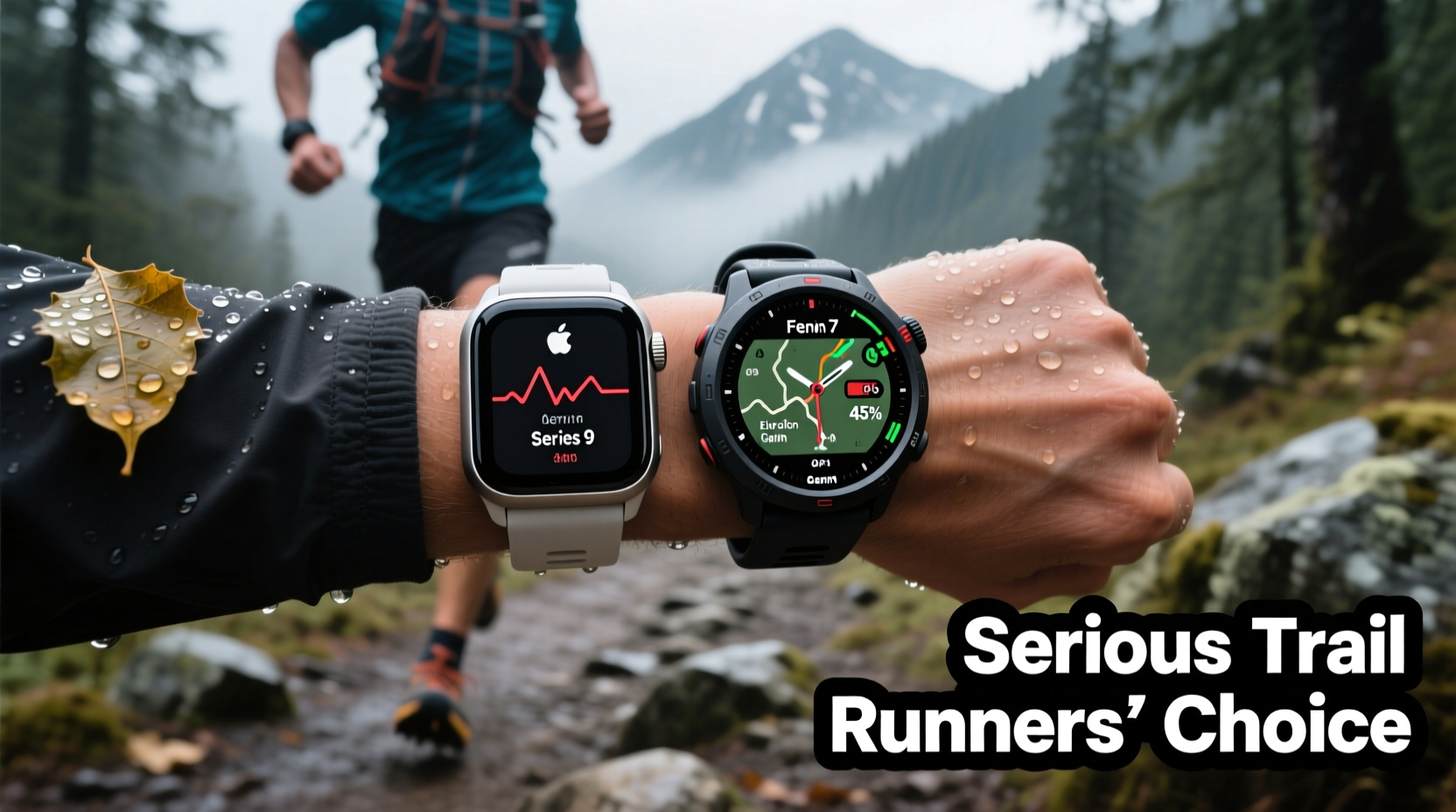
The physical build of a watch matters when you're scrambling over rocks, enduring torrential rain, or navigating steep descents. The Garmin Fenix 7 is engineered like a field tool. Constructed with a fiber-reinforced polymer chassis, sapphire lens (on higher models), and MIL-STD-810 certification for thermal, shock, and water resistance, it’s designed to survive extreme environments. It weighs around 65–75 grams depending on size and band, making it substantial but secure during aggressive movement.
In contrast, the Apple Watch Series 9 uses aerospace-grade aluminum or titanium with an Ion-X or sapphire front. While durable by consumer electronics standards, it lacks military-grade ruggedization. Its sleek profile suits urban environments better than backcountry trails. Though water-resistant up to 50 meters, it’s not marketed for prolonged submersion or extreme temperature exposure. For trail runners frequently brushing against branches, falling on rocky terrain, or racing through mud, the Fenix 7 offers superior peace of mind.
Tip: If you run in remote areas with limited phone access, prioritize a watch that can withstand drops, moisture, and temperature swings—features where Garmin excels.Battery Life: Endurance Beyond the Marathon
No feature divides these watches more starkly than battery life. The Apple Watch Series 9 lasts approximately 18 hours under normal use and up to 36 hours in Low Power Mode. That means even with optimization, it may not survive a full ultramarathon without charging. GPS-only tracking drains it faster—around 6–8 hours. For multi-day stage races or unsupported trail adventures, this becomes a critical limitation.
The Garmin Fenix 7 shines here. In smartwatch mode, it runs up to 21 days; in GPS mode, it sustains 57 hours (Fenix 7X up to 84). With Multi-Band GNSS enabled for maximum accuracy in dense forests or canyons, it still delivers 34 hours. Extended battery life allows runners to track every segment of a long event without carrying external power banks. Solar versions extend this further, harvesting energy from sunlight during daytime runs.
“Battery anxiety should never be part of an endurance athlete’s mental load. When you’re 40 miles into a race, knowing your watch will last matters as much as pace.” — Dr. Lena Torres, Sports Physiologist & Ultrarunner
Navigation and Trail-Specific Features
Trail runners rely on accurate navigation far more than road runners. Getting lost on single-track trails can be dangerous. The Garmin Fenix 7 includes full-color topographic maps, route planning with turn-by-turn directions, TracBack for reversing routes, and breadcrumb tracking. It supports multiple satellite systems (GPS, GLONASS, Galileo) and multi-band signals for pinpoint accuracy—even under thick tree cover.
The Apple Watch Series 9 has basic GPS and can display maps via third-party apps like AllTrails or Komoot, but only if your iPhone is nearby. Without cellular connectivity, offline navigation is nearly impossible. Even with an LTE model, map rendering is limited compared to dedicated outdoor platforms. There’s no built-in compass recalibration, altimeter logging consistency, or route-finding logic tailored for off-grid travel.
Garmin also integrates ClimbPro, which automatically displays upcoming elevation changes during ascents, helping runners manage effort. Incident detection, weather alerts, and storm forecasts add safety layers absent from Apple’s platform.
Key Navigation Comparison
| Feature | Apple Watch Series 9 | Garmin Fenix 7 |
|---|---|---|
| Topo Maps | No (requires paired iPhone) | Yes, preloaded |
| Offline Routing | Limited | Full support |
| Multi-Band GNSS | No | Yes |
| Compass & Altimeter | Basic sensors | Calibrated, field-ready |
| Breadcrumb Tracking | No | Yes |
Training Metrics and Recovery Insights
Serious runners don’t just log miles—they analyze them. The Fenix 7 provides deep physiological insights: Training Load Focus identifies whether workouts emphasize aerobic endurance, speed, power, or muscular strength. Recovery Time recommendations, HRV Status (Heart Rate Variability), and Performance Condition scores update in real time before, during, and after runs. It tracks stride length, vertical oscillation, ground contact time, and balance—all critical for refining trail form and preventing injury.
Apple Watch Series 9 improved its fitness suite with watchOS 10, introducing hiking-specific metrics like elevation gain and estimated VO2 max. However, its data depth lags behind Garmin. While it tracks heart rate, pace, and distance reliably, it lacks nuanced biomechanical feedback. Third-party apps can supplement some gaps, but native integration remains weaker. Additionally, Apple’s algorithm tends to estimate recovery based on general activity, not sport-specific strain.
Garmin’s ecosystem includes Garmin Coach (personalized training plans), Connect IQ app store, and compatibility with foot pods, cycling power meters, and chest straps like the HRM-Pro+. These integrations matter for runners using cross-training or needing precise lactate threshold estimates.
Tip: Use a chest strap with either device for more accurate heart rate readings during intense uphill efforts where optical sensors struggle.Real-World Example: A 50K Trail Race Scenario
Consider Sarah, an experienced trail runner preparing for a mountainous 50K race with 6,000 feet of elevation gain. She starts at dawn, expects to finish after sunset, and will pass through zones with no cell service.
If she uses the Apple Watch Series 9, she must carry her phone for map access and emergency communication. Her watch battery will likely die midway unless she brings a portable charger. While she gets notifications and music streaming via Bluetooth headphones, she loses key navigation cues once the GPS signal weakens in valleys. After mile 30, her watch slows due to low power, and incident detection fails to trigger when she slips on a wet rock.
With the Fenix 7, Sarah downloads the course beforehand, enabling ClimbPro and setting waypoint alerts. She runs entirely phone-free, relying on the watch’s 60-hour battery. During ascent, she checks cadence and vertical ratio to avoid overstriding. When clouds roll in, she receives an on-watch weather alert predicting incoming rain. Late in the race, her Performance Condition drops to “Low,” prompting her to ease her pace. Post-run, her Training Readiness score helps plan recovery.
In this scenario, the Fenix 7 proves not just functional—but essential.
Smart Features and Ecosystem Integration
The Apple Watch Series 9 leads in lifestyle integration. Notifications, Siri voice commands, Apple Pay, sleep staging, mindfulness prompts, and seamless handoff with iPhone and AirPods make it ideal for users deeply embedded in Apple’s ecosystem. It syncs effortlessly with Strava, Nike Run Club, and Health app data, providing a cohesive digital wellness picture.
The Fenix 7 handles basics—notifications, music storage (on some models), and contactless payments via Garmin Pay—but its interface prioritizes function over flash. Apps are sparser, and voice assistant support is limited. However, its focus mode prevents distractions during long runs, and silent alarms help maintain pacing. For runners who value minimalism and distraction-free focus, this restraint is a feature, not a flaw.
If your daily routine revolves around iPhone convenience and you want one device for work, fitness, and social life, Apple wins. But if your priority is performance-first functionality in wild terrain, Garmin’s focused approach delivers greater utility.
Checklist: Choosing the Right Watch for Your Trail Running Needs
- Evaluate your typical run duration: Over 6 hours? Lean toward Fenix 7.
- Assess navigation needs: Do you run solo in unfamiliar terrain? Fenix offers superior mapping.
- Consider phone dependency: Can you always carry your iPhone? If not, Garmin works independently.
- Analyze training goals: Seeking race-specific plans and recovery metrics? Garmin provides deeper insights.
- Weigh ecosystem loyalty: Heavily invested in Apple services? You’ll lose convenience switching.
- Test wearability: Try both—some find the Fenix bulky; others prefer its stability.
Frequently Asked Questions
Can the Apple Watch Series 9 track trail runs accurately?
Yes, the GPS is generally accurate for distance and pace on open trails. However, signal loss in dense forests or canyons is more common than with Garmin’s multi-band GNSS. Elevation data is less consistent, and there’s no topographic context without a connected iPhone.
Is the Garmin Fenix 7 worth the price for casual trail runners?
For casual runners doing short weekend hikes or easy forest loops, it may be overkill. The Apple Watch or Garmin’s Forerunner series (e.g., Forerunner 265) might offer better value. But for those progressing toward ultras or technical terrain, the Fenix 7 pays dividends in reliability and insight.
Does the Apple Watch have any advantages for trail runners?
Absolutely. Its superior microphone and speaker allow clearer emergency calls. Fall detection and Emergency SOS are highly responsive. Music streaming directly from the watch (with LTE) beats Garmin’s limited offline playback. And if you already own AirPods and an iPhone, setup is instant.
Final Verdict: Purpose Over Prestige
The Apple Watch Series 9 is a brilliant smartwatch with excellent health tracking and seamless connectivity. It serves runners well—especially those whose training fits within urban parks or shorter trail loops with reliable phone access. But for serious trail runners pushing limits in remote, rugged environments, it falls short where it counts: battery life, navigation autonomy, and environmental resilience.
The Garmin Fenix 7 was built for this exact audience. It doesn’t dazzle with animations or app stores, but it delivers unwavering performance when the trail turns steep and the weather turns foul. Its training intelligence, safety features, and field-tested durability make it the preferred companion for endurance athletes worldwide.
Ultimately, the choice depends on your definition of \"serious.\" If trail running is a core part of your identity and you regularly test your physical and mental boundaries, the Fenix 7 isn’t just a better tool—it’s the right one. If your runs are shorter, tech integration matters most, and you value aesthetics, the Apple Watch remains compelling.
🚀 Ready to upgrade your trail game? Assess your next race distance, terrain complexity, and tech needs—then choose the watch that empowers your journey, mile after challenging mile.








