Walk into a grocery store in autumn and you’ll find two beverages sharing nearly identical names—and often adjacent shelf space—yet worlds apart in composition, regulation, and experience: apple cider and hard cider. One is a crisp, unfermented juice pressed from fresh apples, served chilled at tailgates and Thanksgiving tables. The other is a fermented, effervescent, alcoholic beverage with centuries-old roots in England and colonial America—and a rapidly evolving craft identity in the U.S. Confusion is common, even among seasoned drinkers. Labels blur lines; marketing leans on nostalgia; and regulatory definitions vary by state and country. This isn’t just semantics—it’s about expectation, safety, pairing, and intention. Understanding where sweetness ends and fermentation begins reveals far more than label literacy. It unlocks better food pairings, informed purchasing, responsible consumption, and deeper appreciation for both traditions.
What Defines Each Beverage: Process, Ingredients, and Legal Boundaries
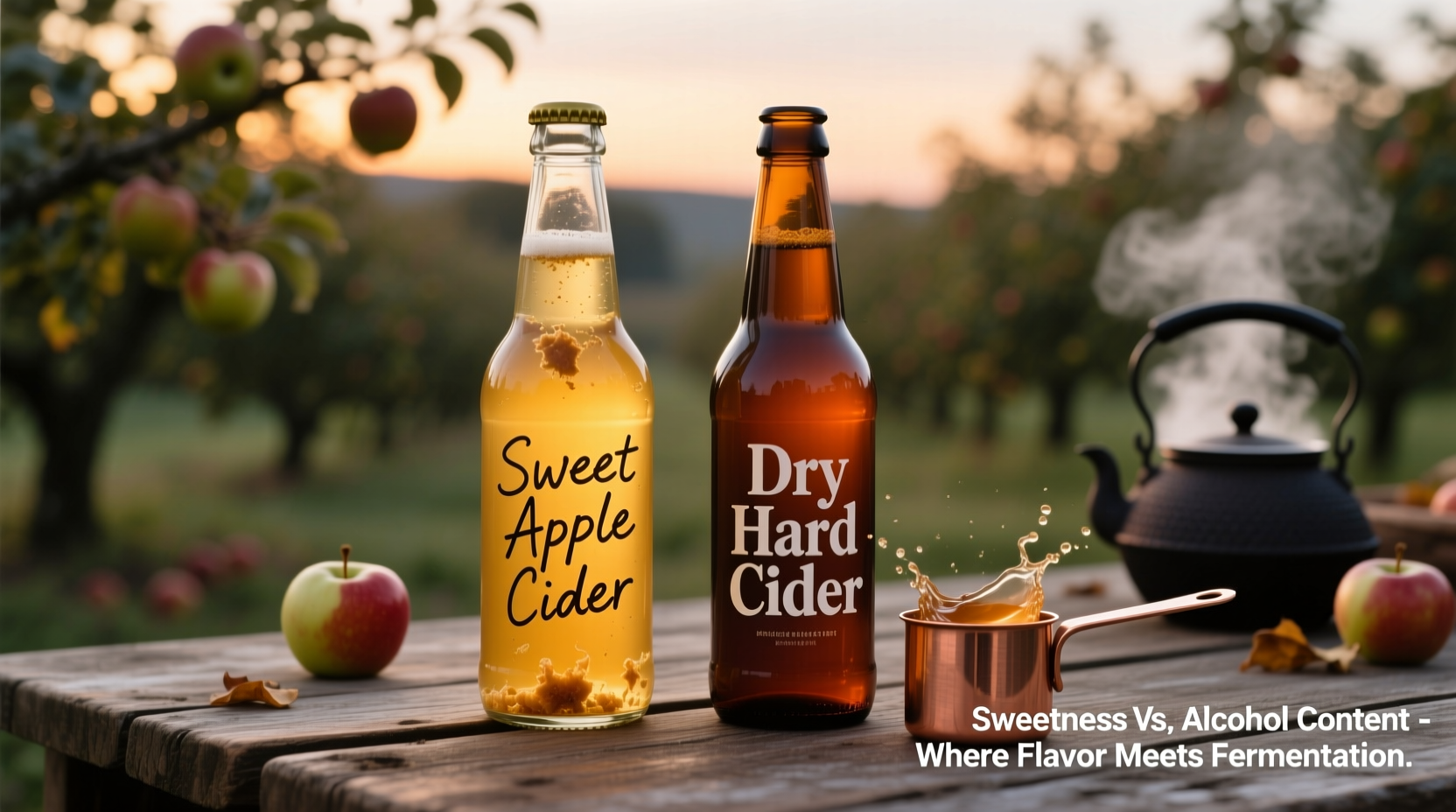
The distinction between apple cider and hard cider rests not in apple variety or region—but in microbial activity and regulatory oversight. Apple cider is raw, unpasteurized (though increasingly pasteurized for safety), non-alcoholic apple juice, typically cloudy and rich in natural enzymes and polyphenols. It’s pressed, filtered minimally, and bottled cold—no yeast, no sugar additions, no time for transformation. Hard cider begins identically: fresh-pressed apple juice, often from heirloom or bittersweet varieties like Kingston Black or Dabinett. But then fermentation begins. Yeast—whether native to the orchard, added by the cidermaker, or cultivated in-house—converts apple sugars into ethanol and carbon dioxide. Alcohol by volume (ABV) emerges, acidity deepens, tannins soften, and aromas evolve from bright fruit to complex notes of baked apple, hay, pear skin, or even funk.
In the United States, federal law draws a sharp line: any fermented apple beverage with 0.5% ABV or higher is classified as “hard cider” and regulated by the Alcohol and Tobacco Tax and Trade Bureau (TTB). It must carry an alcohol content statement, health warning, and adhere to strict labeling rules—including prohibitions on terms like “non-alcoholic” or “juice” unless qualified. Meanwhile, “apple cider” sold in grocery stores falls under FDA jurisdiction. If it contains *any* detectable alcohol—even 0.1% ABV from natural fermentation—it must be labeled as “hard cider” or “fermented apple beverage.” This legal threshold explains why many commercial “ciders” are pasteurized and refrigerated: to halt fermentation before crossing that 0.5% line.
Across the Atlantic, terminology diverges further. In the UK and much of Europe, “cider” *always* means the alcoholic version—what Americans call “hard cider.” What Americans call “apple cider” is simply “fresh apple juice” or “cloudy apple juice.” This transatlantic mismatch fuels consumer confusion, especially when importing or reading international reviews.
Sweetness vs Alcohol: How Fermentation Transforms the Profile
Sweetness and alcohol content exist in direct, dynamic tension. Fermentation consumes sugar. The more completely yeast converts glucose and fructose, the drier and more alcoholic the result. But cidermakers wield precise control—not through additives alone, but through timing, yeast selection, and intervention.
Consider this progression: A freshly pressed juice might contain 12–16% residual sugar (by weight), yielding ~6–8% potential ABV if fully fermented. Yet most ciders land between 4.5% and 7.0% ABV—not because fermentation stops naturally, but because producers choose when to halt it. They may:
- Cool the fermenting juice to stall yeast activity, then filter and bottle while residual sugar remains;
- Add sulfites and potassium sorbate to inhibit further fermentation;
- Ferment to dryness, then back-sweeten with unfermented juice concentrate (a practice permitted under TTB rules for “sweetened cider”); or
- Use malolactic fermentation to reduce perceived acidity, making lower-sugar ciders taste rounder and fruitier.
This means sweetness is not an indicator of low alcohol—and dryness doesn’t guarantee high ABV. A bone-dry French-style cidre can clock in at just 3.8% ABV due to low-sugar crab apples and arrested fermentation. Conversely, a lusciously sweet New England “dessert cider” may reach 8.5% ABV after extended fermentation followed by juice back-sweetening.
Tip: Check the ABV first—not the flavor descriptor. “Crisp,” “tart,” or “dry” on the label says nothing about alcohol strength. Always verify the percentage printed on the neck or side panel.Comparative Breakdown: Key Differences at a Glance
| Feature | Apple Cider | Hard Cider |
|---|---|---|
| Alcohol Content | 0.0% ABV (legally required; trace amounts <0.5% may occur naturally but must be declared) | 0.5%–8.5% ABV (most commonly 4.5%–7.0%) |
| Production Method | Pressed, minimally filtered, often refrigerated and/or pasteurized to prevent fermentation | Fermented with yeast; may be aged in stainless steel, oak, or concrete; often carbonated |
| Shelf Life (Unopened) | 7–14 days refrigerated; up to 12 months if shelf-stable (pasteurized + preservatives) | 6–24 months depending on style, packaging, and storage; improves with age in some traditional styles |
| Taste Profile | Bright, vegetal, tannic, sometimes funky; high volatile acidity possible in raw versions; pronounced apple skin and stem notes | Layered: fermented apple, yeast-derived esters (pear, banana, clove), oxidative notes (nut, honey), tannin structure, carbonation lift |
| Regulatory Body | FDA (Food and Drug Administration) | TTB (Alcohol and Tobacco Tax and Trade Bureau) |
| Labeling Requirements | No alcohol warning; may state “unfiltered,” “raw,” or “fresh-pressed” | Must declare ABV, include government health warning, list ingredients, and comply with TTB formula approval |
Real-World Example: How One Orchard Navigates Both Worlds
Maple Hollow Orchards in Vermont presses over 120,000 gallons of apples each fall. Their operation illustrates the practical, philosophical, and logistical divide between the two categories. In early October, they release “Heritage Press Cider”—unpasteurized, cold-stored, sold only at the farm stand and local co-ops. It’s cloudy, assertively tannic, and smells like wet orchard grass. Within five days, batches begin to bubble faintly in the jug. By day ten, pressure builds. That’s when they pivot: selected barrels go to their on-site cidery, inoculated with Champagne yeast, fermented cool for three weeks, then racked and blended with a portion of barrel-aged cider from the prior year. The resulting “Hollow Oak Reserve” hits 6.2% ABV, bone-dry, with bracing acidity and toasted almond notes.
Crucially, they never sell the same juice as both products. Once fermentation begins—even unintentionally—the batch is reclassified and labeled accordingly. “We had a shipment rejected by a major retailer because a single bottle registered 0.6% ABV in lab testing,” says owner Lena Cho. “They’d ordered ‘apple cider,’ not ‘hard cider.’ One-tenth of a percent cost us $18,000 in returns. That’s when we installed continuous pH and Brix monitoring on our pressing line—and trained every staff member on TTB thresholds.” Her experience underscores a reality many consumers miss: behind every clear, consistent bottle of apple cider lies rigorous microbiological control. And behind every expressive hard cider lies deliberate, skilled fermentation science.
How to Choose, Serve, and Store Each Correctly
Selecting the right beverage depends entirely on context: occasion, audience, food, and personal preference. Here’s how to navigate with confidence.
A Practical Selection & Serving Checklist
- For family gatherings or daytime events: Choose pasteurized, refrigerated apple cider. Look for “shelf-stable” if serving outside refrigeration—but avoid cans or bottles left in hot cars (heat accelerates spoilage and off-flavors).
- For cheese boards or charcuterie: Reach for dry or off-dry hard cider (4.5%–6.5% ABV, under 15 g/L residual sugar). Its acidity cuts through fat; its subtle tannins complement aged cheddar or cured meats.
- For dessert pairings: Select a sweeter, higher-ABV cider (7.0%+), preferably with residual sugar above 30 g/L and notes of caramel or baked apple. Avoid overly carbonated styles—they overwhelm delicate sweets.
- For cooking: Use apple cider—not hard cider—for braises and glazes. Fermentation alters Maillard reaction behavior; hard cider’s alcohol can evaporate unpredictably and leave harsh notes.
- When in doubt about alcohol content: Assume it’s hard cider if sold in liquor stores, bars, or alongside beer. Grocery-store “cider” is almost always non-alcoholic—unless labeled otherwise in small print.
Storage matters profoundly. Apple cider degrades rapidly once opened: refrigerate and consume within 3–5 days. Oxidation turns it vinegary; wild yeast creates fizz and cloudiness. Hard cider, however, benefits from cool, dark storage—but never freezing. Temperatures below 32°F (0°C) can cause yeast to drop out and proteins to haze permanently. Serve apple cider well-chilled (38–42°F); serve traditional hard cider slightly cooler than room temperature (50–55°F) to release aromatic complexity without numbing the palate.
Expert Insight: The Evolving Craft Perspective
“Calling all fermented apple drinks ‘hard cider’ flattens centuries of regional technique. In Normandy, ‘cidre’ is terroir-driven, slow-fermented, and meant to be shared with galette. In Vermont, ‘cider’ is often a canvas for innovation—hopped, barrel-aged, or fruited. But the core truth remains: sweetness is a choice, not a default. It’s where the maker decides fermentation ends—and that decision shapes everything from mouthfeel to food compatibility.” — Dr. Aris Thorne, Cider Research Fellow, Cornell University College of Agriculture and Life Sciences
FAQ: Clarifying Common Misconceptions
Can apple cider turn into hard cider on its own?
Yes—if unpasteurized and unrefrigerated, wild yeasts present on apple skins or in the environment can initiate fermentation. This typically begins within 3–7 days at room temperature, producing CO₂ (fizz), heat, and eventually ethanol. Refrigeration slows but doesn’t stop this process. Pasteurization or preservatives (like potassium sorbate) prevent it entirely. Never consume spontaneously fermented cider if you smell vinegar, sulfur, or rotten eggs—it may harbor harmful bacteria or excessive acetic acid.
Why do some hard ciders taste so sweet if they’re fermented?
Most commercial sweet ciders are fermented to dryness first, then blended with unfermented apple juice concentrate or sweet reserve (a portion of juice held back before fermentation). This preserves apple brightness while adding sugar back post-fermentation. It’s a legal, controlled method—not incomplete fermentation. True “naturally sweet” ciders are rare and require specific yeast strains that stall early or apples with high sorbitol content (which yeast cannot metabolize).
Is “light cider” lower in calories than regular hard cider?
Not necessarily. “Light” refers to alcohol content—not sugar or calories. A 3.2% ABV light cider may contain *more* residual sugar than a 6.5% dry cider, resulting in equal or higher calories. Always check the nutrition facts panel if calorie tracking matters. Dry ciders generally range from 120–150 calories per 12 oz; sweetened styles often exceed 180.
Conclusion: Savor the Distinction, Not Just the Drink
Understanding the boundary between apple cider and hard cider is more than label literacy—it’s respect for process, intention, and tradition. That unassuming jug of cloudy liquid at your farmers’ market represents immediate harvest, enzymatic vitality, and seasonal impermanence. The elegantly labeled bottle beside it in the tasting room embodies patience, microbiology, and craftsmanship honed across generations. When sweetness meets alcohol content, what emerges isn’t confusion—it’s choice. Choice about when to celebrate freshness, when to explore complexity, when to share joy soberly, and when to toast with intention. Next time you reach for either, pause to read the fine print, consider the orchard and the cellar behind it, and pour with awareness. Your palate—and your guests—will appreciate the clarity.
💬 Have you discovered a standout local cider or apple cider producer? Share your favorite bottle, what makes it special, and how you enjoy it—with food, season, or company. Your recommendation could help others savor the difference, too.








