Choosing your first bitter liqueur can feel like stepping into a room full of confident regulars who all know the secret handshake. Aperol and Campari sit side by side on every well-stocked bar shelf—vibrant orange and deep ruby red—but their similarities are mostly visual. Their origins, flavor profiles, alcohol content, and roles in cocktails diverge significantly. For someone new to amari (Italian bitter digestifs), picking the wrong one can mean an unexpectedly aggressive sip that deters further exploration. This isn’t about declaring a “winner.” It’s about matching the right liquid to where you are right now: curious, cautious, and eager to enjoy—not endure—your first bitter experience.
Flavor & Sensory Profile: Where Perception Begins
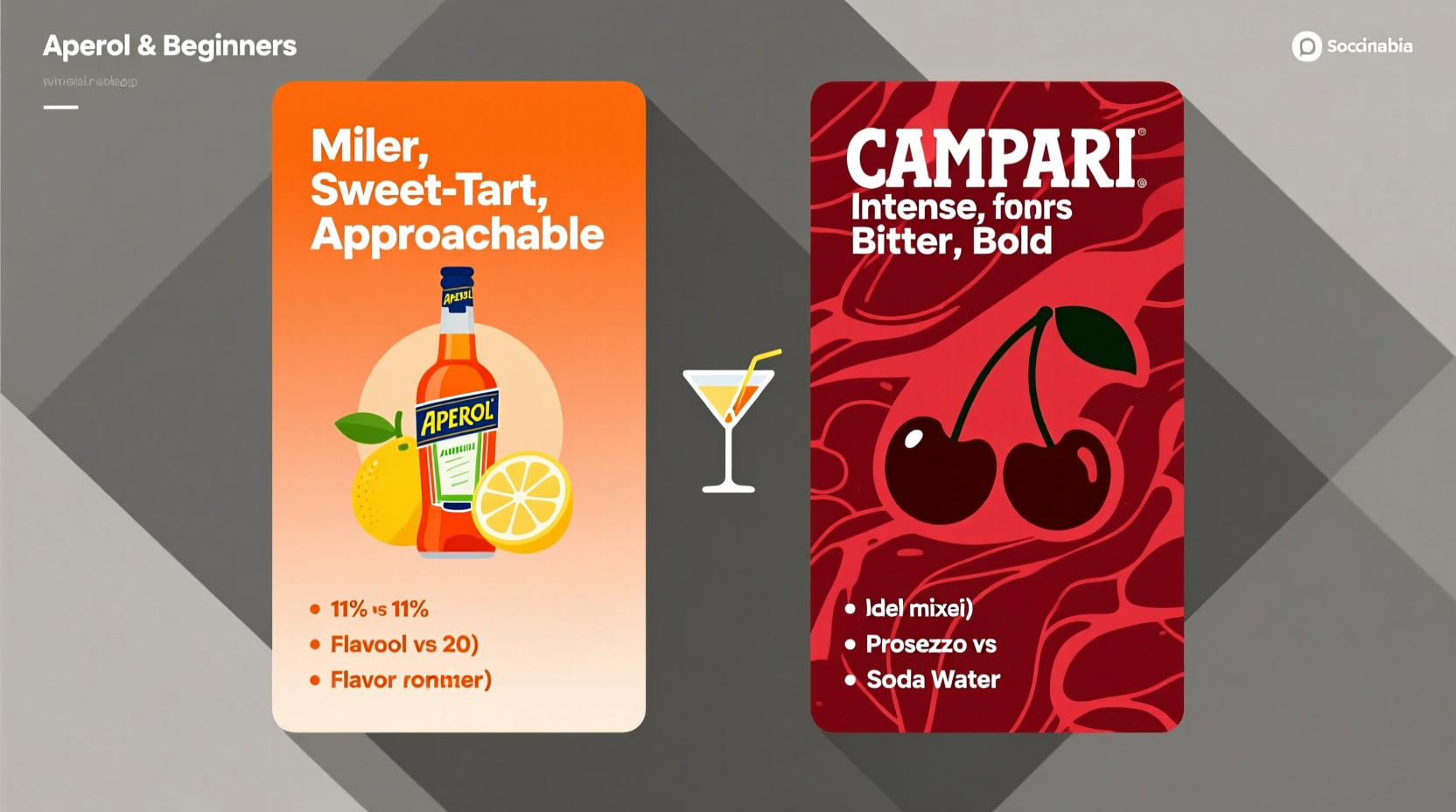
Flavor is the most immediate differentiator—and the most decisive factor for beginners. Campari, launched in Milan in 1860, is built on a complex, proprietary blend of over 60 botanicals—including chinotto (bitter orange), cascarilla bark, gentian root, and quinine. Its taste is assertively medicinal, with sharp citrus peel, burnt sugar, rhubarb tartness, and a lingering, drying bitterness that coats the tongue. At 20.5–28.5% ABV (depending on region), it delivers both intensity and weight.
Aperol, created in Padua in 1919 as a lighter alternative, uses gentian, rhubarb, cinchona bark, and orange peel—but in markedly lower concentrations. Its signature is bright, candied orange zest with subtle herbal sweetness and just enough bitterness to register as “aperitif,” not “medicine.” At 11% ABV, it feels approachable, almost effervescent on the palate—even unchilled.
This contrast explains why many newcomers describe their first Campari sip as “a wake-up call” and their first Aperol as “a friendly hello.” One bartender in Turin told us, “I’ve watched people wince at Campari neat, then light up when they try Aperol Spritz. That moment—the shift from suspicion to delight—is why we don’t serve Campari straight to first-timers.”
Tip: Never judge either liqueur neat on day one. Bitters are designed to be diluted, balanced, and served cold. Taste them only in classic low-ABV aperitif formats—never at room temperature or undiluted.Alcohol Strength & Serving Context: The Practical Threshold
ABV isn’t just a number—it’s a functional threshold. At 11%, Aperol sits comfortably between wine and beer in strength. That makes it ideal for daytime drinking, pre-dinner refreshment, or social settings where heavy alcohol isn’t appropriate. Its lower proof also means it integrates seamlessly into high-volume, low-alcohol drinks without overwhelming other ingredients.
Campari’s higher ABV (minimum 20.5% in the EU, 24–28.5% elsewhere) demands more respect—and more dilution. Served neat, it’s intense. Served on ice with soda, it’s bracing but refreshing. In a Negroni (equal parts Campari, gin, and sweet vermouth), its bitterness becomes structural—anchoring the drink’s balance. But that structure requires palate maturity. Beginners often mistake its power for harshness, missing how it evolves with time and temperature.
A practical benchmark: if you’re comfortable with dry rosé or a crisp pilsner, Aperol is likely within reach. If you regularly enjoy espresso martinis or barrel-aged spirits, Campari may already align with your tolerance.
Cocktail Versatility & Beginner-Friendly Recipes
Both liqueurs shine in cocktails—but their entry points differ sharply. Aperol’s mild profile makes it exceptionally forgiving. Its signature drink, the Aperol Spritz, requires only three ingredients: 3 parts Prosecco, 2 parts Aperol, 1 part soda water, served over ice with an orange slice. It’s hard to over-dilute, nearly impossible to over-bitter, and visually inviting—a golden-orange effervescence that signals celebration, not challenge.
Campari’s flagship, the Negroni, is equally iconic—but far less forgiving. Equal parts Campari, gin, and sweet vermouth must be stirred precisely and served chilled. Too little stirring = warmth and imbalance. Too much vermouth = cloying; too little = abrasive. Even slight variations alter the experience dramatically. As award-winning bartender and author David T. Smith notes: “The Negroni is a rite of passage—not a starting point. It teaches respect for proportion, temperature, and patience. But you shouldn’t need to earn the right to enjoy an aperitif.”
“The Aperol Spritz is hospitality in a glass. The Negroni is conversation in a glass—complex, layered, and worth returning to again and again.” — David T. Smith, author of The Bitter Truth: A History of Amari
Here’s how their foundational recipes compare for beginners:
| Cocktail | Base Ratio | Key Technique | Beginner Difficulty | Why It Works for New Drinkers |
|---|---|---|---|---|
| Aperol Spritz | 3:2:1 (Prosecco:Aperol:Soda) | Pour over large ice; stir gently once | ★☆☆☆☆ (Very Easy) | Effervescence masks bitterness; low ABV; forgiving ratios; no shaking/stirring required |
| Negroni | 1:1:1 (Campari:Gin:Vermouth) | Stir 25–30 seconds with ice; strain into chilled glass | ★★★★☆ (Moderate–Hard) | Requires precise chilling, accurate pouring, and understanding of spirit-forward balance |
| Garibaldi (Aperol) | 2 oz Aperol + 2 oz fresh orange juice | Build in glass over ice; garnish with orange wedge | ★☆☆☆☆ | Fruit-forward, no spirits beyond Aperol; zero technique needed |
| Old Pal (Campari) | 1:1:1 (Campari:Rye:Dry Vermouth) | Stir 30 sec; strain into coupe; lemon twist | ★★★★★ | Dry, smoky, and aggressively bitter—requires developed palate |
A Mini Case Study: How One Bar Changed Its Onboarding Strategy
In early 2022, The Violet Hour in Chicago noticed a pattern: 68% of first-time visitors who ordered a Negroni asked for “something less strong” before finishing half the drink. Meanwhile, Aperol Spritz orders among new guests rose 142% year-over-year—yet staff rarely recommended alternatives after the initial rejection.
They redesigned their aperitif onboarding. Instead of listing “Negroni” and “Aperol Spritz” side-by-side on the menu, they introduced a dedicated “First Taste” section: three drinks explicitly labeled for newcomers, each with a one-sentence descriptor (“Bright, bubbly, and gently bitter” or “Bold, herbaceous, and deeply refreshing”). They trained servers to ask, “Are you exploring bitter flavors for the first time?” before suggesting Campari-based options.
Within six months, customer satisfaction scores for “aperitif experience” rose from 7.2 to 9.1 (out of 10). More tellingly, 41% of guests who started with Aperol Spritz returned within 30 days requesting a “lighter Negroni”—a modified version using ¾ oz Campari instead of 1 oz, plus extra vermouth and a float of soda. The progression was organic, unhurried, and palate-led.
This isn’t dilution—it’s scaffolding. Aperol provides the foundation; Campari becomes the next floor.
Do’s and Don’ts for Your First Bitter Liqueur Experience
- DO start chilled: Store both bottles in the refrigerator for at least two hours before serving.
- DO use quality mixer: Cheap soda water flattens Aperol; low-quality vermouth ruins Campari balance.
- DO taste mindfully: Take a small sip, hold it for 3 seconds, then swallow. Notice where bitterness lands (front/mid/back of tongue) and whether it lingers or fades.
- DON’T assume “bitter” means “bad”: Bitterness triggers salivation and prepares your stomach for food—it’s physiological, not aesthetic.
- DON’T rush to “graduate”: There’s no timeline. Many lifelong drinkers prefer Aperol Spritz year-round—and that’s perfectly valid.
- DON’T skip the garnish: An orange twist expresses oils over Campari; an orange slice adds brightness to Aperol. These aren’t decoration—they’re functional.
FAQ: Addressing Common Beginner Questions
Can I mix Aperol and Campari together?
Yes—but not casually. Their flavor intensities clash unless carefully calibrated. A small amount of Campari (¼ oz) added to an Aperol Spritz creates a “Rosita Spritz,” adding depth without overwhelming. Conversely, substituting Aperol for Campari in a Negroni produces a “Poor Man’s Negroni”—sweeter and milder, but lacking structural backbone. Reserve blending for when you understand each liqueur individually.
Is Aperol “less authentic” than Campari because it’s lighter?
No. Authenticity isn’t measured by bitterness or ABV. Aperol was intentionally formulated as a gentler, more accessible aperitif during Italy’s interwar period—when social drinking shifted toward lighter, more convivial formats. Its consistency, color stability, and balanced profile reflect decades of refinement, not compromise. Campari’s strength is its heritage; Aperol’s is its hospitality.
How long do they last once opened?
Both are highly stable due to high sugar content and alcohol. Store upright, tightly sealed, and away from light. Aperol retains peak freshness for 3–4 months refrigerated; Campari remains excellent for 6–12 months. Neither spoils, but flavor softens and oxidizes gradually—especially Aperol’s bright citrus top notes.
Step-by-Step: Building Your Bitter Confidence in Four Weeks
- Week 1 – The Spritz Phase: Buy Aperol. Make three Aperol Spritzes at home: one standard, one with extra soda (lighter), one with a splash of grapefruit juice (more tart). Note what feels most refreshing.
- Week 2 – The Fruit Bridge: Try a Garibaldi (Aperol + fresh OJ) and a Blood Orange Spritz (Aperol + blood orange juice + soda). Observe how acidity balances bitterness.
- Week 3 – The First Campari Encounter: Order a Campari Soda (1:3 Campari to soda, over ice, orange slice) at a reputable bar. Focus on texture—not just taste. Is it fizzy? Dry? Warming?
- Week 4 – The Gentle Transition: Make a “Halfway Negroni”: ½ oz Campari, 1 oz gin, 1 oz vermouth, stirred and strained. Compare it side-by-side with your favorite Aperol Spritz. Ask: What does bitterness *do* in each? Where does your palate rest?
Conclusion: Choose Curiosity Over Comparison
“Better” isn’t absolute—it’s relational. Aperol is better for beginners who value ease, brightness, and immediate enjoyment. Campari is better for those drawn to complexity, history, and the slow unfurling of layered bitterness. Neither requires apology. Neither demands allegiance. The real win isn’t choosing one over the other—it’s recognizing that your palate has seasons. You might begin with Aperol’s sunlit charm, deepen into Campari’s resonant depth, and later circle back to Aperol’s joyful simplicity—now with deeper appreciation.
What matters is showing up with curiosity, not expectation. Pour thoughtfully. Serve cold. Garnish with intention. And remember: every expert bartender, every seasoned amari collector, every confident Negroni drinker began exactly where you are—holding a glass, wondering what that first bitter note might reveal.
💬 Your turn: Did you start with Aperol or Campari? What was your “aha” moment? Share your first bitter experience—and what you learned—in the comments below. Let’s build a community where every sip counts.








