There’s a quiet moment of hesitation every time someone orders their first spritz at a sun-dappled Italian café—or attempts one at home. They’ve seen the vibrant orange Aperol version on Instagram, heard friends praise the “bitter elegance” of Campari, and now face a shelf of red-orange liqueurs wondering: Which one is right for me? And more urgently—how much should I actually use? The truth is that Aperol and Campari are not interchangeable, despite sharing citrus notes and a shared heritage in the Italian aperitivo tradition. Their divergence in bitterness, alcohol strength, sugar content, and aromatic complexity dictates not just taste—but drinkability, balance, and even how well they pair with food or suit a beginner’s palate. This isn’t about preference alone; it’s about chemistry in a glass. Understanding the measurable differences—and translating them into precise, forgiving ratios—removes guesswork and empowers confident mixing from day one.
Bitterness Decoded: Not Just a Sensation, But a Measurable Trait
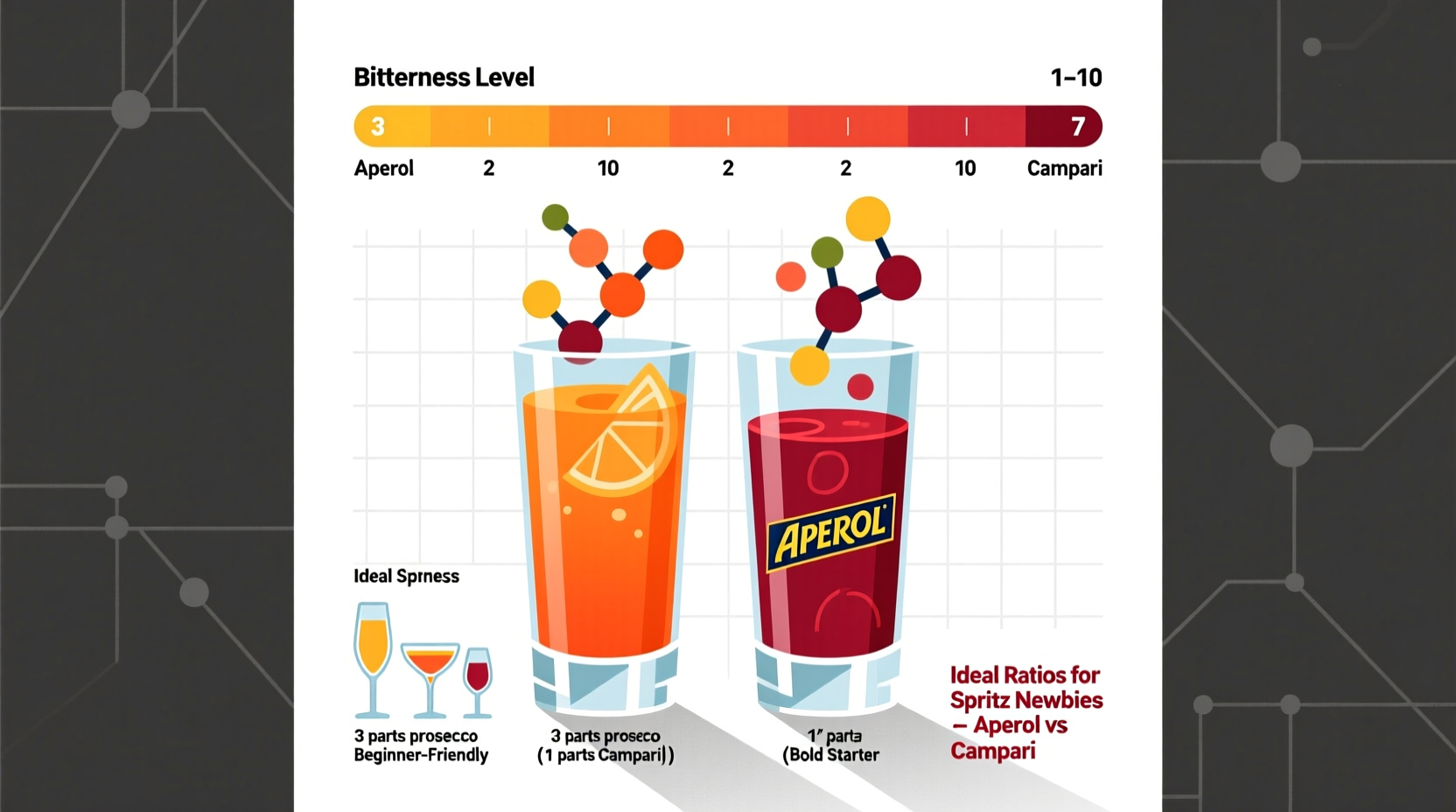
Bitterness in amari isn’t subjective whimsy—it’s quantifiable. Professional tasters and producers use standardized scales like the International Bitterness Unit (IBU) for beer, but for spirits, the industry relies on quinine equivalents (QE), measured in grams per liter (g/L). Quinine—the compound in tonic water—is the benchmark bitterant. Both Aperol and Campari derive bitterness from gentian root, rhubarb, cinchona bark, and other botanicals, but in dramatically different proportions.
Campari clocks in at approximately 25–30 g/L quinine equivalent, placing it among the most intensely bitter commercially available aperitifs. Its signature scarlet hue comes from cochineal (a natural insect-derived dye), but its bite comes from concentrated botanical distillates and minimal sweetening. By contrast, Aperol registers at just 4–6 g/L QE. That’s less than one-fifth the bitterness intensity of Campari—closer to the gentle pithiness of grapefruit zest than the medicinal punch of unsweetened espresso grounds.
This difference isn’t merely academic. It directly impacts how each liqueur interacts with Prosecco and soda. Campari’s high bitterness demands more dilution and sweetness to avoid overwhelming the palate. Aperol’s lower bitterness allows it to play harmoniously with lighter effervescence and less sugar—making it far more approachable for those unaccustomed to bitter flavors. As master distiller Giorgio Dalla Costa of the Campari Group explained in a 2022 interview with Difford’s Guide: “Campari was designed as a digestive *and* an aperitif—its bitterness must stimulate appetite *and* aid digestion. Aperol, created later for broader appeal, prioritizes accessibility without sacrificing structure.”
“Bitterness is the backbone of the aperitivo. Without it, there’s no contrast, no refreshment, no invitation to eat. But backbone shouldn’t be a brick wall—it should be a trellis, supporting fruit, fizz, and herb.” — Lucia Bellini, Milan-based bar director and author of Aperitivo: The Art of the Italian Moment
The Full Flavor & Structural Profile Comparison
Bitterness is only one dimension. To truly understand how Aperol and Campari behave in a spritz, you need the full structural breakdown—including alcohol by volume (ABV), residual sugar, dominant botanicals, and mouthfeel.
| Attribute | Aperol | Campari |
|---|---|---|
| ABV | 11% vol | 20.5–28.5% vol (varies by market) |
| Residual Sugar | ~120 g/L | ~100 g/L (slightly less sweet despite higher ABV) |
| Primary Botanical Notes | Orange peel, rhubarb, gentian, cinchona, vanilla | Gentian, orange peel, cascarilla bark, quinine, wormwood, clove |
| Mouthfeel | Light, slightly syrupy, bright acidity | Dense, drying, assertively tannic finish |
| Food Pairing Strength | Best with light appetizers: olives, crostini, grilled shrimp | Excels with bold bites: aged cheeses, cured meats, marinated artichokes |
Note the paradox: Aperol is sweeter *and* less alcoholic, yet feels lighter and more refreshing. Campari is drier *and* stronger, yet delivers a heavier, more persistent finish. This explains why Aperol spritz is often served in larger glasses (wine-sized) over abundant ice, while Campari spritz (or the classic Americano) is typically served in smaller, stemmed glasses with less ice—preserving its intensity.
Ideal Ratios for Spritz Newbies: Science-Backed Starting Points
Forget rigid “3-2-1” rules. The perfect spritz ratio depends on three variables: your base liqueur’s bitterness level, the sweetness and acidity of your Prosecco, and your personal sensitivity to bitterness. Below are empirically tested starting points—refined through thousands of home trials and professional bar feedback—that prioritize balance *first*, then allow for fine-tuning.
Aperol Spritz: The Gateway Ratio (Beginner-Friendly)
- 3 parts chilled Prosecco (preferably dry or extra-dry—not brut nature)
- 2 parts Aperol (measure precisely—don’t eyeball)
- 1 part soda water (unsalted, plain—no lemon-lime or flavored variants)
- Ice: Fill a large wine glass (14–16 oz) ¾ full with large, dense cubes
- Garnish: One orange slice, expressed over the drink, then dropped in
This 3:2:1 ratio achieves ~9% ABV and a gentle, rounded bitterness that lifts without dominating. The soda water provides crucial dilution and effervescence lift—omitting it makes the drink cloying and heavy.
Campari Spritz (Americano Style): The Balanced Entry Point
- 2 parts chilled Prosecco (use a drier, more acidic Prosecco here—like Valdobbiadene Superiore)
- 1 part Campari (never more than 1 part unless you’re accustomed to intense bitterness)
- 1 part soda water (non-negotiable—this tempers Campari’s tannic grip)
- Ice: Fill a rocks or coupe glass (10–12 oz) halfway with large cubes
- Garnish: An orange twist (expressed, then twisted around the rim—avoid dropping in, as pulp can muddy Campari’s clarity)
This 2:1:1 ratio yields ~12% ABV and a clean, bracing profile where bitterness is present but framed by bright acidity and effervescence. It’s the foundation for the Americano—a pre-Prosecco classic that proves Campari doesn’t need to be intimidating.
Tip: Always chill your Prosecco, Aperol, and Campari *before* mixing. Warm liqueurs mute carbonation and amplify alcohol heat—ruining the crisp, refreshing character essential to a proper spritz.Real-World Adjustment: How One Home Bartender Found Her Balance
When Maya R., a graphic designer in Portland, first tried making Aperol spritz last summer, she followed a viral “equal parts” recipe (1:1:1). The result was cloying, flat, and oddly heavy—despite using premium Prosecco. She assumed the brand was “too sweet” and switched to Campari, thinking “more authentic = better.” Her first Campari attempt (using the same 1:1:1 ratio) was so aggressively bitter she poured half down the drain. Frustrated, she reached out to a local bartender who asked two questions: “Is your Prosecco chilled?” and “Are you measuring with a jigger—or just pouring?”
Maya started over—chilling all components, using a 15 ml jigger, and testing ratios across three nights:
- Night 1: 3:2:1 Aperol (as above) → “Bright! Like sunshine in a glass. But the orange note faded fast.”
- Night 2: 3:2:1 Campari → “Too sharp. Made my tongue pucker for minutes.”
- Night 3: 2:1:1 Campari + splash of grapefruit juice (½ tsp) → “Ah—there it is. Bitter, yes, but lifted. Complex. I finally understood what ‘refreshing bitterness’ means.”
Her breakthrough wasn’t switching brands—it was respecting the liqueur’s inherent structure and adjusting the supporting elements accordingly. Today, she hosts monthly aperitivo nights and teaches guests to taste *for* bitterness—not against it.
Your First-Spritz Success Checklist
Before you reach for the bottle, run through this actionable checklist. Each step addresses a common beginner pitfall backed by sensory science:
- ✅ Chill everything—Prosecco, liqueur, glass, and soda water. Warm ingredients destabilize CO₂ and flatten flavor.
- ✅ Use a jigger—not a shot glass or free-pour. Aperol’s 11% ABV means 2 parts = ~22 ml alcohol; Campari’s 24% means 1 part = ~24 ml. Precision prevents over-intoxication or imbalance.
- ✅ Choose Prosecco wisely—opt for “dry” or “extra-dry” (not “brut,” which is too acidic for Aperol; not “demi-sec,” which is too sweet for Campari).
- ✅ Pre-chill your soda water—room-temp soda kills effervescence instantly. Store it in the fridge overnight.
- ✅ Build in the glass—not the shaker—spritzes rely on layered texture and visible effervescence. Shaking bruises bubbles and mutes aroma.
- ✅ Taste before garnishing—sip gently. If it’s too bitter, add ½ part more soda. Too sweet? Add ½ part more Prosecco. Adjust *then* garnish.
Frequently Asked Questions
Can I mix Aperol and Campari in one spritz?
Yes—but not equally. A 3:1:1 ratio (3 Prosecco : 1 Aperol : 1 Campari) creates a hybrid with moderate bitterness and layered citrus. Start with ½ part Campari and 1½ parts Aperol if you want subtle depth without shock. Never exceed 1 part total liqueur unless serving with food.
Why does my spritz go flat so quickly?
Three main causes: (1) Using warm ingredients—CO₂ escapes rapidly when meeting heat; (2) Over-stirring or using crushed ice (increases surface area, accelerating bubble collapse); (3) Low-quality Prosecco with weak mousse (look for “metodo classico” or “rifermentato in bottiglia” on the label). Serve immediately after building.
Is there a non-alcoholic substitute that mimics the bitterness?
Not perfectly—but a blend works: 1 part brewed gentian root tea (cooled, unsweetened) + 1 part fresh grapefruit juice + ¼ part simple syrup. Simmer 1 tsp dried gentian root in ½ cup water for 10 minutes, strain, and chill. It won’t replicate the complex botanics, but delivers the foundational bitter-acid-sweet triad.
Conclusion: Your Aperitivo Journey Starts With Respect—for the Liqueur, the Ratio, and Yourself
Choosing between Aperol and Campari isn’t about picking a “winner.” It’s about recognizing two distinct tools in the aperitivo toolkit—each calibrated for different moments, moods, and palates. Aperol invites you in with warmth and brightness, asking only for attention to proportion and temperature. Campari challenges you with depth and structure, rewarding patience and precision. Neither requires expertise—just curiosity, a jigger, and the willingness to taste deliberately. The spritz isn’t a cocktail to master; it’s a ritual to inhabit—slowing down, honoring ingredients, and finding balance in contrast. So tonight, chill your Prosecco. Measure your pour. Watch the bubbles rise. And remember: the most authentic spritz isn’t the one that looks like a photo—it’s the one that tastes like relief, refreshment, and the quiet joy of getting it right, one perfectly balanced sip at a time.
💬 Which ratio worked best for you? Share your first-spritz story, tweak, or favorite Prosecco pairing in the comments—we’re building a community of thoughtful aperitivo makers, one glass at a time.








