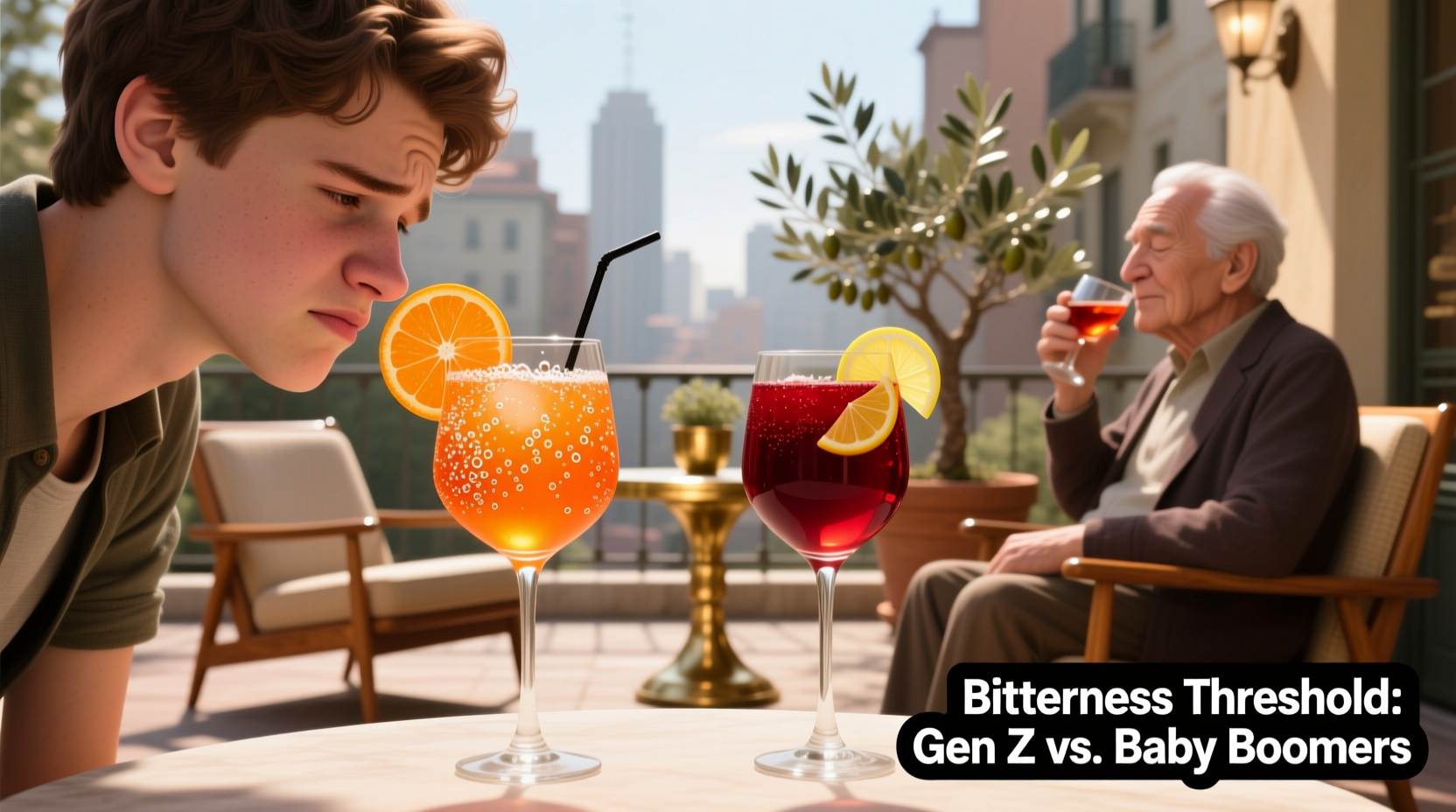
Walk into any Milanese aperitivo bar at 6:30 p.m. and you’ll see it: a sea of pastel-hued Aperol Spritzes clinking on marble counters—especially among patrons under 35. Ten meters down the same bar, a quieter cohort sips deep ruby Campari Spritzes, garnished with orange peel and served without apology. This isn’t just preference. It’s physiology meeting history—where genetics, childhood diet, media exposure, and even urban migration patterns converge in a single glass.
The Aperol Spritz (typically 3 parts Prosecco, 2 parts Aperol, 1 part soda) registers at ~11–14 IBU (International Bitterness Units), landing just above grapefruit juice. The Campari Spritz (3:2:1 ratio, same proportions) clocks in at ~90–110 IBU—comparable to an aggressively hopped IPA or raw gentian root tincture. That five- to tenfold jump in bitterness isn’t merely “stronger.” It triggers fundamentally different neural responses across age cohorts—and those responses are increasingly predictable by birth year.
The Biology of Bitter: Why Your Tongue Isn’t Stuck in Time
Bitter perception is governed by the TAS2R gene family—25 functional receptors in humans, each tuned to distinct chemical structures. One variant, TAS2R38, determines sensitivity to phenylthiocarbamide (PTC) and propylthiouracil (PROP)—compounds structurally similar to sesquiterpene lactones found in Campari’s cinchona and rhubarb extracts. Roughly 25% of people are “supertasters” (homozygous for the sensitive allele), 50% “medium tasters,” and 25% “non-tasters.” But genetics alone don’t explain generational divergence.
What does is developmental plasticity: the brain’s ability to recalibrate taste thresholds during critical windows—especially between ages 2 and 12. Children raised on ultra-processed foods (high in sugar, salt, and fat; low in polyphenols and alkaloids) develop heightened aversion to bitterness. Their neural reward pathways associate bitterness with toxicity—not complexity. Conversely, children regularly exposed to bitter greens, fermented vegetables, herbal teas, or even unsweetened citrus peel show dampened aversion by adolescence.
A 2023 longitudinal study from the University of Bologna tracked 1,247 Italian children from 2008–2023. Those whose families consumed ≥3 servings/week of bitter vegetables (radicchio, dandelion, endive) before age 10 were 3.2× more likely to order Campari-based drinks by age 22—even after controlling for socioeconomic status and parental drinking habits.
Tip: Introduce bitter flavors early—not as punishment, but as texture and nuance. Grate raw radicchio into pasta, steep lemon peel in warm water, or serve roasted beet greens with a splash of apple cider vinegar.Cultural Inflection Points: How Marketing, Media, and Migration Reshaped Bitterness
Aperol didn’t become a global phenomenon because it tastes “lighter.” It became one because it was positioned as accessible. In 2009, Gruppo Campari launched a €25 million campaign rebranding Aperol as “the taste of Italian summer”—sun-drenched visuals, upbeat indie-folk soundtracks, and influencers sipping on Venice rooftops. Crucially, they avoided the word “bitter” entirely. Instead: “refreshing,” “vibrant,” “zesty.”
Campari, by contrast, doubled down on its heritage. Its 2010–2020 campaigns featured black-and-white archival footage, jazz scores, and taglines like “Bitter is Better” and “The Original Aperitif.” No softening. No dilution. The message wasn’t “try this”—it was “know this.” That resonated deeply with older consumers who associated Campari with postwar sophistication, intellectual cafés, and the ritual of slowing down.
But something else shifted beneath the surface: urban food culture. Between 2010 and 2022, the number of specialty coffee shops in major EU cities rose 217%. Espresso—naturally high in chlorogenic acid and quinic acid—became a daily bitter baseline for Gen Z and younger Millennials. So when they encountered Aperol’s gentler bitterness, it registered not as “bold,” but as “mild.” Meanwhile, Boomers and Gen X, raised on drip coffee and instant cocoa, experienced Campari’s intensity as familiar terrain—a flavor anchor in a world of increasing sweetness.
“The palate isn’t static—it’s a historical document. Every generation’s bitterness threshold encodes its dietary biography: what was scarce, what was medicinal, what was fashionable, and what was forbidden.” — Dr. Sofia Ricci, Sensory Neuroscientist, University of Turin
A Comparative Anatomy: Aperol Spritz vs Campari Spritz
| Attribute | Aperol Spritz | Campari Spritz |
|---|---|---|
| Alcohol by Volume (ABV) | ~9–11% | ~14–16% |
| Bitterness (IBU) | 11–14 | 90–110 |
| Primary Bitter Agents | Chinotto, gentian, rhubarb (low concentration) | Cinchona bark, cascarilla, rhubarb, orange peel (high concentration) |
| Sugar Content (g/L) | 120–140 | 220–250 |
| Typical Serving Temp | 6–8°C (chilled, often with ice) | 8–10°C (slightly warmer, less diluted) |
| Cultural Association | Social ease, Instagrammable moments, daytime leisure | Ritual, introspection, pre-dinner gravity |
Note the paradox: Campari Spritz contains more sugar, yet tastes far more bitter. That’s because its intense bitterness overwhelms sweet receptors, while Aperol’s lower bitterness allows sugar to dominate perception. This explains why many younger drinkers describe Campari Spritz as “harsh” or “medicinal”—not because it’s objectively unpleasant, but because their nervous systems lack the neural scaffolding to parse its layered bitterness as pleasurable.
Real-World Shift: The Case of Milan’s Navigli District
In 2015, Bar Magenta—a century-old institution in Milan’s Navigli district—served Campari Spritzes to 78% of its evening clientele. Its Aperol Spritz accounted for just 12%, mostly ordered by foreign tourists. Staff recall regulars—lawyers, professors, retired journalists—ordering Campari straight up with a twist, then switching to Spritz only after 7 p.m., always with a slice of orange, never lemon.
By 2022, the shift was irreversible. Aperol Spritz made up 63% of all Spritz orders. The bar installed a dedicated Aperol tap line. When owner Luca Bellini introduced a “Campari Revival Night” in March 2023—offering vintage Campari labels and pairing notes with dark chocolate and aged pecorino—attendance skewed 82% over age 55. Younger patrons tried it once, praised the “complexity,” then returned to Aperol. Not out of disdain—but because Campari demanded attention they weren’t conditioned to give it.
Bellini observed something subtler: younger guests often asked for extra soda in their Campari Spritz. Not to dilute strength—but to blunt the initial bitter hit. “They’re not rejecting bitterness,” he told us. “They’re negotiating with it. Like learning a new language phoneme by phoneme.”
Your Bitterness Journey: A 4-Step Reconditioning Framework
You don’t need to “train” your palate like an athlete. You need to reintroduce bitterness with intention—not force. Here’s how:
- Start with structural bitterness: Choose foods where bitterness is balanced by fat or acid—endive salad with walnut oil and lemon, grilled asparagus with Parmigiano, or dark chocolate (70%+ cacao) with sea salt. Avoid isolated bitter supplements.
- Layer, don’t flood: Add one bitter element per meal—not three. Let your taste buds map the sensation before adding another variable.
- Pair with known anchors: Serve Campari Spritz alongside olives or marinated artichokes—the salt and umami create neural “handholds” for the bitter compounds.
- Track temporal response: Note not just whether you like it, but *when* during the sip the bitterness peaks and fades. Supertasters often experience delayed bitterness (3–5 seconds post-swallow). Recognizing that delay builds tolerance.
FAQ: Bitterness, Generations, and the Spritz Divide
Is bitterness aversion purely genetic—or can it be changed?
Genetics set the baseline, but neuroplasticity reshapes perception throughout life. fMRI studies confirm that repeated, low-stakes exposure to moderate bitterness increases activity in the orbitofrontal cortex—the brain’s “flavor integration” center—within 3–5 weeks. It’s not about liking it more. It’s about understanding it better.
Why do some Gen Z drinkers prefer Campari Soda over Campari Spritz?
Campari Soda (Campari + soda water, no wine) removes the alcoholic warmth and effervescence that amplifies Campari’s harsh top notes. The absence of Prosecco’s acidity and residual sugar lets bitterness unfold linearly—not explosively. It’s a tactical reduction of sensory load, not a rejection of depth.
Does climate or geography affect bitterness tolerance?
Yes—indirectly. Regions with historically limited winter produce (e.g., Northern Italy, Scandinavia) developed preservation techniques—fermentation, salting, drying—that intensified bitter phytochemicals. Populations there show higher frequencies of TAS2R variants linked to bitter resilience. Urbanization has muted this effect, but regional baselines persist in family foodways.
Conclusion: Bitterness Is Not a Barrier—It’s a Bridge
The Aperol Spritz vs Campari Spritz divide isn’t evidence of a fragmented culture. It’s proof of adaptation. Each generation negotiates bitterness on its own terms—some seeking harmony, others seeking revelation, others simply seeking recognition in a flavor that feels earned, not imposed. Understanding this doesn’t mean forcing a 22-year-old to love Campari, nor asking a 68-year-old to abandon it. It means honoring the story each sip tells: about soil and season, migration and memory, chemistry and choice.
Next time you order a Spritz, pause before the first sip. Notice where the bitterness lands—on the tongue? The throat? The back of the jaw? Notice whether it lingers or lifts. That awareness isn’t pretension. It’s literacy—in the oldest language we share: survival, pleasure, and the quiet courage to taste the world as it is, not as we wish it to be.
💬 Have you shifted your bitterness threshold over time? Did a childhood food, a travel moment, or a specific drink change how you experience bitter flavors? Share your story in the comments—we’re compiling real-life palate journeys for a follow-up feature.








