When it comes to compelling storytelling, few elements captivate audiences more than a villain who walks the razor’s edge between darkness and redemption. In both anime and Disney narratives, antagonists often serve as emotional anchors—characters whose pain, choices, and transformations linger long after the credits roll. But when we compare these two cinematic traditions, a critical question emerges: which universe crafts villains with greater potential for meaningful redemption?
The answer isn’t simply about morality or momentary regrets. It’s about structure, psychology, and the cultural values embedded in each form of storytelling. Anime, rooted in complex philosophies and often serialized formats, tends to explore moral ambiguity with surgical precision. Disney, shaped by Western ideals of good versus evil and family-friendly messaging, traditionally favors clear resolutions—but has evolved significantly in recent decades.
This article examines the redemption arc potential of villains from both worlds, analyzing narrative depth, emotional complexity, and real-world resonance to determine where true transformation is not only possible but believable.
Defining Redemption Arc Potential
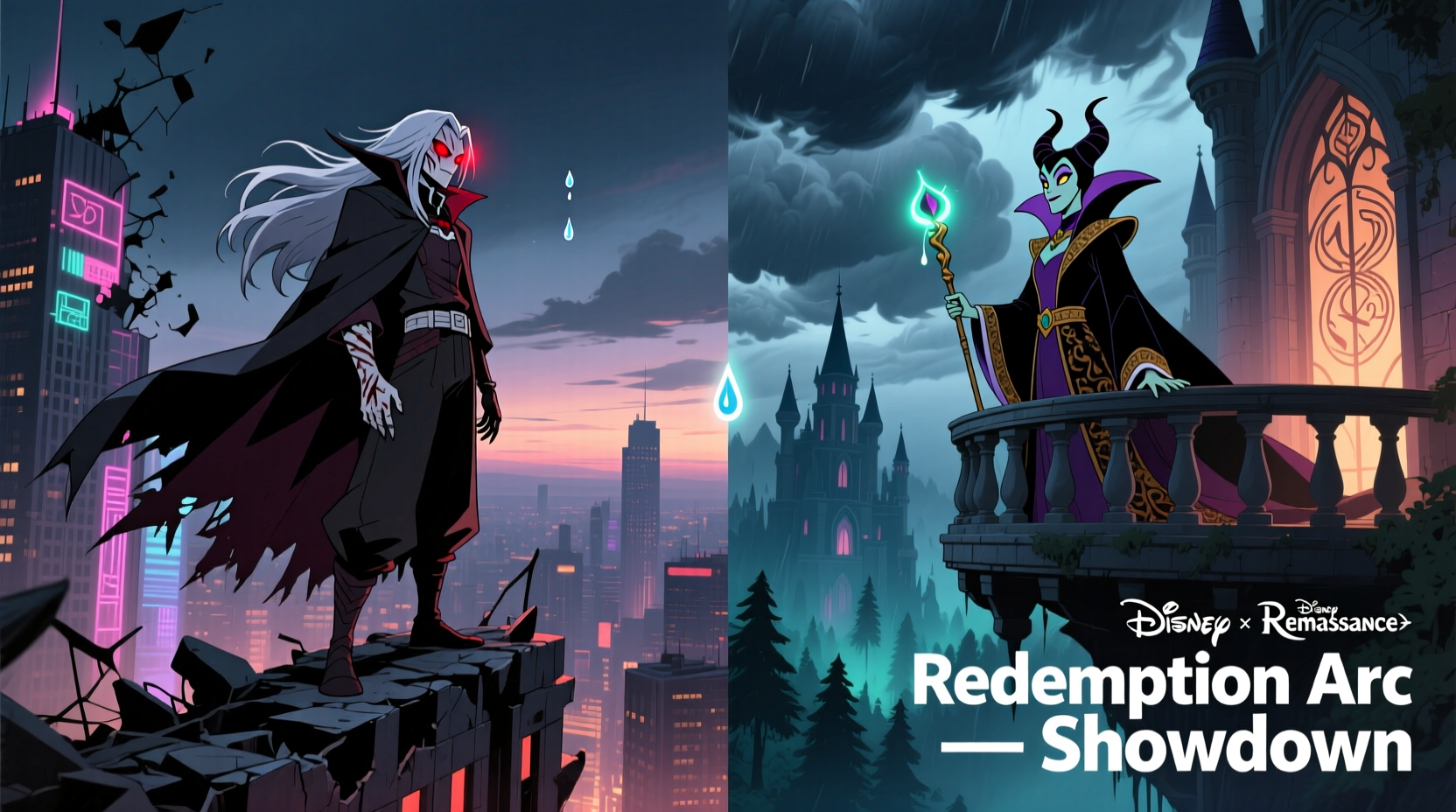
A redemption arc isn’t merely a change of heart. It requires three core components: motivation, consequence, and transformation. The most powerful arcs begin with understandable motives—grievances, trauma, or ideological convictions that make the character’s descent into villainy feel inevitable. Consequences must follow: suffering, loss, or isolation that force introspection. Finally, transformation must be earned—not granted through deus ex machina or sudden forgiveness.
In this context, “potential” refers not just to whether a character *does* redeem themselves, but whether the narrative framework allows for it. Does the story leave room for doubt? Are their actions contextualized rather than demonized? Is there space for growth beyond punishment?
Anime frequently builds its stories around characters whose identities shift across seasons. This serialization allows time for gradual internal conflict, recurring self-doubt, and philosophical debate—all fertile ground for redemption. Disney, historically constrained by runtime and tone, often resolves villainy through defeat or death. Yet modern entries have begun challenging this pattern, suggesting a convergence of styles.
Narrative Structures: Serialization vs. Resolution
One of the most significant differences lies in format. Most anime series unfold over dozens, sometimes hundreds, of episodes. This extended timeline enables nuanced development. A character like Pain from *Naruto Shippuden* can spend entire arcs explaining his worldview before facing consequences—and even then, his end includes a measure of absolution.
Disney films, typically 90–100 minutes long, operate under tighter constraints. Villains are introduced, establish threat, and are defeated within a single act. Consider Scar from *The Lion King*—charismatic and treacherous, yet ultimately irredeemable. His final moments offer no remorse, only defiance. There’s little room for reflection, let alone rehabilitation.
But exceptions exist. Zuko from *Avatar: The Last Airbender*—an animated series influenced by anime aesthetics and Eastern philosophy—is one of the most celebrated redemption arcs in modern animation. Though not produced in Japan, *Avatar* exemplifies how extended storytelling enables authentic transformation. Had Zuko been confined to a two-hour film, his journey might have felt rushed or unearned.
Tip: Look beyond surface actions—true redemption potential lies in a character’s capacity for self-awareness and sustained effort to change.Psychological Depth and Motivation
Anime villains are rarely evil for evil’s sake. Take Griffith from *Berserk*, whose betrayal stems from an obsession with destiny and transcendence. Or Light Yagami from *Death Note*, who begins as a brilliant student wanting to purge corruption—only to become what he despised. These characters aren’t caricatures; they’re tragic figures shaped by ambition, trauma, or existential despair.
Disney antagonists, especially in earlier works, were often motivated by jealousy (Cruella de Vil), power lust (Ursula), or pure malice (Maleficent in her original portrayal). While entertaining, such motivations limit redemption potential—they suggest inherent wickedness rather than corrupted ideals.
However, recent reimaginings have added layers. Maleficent’s 2014 live-action origin story reframed her as a betrayed guardian turned avenger, making her eventual softening toward Aurora psychologically coherent. Similarly, Yzma from *The Emperor’s New Groove* is comically evil but shows vulnerability, hinting at insecurity beneath the theatrics.
Still, anime consistently goes further. Characters like Sasuke Uchiha (*Naruto*) spend years oscillating between ally and enemy, driven by revenge, identity crisis, and survivor’s guilt. His eventual return to the village isn’t instantaneous—it’s negotiated through battle, dialogue, and mutual understanding.
“Redemption isn’t flipping a switch. It’s walking back through fire you once believed would cleanse the world.” — Dr. Lena Park, Narrative Psychologist & Pop Culture Analyst
Cultural Context and Moral Frameworks
The divergence in redemption potential also reflects deeper cultural attitudes. Japanese storytelling, influenced by Shinto, Buddhist, and Confucian thought, often embraces impermanence, duality, and the possibility of renewal. Even grave sins can be atoned for through action and endurance.
Western traditions, particularly those shaped by Judeo-Christian ethics, tend to emphasize sin, judgment, and irreversible consequences. Evil is something to be vanquished, not reconciled. This mindset historically limited Disney’s willingness to rehabilitate villains—after all, children’s media needed clear moral boundaries.
Yet globalization has blurred these lines. Modern Disney productions reflect a more pluralistic worldview. In *Ralph Breaks the Internet*, even self-proclaimed “bad guys” question their roles, asking if they’re destined to remain outside the hero’s circle. The film doesn’t offer full redemption for every antagonist, but it validates their longing for acceptance.
Anime, meanwhile, continues to push boundaries. Series like *Chainsaw Man* or *Jujutsu Kaisen* present villains who are victims of systemic oppression or cursed emotions—entities born from human fear, not choice. Can a curse seek redemption? Perhaps not—but the narrative invites us to empathize, to see the tragedy behind the terror.
Comparative Analysis: Redemption Arc Potential Matrix
| Villain Trait | Anime Examples | Disney Examples | Redemption Feasibility |
|---|---|---|---|
| Motivated by Trauma | Itachi Uchiha (*Naruto*), Eren Yeager (*Attack on Titan*) | Maleficent (*Maleficent*), Ursula (*The Little Mermaid* – implied backstory) | High – personal loss creates empathy |
| Idealistic Origins | Light Yagami (*Death Note*), Griffith (*Berserk*) | Zuko (*ATLA*), Jafar (*Aladdin* – minor hints) | Medium-High – noble goals corrupted |
| Comedic or Caricatured | Hidan (*Naruto*), Frieza (*Dragon Ball*) | Yzma (*Emperor’s New Groove*), Hades (*Hercules*) | Low – humor reduces stakes |
| Fully Irredeemable | Dio Brando (*JoJo*), Madara Uchiha (*Naruto*) | Scar (*The Lion King*), Judge Doom (*Who Framed Roger Rabbit*) | None – defined by destruction |
| Completed Redemption | Sasuke Uchiha, Roy Mustang (initially ambiguous in *FMA*) | Zuko (*ATLA*), Megara (*Hercules* – morally gray) | Proven – demonstrated change over time |
This comparison reveals a trend: anime features a broader spectrum of morally complex antagonists, increasing the likelihood that some will possess high redemption potential—even if they never fully achieve it. Disney, while improving, still leans toward binary outcomes unless explicitly subverting genre norms.
Case Study: Itachi Uchiha vs. Scar
Consider two characters: Itachi Uchiha from *Naruto* and Scar from *The Lion King*. Both commit mass murder. Both are driven by ideology. Yet their paths diverge dramatically in terms of redemption possibility.
Itachi slaughtered his entire clan—including his parents—to prevent a coup that would have sparked civil war. He lived in exile, hated by his younger brother, all while secretly protecting the village. When his truth is revealed, viewers don’t excuse his actions—but they understand them. His sacrifice becomes part of a larger narrative about duty, love, and regret. Posthumously, he’s pardoned, and his legacy is reevaluated.
Scar, by contrast, murders his brother Mufasa and exiles Simba to seize the throne. His motive? Jealousy and entitlement. There’s no hidden nobility, no secret plan to save the Pride Lands. When defeated, he’s consumed by hyenas—a symbolic end for someone who embraced chaos. No apology, no realization. Just downfall.
Could Scar have been redeemed? Only with radical rewriting. But Itachi was always on the edge of redemption—the audience just didn’t know it yet. That uncertainty is key. Redemption feels powerful when it emerges from ambiguity, not certainty.
Checklist: Evaluating Redemption Arc Potential
Use this checklist to assess any villain’s capacity for redemption, regardless of origin:
- Backstory with Emotional Weight: Was the character shaped by loss, injustice, or systemic failure?
- Moral Complexity: Do their actions challenge simple labels like “evil”?
- Capacity for Regret: Have they shown doubt, sorrow, or hesitation?
- Relational Growth: Do they form bonds that contradict their villainous role?
- Narrative Space: Is there enough time in the story for gradual change?
- Consequences Over Punishment: Are they allowed to suffer meaningfully without being written off?
- Agency in Change: Do they choose redemption, or is it forced upon them?
Characters scoring high on this list—like Itachi, Zuko, or even Guts’ enemies in *Berserk*—possess strong redemption potential, even if the story doesn’t realize it.
FAQ
Can a Disney villain ever match anime-level redemption depth?
Yes—but only with expanded storytelling. Films like *Wicked* (upcoming) or series such as *Descendants* suggest Disney is moving toward deeper exploration. However, theatrical runtime limits still hinder the slow-burn evolution common in anime.
Why do anime villains seem more sympathetic?
It’s not just sympathy—it’s perspective. Anime often dedicates entire episodes to a villain’s past, letting viewers experience their pain firsthand. Disney traditionally reserves that depth for protagonists.
Does redemption require forgiveness from victims?
Not necessarily. True redemption is internal—changing behavior, accepting responsibility, making amends where possible. Forgiveness may come, but it’s not the metric of success. Some of the most powerful redemptions, like Itachi’s, occur posthumously, without direct reconciliation.
Conclusion: Where Transformation Thrives
If redemption arc potential were measured by narrative real estate—space for doubt, time for growth, and permission for contradiction—then anime holds a distinct advantage. Its format, cultural roots, and thematic ambitions create fertile soil for villains who might one day lay down their arms, not because they lost, but because they’ve seen another way.
Disney hasn’t abandoned the possibility. Characters like Zuko (in spirit, if not production origin) and reimagined figures like Maleficent prove that even tightly structured stories can accommodate transformation. But these remain exceptions in a canon built on closure.
The future may bring convergence. With streaming platforms enabling longer-form animated storytelling, Disney now has the tools to explore antagonists with the same depth as anime. Imagine a limited series tracing Ursula’s fall from sea scholar to outcast sorceress, or a psychological drama unpacking Jafar’s obsession with power as compensation for marginalization.
Until then, anime remains the undisputed leader in crafting villains whose darkness feels human—and whose light, however faint, feels possible.
💬 Which villain do you believe deserved redemption but never got the chance? Share your thoughts and debate the ethics of forgiveness in animation—we’d love to hear your perspective.








