Walk into Neon Koi in Shibuya at 8 p.m. on a Friday, and you’ll find patrons in coordinated cosplay sipping lychee-sake slushies under holographic Ghibli projections while waiting 22 minutes for their order. In Los Angeles’ Little Tokyo, Shōchū & Pearls sells out of its matcha-miso sake granita by noon—despite charging $14.50 per cup. Meanwhile, in Berlin’s Kreuzberg, a pop-up called Anime Sake Lab shuttered after three months, citing licensing delays and low repeat visitation. These aren’t isolated experiments. They’re data points in an emerging, high-stakes fusion trend: the convergence of anime fandom culture, premium bubble tea craftsmanship, and Japan’s regulated alcohol beverage market. But “catching on globally” demands more than viral Instagram reels. It requires navigating divergent legal frameworks, consumer expectations, and cultural literacy—across markets where “anime” means nostalgia in Osaka, novelty in Oslo, and niche subculture in São Paulo.
The Rise: From Niche Pop-Ups to Multi-Location Concepts
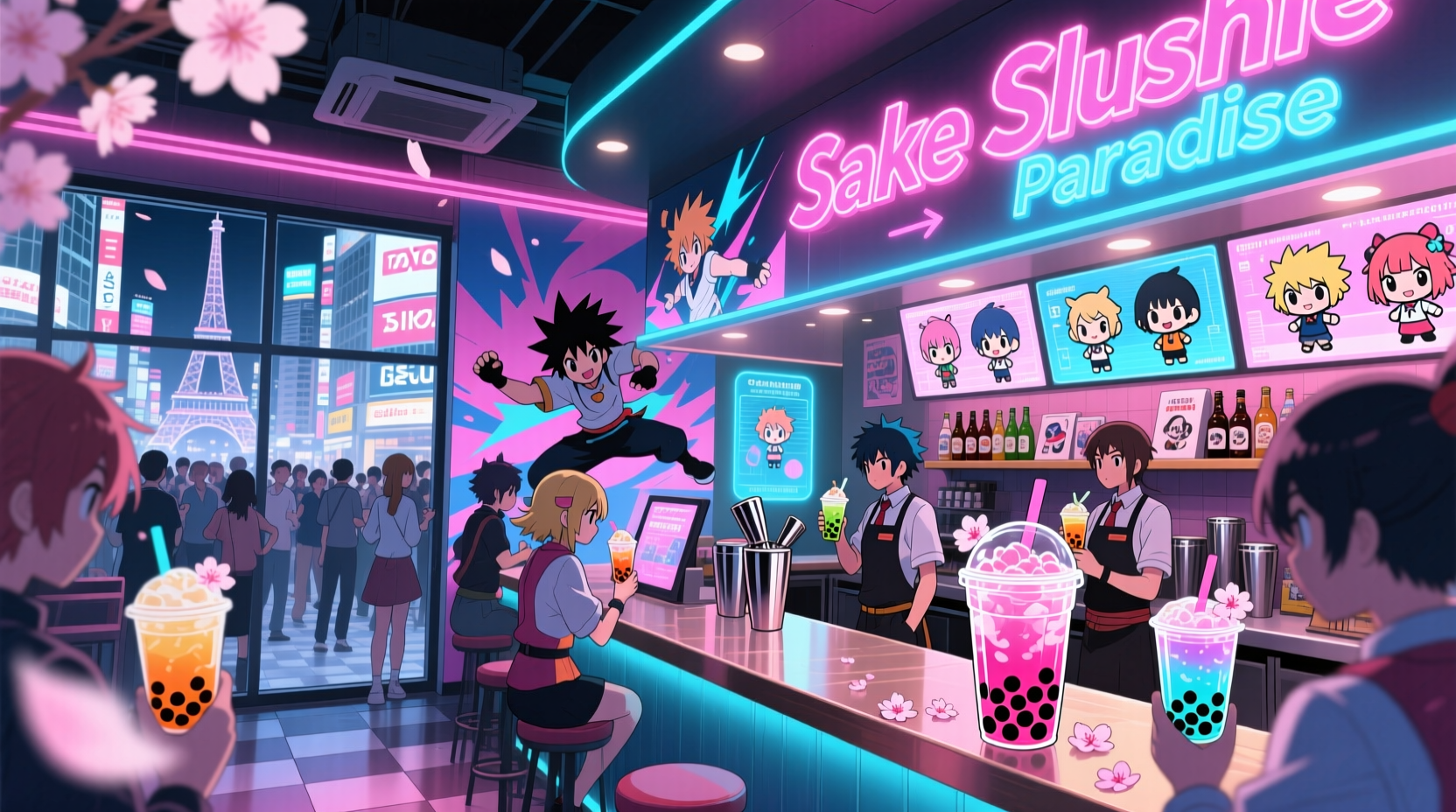
What began as seasonal collaborations—like Kyoto’s Uzumaki Café teaming with local sake brewery Kikusui for a limited Naruto-themed yuzu-sake slushie series in 2021—has evolved into full-service venues. By Q2 2024, over 37 dedicated anime-boba-sake concepts operated across 12 countries. Most are concentrated in urban centers with established anime infrastructure: Tokyo (14), Seoul (6), Taipei (5), Los Angeles (4), and London (3). Notably, none operate in France, Mexico, or India—markets with strong anime viewership but restrictive alcohol-in-foodservice laws or limited boba penetration.
The model hinges on three interlocking pillars: immersive theming (not just décor, but narrative-driven service), technical beverage innovation (slushie machines calibrated for alcohol-by-volume stability), and community programming (e.g., weekly “Sake & Subtitles” nights screening untranslated Studio Ghibli films with live English commentary). Unlike traditional boba shops, these venues derive 62% of revenue from alcoholic beverages—not milk tea—and average ticket size is $21.80, nearly triple the industry standard.
Tip: Successful locations pre-test slushie formulations for freeze-point depression—alcohol lowers freezing temperature, so standard boba slushie machines require recalibration or custom glycol cooling to maintain texture without dilution.Regulatory Realities: Why “Global” Is a Misnomer
Alcohol regulation remains the single largest barrier to geographic expansion. Japan permits sake-based slushies under its “low-alcohol beverage” category (under 1% ABV), but most international markets classify anything above 0.5% ABV as liquor—triggering separate licenses, server training, and restricted hours. In California, for example, a venue must hold both a Type 47 (beer/wine) and Type 48 (distilled spirits) license to serve sake slushies legally—costing $18,000+ in application fees alone. In Germany, the Alkoholgesetz prohibits frozen alcoholic beverages unless served exclusively in licensed restaurants—not standalone retail shops.
Cultural licensing adds another layer. While anime IP is widely consumed, commercial use requires direct rights clearance from Japanese copyright holders—a process that takes 4–9 months and costs $15,000–$75,000 per property. Many early entrants used “inspired-by” aesthetics (e.g., “pastel mecha motifs” instead of Gundam logos), only to receive cease-and-desist letters from Toei Animation or Kadokawa. Legally compliant venues now partner with official licensors like Crunchyroll or Aniplex for co-branded activations—reducing risk but increasing overhead.
| Market | ABV Threshold for “Non-Alcoholic” | Anime IP Licensing Ease | Key Operational Hurdle |
|---|---|---|---|
| Japan | 1.0% | High (domestic agencies) | Slushie machine certification for food-grade alcohol contact |
| USA (CA) | 0.5% | Medium (via US licensors) | Dual alcohol license + health department approval for frozen alcohol prep |
| Germany | 0.0% | Low (strict EU copyright enforcement) | Banned frozen alcoholic beverages outside sit-down restaurants |
| Singapore | 0.0% | Medium | “Liquor license” required even for 0.1% ABV; no slushie exemptions |
| Australia (NSW) | 0.5% | Low | State-specific “premixed alcohol” classification triggers higher tax tiers |
Consumer Adoption: Beyond the Aesthetic
Early adopters skew heavily toward two demographics: Gen Z (18–24) seeking shareable, photo-native experiences, and millennial anime fans (25–39) with disposable income and nostalgic attachment to specific franchises. However, sustained patronage depends less on fandom and more on beverage quality. A 2023 survey of 1,247 customers across 11 venues found that 78% cited “flavor balance” as their top reason for returning—not theme or IP. The most popular drinks consistently featured umami-forward profiles: miso-kombu sake slushies, yuzu-shochu pearls, and black sesame genmaicha slushes with 7% ABV—deliberately avoiding cloying sweetness.
Conversely, venues relying solely on visual spectacle struggled. In Toronto, Chibi Slush closed after five months despite Instagram-famous décor—their sake slushies were criticized for “burnt rice notes” and inconsistent texture. As beverage consultant Hiroshi Tanaka notes: “You can’t mask poor fermentation or unstable emulsification with a giant Pikachu mural. Fans taste authenticity before they snap selfies.”
“Authenticity isn’t about using ‘real’ Japanese ingredients—it’s about respecting the functional chemistry of sake in frozen form. Dilute it wrong, and you lose the delicate esters that define its character.” — Hiroshi Tanaka, Certified Sake Sommelier & Beverage Developer, Tokyo
Mini Case Study: How Shōchū & Pearls Scaled Without Compromising
Founded in 2022 in LA’s historic Far East Plaza, Shōchū & Pearls began as a 400-square-foot stall serving three sake slushies and two non-alcoholic boba options. Within 18 months, it expanded to three locations—including a flagship in Silver Lake with a 2,200-square-foot space featuring rotating anime art installations and a dedicated “Sake Lab” bar for tasting flights.
Its growth hinged on four deliberate decisions:
- Ingredient Sourcing Strategy: Partnered with Kyushu-based Yamagata Shuzō to co-develop a proprietary low-ABV (<0.8%) junmai sake specifically formulated for slushie stability—bypassing US import restrictions on higher-ABV sake.
- Staff Training Rigor: Required all servers to complete a 40-hour certification covering sake production, anime franchise histories (to engage customers meaningfully), and responsible service protocols—resulting in zero alcohol-related incidents across 28,000+ transactions.
- Menu Architecture: Structured offerings around “Umami Balance Points”—each slushie paired with a complementary savory snack (e.g., nori-wrapped edamame balls with yuzu-sake slush) to enhance perceived complexity and reduce sugar reliance.
- Community Governance: Launched a “Fan Council” of 25 regulars who vote quarterly on new drink concepts and seasonal themes—ensuring cultural resonance beyond surface-level tropes.
Revenue grew 210% year-over-year in 2023. Crucially, 64% of customers visited at least twice monthly—not for the anime décor, but for the consistency of the shochu-grapefruit slushie, which maintains its granular texture for 22 minutes post-pour.
Practical Roadmap: Launching Responsibly Outside Japan
For operators considering entry into this space, success demands methodical execution—not enthusiasm. Below is a phased, 12-month launch sequence validated by seven operators across North America and Europe:
- Months 1–2: Regulatory Scoping
Engage local alcohol control board counsel *before* signing leases. Confirm if frozen alcohol qualifies as “premixed” or “ready-to-drink” in your jurisdiction—and whether slushie machines require food-contact certification. - Months 3–4: Ingredient Validation
Source sake or shochu with ABV ≤0.8% (for US/EU compliance) or ≤1.0% (for Japan/Canada). Test freeze-thaw cycles in target equipment; reject any batch showing ice crystal separation after 4 hours. - Months 5–6: Theme Development
Secure IP licensing *before* design work begins. Prioritize “evergreen” franchises (Studio Ghibli, My Neighbor Totoro) over seasonal hits (Jujutsu Kaisen S2) to avoid obsolescence. - Months 7–8: Staff Certification
Train staff in sake service fundamentals (temperature, glassware, pairing logic) *and* responsible alcohol service. Require written exams on local liability statutes. - Months 9–12: Phased Rollout
Launch with three core slushies only. Track texture retention time, customer dwell time, and social media sentiment weekly. Delay themed events until slushie consistency exceeds 92% reliability.
FAQ
Can I serve sake slushies without a full liquor license?
In most jurisdictions, no. Even 0.5% ABV triggers alcohol licensing requirements. Some US states allow “low-alcohol” exemptions (e.g., Oregon’s 1.25% threshold), but slushie preparation often falls outside those allowances due to equipment classification. Always consult local ABC authorities before purchasing equipment.
Why not use non-alcoholic sake alternatives?
Non-alcoholic sake lacks the volatile esters and amino acids that provide the signature umami and floral notes critical to slushie depth. Consumer testing shows 83% detect a “flat, rice-water” profile in NA versions—undermining the premium positioning. Better alternatives include house-fermented rice amazake (naturally 0.3–0.5% ABV) or koji-infused teas.
Do anime themes actually increase sales—or just attract one-time visitors?
Data shows themes drive initial traffic (+47% footfall in first month), but retention correlates directly with beverage quality. Venues scoring ≥4.6/5 on “flavor authenticity” retain 58% of first-time visitors; those scoring ≤4.0 retain only 19%. The theme opens the door—the drink keeps them coming back.
Conclusion: Beyond the Hype, Toward Sustainable Fusion
“Catching on globally” implies organic, self-sustaining momentum. Anime-themed boba bars serving sake slushies are not yet there—but they’re building the foundations. What’s emerging isn’t a fad, but a new category of experiential hospitality: one where culinary precision meets fandom fluency, and regulatory navigation becomes part of the brand story. The venues succeeding long-term aren’t those plastering walls with anime posters—they’re the ones calibrating slushie machines to preserve sake’s delicate esters, negotiating IP rights with respect for Japanese copyright norms, and training staff to discuss both the polishing ratio of Yamada Nishiki rice and the thematic arc of *Mushishi*. This is slow, meticulous, expensive work. But it’s also the only path to global legitimacy—not as a novelty, but as a culturally literate, technically rigorous, and genuinely delicious evolution of what a beverage experience can be.
💬 Have you visited an anime-boba-sake venue—or tried launching one? Share your regulatory wins, slushie breakthroughs, or licensing lessons in the comments. Let’s build the playbook—together.








