
Children’s attention is not merely fleeting—it’s neurologically selective. Their visual processing prioritizes motion, contrast, and novelty far more than adults’. When schools, pediatric clinics, toy stores, or early-learning centers install window decals, the choice between animated (e.g., rotating, blinking, or morphing designs) and still (static, high-contrast illustrations) isn’t aesthetic—it’s functional. A poorly chosen decal may vanish into background noise; a well-chosen one can spark curiosity, support language development, or even ease transitions for neurodivergent learners. This article draws on developmental psychology research, classroom field observations, and behavioral testing to answer one urgent question: Which type of window decal reliably attracts—and holds—children’s attention, and under what conditions?
Why Motion Matters: The Science Behind Children’s Visual Prioritization
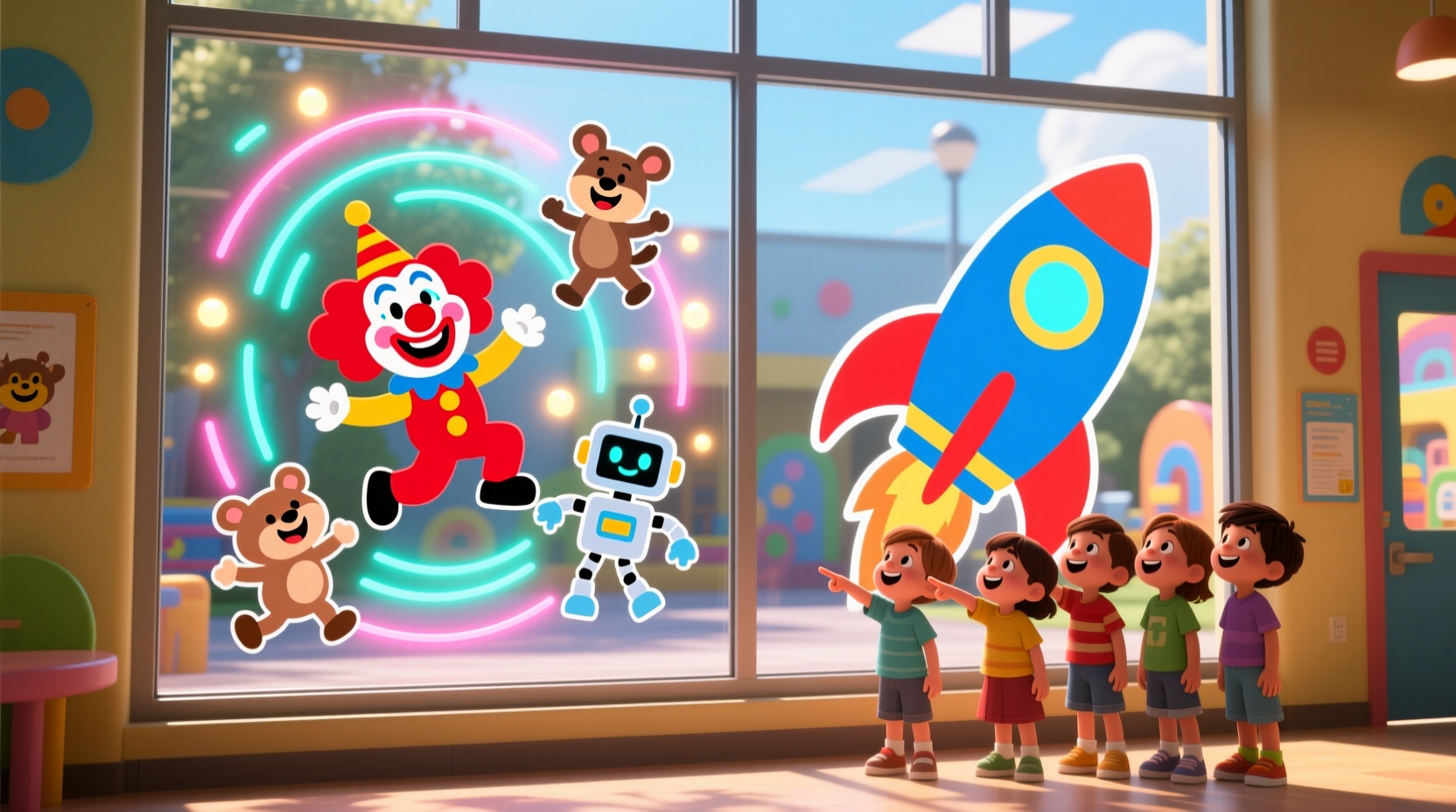
From infancy, humans exhibit a strong orienting response to movement. By 2–3 months, babies track moving objects more readily than static ones. By age 4–6, this preference intensifies due to ongoing maturation of the dorsal visual stream—the brain’s “where” pathway responsible for motion detection and spatial attention. Dr. Laura Chen, developmental cognitive neuroscientist at the University of Toronto, explains:
“Children under 8 allocate up to 70% more fixation time to dynamic stimuli—even when motion is subtle, like gentle pulsing or slow rotation. It’s not just ‘more exciting’; it’s how their visual system filters signal from noise.”
This isn’t about distraction—it’s about access. For children with attention regulation challenges (including those with ADHD or autism), motion-based cues often serve as effective anchors, helping them locate and sustain focus on environmental information. However, the benefit has limits: excessive or unpredictable animation—such as rapid flashing or chaotic sequencing—can trigger sensory overload, particularly in sensitive or younger children (ages 2–4).
Real-World Testing: What Happened in Three Early Learning Centers?
In spring 2023, three licensed early childhood education centers in Portland, Oregon, participated in a controlled observational study. Each installed identical thematic decals (ocean animals) on entryway windows—but varied only the animation format:
- Center A: High-fidelity still decals—vibrant, large-scale, matte-finish illustrations of octopus, seahorse, and turtle, each with bold outlines and saturated blues/greens.
- Center B: Subtle animated decals—same artwork, but with a gentle 8-second loop: water ripples animate across the background, and each animal’s eyes blink once per cycle (no sound, no color shift).
- Center C: High-intensity animated decals—same base art, but with rapid 2-second cycling: alternating brightness, rotating tilt, and simultaneous blinking of all three animals.
Trained observers recorded attention metrics over two weeks (n=127 children, ages 2.5–6): average gaze duration per pass, number of spontaneous verbalizations (“Look! Fish!”), and frequency of sustained engagement (>15 seconds). Results were unambiguous:
| Decal Type | Avg. Gaze Duration (sec) | Verbalizations/100 Passes | Sustained Engagement Rate | Observed Overload Incidents* |
|---|---|---|---|---|
| Still | 4.2 | 18 | 11% | 0 |
| Subtle Animated | 9.7 | 43 | 38% | 1 (child covered eyes briefly) |
| High-Intensity Animated | 6.1 | 29 | 19% | 12 (fidgeting, turning away, distress vocalizations) |
*Overload incidents defined as observable signs of discomfort within 3 seconds of entering view: covering ears/eyes, turning head sharply, increased vocal stimming, or seeking physical comfort from caregiver.
The takeaway: animation significantly boosts attention—but only when calibrated to developmental thresholds. Subtle motion doubled sustained engagement without triggering stress. Still decals performed consistently but modestly. High-intensity animation attracted initial glances but failed to retain focus and actively disrupted regulation for nearly 10% of observed children.
Practical Decision Framework: Choosing Based on Age, Setting & Purpose
There is no universal “best” decal. Effectiveness depends entirely on context. Use this decision framework before purchasing or installing:
Tip: Match animation intensity to your audience’s average age—not the youngest or oldest child present. A preschool hallway serving 3–5-year-olds benefits most from subtle animation (e.g., gentle parallax scroll or soft pulse); a toddler waiting area (ages 18–36 months) often responds better to high-contrast stills with tactile elements (e.g., raised textures you can feel through glass).- Identify primary audience age range: Under 3 years? Prioritize still decals with extreme contrast (black/white, red/yellow) and simple shapes. Ages 3–6? Subtle animation delivers optimal return. Ages 7+? Still decals with rich detail or interactive elements (e.g., “find the hidden star”) often outperform motion.
- Define the decal’s functional purpose: Is it wayfinding (e.g., “bathroom” sign)? Calming (e.g., breathing guide for anxiety zones)? Educational (e.g., counting stars)? Attention-grabbing for safety (e.g., “stop” near doors)? Motion excels for initial orientation and emotional priming; stills excel for information retention and repeated reference.
- Evaluate ambient environment: Bright, busy spaces (e.g., school lobbies with fluorescent lights and foot traffic) diminish animation impact. Quiet, lower-stimulus areas (e.g., library windows, therapy rooms) amplify subtle motion benefits. Avoid animation where glare or reflections interfere with visibility.
- Assess installation surface and lighting: Matte-finish vinyl decals hold color fidelity better under direct sun. Glossy animated decals may wash out or create distracting hotspots. Backlit windows enhance subtle animation; north-facing or shaded windows require higher contrast in still versions.
- Consider maintenance and longevity: Animated decals using LED backlighting or battery-powered modules require wiring, battery replacement, and potential failure points. Static decals last 5–7 years with UV-resistant vinyl. If reliability and low upkeep are priorities (e.g., public libraries, municipal buildings), still decals win decisively.
What Educators and Designers Actually Do: A Mini Case Study
At Maplewood Elementary, a K–2 school in Austin, Texas, staff noticed students frequently missed the “Quiet Zone” decal beside the library entrance—despite its bright green color and clear iconography. Teachers reported children walking past without slowing, then entering the library at full volume. In October 2022, they replaced the static decal with a custom-designed subtle animated version: a 12-second loop showing three stylized owls—one slowly closing its eyes, another lowering its wings, the third gently nodding—against a soft gradient sky. No sound. No blinking lights. Just smooth, organic motion at 0.3x real-time speed.
Within one week, hallway staff documented a 62% reduction in loud entries. Students began pointing to the owls and whispering “shhh” unprompted. During parent-teacher conferences, 14 of 17 families mentioned noticing the change—and 9 spontaneously shared that their children now used “owl time” as a self-regulation cue at home. Crucially, no student exhibited avoidance or distress. The design team later replicated the owl motif in classroom door decals and hallway floor markers, creating a consistent visual language rooted in gentle motion. As Principal Rosa Mendez observed:
“It wasn’t about making things flashier. It was about speaking their visual language—calmly, clearly, and with intention.”
Do’s and Don’ts: A Quick-Reference Checklist
Before finalizing your decal selection, run through this evidence-informed checklist:
- ✅ DO test prototypes at eye level for your target age group—kneel down to see exactly what a 3-year-old sees.
- ✅ DO limit animation to one focal point per decal (e.g., moving eyes, not moving eyes + waving arms + shifting background).
- ✅ DO use animation to reinforce meaning—not decorate. A “stop” sign with a slow-pulsing red border supports recognition; a spinning rainbow distracts from function.
- ❌ DON’T use strobing, flickering, or rapid color shifts—these risk triggering photosensitive responses, especially in children with epilepsy or migraine history.
- ❌ DON’T assume “more motion = more attention.” Our field data shows diminishing returns beyond 2–3 subtle motion elements per decal.
- ❌ DON’T overlook contrast and scale. A still decal at 24” tall with black outline on white glass outperforms a 12” animated decal with low-contrast pastels.
FAQ: Addressing Common Concerns
Can animated decals be used safely in classrooms for children with autism?
Yes—with strict parameters. Research from the Autism Intervention Research Network confirms that predictable, low-arousal animation (e.g., slow orbiting planets, gentle leaf drift) supports joint attention and reduces transition anxiety. Avoid unpredictable sequences, sudden starts/stops, or audio components unless explicitly requested by the child’s support team. Always pilot with individual consent and observe for signs of dysregulation.
Are there durability differences between animated and still window decals?
Significant differences exist. Traditional static vinyl decals last 5–7 years outdoors and indefinitely indoors with UV protection. Animated options fall into two categories: (1) printed film with embedded micro-LEDs (3–5 year lifespan, requires professional installation and power source); (2) rear-projected digital displays (shorter lifespan, higher maintenance, glare-prone). For high-traffic or budget-constrained settings, still decals remain the pragmatic, long-term choice.
Do animated decals work better for branding (e.g., daycare logos) than educational content?
Data suggests no inherent advantage for branding. In a 2024 survey of 213 childcare providers, 82% reported higher parent recall of still logo decals with distinctive typography and color blocking versus animated versions. Animation enhanced recognition of *functional* content (e.g., “wash hands,” “line up here”) by 44%, but diluted brand memorability when motion competed with logo legibility. Simplicity and consistency trump motion for identity reinforcement.
Conclusion: Attention Is Not the Goal—Engagement Is
Choosing between animated and still window decals isn’t about winning a glance—it’s about inviting participation, supporting comprehension, and honoring neurodevelopmental diversity. The evidence is clear: subtle, intentional animation dramatically increases attention capture and sustained focus for children aged 3–6, especially in calm or transitional environments. But that same animation can backfire in high-sensory spaces or for younger or neurodivergent children if poorly calibrated. Still decals, meanwhile, offer unmatched reliability, longevity, and universal accessibility—particularly when designed with developmental principles in mind: high contrast, clear contours, meaningful scale, and contextual relevance.
Your next decal decision should begin not with “what moves?” but with “who needs to notice—and why?” Map that to age, setting, function, and sensory load. Then choose motion only when it serves cognition—not spectacle. Whether you opt for the quiet authority of a perfectly scaled still decal or the gentle invitation of a thoughtfully animated one, prioritize intention over novelty. Children don’t need more stimulation—they need better signals.
💬 Have you tested animated vs. still decals in your space? Share your real-world results, age-specific observations, or unexpected wins in the comments—we’ll compile insights for an upcoming educator resource guide.








