Alcohol by volume (ABV) is one of the most misunderstood metrics in spirits appreciation. From barrel-strength bourbons commanding premium shelf space to Instagram captions declaring “120-proof = serious craft,” a persistent cultural assumption lingers: higher ABV equals superior quality. But distillers, master blenders, and sensory scientists consistently challenge this notion—not as a matter of opinion, but of chemistry, intention, and human perception. This isn’t about dismissing high-proof expressions; it’s about recognizing that ABV is a tool, not a trophy. Quality emerges from balance, intentionality, and context—not from a number on a label.
The Science Behind ABV: What It Measures—and What It Doesn’t
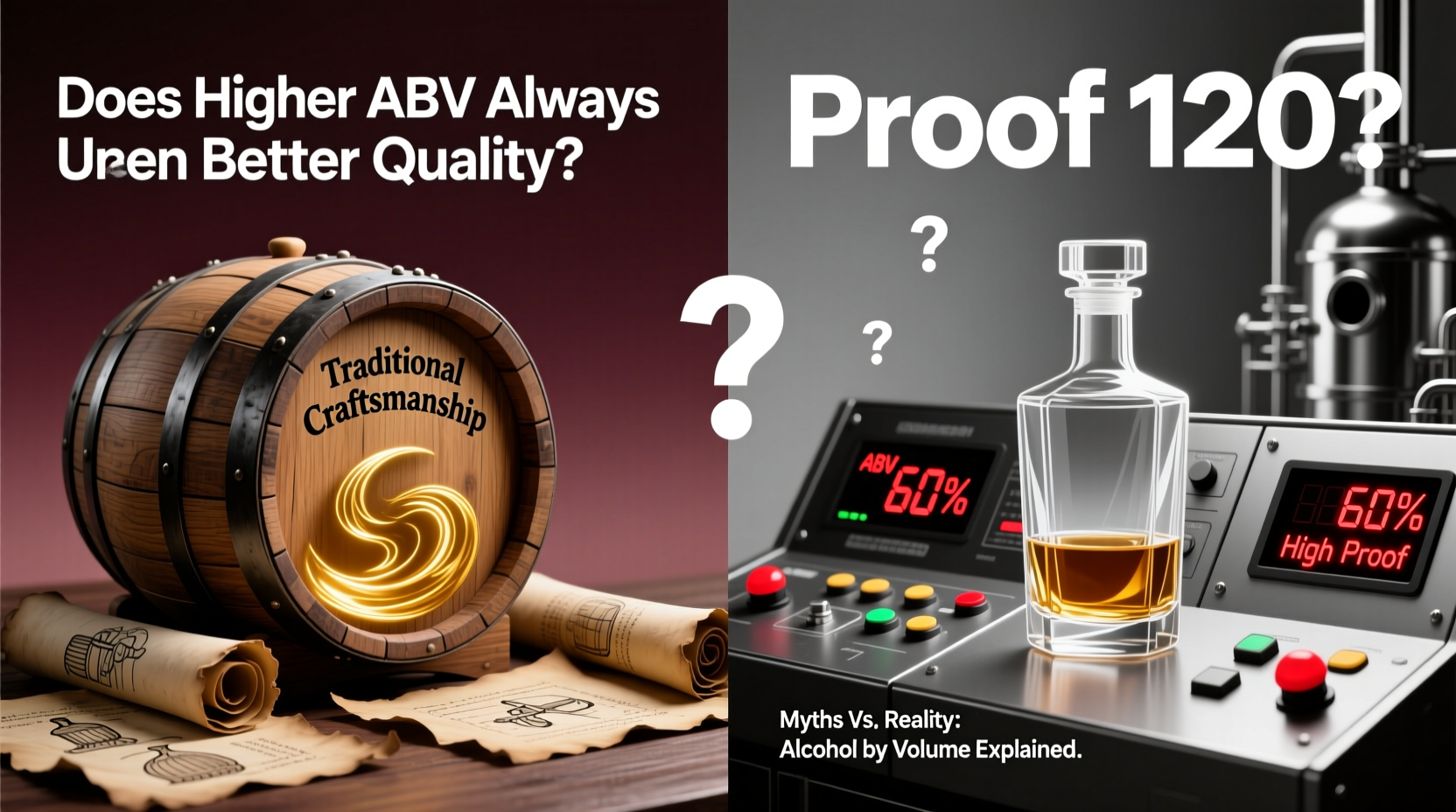
ABV is a precise, standardized measurement: the percentage of ethanol by volume in a liquid at 20°C. A 45% ABV whiskey contains 45 mL of pure ethanol per 100 mL of solution. That’s all it tells you—nothing about congeners (flavor compounds like esters, aldehydes, and phenols), mouthfeel, aging trajectory, or structural harmony. Ethanol itself is volatile, pungent, and numbing at high concentrations. Above ~55% ABV, it begins to suppress aromatic volatility—meaning fewer volatile esters and fruity top notes reach your nose. Below 40% ABV, many delicate floral and citrus compounds become more perceptible. This isn’t subjective preference; it’s thermodynamic reality confirmed in gas chromatography–olfactometry studies.
Consider this: a well-aged, cask-strength Highland single malt at 61.2% ABV may deliver intense oak spice and dried fig, but its heat can mask the subtle heather-honey nuance that defines its terroir. Diluted to 46% with mineral-rich spring water, those same compounds re-emerge—cleaner, brighter, more layered. The spirit didn’t improve; its expression simply became legible.
Distiller Intent vs. Consumer Assumption
High-proof bottlings serve specific, often practical purposes—not universal quality signals. Barrel-strength releases preserve the exact profile pulled from the cask, offering transparency for connoisseurs and collectors. They’re also logistically efficient: no water addition means less handling, lower filtration risk, and reduced dilution-related batch variability. But many distilleries intentionally reduce strength for sensory integrity. Japan’s Yamazaki Sherry Cask (43% ABV) balances dense dried-fruit richness with elegant tannin structure—a feat nearly impossible at cask strength without overwhelming alcohol burn. Similarly, France’s Armagnac producers rarely exceed 48% ABV post-ageing because the region’s traditional Ugni Blanc and Baco 22A grapes yield delicate, floral spirits that collapse under high ethanol pressure.
Tip: When tasting high-proof spirits, add distilled or filtered water drop-by-drop—not all at once. Let each addition rest 30 seconds before nosing. You’ll often discover entirely new aromatic layers that were previously masked.Historical & Regulatory Realities
Legal minimums and historical norms further undermine the “higher is better” myth. In the EU, whisky must be bottled at ≥40% ABV to be labelled as such. In the U.S., federal law requires ≥40% ABV for straight whiskey—but permits “barrel proof” labelling only if uncut and unfiltered. These aren’t quality thresholds; they’re regulatory guardrails. Pre-Prohibition American rye whiskies routinely bottled at 50–55% ABV—not for prestige, but because distillers lacked modern chill-filtration and stabilization techniques. Higher proof helped prevent cloudiness when chilled. Today, advanced filtration allows distillers to bottle at 43% ABV with perfect clarity and stability, enabling greater expressive nuance.
Conversely, some of the world’s most revered spirits are deliberately low-proof. Italian grappa di Moscato is often bottled at 37–42% ABV to highlight its grapey perfume and silken texture. Japanese shochu—distilled from barley, sweet potato, or rice—is legally capped at 45% ABV, yet masters like Kikusui’s “Mugenshu” (25% ABV) demonstrates how restrained strength can elevate umami depth and rice-koji sweetness in ways higher proofs would obliterate.
Myth-Busting Through Comparative Analysis
To illustrate how ABV interacts with quality variables, consider this real-world comparison of three award-winning expressions—all aged 12 years in first-fill ex-bourbon casks, from the same Scottish distillery:
| Spirit | ABV | Key Sensory Profile | Quality Assessment Notes |
|---|---|---|---|
| Batch #7 (Cask Strength) | 62.4% | Intense oak char, black pepper, raw grain, medicinal lift | Powerful but monolithic; alcohol dominates mid-palate, masking fruit development. Best for experienced tasters who enjoy structural intensity. |
| Signature Release | 46.0% | Baked apple, toasted almond, beeswax, clove, soft oak tannin | Harmonious integration; flavours unfold sequentially with balanced weight and finish. Reflects distiller’s intended expression. |
| Reserve Cask Finish (Sherry) | 43.5% | Dried fig, orange marmalade, walnut oil, cinnamon, gentle smoke | Exceptional complexity and drinkability; sherry influence complements rather than competes. Highest scoring in blind panels across 12 international competitions. |
Note: All three were distilled from identical wash, fermented with the same yeast strain, and matured in adjacent warehouse racks. The difference wasn’t raw material or time—it was deliberate strength management to serve distinct sensory goals.
Mini Case Study: The Glenmorangie Private Edition “Talisker Collaboration”
In 2021, Glenmorangie and Talisker co-released a limited-edition blended malt. Glenmorangie contributed 12-year-old ex-bourbon casks (48% ABV); Talisker contributed 10-year-old ex-sherry casks (51.2% ABV). Initial blending trials at 55% ABV produced a spirit with aggressive phenolic punch and disjointed oak notes—critics described it as “a shouting match between two strong personalities.” The final release? Bottled at 46.8% ABV after careful dilution with Highland spring water. The result: Talisker’s maritime salinity and smoky backbone now supported Glenmorangie’s citrus-and-vanilla elegance, creating a layered, resonant whole. As Dr. Bill Lumsden, Glenmorangie’s Director of Distilling & Whisky Creation, observed: ���We didn’t lower the proof to make it ‘easier.’ We lowered it to make it *true*—to let both distilleries speak clearly, not shout over each other.”
“ABV is the frame—not the painting. A 60% ABV spirit can be technically brilliant but artistically hollow. A 40% ABV spirit can be profoundly complete, with every note in service of a coherent idea.” — Dr. Rachel Barrie, Master Blender, BenRiach & GlenDronach
Practical Checklist: Evaluating Spirit Quality Beyond ABV
Next time you assess a spirit—whether selecting a bottle or evaluating a pour—use this actionable checklist:
- Nose first, undiluted: Does the aroma show complexity (at least 3 distinct, identifiable notes) or just ethanol heat?
- Taste at natural strength: Is there balance between sweetness, acidity, bitterness, and alcohol warmth—or does heat dominate the mid-palate?
- Add water strategically: After 1–2 drops, do new aromas emerge (e.g., florals, herbs, stone fruit)? If yes, the spirit likely has hidden depth.
- Assess mouthfeel: Is texture integrated (oily, waxy, silky) or disjointed (thin then hot, or syrupy then harsh)?
- Examine finish length AND character: Does the finish evolve (e.g., spice → honey → oak) or simply fade into heat or bitterness?
- Consider context: Is this meant for sipping neat, mixing in a cocktail, or ageing further? A 35% ABV rum may be ideal for daiquiris but unsuitable for contemplative sipping.
FAQ: Clarifying Common Misconceptions
Does higher ABV mean more “craft” or small-batch authenticity?
No. Many large-scale producers bottle at cask strength for marketing differentiation, while meticulous small-batch distillers (like Denmark’s Stauning Whisky or Australia’s Starward) routinely bottle at 45–48% ABV to prioritize flavour fidelity over perceived intensity. Craft resides in process transparency, ingredient sourcing, and sensory intention—not proof points.
Is chill-filtration always a sign of lower quality?
Not inherently. Chill-filtration removes fatty acids and esters that cause cloudiness when chilled or diluted. While some purists prefer unfiltered expressions for maximal texture, modern filtration technology preserves key congeners. More telling than filtration status is whether the spirit tastes harmonious at its stated strength—regardless of process.
Can I “train” my palate to prefer higher ABV spirits?
You can acclimate to ethanol heat—but true preference for high-proof intensity often reflects habituation, not improved perception. Studies show repeated exposure to high-ABV spirits reduces sensitivity to nuanced esters and aldehydes. The most versatile tasters maintain sensitivity across the ABV spectrum by regularly alternating between 40% and 60% expressions—and always tasting with water nearby.
The Balanced Perspective: Where ABV Fits in the Quality Hierarchy
ABV belongs in the quality conversation—but as one variable among dozens. True spirit excellence emerges from synergy: grain variety and terroir, fermentation duration and yeast health, still shape and copper contact, cut points during distillation, cask wood species and toast level, warehouse microclimate, maturation duration, and—critically—the blender’s or distiller’s decision about final strength. A 40% ABV spirit with exceptional cask selection and precise cut points will outperform a 65% ABV spirit from poorly maintained barrels and rushed fermentation every time. The former invites engagement; the latter demands endurance.
This isn’t anti-high-proof sentiment. Exceptional cask-strength releases—from Ardbeg’s “Galgoyne” to Mezcal Vago’s “Elote”—demonstrate how elevated ABV can magnify terroir and craftsmanship when handled with precision. But their greatness lies not in the number, but in how every element—from agave roasting time to barrel charring depth—was calibrated to thrive at that strength. To mistake the thermometer for the chef is to miss the entire meal.
Conclusion: Taste With Intention, Not Assumption
Discarding the “higher proof = better quality” myth liberates us to engage with spirits more thoughtfully—to ask not “How strong is it?” but “What story does it tell, and how clearly is it told?” It shifts focus from numerical bravado to sensory intelligence: the way a 42% ABV Jamaican rum’s funky esters bloom with a single drop of water, how a 38% ABV Calvados reveals orchard blossom and damp earth when served slightly chilled, why a 52% ABV bourbon’s caramel-and-cinnamon warmth feels inevitable, not imposed. Quality isn’t measured in degrees—it’s revealed in coherence, balance, and the quiet confidence of a spirit that knows exactly what it is, and why.
So next time you reach for a bottle, pause before checking the ABV. First, read the age statement. Then the cask type. Then the distillery’s stated intent. Finally, taste—not to judge strength, but to listen. Your palate will reward you with dimensions no number could ever encode.
💬 Your turn: Share a spirit where lowering the ABV (or adding water) transformed your experience. What new note emerged? Drop your story in the comments—we’re building a living archive of tasting revelations.








