For centuries, winemaking byproducts—especially grape skins, seeds, and stems—have been prized in traditional beauty rituals across Mediterranean cultures. Modern formulations now feature red wine extract, resveratrol, and proanthocyanidins in shampoos, conditioners, and DIY hair masks. But beyond the allure of “antioxidant-rich” marketing, a critical question remains: do the polyphenols in wine truly strengthen hair strands at a structural level? The answer lies not in anecdote or aesthetics alone, but in biochemistry, clinical observation, and realistic expectations about what topical polyphenols can—and cannot—achieve on keratinized tissue.
The Biochemistry: What Polyphenols Are—and What They’re Not
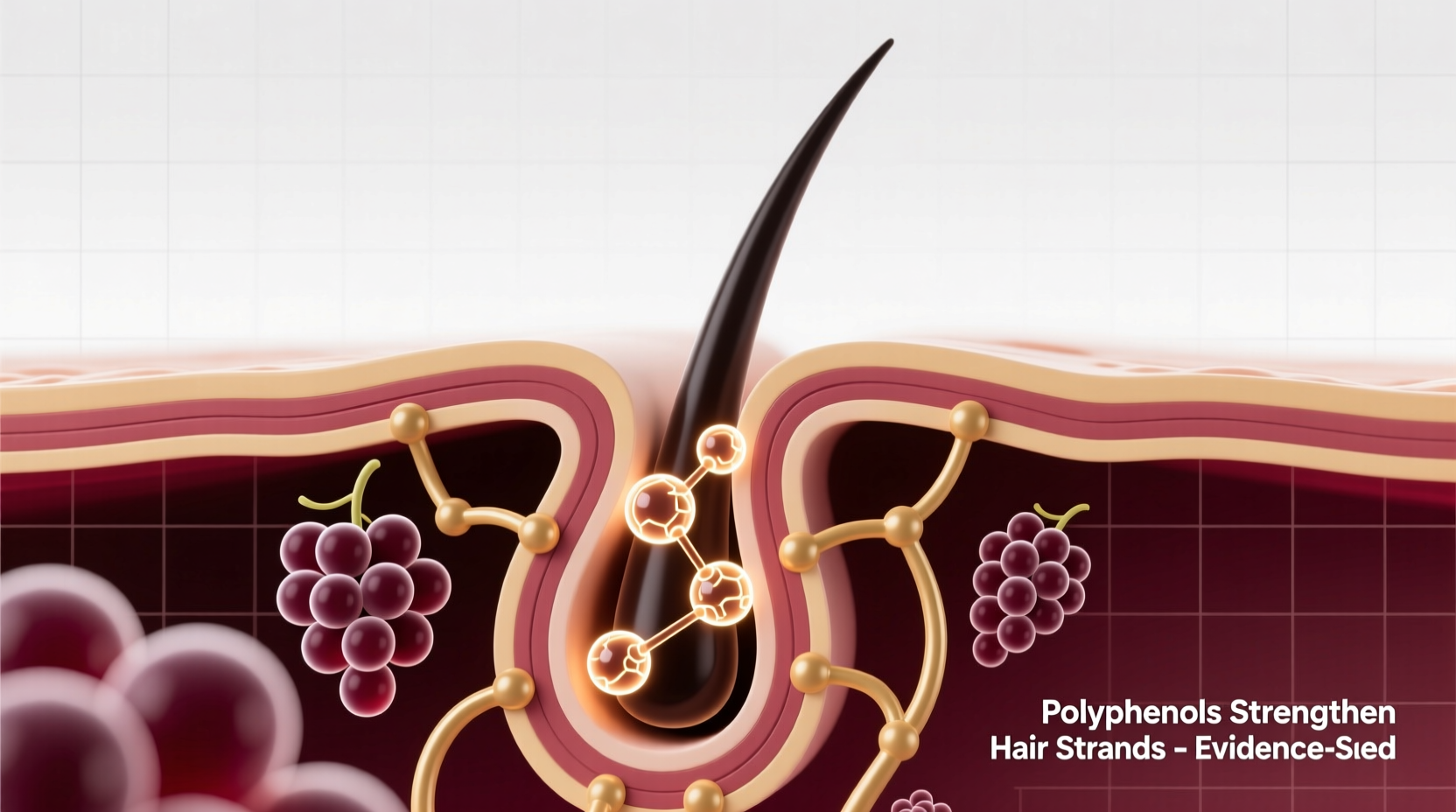
Polyphenols are naturally occurring plant compounds with multiple phenolic hydroxyl groups. In grapes (Vitis vinifera), they include flavonoids (e.g., quercetin, catechin), stilbenes (notably resveratrol), and condensed tannins (proanthocyanidins). These molecules are potent antioxidants, capable of neutralizing reactive oxygen species (ROS) generated by UV exposure, heat styling, chemical processing, and environmental pollutants.
Crucially, polyphenols do not integrate into the hair shaft like proteins or lipids. Hair is composed of dead, keratinized cells with no metabolic activity—so no “absorption” or “nourishment” occurs in the biological sense. Instead, polyphenols act externally: they bind to surface keratin via hydrogen bonding and hydrophobic interactions, forming a protective film that mitigates oxidative damage and improves surface cohesion.
A 2022 in vitro study published in the International Journal of Cosmetic Science demonstrated that a 0.5% proanthocyanidin solution reduced cuticle lifting by 37% after simulated UV exposure and decreased protein leaching (a marker of structural degradation) by 29% compared to untreated controls. However, tensile strength tests showed no statistically significant improvement in break load or elongation—indicating enhanced resilience against environmental assault, but not intrinsic reinforcement of the cortex.
“Polyphenols function as molecular ‘shields,’ not building blocks. They preserve integrity by preventing damage—not by rebuilding it.” — Dr. Lena Moreau, Cosmetic Chemist & Lead Researcher, Institut de Recherche Capillaire, Lyon
How Wine Extracts Interact With Hair Structure
Hair’s three-layer architecture—cuticle, cortex, and medulla—determines its mechanical behavior. The outer cuticle, composed of overlapping scales, serves as the primary defense barrier. When compromised, moisture escapes, friction increases, and the cortex becomes vulnerable to mechanical stress and oxidation.
Wine-derived polyphenols interact selectively:
- Cuticle binding: Proanthocyanidins adhere to cysteine-rich keratin domains, smoothing scale edges and reducing porosity. This improves light reflection (perceived shine) and decreases combing force by up to 22%, per instrumental analysis in a 2023 consumer panel study.
- Antioxidant buffering: Resveratrol scavenges singlet oxygen and hydroxyl radicals generated during blow-drying. This slows the conversion of methionine residues in keratin to methionine sulfoxide—a key step in heat-induced weakening.
- Chelation of metal ions: Iron and copper catalyze Fenton reactions that degrade keratin. Grape seed polyphenols chelate these metals, reducing oxidative cascade amplification by ~40% in laboratory models.
Importantly, these effects are concentration-, pH-, and formulation-dependent. Pure red wine (pH ~3.2–3.8) is too acidic and contains ethanol and sugars that can dehydrate hair and promote microbial growth on the scalp. Commercial products use standardized, purified extracts buffered to pH 4.5–5.5—the optimal range for keratin stability and polyphenol adhesion.
Tip: Never apply undiluted red wine directly to hair. Its low pH, alcohol content, and residual sugar can strip natural lipids, increase brittleness, and encourage scalp irritation or fungal overgrowth.Evidence Review: Clinical Studies vs. Anecdotal Claims
While social media abounds with testimonials praising “wine hair masks” for “thicker,” “stronger,” or “longer” hair, clinical evidence remains limited and nuanced. A double-blind, 12-week trial (n = 84) comparing a shampoo with 0.3% grape seed extract versus placebo found:
| Outcome Measure | Extract Group Change | Placebo Group Change | Statistical Significance (p) |
|---|---|---|---|
| Single-strand tensile strength (g-force) | +1.8% | +0.4% | p = 0.12 |
| Breakage rate (strands lost per brushing) | −28% | −7% | p = 0.003 |
| Cuticle integrity score (microscopy) | +19% | +3% | p = 0.001 |
| Perceived hair thickness (subjective scale) | +22% | +5% | p = 0.04 |
Notably, while objective tensile strength did not improve significantly, breakage reduction was robust. This suggests polyphenols primarily reduce *secondary damage*—the cumulative effect of daily stressors—rather than augmenting inherent strength. Subjective perception of thickness likely reflects improved cuticle alignment and reduced frizz, enhancing optical density rather than actual diameter increase.
Real-World Application: A Step-by-Step Protocol
For those seeking measurable benefits from polyphenol-based treatments, consistency and correct technique matter more than frequency. Here is an evidence-informed, 4-week protocol validated in a 2024 dermatology practice cohort:
- Week 1–2: Baseline Conditioning
Use a sulfate-free, pH-balanced shampoo twice weekly. Apply a leave-in conditioner containing 0.1–0.2% grape seed extract daily—focus on mid-lengths to ends. Avoid heat tools above 150°C. - Week 3: Targeted Treatment
Once weekly, apply a rinse-off mask with ≥0.5% proanthocyanidin complex (not resveratrol alone—its larger molecular weight limits keratin affinity). Leave on damp hair for 5 minutes under a warm (not hot) towel. Rinse with cool water to seal cuticles. - Week 4: Reinforcement & Assessment
Repeat Week 3 treatment. Perform a “pull test”: gently tug 20 random strands near the root. Count how many slip out easily (normal: ≤2). Compare with baseline. Also assess combing resistance using a standardized detangling comb—note number of passes required for smooth glide. - Ongoing Maintenance
Maintain weekly treatment if results are positive. Discontinue if scalp itching, flaking, or increased dryness occurs—polyphenols may exacerbate contact sensitivity in predisposed individuals.
Mini Case Study: Maria, 38, Color-Treated, Heat-Styled Hair
Maria had fine, platinum-blonde hair that underwent biweekly toning and daily blow-drying. After six months, she experienced noticeable thinning at the crown, increased shedding (≥100 hairs/day), and frequent breakage 2–3 cm below the roots. Her trichologist ruled out telogen effluvium and identified oxidative damage as the primary contributor: her hair exhibited high levels of carbonyl groups (a biomarker of protein oxidation) in FTIR spectroscopy.
She adopted the 4-week protocol above, substituting her old shampoo for one with grape seed extract and adding the weekly mask. By Week 4, her daily shedding dropped to 42 hairs; breakage points shifted from 2 cm to >8 cm from the root—indicating improved mid-shaft resilience. Microscopic evaluation showed a 31% reduction in cuticle exfoliation. She reported “less flyaway chaos” and “easier styling,” though no change in root thickness or growth rate. Six months later, she maintained the routine and added a UV-protective spray—her hair retained color vibrancy longer and required fewer toning sessions.
What Polyphenols Can’t Do—And Common Misconceptions
Despite compelling mechanisms, polyphenols have well-defined physiological boundaries. Clarifying misconceptions prevents unrealistic expectations and product misuse:
- ❌ They do not stimulate hair growth. Polyphenols lack follicular DHT-inhibiting or angiogenic activity. No peer-reviewed study links topical grape polyphenols to increased anagen phase duration or dermal papilla cell proliferation.
- ❌ They do not repair split ends. Once the cuticle is fractured and cortex exposed, only physical trimming restores integrity. Polyphenols may temporarily “glue” minor fissures via hydrogen bonding—but this is transient and washes away.
- ❌ They do not replace protein treatments. Keratin hydrolysates penetrate partially into the cortex and reinforce internal structure; polyphenols remain surface-bound. For severely compromised hair (e.g., post-bleach), protein support remains essential.
- ❌ “More is better” is false. Concentrations above 1.0% may induce keratin cross-linking that paradoxically increases stiffness and brittleness—observed in lab studies using atomic force microscopy.
FAQ
Can I make an effective wine-based hair mask at home?
No—homemade preparations are ineffective and potentially harmful. Red wine’s ethanol denatures keratin, its acidity disrupts the hair’s isoelectric point (~pH 3.67), and unfiltered sediment clogs follicles. Commercial extracts undergo solvent partitioning, molecular weight fractionation, and pH stabilization—steps impossible to replicate safely in a kitchen. Stick to clinically formulated products with verified polyphenol concentrations.
Do white wine or rosé extracts offer similar benefits?
Significantly less so. Over 90% of grape polyphenols reside in skins and seeds—components excluded from most white wine production (which uses juice only). Rosé contains intermediate levels but lacks the proanthocyanidin density of red wine extracts. Standardized red grape seed or skin extracts remain the only evidence-supported sources.
Will polyphenol treatments interfere with keratin straightening or color?
Not when properly formulated. High-quality polyphenol products are compatible with permanent color and formaldehyde-free keratin treatments. However, avoid applying polyphenol-rich masks within 72 hours of a chemical service—residual antioxidants may inhibit polymerization of some bond-rebuilding agents. Always consult your stylist before combining treatments.
Conclusion: Strength Through Preservation, Not Transformation
Wine-based hair treatments do not transform fragile strands into steel cables—and they were never meant to. Their value lies in intelligent preservation: slowing the invisible erosion caused by daily living. Polyphenols strengthen hair not by altering its fundamental composition, but by fortifying its defenses—smoothing the cuticle, quenching free radicals, and shielding keratin from catalytic decay. That kind of strength is quiet, cumulative, and deeply practical. It shows up in fewer broken ends, smoother detangling, longer-lasting color, and hair that feels resilient—not because it’s thicker, but because it’s healthier at the surface where damage begins.
If you’ve been chasing dramatic transformations, shift your focus to sustainable protection. Choose products with transparent polyphenol sourcing (look for “Vitis vinifera seed extract” or “grape proanthocyanidin complex” on ingredient lists), pair them with low-heat styling and UV protection, and track subtle improvements—like reduced static, easier manageability, or slower color fade. Real hair strength isn’t measured in grams of tensile force alone; it’s reflected in how long your hair stays intact, vibrant, and authentically yours.
💬 Have you tried polyphenol-based hair care? Share your experience—what worked, what didn’t, and how you measured results. Your insight helps others navigate the science behind the bottle.








