
Bong Joon-ho’s 2019 masterpiece Parasite made history as the first non-English language film to win Best Picture at the Academy Awards. Its sharp social commentary, masterful storytelling, and gripping tension earned global acclaim. Yet, despite its artistic prestige, the film carries an R rating from the Motion Picture Association of America (MPAA). For many viewers, especially parents or educators considering it for younger audiences, this raises a critical question: Why is Parasite rated R? The answer lies not in one single factor but in a combination of thematic depth, violent moments, strong language, and unsettling psychological intensity that together meet the criteria for restricted viewing.
Understanding the MPAA Rating System
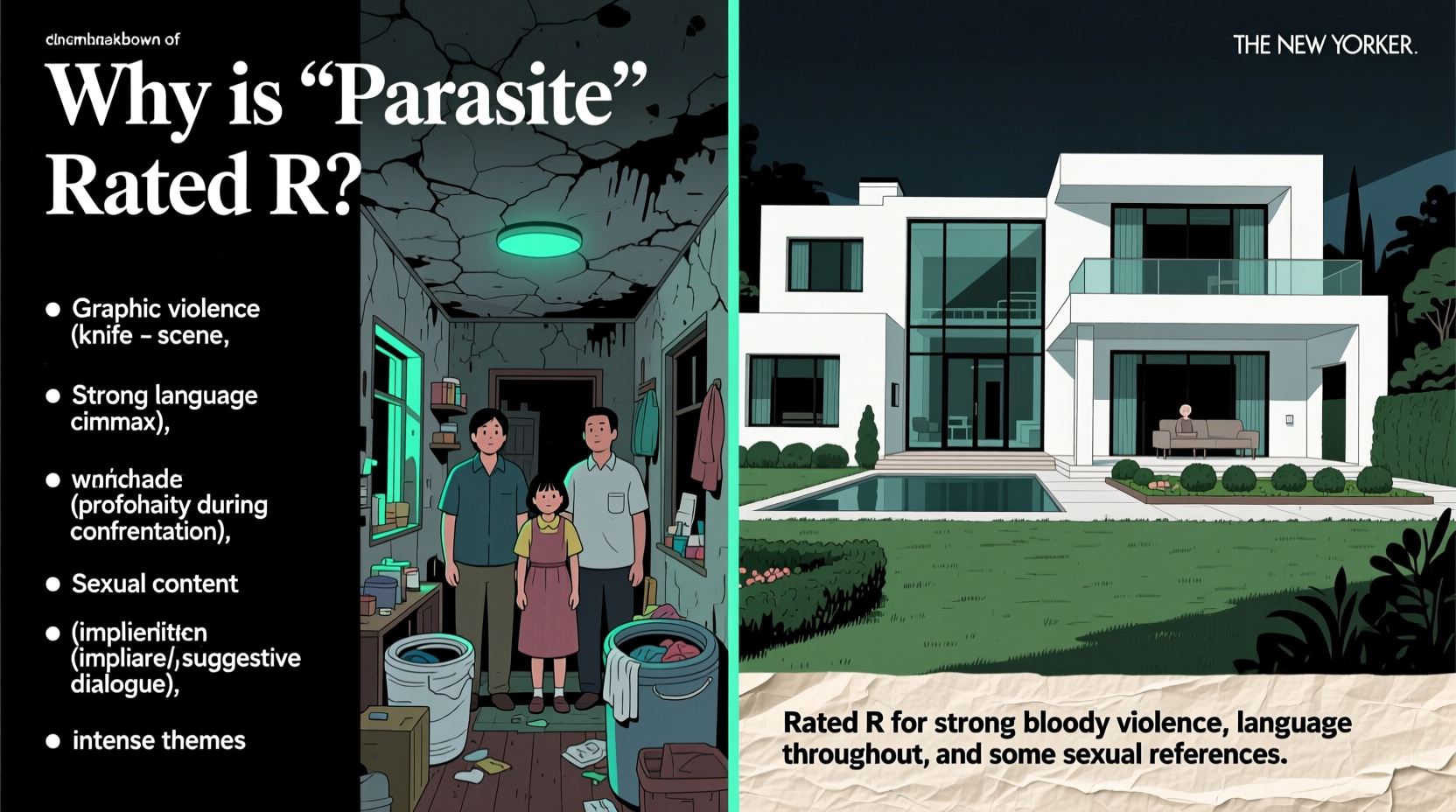
The MPAA assigns movie ratings to guide audiences on content suitability. An “R” rating means “Restricted,” indicating that viewers under 17 require accompanying parent or guardian. According to the MPAA, films receive an R rating for reasons including:
- Strong or pervasive language
- Graphic violence or disturbing imagery
- Sexual content or nudity
- Mature or intense thematic elements
Parasite does not feature explicit nudity or overt sexual scenes, nor does it rely on constant gore. However, its R classification stems from specific, impactful instances of violence, language, and emotional weight that accumulate throughout the narrative. Unlike action films where violence may feel stylized or distant, Parasite presents brutality in a raw, sudden, and psychologically jarring way—making its impact all the more potent.
Key Reasons Behind the R Rating
1. Sudden and Graphic Violence
One of the most cited reasons for the R rating is the film’s abrupt and intense violence. While much of Parasite unfolds with subtle tension and dark humor, it culminates in a shocking sequence during a stormy night. A pivotal moment involves a character being stabbed in the neck with a large kitchen knife—an act depicted without glorification but with visceral realism. Blood sprays across walls and clothing, and the aftermath includes a body collapsing down a staircase.
This scene isn’t prolonged, but its unpredictability and emotional gravity elevate its impact. The MPAA often considers not just frequency but also severity and context. As noted by film critic and MPAA analyst David Ehrlich:
“ Parasite doesn’t linger on violence, but it refuses to look away when it happens. That honesty makes it more disturbing—and more deserving of a mature audience.” — David Ehrlich, IndieWire
2. Strong Language
The film contains multiple uses of strong language, primarily in Korean, but translated equivalents appear in subtitles. The MPAA evaluates both spoken dialogue and implied meaning. In several scenes, characters use profanity during moments of frustration, fear, or confrontation. Though not excessive by modern cinematic standards, the language is impactful due to context—especially when tied to class resentment or personal betrayal.
For example, during a heated argument between two central characters, derogatory terms related to poverty and social status are exchanged. These aren’t casual swears; they carry deep cultural and emotional weight, amplifying their offensiveness and contributing to the film’s mature tone.
3. Thematic Intensity and Psychological Depth
Perhaps the most significant factor behind the R rating is the film’s unflinching exploration of inequality, deception, and moral decay. Parasite delves into systemic class divides, portraying how economic desperation can drive people to manipulation, crime, and self-destruction. The story builds a suffocating atmosphere of anxiety, where trust erodes and survival instincts override ethics.
Younger viewers may struggle to process the film’s layered critique of capitalism and privilege, but the MPAA considers emotional intensity alongside physical content. The sense of dread, betrayal, and helplessness experienced by characters—particularly in the film’s final act—contributes to its designation as unsuitable for general audiences.
Tip: If showing Parasite in an educational setting, provide pre-viewing context about South Korea’s socioeconomic landscape to enhance understanding.Comparative Analysis: How Does It Stack Up?
To better understand the fairness of the R rating, consider how Parasite compares to other similarly rated films. The table below outlines key content elements across three acclaimed R-rated movies:
| Film | Violence | Language | Nudity/Sexual Content | Thematic Maturity |
|---|---|---|---|---|
| Parasite | Intense, sudden physical violence (stabbing, assault) | Moderate profanity (subtitled) | None | High (class conflict, moral ambiguity) |
| Joker (2019) | Pervasive violence, shootings, stabbings | Frequent strong language | Minimal | Very high (mental illness, societal collapse) |
| The Shape of Water | Moderate (interrogation, physical abuse) | Occasional profanity | Yes (non-explicit intimacy) | High (love across boundaries, oppression) |
As shown, Parasite aligns closely with other R-rated dramas in terms of thematic weight and isolated violent incidents. It lacks nudity and has less frequent swearing than many peers, yet its psychological realism and sudden brutality justify the rating.
Real-World Example: A Teacher’s Experience
In 2020, a high school film studies teacher in Portland, Oregon, attempted to screen Parasite for her AP Cinema class. Despite its educational value, several parents objected after their children described the stabbing scene as “traumatizing.” One student, age 16, reported difficulty sleeping for two nights following the viewing.
The incident sparked a discussion among faculty about content warnings and developmental appropriateness. While the teacher believed the film offered vital insights into global cinema and social justice, she later acknowledged that advance preparation—including scene previews and post-film discussion—could have mitigated distress.
This case underscores a broader truth: even films praised for artistry can contain material requiring emotional maturity. The R rating serves not as a condemnation but as a caution.
What Parents and Educators Should Know
If you're considering whether Parasite is appropriate for a teen viewer, here’s a concise checklist to help evaluate readiness:
- Assess emotional maturity: Can the viewer process complex themes like inequality and deception without becoming unduly anxious?
- Preview key scenes: Watch the basement reveal and climax to gauge tolerance for sudden violence.
- Discuss context: Explain South Korea’s housing crisis and class structure to deepen comprehension.
- Monitor reactions: Be prepared to pause and discuss if the content becomes overwhelming.
- Use subtitles: Ensure clear subtitle visibility to avoid missing nuanced dialogue.
Frequently Asked Questions
Does Parasite have nudity?
No, the film contains no nudity or explicit sexual content. There is a brief suggestive scene involving a hidden character during a party, but it does not include exposed skin or intercourse.
Is the violence in Parasite gratuitous?
No. The violence is narrative-driven and thematically relevant, illustrating the consequences of systemic inequality and personal desperation. However, its suddenness and realism make it disturbing for sensitive viewers.
Can I show Parasite in a classroom?
Yes, but with caution. It’s excellent for discussions on global cinema, social class, and filmmaking technique. Provide parental notice, offer an alternative assignment, and facilitate a guided discussion afterward.
Final Thoughts: Respecting the Rating Without Diminishing the Art
The R rating for Parasite is not a flaw—it’s a reflection of the film’s uncompromising vision. Bong Joon-ho never intended his work to be comfortable or easily digestible. He crafted a story that confronts uncomfortable truths through precise, controlled storytelling. The violence shocks because real injustice often does. The language stings because words carry power in moments of crisis.
Recognizing why Parasite earned its R rating allows us to engage with it more thoughtfully. Whether you’re a parent, educator, or film enthusiast, understanding the MPAA’s rationale empowers informed choices. This isn’t a film to be shielded from, but one to be approached with awareness and respect.
💬 Have you seen Parasite? Did you find the R rating justified? Share your thoughts and experiences in the comments to help others navigate this powerful film responsibly.








