Dogs are masters of nonverbal communication, expressing curiosity, concern, excitement, and affection through subtle body language. One of the most endearing and frequently observed behaviors is the head tilt—a slight cocking of the head to one side, often accompanied by wide, attentive eyes and perked ears. While it may seem like a simple gesture of cuteness, this behavior is deeply rooted in canine cognition, auditory processing, and social bonding. Understanding what drives your dog to tilt their head can deepen your connection and improve how you communicate with them.
The head tilt isn’t random. It’s a calculated response shaped by evolution, anatomy, and learned experience. From adjusting ear positioning to interpret sounds more clearly, to reading human facial expressions for emotional cues, dogs use this motion as a functional tool. But it also serves an emotional purpose—many dogs have learned that tilting their head elicits positive reactions from humans, reinforcing the behavior over time.
The Science Behind the Tilt: How Dogs Process Sound
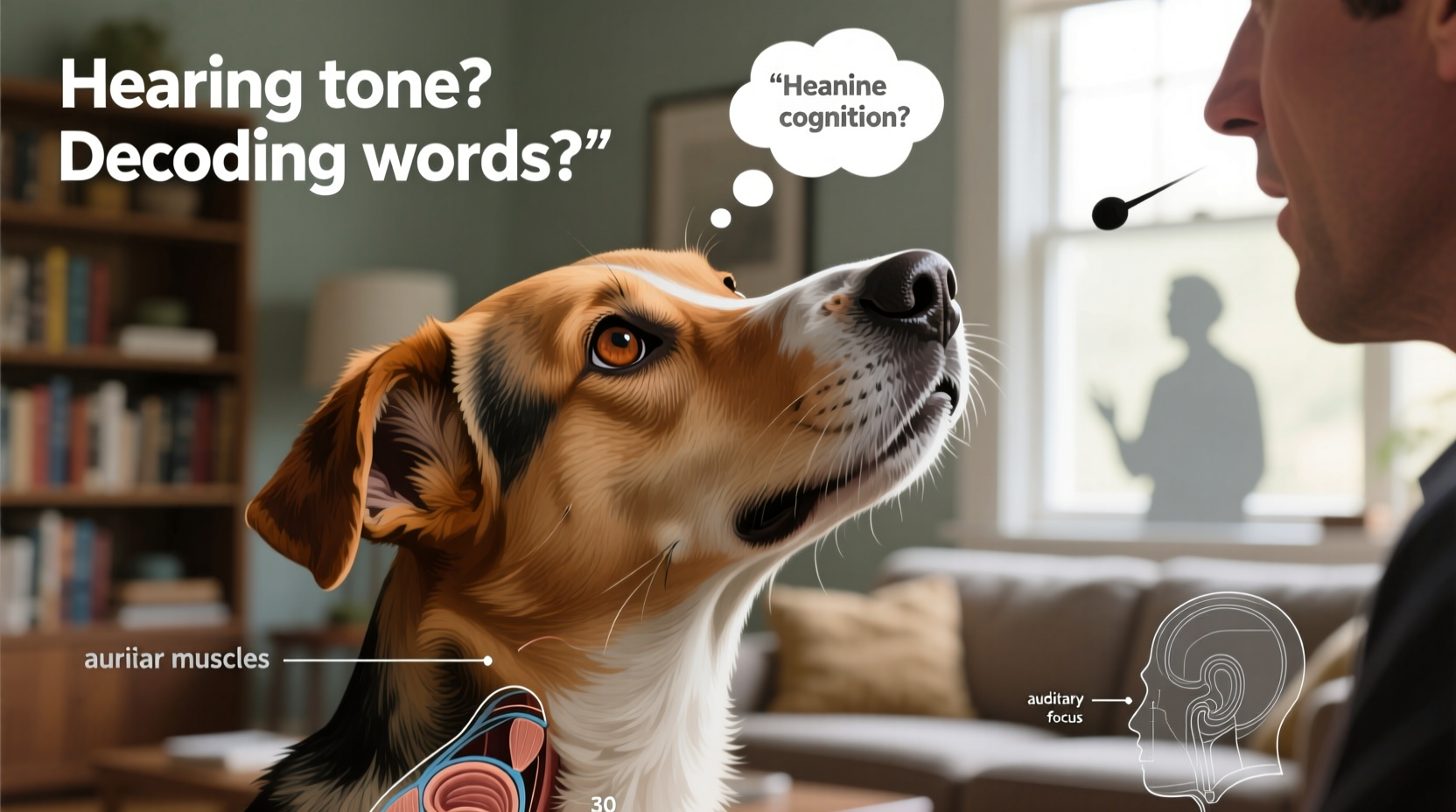
Dogs hear at frequencies far beyond human capability, detecting sounds between 40 Hz and 60,000 Hz (humans hear up to about 20,000 Hz). However, pinpointing the exact source of a sound requires more than just sensitive hearing—it demands spatial analysis. The head tilt plays a crucial role in helping dogs locate where a noise originates.
When a dog hears an unfamiliar or high-pitched sound—such as a squeaky toy, a bird chirping, or even certain vowel sounds in human speech—they often tilt their head to adjust the position of their ears. This small movement changes how sound waves enter each ear canal, allowing the brain to triangulate the direction and distance of the sound more accurately.
Dr. Stanley Coren, a leading expert in canine psychology and author of *How Dogs Think*, explains:
“Dogs use their head movements much like we might turn our head toward a whisper. By tilting, they optimize the timing difference of sound reaching each ear, which helps determine its origin.” — Dr. Stanley Coren, Canine Behavior Researcher
This auditory fine-tuning is especially important for breeds with long, floppy ears (like Basset Hounds or Cocker Spaniels), which can partially block sound. These dogs may tilt more frequently to compensate for reduced acoustic clarity.
Tip: If your dog tilts their head every time you say specific words like “walk” or “treat,” they’re likely associating those sounds with positive outcomes—and using the tilt to confirm what they’re hearing.Visual Alignment: Seeing Beyond the Snout
While sound localization is a key factor, vision also contributes to the head tilt. A dog’s muzzle varies greatly in length and width across breeds. Brachycephalic dogs (short-nosed breeds like Pugs or Bulldogs) have a wider field of forward vision, but dolichocephalic breeds (long-nosed dogs like Collies or Greyhounds) have muzzles that obstruct part of their lower visual field.
When you speak to your dog, especially if you're crouched down or holding treats near your waist, your dog may tilt their head to see your face, lips, or hands more clearly. This adjustment allows them to pick up on visual cues such as lip movements, facial expressions, and hand gestures—all of which help them interpret your intent.
A 2019 study published in *Animal Cognition* found that dogs rely heavily on human facial expressions to guide their behavior. When visual access to the mouth was blocked, dogs were significantly less accurate in following commands. The head tilt, therefore, may be a compensatory strategy to get a better view of critical emotional signals.
How Breed Anatomy Influences Head Tilting Frequency
| Breed Type | Muzzle Length | Typical Head Tilt Frequency | Primary Reason for Tilting |
|---|---|---|---|
| Border Collie | Long | High | Vision obstruction + high trainability |
| Poodle | Moderate | Medium-High | Auditory focus + responsiveness |
| Shih Tzu | Short | Low-Medium | Social reinforcement + mild hearing check |
| Beagle | Moderate | High | Sound localization (floppy ears) |
| Bulldog | Very short | Low | Rarely needed for vision; occasional curiosity |
The data suggests that both physical structure and behavioral predisposition influence how often a dog uses the head tilt. Highly intelligent, attentive breeds tend to tilt more—not necessarily because they don’t understand, but because they’re actively trying to gather more information.
Social Bonding and Learned Behavior
One of the most compelling reasons dogs continue to tilt their heads lies not in biology, but in psychology. Many dogs learn early in life that the head tilt draws positive attention from humans. A slight cock of the head makes them appear curious, innocent, or empathetic—qualities that trigger nurturing responses in people.
When a dog tilts their head and receives praise, laughter, or a treat, the behavior becomes reinforced through operant conditioning. Over time, they may deploy the tilt strategically, especially when they sense uncertainty in tone or context, or when they want something.
Consider this real-life example:
Emma, a Golden Retriever owner in Portland, noticed her dog Max would tilt his head whenever she said, “Are you hungry?”—even if it was only 30 minutes after a meal. Curious, she tested it by saying unrelated phrases like “Let’s go for a drive” or “Time to sleep.” Max didn’t react. But when she used food-related intonation—higher pitch, slower pace—he tilted instantly. Emma realized Max wasn’t responding to the words alone, but to the emotional tone and pattern she used around feeding time. The head tilt had become part of his way of confirming expectations.
This case illustrates how dogs combine auditory cues, memory, and social learning to navigate human environments. The head tilt, in this context, functions as both a sensory adjustment and a communicative signal: “I’m listening, and I think I know what you mean.”
When the Head Tilt Signals Something Else
While the head tilt is usually harmless and even beneficial, persistent or exaggerated tilting—especially when accompanied by other symptoms—can indicate underlying health issues. Owners should be alert to changes in frequency, balance, or coordination.
A constant head tilt, particularly if it leans to one side without returning to neutral, may point to vestibular disease, ear infections, neurological disorders, or even tumors. Other warning signs include:
- Loss of balance or circling
- Nystagmus (involuntary eye movement)
- Discharge or odor from the ears
- Reduced appetite or lethargy
- Whining or pawing at the ears
If your dog suddenly begins tilting their head frequently without an obvious trigger—or if the tilt becomes fixed—it’s essential to consult a veterinarian. Early diagnosis of ear or neurological conditions can prevent long-term complications.
Tip: Regular ear cleaning and check-ups can prevent many causes of abnormal head tilting. Avoid inserting anything into the ear canal—use vet-approved cleaners and cotton balls instead.Step-by-Step: Assessing Your Dog’s Head Tilt Behavior
- Observe the context: Does the tilt happen during conversation, when hearing strange noises, or when you show food?
- Note frequency and duration: Is it occasional or constant? Does it resolve quickly?
- Check for symmetry: Does the head return to center, or does it remain off-balance?
- Monitor related behaviors: Look for signs of discomfort, hearing loss, or disorientation.
- Consult your vet if concerned: Schedule an exam if the tilt is new, persistent, or paired with other symptoms.
Decoding Other Canine Communication Cues
The head tilt doesn’t exist in isolation. It’s part of a broader language system dogs use to interact with humans and other animals. To fully understand your dog’s intentions, consider the full range of body signals accompanying the tilt:
- Ears forward: Alertness and interest.
- Soft eyes, slightly open mouth: Calm curiosity.
- Tail wagging slowly: Friendly engagement.
- One paw lifted: Uncertainty or request for attention.
Conversely, if the head tilt occurs with flattened ears, tense muscles, or avoidance, your dog may feel anxious or confused. In these cases, simplify your language, reduce background noise, and offer reassurance.
Experts emphasize that understanding canine body language goes beyond recognizing isolated gestures. As Dr. Patricia McConnell, animal behaviorist and author, notes:
“Dogs don’t speak in single words. They speak in whole-body sentences. The head tilt might be a punctuation mark, but you need to read the entire paragraph.” — Dr. Patricia McConnell, Ethologist and Dog Behavior Consultant
Canine Communication Checklist
To better interpret your dog’s head tilts and overall communication, follow this practical checklist:
- ✅ Observe the situation: What prompted the tilt?
- ✅ Check ear position and eye expression.
- ✅ Listen to your tone: Are you using high-pitched, friendly language?
- ✅ Reward attentive behavior positively—without encouraging excessive dependency.
- ✅ Rule out medical concerns if tilting becomes habitual or unidirectional.
- ✅ Record videos occasionally to track patterns over time.
- ✅ Consult a veterinary behaviorist if communication seems impaired.
Frequently Asked Questions
Is head tilting a sign of intelligence in dogs?
Not directly. While intelligent breeds may tilt more due to heightened attentiveness and problem-solving tendencies, the behavior itself reflects sensory processing and social learning rather than IQ. However, dogs that frequently engage in active listening—like tilting to understand commands—are often easier to train.
Do all dogs tilt their heads?
No. Individual variation plays a big role. Some dogs rarely or never tilt their heads, either due to breed anatomy, personality, or lack of reinforcement. This doesn’t mean they’re less attentive; they may simply process information differently or have fewer physical barriers to sound or sight.
Should I encourage my dog to tilt their head?
In moderation, yes—if it comes naturally. But avoid training or baiting your dog solely to perform the tilt for entertainment. Prioritize genuine communication over performative gestures. Excessive encouragement could lead to confusion or stress if the dog feels pressured to respond.
Conclusion: Listening Beyond Words
The head tilt is more than a charming quirk—it’s a window into your dog’s mind. Whether they’re fine-tuning their hearing, adjusting their line of sight, or seeking emotional confirmation, this gesture reveals a deep desire to connect and understand. By paying attention to when and why your dog tilts their head, you become a more attuned communicator and a more responsive companion.
Next time your dog cocks their head in that familiar way, pause and reflect: What are they trying to figure out? Are they asking for clarity, comfort, or connection? Respond not just with words, but with presence. That moment of mutual awareness strengthens the bond that makes your relationship truly special.
💬 Have a story about your dog’s head tilt? Share your experiences in the comments—your insights might help fellow dog lovers better understand their own furry communicators!








