Dogs are masters of nonverbal communication, and one of the most common — and sometimes unnerving — behaviors they display is staring intently while their human eats. You sit down to dinner, take a bite, and suddenly feel two unblinking eyes locked onto you. It’s easy to interpret that gaze as judgment or manipulation. But in reality, your dog isn’t trying to make you feel guilty. Their behavior is rooted in biology, social learning, and deep emotional connection. Understanding the real reasons behind the stare can help you appreciate this moment for what it truly is: a sign of trust, attachment, and canine intelligence.
The Evolutionary Roots of Food-Focused Behavior
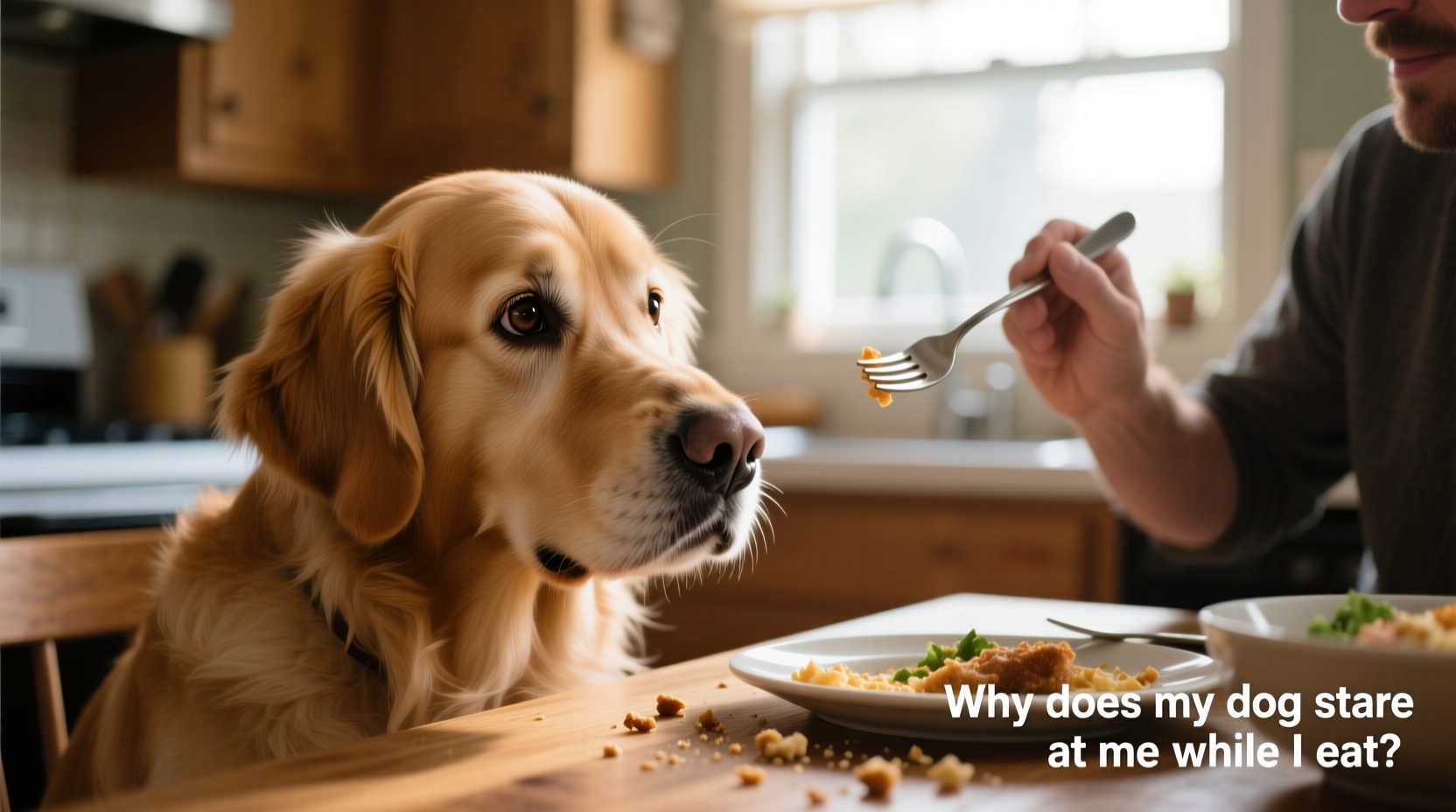
Dogs evolved from wolves, animals that survive through cooperative hunting and shared meals. In a pack, food distribution is hierarchical, and subordinates often watch dominant members closely during feeding. This instinct hasn’t disappeared with domestication. Instead, it has transformed. Your dog sees you as part of their social group — possibly even as a leader — and naturally monitors your eating behavior as a survival mechanism.
Over thousands of years of cohabitation, dogs have developed an extraordinary ability to read human cues. Studies show that dogs outperform even chimpanzees in following human gestures like pointing or eye direction. When you begin eating, your dog picks up on subtle signals: the rustle of packaging, the clink of cutlery, or the shift in your attention. These trigger anticipation, not because they’re greedy, but because they’ve learned — through experience — that food-related activity might lead to opportunity.
“Dogs have evolved to be hypersensitive to human behavior, especially around resources like food. That stare isn’t manipulation — it’s attentiveness.” — Dr. Brian Hare, Canine Cognition Researcher, Duke University
What Your Dog Is Actually Thinking
The stare isn’t just about food. It’s layered with meaning:
- Anticipation: Your dog associates your mealtime with potential scraps, dropped morsels, or handouts. Even if you never feed them from the table, past experiences may have conditioned them to hope.
- Attention-seeking: Staring is an effective way to get noticed. Dogs quickly learn that persistent eye contact increases the chance of interaction — whether verbal, physical, or nutritional.
- Bonding: Mutual gaze between dogs and humans releases oxytocin, the “love hormone,” in both species. A 2015 study published in *Science* found that prolonged eye contact between owners and dogs significantly increased oxytocin levels, mirroring parent-infant bonding in humans.
- Curiosity: The smell, texture, and movement of food are fascinating. Your dog is observing how you interact with your meal — chewing, using utensils, making sounds — all of which are foreign yet intriguing behaviors.
Is It Begging? Or Something Deeper?
While the behavior resembles begging, it’s often more nuanced. True begging involves active attempts to solicit food — pawing, whining, nudging. Passive staring, by contrast, may simply reflect engagement. Many dogs don’t expect to receive food; they just want to be involved.
In multi-dog households, differences in behavior become apparent. Some dogs immediately lie down when their owner eats, having learned no rewards come from staring. Others remain fixated, not out of greed, but because they’ve been inconsistently rewarded in the past. This inconsistency — sometimes getting a scrap, sometimes being scolded — strengthens the behavior through intermittent reinforcement, a powerful psychological principle.
Do’s and Don’ts of Responding to the Stare
| Do | Avoid |
|---|---|
| Maintain calm, consistent boundaries | Yelling or punishing your dog for staring |
| Redirect attention with a chew toy or bone | Giving food only when stared at (reinforces begging) |
| Use mealtime to reinforce training (e.g., “stay” or “go to mat”) | Feeding table scraps irregularly |
| Engage in brief positive eye contact before eating to acknowledge your dog | Ignoring your dog entirely, which may increase anxiety |
A Real-Life Example: How One Owner Transformed Mealtime
Sarah, a dog owner from Portland, used to feel guilty every time her rescue terrier mix, Milo, stared at her during dinner. She assumed he was hungry or felt excluded. After consulting a canine behaviorist, she realized Milo wasn’t distressed — he just wanted to participate. Instead of shooing him away, Sarah began placing a frozen Kong filled with peanut butter and kibble in his bed before she sat down to eat. Within a week, Milo stopped staring and happily occupied himself.
“I thought I was being kind by occasionally giving him bites,” Sarah said. “But it just made him more persistent. Now that he has his own ‘mealtime ritual,’ we both relax.”
This case illustrates a key principle: dogs thrive on predictability. When expectations are clear and needs are met proactively, behaviors like obsessive staring diminish naturally.
Training Strategies to Reduce Unwanted Staring
You don’t need to eliminate the stare entirely — it’s a natural part of dog-human interaction. But if it becomes intrusive or leads to begging, structured training can help. Here’s a step-by-step approach:
- Establish a pre-meal routine: Before you eat, give your dog a high-value chew, stuffed toy, or treat-dispensing puzzle. This creates a positive association with your mealtime.
- Teach a “place” command: Train your dog to go to a specific mat or bed and stay there during meals. Use treats to reinforce compliance.
- Practice ignoring unwanted behavior: If your dog stares or approaches, avoid eye contact and do not speak. Only reward them when they disengage and return to their spot.
- Reinforce alternative behaviors: Reward your dog for lying down quietly nearby, even if they’re still watching. Gradually increase the duration of calm behavior required for a reward.
- Be consistent across all family members: Mixed signals — one person feeding scraps, another scolding — will undermine progress.
When Staring Might Signal a Problem
In most cases, staring is harmless. However, it can occasionally indicate underlying issues:
- Anxiety: If your dog paces, drools, or whines while staring, they may be stressed about missing out or fear resource loss.
- Medical conditions: Sudden changes in behavior, including excessive fixation on food or people, could signal vision problems, cognitive decline (especially in older dogs), or hormonal imbalances.
- Resource guarding tendencies: While rare, some dogs may stare as a precursor to guarding behavior, especially if they’ve had unstable food access in the past.
If the stare is accompanied by rigidity, growling, or refusal to move when called, consult a certified veterinary behaviorist. Otherwise, occasional gazing is typically benign — even beneficial.
Checklist: Healthy Mealtime Habits for You and Your Dog
- ✅ Provide your dog with a safe, engaging activity during your meals
- ✅ Avoid reinforcing staring by inconsistently giving food
- ✅ Acknowledge your dog briefly before eating to reduce attention-seeking
- ✅ Train a reliable “place” or “down-stay” command for mealtime
- ✅ Feed your dog before or during your meal to reduce food-related excitement
- ✅ Watch for signs of anxiety or medical issues if behavior changes suddenly
Frequently Asked Questions
Does my dog think I’m sharing food by looking at him?
Not exactly. Dogs don’t have a human concept of sharing, but they do associate eye contact with interaction. If you’ve ever given them a bite after locking eyes, they’ve learned that staring can lead to rewards. It’s not entitlement — it’s learned cause-and-effect.
Should I let my dog watch me eat?
Yes, as long as boundaries are clear. Complete exclusion can create frustration or anxiety. Instead, allow observation from a designated spot, such as a mat across the room. This includes your dog in the moment without encouraging intrusion.
Is it bad to make eye contact with my dog during meals?
No — in fact, brief, calm eye contact can strengthen your bond. Just avoid doing so right before giving food, as this may teach them that staring = reward. A quick “I see you” glance followed by redirection is ideal.
Conclusion: Embrace the Gaze Without Guilt
Your dog’s stare isn’t a silent accusation. It’s a complex blend of affection, curiosity, and evolutionary instinct. Far from being manipulative, this behavior reflects your dog’s deep attunement to your actions and emotions. They aren’t calculating how to exploit you — they’re simply tuned in, present, and invested in your shared life.
Instead of feeling guilty or annoyed, consider reframing the moment. That steady gaze is a testament to the unique bond you’ve built. With gentle guidance and consistency, you can maintain harmony at mealtimes while honoring your dog’s natural instincts. The goal isn’t to stop the stare, but to understand it — and respond with patience, clarity, and love.
💬 Have a story about your dog’s mealtime habits? Share your experience in the comments and help others navigate this everyday moment with confidence and compassion.








