Dogs are deeply attuned to sound. From the rustle of a treat bag to the tone of their owner’s voice, canines process auditory cues with remarkable sensitivity. So when you sit down at the piano and strike a chord, it’s not unusual for your dog to respond—sometimes with a sudden, soulful howl. While this behavior might seem quirky or even disruptive, it's rooted in biology, evolution, and neurology. Understanding why your dog howls when you play piano isn’t just about curiosity—it offers insight into your pet’s perception of the world and emotional state.
This phenomenon spans multiple scientific domains: canine auditory processing, evolutionary behavior, emotional contagion, and even music cognition. By examining these angles, we can move beyond anecdote and explore what researchers and animal behaviorists have uncovered about this fascinating interaction between music and man’s best friend.
The Canine Auditory System: Tuned to High Frequencies
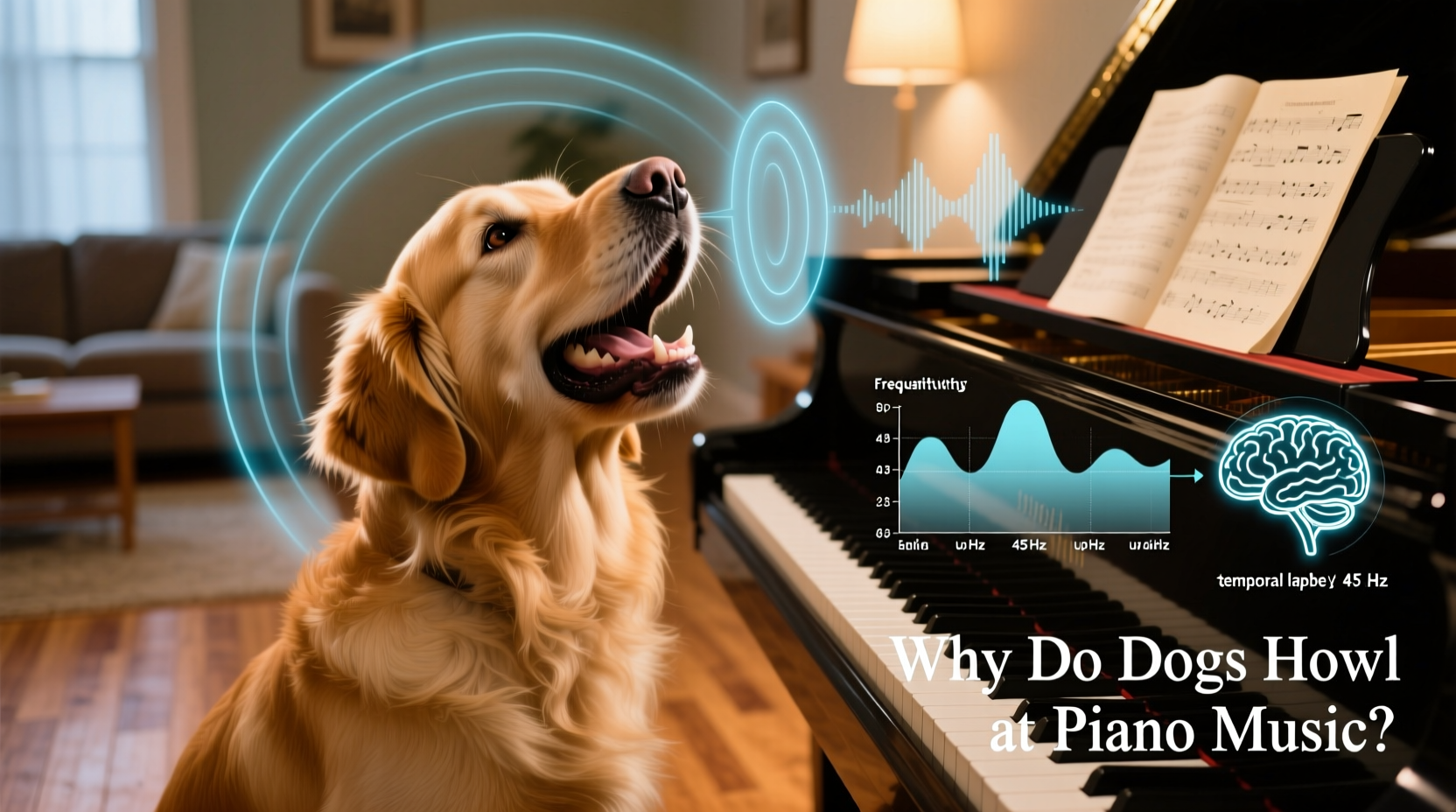
Dogs hear differently than humans. Their hearing range extends from about 40 Hz to 60,000 Hz, compared to the human range of 20 Hz to 20,000 Hz. This means dogs can detect higher-pitched sounds that are completely inaudible to us—especially those produced by upper-register piano keys.
When you play certain notes, particularly sustained high tones or dissonant chords, your dog may perceive them as piercing or even alarming. These frequencies can resemble distress calls or warning signals in the wild. For example, the cry of a hurt animal often contains sharp, high-frequency components—similar to some piano overtones. Your dog’s howl could be an instinctive response to what they interpret as a call for help.
Moreover, dogs use vocalizations like howling to communicate across distances. In the wild, wolves howl to regroup scattered pack members. A piano note with long sustain or reverb may mimic the acoustic properties of a distant howl, prompting your dog to “respond” in kind.
Tip: If your dog consistently howls at specific notes, try playing lower-register chords or shorter staccato phrases—they may find these less stimulating.Evolutionary Roots: The Wolf Connection
Dogs inherited many behaviors from their wolf ancestors, including vocal communication. Howling is a group-oriented behavior used to maintain social cohesion. When one wolf howls, others often join in—a phenomenon known as chorus howling. This behavior strengthens bonds and reinforces pack identity.
Domestic dogs still exhibit this tendency. Playing piano, especially melodic or sustained passages, may trigger a similar impulse. The music acts as an auditory stimulus that mimics a pack member’s call. Your dog doesn’t distinguish between a fellow canine’s howl and a resonant piano chord—they may simply be responding to what feels like a social cue.
Dr. Patricia McConnell, a renowned animal behaviorist, explains:
“Dogs are incredibly responsive to tonal patterns. Music with a clear pitch contour can sound like another animal calling. To a dog, joining in isn't misbehavior—it's participation in what they perceive as a conversation.” — Dr. Patricia McConnell, Ethologist and Canine Behavior Expert
This theory is supported by observational studies in which dogs exposed to recordings of howls were significantly more likely to howl themselves—especially if the howl had a rising pitch, much like a minor arpeggio on the piano.
Emotional Contagion and Empathy in Dogs
Recent research suggests dogs are capable of emotional contagion—the ability to \"catch\" emotions from others. This includes responding to human emotional expressions through voice, facial cues, and body language. When you play piano, especially expressively, your dog may pick up on subtle shifts in your mood.
A melancholic piece played in a minor key may evoke sadness in listeners—including dogs. Studies have shown that dogs exhibit stress-related behaviors (like whining or tail tucking) when exposed to dissonant or slow-tempo music. Conversely, they relax more quickly when listening to consonant, moderate-tempo classical pieces.
In this context, howling may be a form of empathetic response. Your dog senses something somber or intense in the music and expresses solidarity. It’s not mimicry; it’s emotional resonance. Think of it as your dog saying, “I feel that too.”
A 2017 study published in *Animal Cognition* found that dogs exposed to emotionally charged music (both happy and sad) showed measurable changes in heart rate and behavioral indicators. Those hearing minor-key compositions were more likely to vocalize, suggesting a link between musical mode and canine emotional expression.
Acoustic Triggers and Sensory Overload
Not all piano music elicits howling. The specific characteristics of the sound matter. Three primary acoustic features appear to trigger responses:
- Pitch: High, sustained notes are most likely to provoke howling.
- Volume: Loud dynamics (forte or fortissimo) can startle or excite dogs.
- Timbre: Bright, resonant tones—especially with pedal use—create lingering sound waves that mimic natural howls.
Some dogs are more sensitive than others. Breeds with strong vocal traditions—such as Siberian Huskies, Alaskan Malamutes, and Beagles—are far more prone to howling in response to music. This isn’t coincidental. These breeds were historically selected for vocal communication in harsh environments, making them naturally predisposed to respond to tonal stimuli.
On the other hand, dogs with lower auditory sensitivity or those raised in quiet environments may show little to no reaction. Individual temperament also plays a role: anxious dogs may howl out of stress, while confident ones may do so playfully or socially.
| Acoustic Feature | Effect on Dogs | Example on Piano |
|---|---|---|
| High Pitch (above 3,000 Hz) | Likely to trigger howling or alertness | C7 and above, harmonic overtones |
| Sustained Notes (with pedal) | Mimics natural howl duration | Legato phrases in Chopin nocturnes |
| Dissonant Chords | May cause anxiety or vocal protest | Minor 2nds, tritones, cluster chords |
| Repetitive Melodic Patterns | Can induce entrainment or vocal imitation | Ostinatos in minimalist music |
Mini Case Study: Bella the Border Collie and the Evening Sonata
Sarah, a music teacher in Vermont, noticed that her Border Collie, Bella, began howling every evening around 7 p.m.—coinciding with her piano practice. At first, she assumed Bella was distressed. But after observing the behavior for weeks, she realized Bella only howled during slow, lyrical pieces in minor keys. Upbeat sonatinas or jazz improvisations elicited no response.
Sarah consulted a veterinary behaviorist, who suggested recording Bella’s reactions. Video analysis revealed that Bella would tilt her head, then pace slightly before launching into a sustained howl—always after the first phrase of a Chopin prelude. Notably, she never howled at recorded music, only live performance.
The conclusion? Bella wasn’t distressed. She was engaging socially. The live acoustic nuances—the breath between phrases, the slight variations in timing—were absent in recordings. To Bella, Sarah’s playing was a real-time interaction, and her howl was a form of duet.
After adjusting her routine to include more upbeat pieces in the evening, Sarah found Bella’s howling decreased significantly—except during special performances, when Bella would still join in, almost ceremonially.
Practical Guide: Managing and Understanding Musical Howling
If your dog howls when you play piano, consider these steps to understand and manage the behavior:
- Observe the pattern: Does it happen with specific keys, volumes, or pieces? Keep a log for a week.
- Test different genres: Try playing major-key melodies, staccato passages, or electronic music to see if the response changes.
- Check body language: Is your dog tense, ears back, and tail low? Or relaxed, wagging, and approaching the piano? The latter suggests positive engagement.
- Limit exposure if needed: If howling indicates stress, reduce volume or practice in a separate room.
- Encourage alternative responses: Reward calm behavior during practice with treats or praise.
FAQ: Common Questions About Dogs and Piano Music
Is it bad if my dog howls when I play piano?
Not necessarily. Occasional howling in response to music is normal and often harmless. However, if your dog appears anxious—panting, pacing, hiding—it may indicate discomfort. In such cases, adjust your playing or give your dog space.
Can dogs recognize specific songs?
Yes. Dogs can learn to associate certain melodies with events (e.g., bedtime music). Some even react differently to composers—showing excitement at upbeat Bach but calm during Debussy. Their memory for sound patterns is stronger than many realize.
Should I stop playing piano if my dog howls?
No need to stop entirely. Instead, experiment with dynamics and repertoire. You might discover that your dog enjoys certain pieces and tolerates others. Turning it into a shared experience—within reason—can strengthen your bond.
Checklist: Assessing Your Dog’s Reaction to Piano Music
- ✅ Observe frequency and timing of howling
- ✅ Note which notes, keys, or pieces trigger the response
- ✅ Monitor body language: relaxed vs. stressed
- ✅ Test playback vs. live performance
- ✅ Try lowering volume or using a rug to dampen resonance
- ✅ Introduce calming background sounds if needed
- ✅ Consult a vet or behaviorist if howling is excessive or linked to anxiety
Conclusion: Harmony Between Species
Your dog’s howl during a piano piece isn’t random noise—it’s a complex response shaped by evolution, hearing, and emotion. Whether they’re echoing ancestral instincts, expressing empathy, or simply reacting to a high-pitched tone, their vocalization is a window into their inner world. Rather than suppress it outright, consider exploring it with curiosity.
Adjust your playing, observe your dog’s cues, and perhaps even embrace the occasional duet. After all, music has always been a communal act. If your dog wants to join the ensemble, maybe they’re not off-key—they’re just singing from a different score.
💬 Have a story about your dog and music? Share your experience below. Your insights could help other pet owners understand this beautiful, baffling behavior.








