It starts subtly—a flicker of holiday string lights, the shimmer of sunlight on glass, or the rhythmic pulse of a security sensor. Then, your dog freezes, ears pricked, eyes locked on the source. A low growl rises, followed by sharp, insistent barking. You turn off the lamp, pull the curtain, or unplug the garland—but the reaction returns each time the light dances again. This isn’t “just being dramatic.” It’s a neurologically grounded response rooted in canine vision, evolutionary wiring, and individual temperament. Understanding *why* your dog reacts—and what actually works to ease it—is the first step toward restoring calm, not just for your household, but for your dog’s nervous system.
The Science Behind the Spark: Why Twinkling Lights Trigger Barking
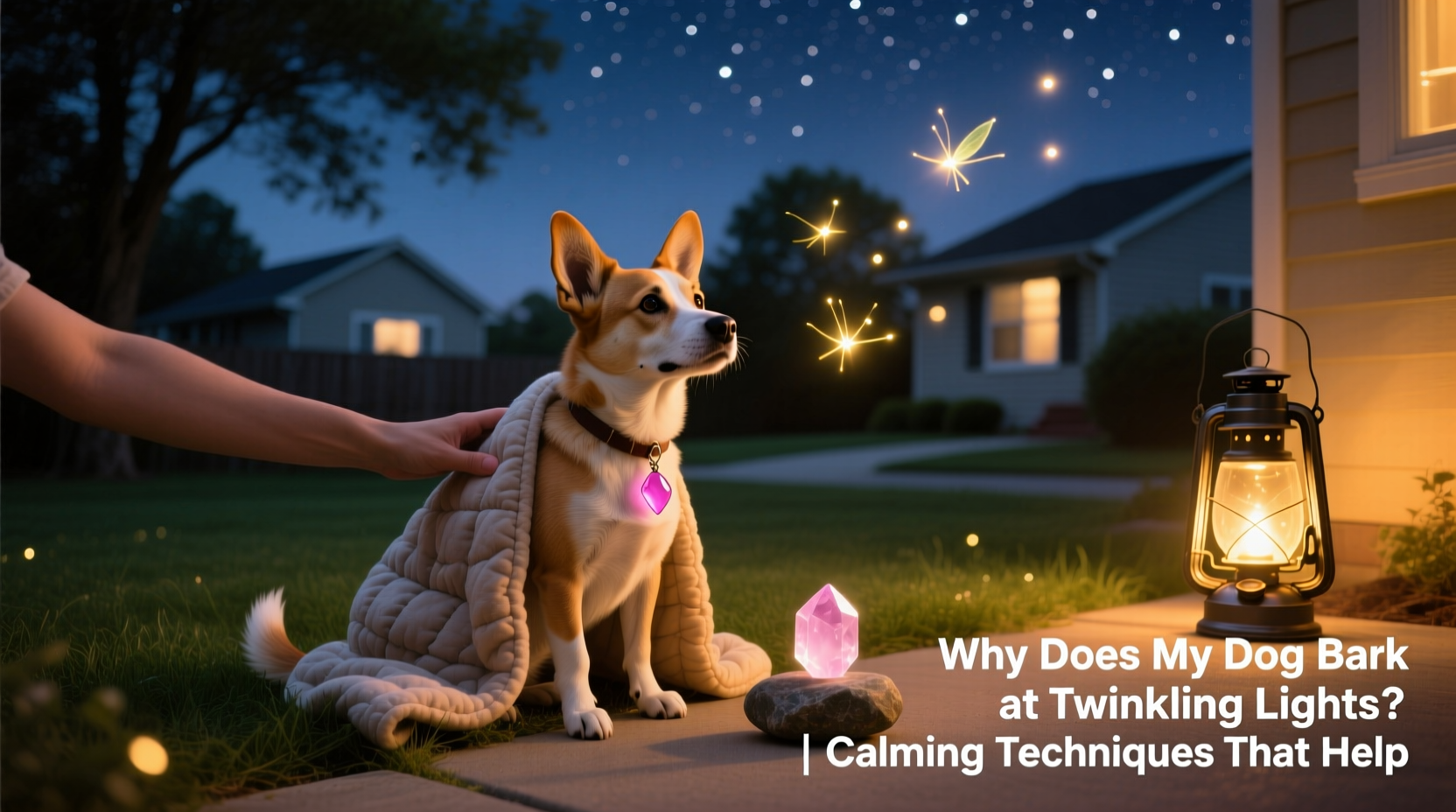
Dogs perceive light differently than humans. Their retinas contain a higher density of rod photoreceptors—cells specialized for detecting motion and low-light contrast. This gives them superior night vision but also makes them acutely sensitive to rapid changes in luminance. Twinkling lights—whether from LED holiday strings, reflective ornaments, or even the strobing effect of ceiling fans catching sunlight—create high-frequency visual stimulation that registers as erratic, unpredictable movement. To a dog’s brain, this can mimic the darting motion of small prey, the flash of a predator’s eyes, or simply an unresolved environmental anomaly demanding attention.
Compounding this is the tapetum lucidum—a reflective layer behind the retina that amplifies available light. While beneficial for nocturnal vision, it also intensifies glare and causes light sources to appear brighter and more fragmented. When combined with a dog’s naturally heightened startle reflex (a survival trait inherited from wild ancestors), even benign twinkles can activate the sympathetic nervous system—triggering vigilance, arousal, and ultimately, barking as both an alert and a coping mechanism.
Not all dogs react the same way. Puppies and young adults may bark out of curiosity or play drive. Older dogs with declining vision may misinterpret flickering as phantom movement. Dogs with noise sensitivity, generalized anxiety, or prior negative associations (e.g., a firework explosion coinciding with outdoor lights) are significantly more likely to develop a conditioned fear response. Importantly, this behavior is rarely about “dominance” or “attention-seeking”—it’s a genuine sensory experience that feels urgent and threatening to them.
What Doesn’t Work (And Why)
Before turning to solutions, it’s critical to recognize common interventions that worsen the problem—not because they’re ill-intentioned, but because they ignore canine neurobiology and learning principles.
| Common Response | Why It Backfires | Neurological Impact |
|---|---|---|
| Yelling “No!” or punishing the barking | Increases arousal and pairs the light stimulus with fear or confusion | Strengthens amygdala-driven threat response; deepens negative association |
| Forcing proximity (“Look, it’s fine!”) | Triggers learned helplessness or defensive aggression | Overwhelms the prefrontal cortex’s ability to regulate emotion; escalates fight-or-flight |
| Ignoring completely without addressing root cause | Allows chronic stress to accumulate; may lead to redirected aggression or compulsive behaviors | Elevates baseline cortisol; weakens hippocampal regulation of fear memory |
| Using citronella collars or shock devices | Associates pain with the light itself—not the barking—causing generalized anxiety | Activates pain pathways that override safety signals; impairs trust in environment |
These approaches treat the symptom (barking) while ignoring the underlying sensory and emotional drivers. Effective intervention begins not with suppression, but with recalibration—of the environment, the dog’s nervous system, and your shared communication.
Calming Techniques That Are Evidence-Informed
Successful strategies fall into three tiers: immediate de-escalation, short-term desensitization, and long-term nervous system resilience. Each builds on the last—and none rely on force or fear.
Tip: Never begin desensitization when your dog is already barking. Wait until they’re fully relaxed—even if that means waiting 20 minutes after the last trigger—to reset their neurological baseline.Immediate Calming Protocol (First 60 Seconds)
When barking begins, your priority is lowering physiological arousal—not stopping sound. Follow this sequence:
- Pause and breathe: Take two slow, audible breaths yourself. Your calm is contagious via autonomic resonance.
- Block the visual trigger: Gently guide your dog behind a solid barrier (a closed door, a blanket-draped crate, or even your own body) — not as punishment, but to remove input.
- Offer tactile grounding: Apply gentle, sustained pressure along the spine or shoulders—not petting, which can heighten arousal. Think firm, slow strokes mimicking maternal contact.
- Introduce a low-sensory cue: Whisper a known cue like “settle” or offer a single lick of plain pumpkin puree (no spices). Taste engages the parasympathetic nervous system faster than verbal commands.
Gradual Desensitization & Counterconditioning (Weeks 1–6)
This evidence-based method rewires the dog’s emotional response by pairing the trigger with something deeply positive—*at a sub-threshold intensity*. Start so faintly that your dog notices the light but shows zero tension (no stiffening, no hard stare, no vocalization).
“Desensitization fails when owners jump ahead too quickly. The goal isn’t ‘exposure’—it’s creating a new neural pathway where the light predicts safety, not threat. That requires precision, not persistence.” — Dr. Sarah Lin, Veterinary Behaviorist and author of Sensory-Smart Canine Care
Use this progression over multiple short sessions (3–5 minutes, 2x daily):
- Stage 1: Light source off-camera (e.g., twinkling string lights placed across the room, behind a frosted glass panel).
- Stage 2: Introduce the light for 2 seconds, then immediately give a high-value treat (boiled chicken, tripe, or commercial freeze-dried liver). Repeat 5x/session.
- Stage 3: Extend duration to 5 seconds, then treat. If your dog looks away or blinks softly, that’s success—reward it.
- Stage 4: Add gentle movement: slowly sway the light source side-to-side while maintaining distance.
- Stage 5: Reduce distance by 6 inches only after 3 consecutive sessions with zero stress signals.
Never advance if your dog exhibits whale eye, lip licking, yawning (not sleep-related), or tail tucking. Regress one stage and rebuild.
Real-Life Application: Maya’s Story with Her Rescue Terrier Mix
Maya adopted 3-year-old Finn from a rural shelter. He’d never seen indoor holiday lights—and during his first December, he barked relentlessly at her kitchen’s under-cabinet LED strip, which pulsed gently with motion activation. She tried covering the lights, scolding, and even moving his bed—but Finn’s anxiety escalated. Within weeks, he began trembling at reflections in windows and avoiding the entire kitchen.
Working with a certified behavior consultant, Maya implemented a modified desensitization plan. She started by placing a single battery-operated tea light (with a soft, warm glow—not twinkling) inside a closed cardboard box with a small viewing slit. For five days, she’d open the slit just wide enough for Finn to see the light for one second, then toss him a piece of smoked salmon. By day 12, he’d voluntarily approach the box and rest his chin on it while the light glowed. Only then did she introduce a low-intensity, non-flickering LED string—still enclosed—and gradually increase exposure over four weeks.
Critical to her success was consistency and environmental control: she used blackout curtains during evening walks to reduce overstimulation, added white noise during peak light hours, and taught Finn a “look away” cue using positive reinforcement. After ten weeks, Finn ignored the kitchen lights entirely—and even chose to nap beneath them. His transformation wasn’t about obedience. It was about reclaimed safety.
Supportive Strategies for Long-Term Resilience
Calming techniques work best when embedded within a holistic framework that supports nervous system health. These aren’t add-ons—they’re foundational.
Environmental Adjustments
- Minimize unpredictable light sources: Replace flickering LEDs with steady-output bulbs (look for “flicker-free” on packaging); use lampshades to diffuse glare; avoid mirrored surfaces near high-traffic zones.
- Create low-stimulus sanctuaries: Designate one quiet room with dimmable lighting, sound-absorbing rugs, and a covered crate or cave bed. Keep it consistently accessible—not just during triggers.
- Control ambient light cycles: Use timers for outdoor lights to prevent sudden activation at dusk; draw blinds before sunset if twilight shimmer triggers reactions.
Nutritional & Physiological Support
Chronic visual sensitivity often coexists with subtle nutrient deficits affecting neural regulation. Consult your veterinarian before supplementing, but consider:
- L-Theanine: An amino acid shown in canine studies to support alpha-wave brain activity (associated with calm focus) without sedation.
- Omega-3 DHA: Critical for retinal cell membrane integrity and reducing neuroinflammation linked to sensory hypersensitivity.
- Consistent meal timing: Irregular feeding elevates cortisol and lowers stress tolerance. Feed twice daily at fixed times—even on weekends.
Behavioral Anchors
Teach your dog reliable “calm on cue” behaviors that serve as neurological anchors:
- “Touch”: Train your dog to gently nose your palm. Use it to redirect attention *before* the light captures focus.
- “Settle”: Reward stillness on a mat with increasing duration—even during mild light exposure.
- “Find it”: Scatter high-value treats on the floor when lights are present. Engages the olfactory system (which directly calms the amygdala) and shifts attentional focus.
FAQ: Addressing Common Concerns
Could this be a sign of vision problems?
Yes—especially in senior dogs or breeds prone to progressive retinal atrophy (PRA) or cataracts. What appears as “barking at lights” may actually be your dog reacting to visual distortions: halos, glare, or floating phantoms. Schedule a veterinary ophthalmology exam if barking coincides with bumping into objects, reluctance on stairs, or cloudy pupils. Early intervention can preserve functional vision.
Will my dog ever stop reacting completely?
Most dogs show significant improvement within 4–12 weeks of consistent, science-based intervention. Complete cessation isn’t always necessary—or realistic. The goal is functional calm: your dog notices the light, pauses, looks at you for guidance, and resumes relaxing. That shift reflects profound neurological growth—not suppression.
Can I use CBD oil to help?
Current peer-reviewed research in dogs is limited and inconclusive. While some anecdotal reports exist, quality control, dosing accuracy, and long-term safety data are lacking. Veterinarians caution against replacing evidence-based behavioral work with unregulated supplements. If considering CBD, choose third-party tested, THC-free products—and only under direct veterinary supervision alongside behavioral protocols.
Conclusion: Reclaiming Calm, One Flicker at a Time
Your dog’s barking at twinkling lights isn’t defiance. It’s data—a signal that their sensory world feels unstable, overwhelming, or unsafe. Responding with patience, precision, and compassion doesn’t indulge “bad behavior.” It honors their biology, respects their experience, and actively participates in reshaping their relationship with uncertainty. Every time you pause before reacting, every time you lower the light intensity before advancing, every time you reward a soft blink instead of demanding silence—you’re strengthening neural pathways of safety. You’re teaching your dog, in the language their nervous system understands, that the world can shimmer without threat.
This work asks for consistency, not perfection. Some days will feel like two steps forward, one step back—and that’s part of the process. What matters is showing up with clarity, kindness, and the willingness to see beyond the bark to the being beneath it.
💬 Your experience matters. Have you helped your dog overcome light sensitivity? Share one technique that worked—or one question you’re still exploring—in the comments below. Your insight could be the exact lifeline another pet parent needs.








