Dogs don’t bark at blinking lights because they’re “being dramatic.” They bark because something in that flicker triggers a primal neurological response—whether it’s visual sensitivity, perceived movement, associative fear, or an underlying medical condition. What looks like a simple behavioral quirk can signal deeper sensory processing differences, stress accumulation, or even neurological vulnerability. Recognizing this distinction is the first step toward compassionate, effective intervention—not suppression.
The Science Behind the Blink: Why It Triggers Barking
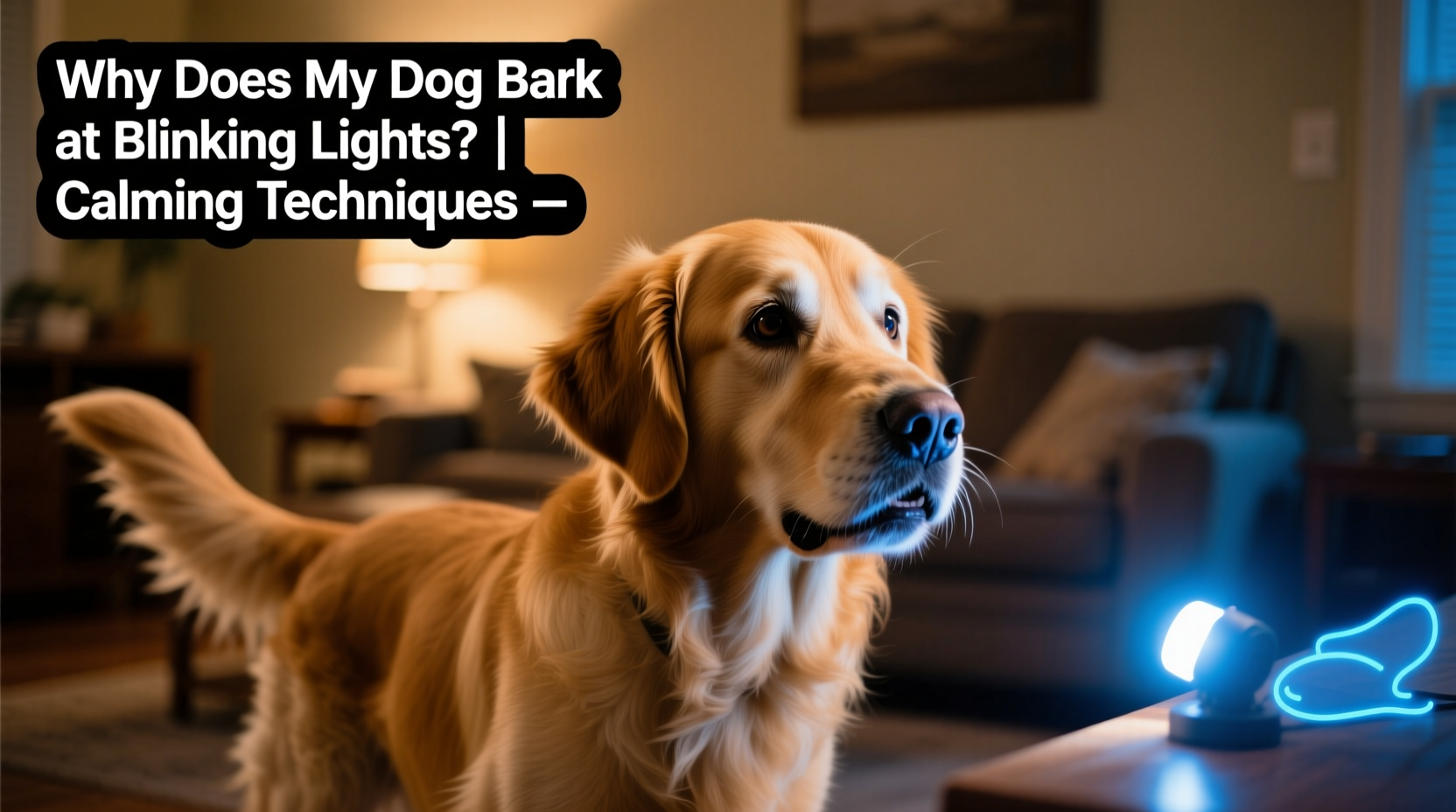
Unlike human vision, which processes light at roughly 60 Hz (frames per second), many dogs perceive flickering light at rates up to 75–80 Hz. This means lights that appear steady to us—LED holiday strings, faulty fluorescents, security camera IR emitters, or even the subtle strobing of some smart bulbs—may register as rapid, unpredictable pulses to a dog’s visual system. That perceptual mismatch creates ambiguity: Is it movement? A threat? A broken signal from the environment?
Neurologically, the canine thalamus and superior colliculus—brain regions governing visual attention and reflexive orienting—are highly attuned to motion contrast. A blinking light generates high-contrast transients that mimic prey movement or predatory cues. In dogs with heightened arousal thresholds (common in herding, terrier, and guarding breeds), this stimulus can activate the amygdala before the prefrontal cortex has time to assess safety—leading to immediate barking as both alert and displacement behavior.
Environmental context matters deeply. A dog who barks only at the blinking red LED on the baby monitor may be associating that light with the arrival of unfamiliar people or loud noises (e.g., the monitor’s audio chime). Conversely, a dog who lunges and barks at streetlights flickering during dusk may be experiencing low-light visual noise—a known trigger for dogs with early-stage retinal degeneration or SARDS (Sudden Acquired Retinal Degeneration Syndrome).
Tip: Observe your dog’s body language *before* the bark: dilated pupils, stiff posture, head tilting, or rapid blinking often precede vocalization—and indicate sensory overload, not defiance.Medical & Neurological Red Flags to Rule Out First
Before implementing behavioral strategies, rule out physiological contributors. Chronic or escalating reactivity to blinking lights—especially when paired with other symptoms—can reflect treatable conditions:
- Canine Epileptiform Visual Sensitivity: Some dogs experience photic-induced seizures triggered by rhythmic visual stimuli (e.g., strobes, rotating fan blades, or even sunlight through moving leaves). These episodes may begin with freezing, lip licking, or frantic pawing before progressing to full seizure activity.
- Retinal Disease: Conditions like progressive retinal atrophy (PRA) or SARDS cause abnormal neural signaling in low-light or high-contrast environments. Dogs may bark at lights not because they see them clearly—but because the erratic signals confuse their visual cortex.
- Chronic Pain or Neuroinflammation: Dogs in pain (e.g., from arthritis or dental disease) often develop lowered sensory thresholds. A blinking light becomes one more unignorable stimulus in an already overloaded nervous system.
Veterinary neurologists recommend a baseline ophthalmic exam and EEG if blinking-triggered barking coincides with disorientation, circling, or sudden changes in sleep patterns. As Dr. Lena Torres, board-certified veterinary neurologist at UC Davis, explains:
“Barking at intermittent lights isn’t ‘just behavior’ when it appears abruptly after age 5. In 23% of cases we see, it’s the earliest observable sign of cortical hyperexcitability—often reversible with targeted anti-inflammatory protocols or seizure threshold modulation.” — Dr. Lena Torres, DVM, DACVIM (Neurology)
Evidence-Based Calming Techniques (Not Just Distraction)
Effective intervention targets three layers: neurological regulation, associative learning, and environmental design. The following techniques are grounded in veterinary behavior science—not anecdote or convenience.
Phase 1: Immediate De-escalation Protocol
When barking begins, avoid shouting, leash corrections, or covering the light. Instead:
- Quietly guide your dog to a pre-designated low-stimulus zone (e.g., a closet with soft bedding, not a crate unless already positive).
- Offer a high-value chew (e.g., frozen goat milk bone) to engage the parasympathetic nervous system via oral motor input.
- Use gentle, rhythmic pressure along the spine (not petting) for 90 seconds—this activates vagal tone and slows heart rate.
Phase 2: Desensitization & Counterconditioning (D/CC)
This is not exposure—it’s precise, incremental pairing of the light with deep relaxation. Start only when your dog is fully calm and not currently reactive.
| Step | Light Intensity | Duration | Paired Action |
|---|---|---|---|
| 1 | Dim, distant blink (e.g., light across the room) | 2 seconds every 60 sec | Drop single piece of boiled chicken; no eye contact |
| 2 | Same light, 3 feet closer | 1.5 seconds every 45 sec | Hand-feed 3 pieces while maintaining relaxed posture |
| 3 | Light at same distance, but increased frequency (every 30 sec) | 1 second | Click + treat only if dog blinks *naturally* (sign of relaxation) |
| 4 | Light at 2 feet, normal blink pattern | Continuous for 10 sec | Begin gentle massage behind ears *during* blink |
Crucially: If your dog looks away, licks lips, or shifts weight *before* the light blinks, you’ve successfully built anticipatory calm. That’s your benchmark for advancement—not silence alone.
Real-World Case Study: Maya & Arlo
Maya adopted 3-year-old Australian Shepherd Arlo from a rescue that noted his “odd fixation on electronics.” At home, he barked intensely at the blinking blue light on her Wi-Fi router—only between 7–9 p.m., when household activity peaked. Initial assumptions pointed to boredom. But observation revealed he also froze and sniffed the floor near the router at other times, suggesting olfactory or vibrational sensitivity.
Her veterinarian identified mild patellar luxation, confirmed via orthopedic exam. Pain management reduced his overall vigilance. Simultaneously, Maya implemented D/CC using a programmable LED (not the actual router light) and discovered Arlo’s threshold dropped significantly when she played low-frequency brown noise (not white noise) during sessions—likely masking subtle electromagnetic hums.
After six weeks of daily 5-minute sessions, Arlo not only ignored the router light—he’d rest his chin on Maya’s knee when it blinked. His barking ceased entirely—not because he stopped noticing the light, but because his brain no longer interpreted it as ambiguous or threatening.
Practical Environmental Adjustments You Can Make Today
You don’t need to replace every bulb. Strategic modifications yield measurable reductions in reactive episodes:
- Replace pulse-modulated LEDs: Look for bulbs labeled “flicker-free” or “IEEE 1789 compliant.” Avoid cheap string lights and dimmable LEDs on non-compatible switches.
- Mask problematic sources: Cover blinking status LEDs with matte black electrical tape—not clear tape, which diffuses but doesn’t eliminate the pulse.
- Control ambient contrast: Use blackout curtains in rooms where blinking lights occur (e.g., home offices with security systems). High ambient light reduces the relative intensity of the blink.
- Introduce predictable rhythm: For unavoidable blinking (e.g., smoke detectors), use a small battery-powered nightlight on a timer to create consistent, gentle background illumination—reducing the perceptual “pop” of the blink.
Frequently Asked Questions
Can training “fix” this without addressing health or environment?
No. Obedience commands like “quiet” applied to blinking-light barking rarely generalize and often increase frustration. Without reducing the neurological trigger or treating underlying pain, suppression leads to redirected behaviors—pacing, self-licking, or aggression toward unrelated stimuli. Effective resolution requires integrated care.
My dog only barks at Christmas lights—is that just excitement?
Not necessarily. Seasonal blinking lights combine multiple stressors: high-frequency flicker, erratic movement patterns, unfamiliar colors, and association with household chaos (guests, noise, schedule shifts). What appears as “excitement” may be conflicted arousal—especially if your dog exhibits whale eye, tucked tail, or avoids the decorated area when unsupervised.
Will medication help?
In select cases, yes—but only as part of a comprehensive plan. SSRIs like fluoxetine may support neuroplasticity during D/CC for dogs with comorbid anxiety disorders. However, they do not replace behavioral work. A 2023 Journal of Veterinary Behavior study found dogs receiving fluoxetine *plus* structured D/CC showed 4.2x faster reduction in light-reactive barking than those receiving either intervention alone.
Conclusion: From Reactivity to Resilience
Your dog’s barking at blinking lights is not a flaw to correct—it’s data to interpret. It tells you about their sensory world, their neurological wiring, their physical comfort, and the emotional safety of their environment. When you respond with curiosity instead of correction, with physiology-aware strategies instead of quick fixes, you shift from managing symptoms to cultivating resilience. Every calm blink observed, every relaxed sigh in the presence of light, every moment your dog chooses stillness over alarm—they’re not just tolerating the world. They’re learning, deeply and biologically, that they are safe within it.
Start small: choose one light source this week. Observe your dog’s pre-bark signals. Replace one bulb or cover one LED. Run one 5-minute D/CC session—not to eliminate the behavior, but to witness what calm looks like in their body. Progress isn’t measured in silence alone, but in the quiet certainty that grows when a dog no longer needs to bark to feel heard.
💬 Your experience matters. Have you identified a specific light source that triggers your dog—or discovered an unexpected technique that worked? Share your insight in the comments. Real-world observations help other guardians decode their dog’s unique language.








