
It’s a scene straight out of a suspense film: you’re winding down for the night when you notice your cat sitting perfectly still, eyes locked on an empty stretch of wall. No movement. No sound. Just intense focus in the dim light. While it might seem unsettling—especially if it happens regularly at night—this behavior is more common than many owners realize. But what exactly causes it? Is your cat seeing something invisible to you, reacting to sounds beyond human hearing, or could there be a medical issue at play?
Cats are naturally observant and possess senses far sharper than our own. Their behaviors often reflect instincts honed over thousands of years of evolution. However, persistent wall-staring—particularly in darkness—can sometimes signal underlying issues that warrant attention. Understanding the full spectrum of possible causes, from harmless quirks to serious neurological conditions, is essential for any responsible pet owner.
Understanding Feline Senses and Nocturnal Behavior
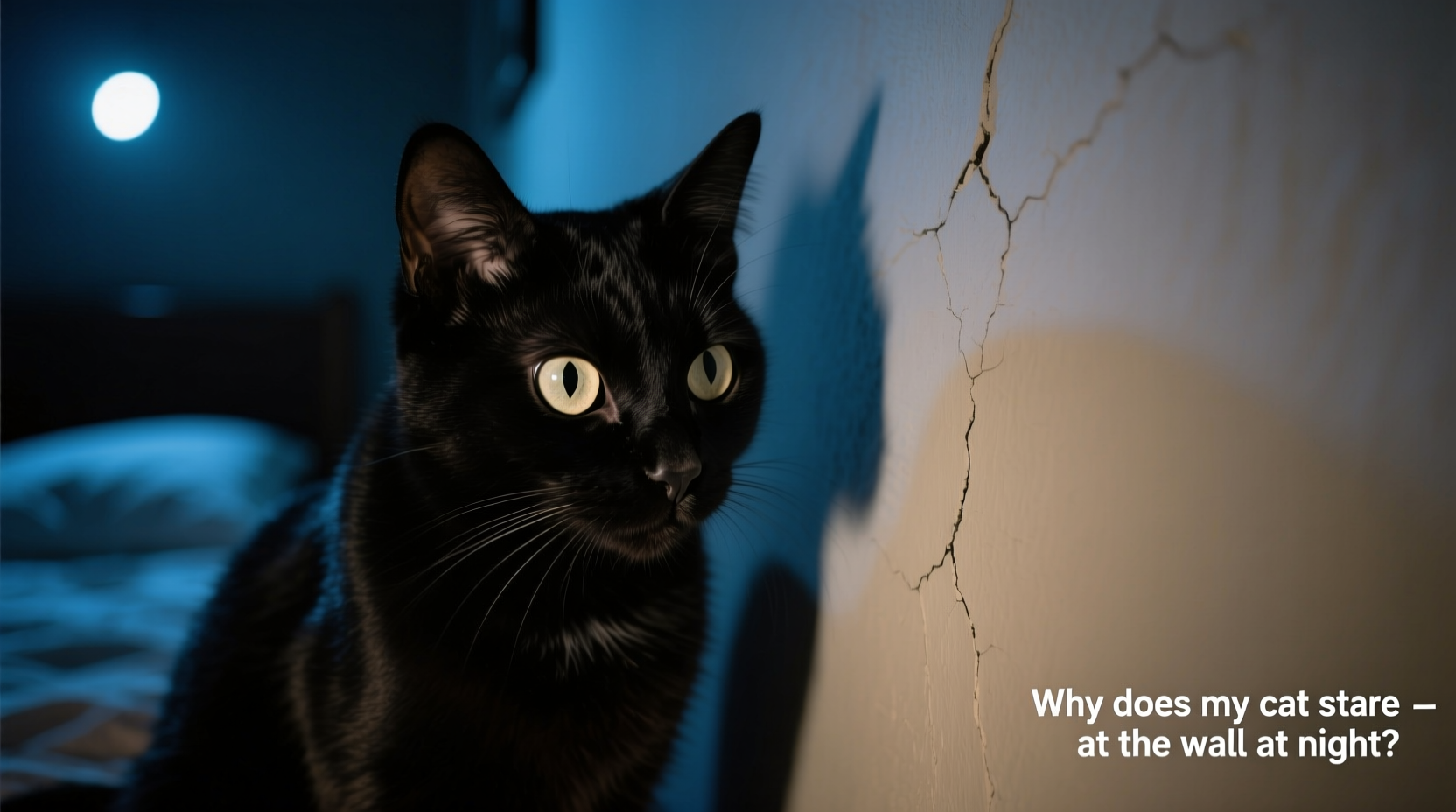
Cats are crepuscular animals, meaning they're most active during dawn and dusk. This natural rhythm explains why many cats become more alert and energetic at twilight hours, even in indoor environments. During these times, their heightened senses take center stage. A cat's vision, while not truly \"night vision,\" is adapted to low-light conditions with a high number of rod cells in the retina and a reflective layer called the tapetum lucidum that amplifies available light.
Beyond sight, cats hear frequencies up to 64 kHz—well above the human range—and can detect subtle movements through vibrations sensed in their paws and whiskers. What appears to be blank wall space to us may contain auditory or visual stimuli imperceptible to human senses. Tiny insects crawling behind baseboards, drafts causing faint shadows, or even electrical hums from wiring inside walls can capture a cat’s attention.
In the quiet of night, when household noise diminishes, these otherwise masked signals become more prominent. Your cat isn’t necessarily “staring for no reason.” They may be tracking something real—just not something we can perceive.
Tip: Observe your cat’s body language. If ears are forward, tail is still, and posture is relaxed, they’re likely just focused. If pupils are dilated, fur is puffed, or tail flicks rapidly, stress or discomfort may be involved.Possible Explanations for Wall-Staring at Night
The act of staring at walls, especially after dark, can stem from a variety of sources. Some are entirely benign; others require veterinary evaluation. Below are the most common explanations categorized by likelihood and severity.
1. Normal Sensory Detection
Your cat may detect motion, sound, or scent originating from within or behind the wall. Common examples include:
- Mice, spiders, or insects moving inside walls
- Faint drafts creating shifting shadows
- Electrical buzzing from outlets or wiring
- Dripping water inside pipes
These stimuli, though minor, can trigger a predatory response or sustained curiosity, particularly in younger or more alert cats.
2. Behavioral or Environmental Triggers
Changes in routine, new furniture placement, or unfamiliar scents (e.g., from renovations) can cause temporary fixation. Cats use visual cues to map their territory, and a change—even subtle—might prompt re-evaluation of familiar spaces.
3. Cognitive Dysfunction (Especially in Older Cats)
Senior cats (typically 10+ years) may develop feline cognitive dysfunction syndrome (CDS), similar to dementia in humans. Symptoms include disorientation, altered sleep cycles, vocalization at night, and vacant staring. Affected cats may appear “lost” or confused, fixating on corners or walls without apparent cause.
4. Neurological or Medical Conditions
More concerning causes involve brain function abnormalities. These include:
- Seizure activity (especially partial or focal seizures)
- Brain tumors
- Hyperesthesia syndrome (a nervous system disorder causing skin rippling and odd behaviors)
- Retinal or optic nerve diseases leading to hallucinations
In such cases, wall-staring may be accompanied by other signs like twitching, drooling, unresponsiveness, or sudden bursts of running.
“Cats don’t typically engage in aimless staring without some form of sensory input or internal disturbance. Persistent, trance-like fixation—especially at night—should always be evaluated in context.” — Dr. Lena Torres, DVM, Veterinary Neurology Specialist
When to Be Concerned: Red Flags to Watch For
Occasional wall-gazing is usually nothing to worry about. However, certain patterns suggest the need for professional assessment. Use the checklist below to evaluate your cat’s behavior.
🚨 Cat Wall-Staring Risk Checklist
- Staring lasts longer than 30 seconds repeatedly
- Accompanied by freezing, unresponsiveness, or lack of blinking
- Happens multiple times per night, several nights per week
- Followed by sudden dashing, tail chasing, or aggression
- New onset in older cats (over 10 years)
- Vocalization during episodes (yowling, growling)
- Loss of litter box training or appetite changes
If three or more of these apply, schedule a vet visit. Early diagnosis of neurological or cognitive issues significantly improves management outcomes.
Step-by-Step Guide: What to Do If Your Cat Stares at Walls at Night
Discovering this behavior doesn’t mean panic—but it does call for systematic observation and action. Follow this timeline to determine whether intervention is needed.
- Document the Behavior (Days 1–3): Note time, duration, frequency, and environmental conditions. Use a journal or voice memo app.
- Check for Stimuli (Day 4): Inspect walls for insect activity, drafts, or electrical noise. Tap along baseboards to listen for hollow spots indicating pests.
- Monitor Body Language (Ongoing): Is your cat relaxed or tense? Does he respond when called? Record videos if possible.
- Adjust Environment (Day 5): Provide alternative stimulation—interactive toys, nightlights, or white noise—to redirect focus.
- Consult Your Veterinarian (Day 7 or sooner if red flags present): Share your notes. Request a full physical, neurological exam, and possibly bloodwork or imaging.
- Implement Recommendations (Week 2+): Whether it’s medication, dietary changes, or environmental enrichment, consistency is key.
This structured approach helps differentiate between instinctual behavior and pathological causes.
Comparing Likely Causes: A Diagnostic Table
| Cause | Typical Age | Night-Specific? | Other Symptoms | Action Required |
|---|---|---|---|---|
| Sensory detection (insects, sounds) | All ages | Yes – due to quieter environment | Head tilting, ear movement, brief focus | None or pest control |
| Normal predatory focus | Young to middle-aged | Sometimes | Stalking posture, pouncing after | None |
| Feline cognitive dysfunction | 10+ years | Commonly | Confusion, nighttime yowling, soiling | Veterinary evaluation |
| Focal seizures | Any, but often 4+ years | Frequent | Twitching, drooling, post-event fatigue | Immediate vet consult |
| Hyperesthesia syndrome | Middle-aged | Often | Skin rippling, frantic grooming, biting | Veterinary neurology referral |
Real Example: Bella the Siamese
Bella, a 12-year-old Siamese mix, began staring at the living room wall every night around 2 a.m. Her owner initially dismissed it as quirkiness. Over six weeks, the episodes grew longer—sometimes lasting two minutes—and were followed by loud yowling. Bella also started urinating outside the litter box.
After video recording an episode and visiting her vet, Bella was diagnosed with mild cognitive dysfunction and early-stage hypertension affecting her vision. Bloodwork revealed elevated kidney values, which can contribute to both conditions. With a combination of a senior diet, blood pressure medication, and nightly melatonin supplementation, Bella’s nighttime staring decreased dramatically within a month. Her owner also added a nightlight and established a calming pre-bed routine.
This case illustrates how seemingly odd behavior can be an early warning sign. Intervention didn’t reverse aging, but it improved Bella’s quality of life significantly.
Frequently Asked Questions
Is it normal for cats to stare at walls at night?
Occasional staring can be normal, especially if triggered by sounds or movement only cats can detect. However, frequent, prolonged, or trance-like staring—particularly in older cats—should be evaluated by a veterinarian to rule out medical causes.
Can cats see ghosts or spirits on walls?
There is no scientific evidence that cats see supernatural entities. What may appear mystical is often explainable through superior senses. Cats detect ultrasonic noises, infrared heat gradients, and microscopic movements invisible to humans. Attributing behavior to paranormal causes can delay recognition of real health issues.
Should I stop my cat from staring at the wall?
Interrupting briefly is fine—calling their name or offering a toy—but avoid startling them, especially if they seem entranced. Sudden disruption during a seizure-like episode can increase anxiety. Instead, gently redirect with calm interaction and document the event for your vet.
Conclusion: Knowledge Is Protection
Your cat’s nighttime wall-staring may never fully lose its eerie edge. But understanding the science behind the gaze transforms fear into informed care. From evolutionary instincts to age-related decline, each explanation offers a pathway to better support your feline companion.
Don’t ignore persistent behavior simply because “cats are weird.” At the same time, avoid jumping to worst-case conclusions without evidence. Careful observation, documentation, and timely veterinary partnership are your strongest tools.
Every glance, blink, and twitch tells a story. Learn to read them—not as mysteries, but as messages. Your cat depends on you to notice what others overlook.
💬 Has your cat ever stared at a wall for no clear reason? Share your experience, observations, or questions in the comments. Your story could help another owner recognize a pattern—or know when to seek help.








