
Cats are enigmatic creatures. One moment they're curled up in serene sleep, the next they're crouched low behind the couch, eyes locked on you as if you're prey. If you've ever walked into a room only to find your cat silently tracking your every move from a distance, you're not alone. This behavior—commonly referred to as \"cat stalking\"—can be puzzling, amusing, or even slightly unnerving. But far from being random or sinister, stalking is deeply rooted in feline psychology and instinct. Understanding why your cat follows you so intently can deepen your bond and help you interpret their needs more accurately.
The Instinct Behind the Stalk
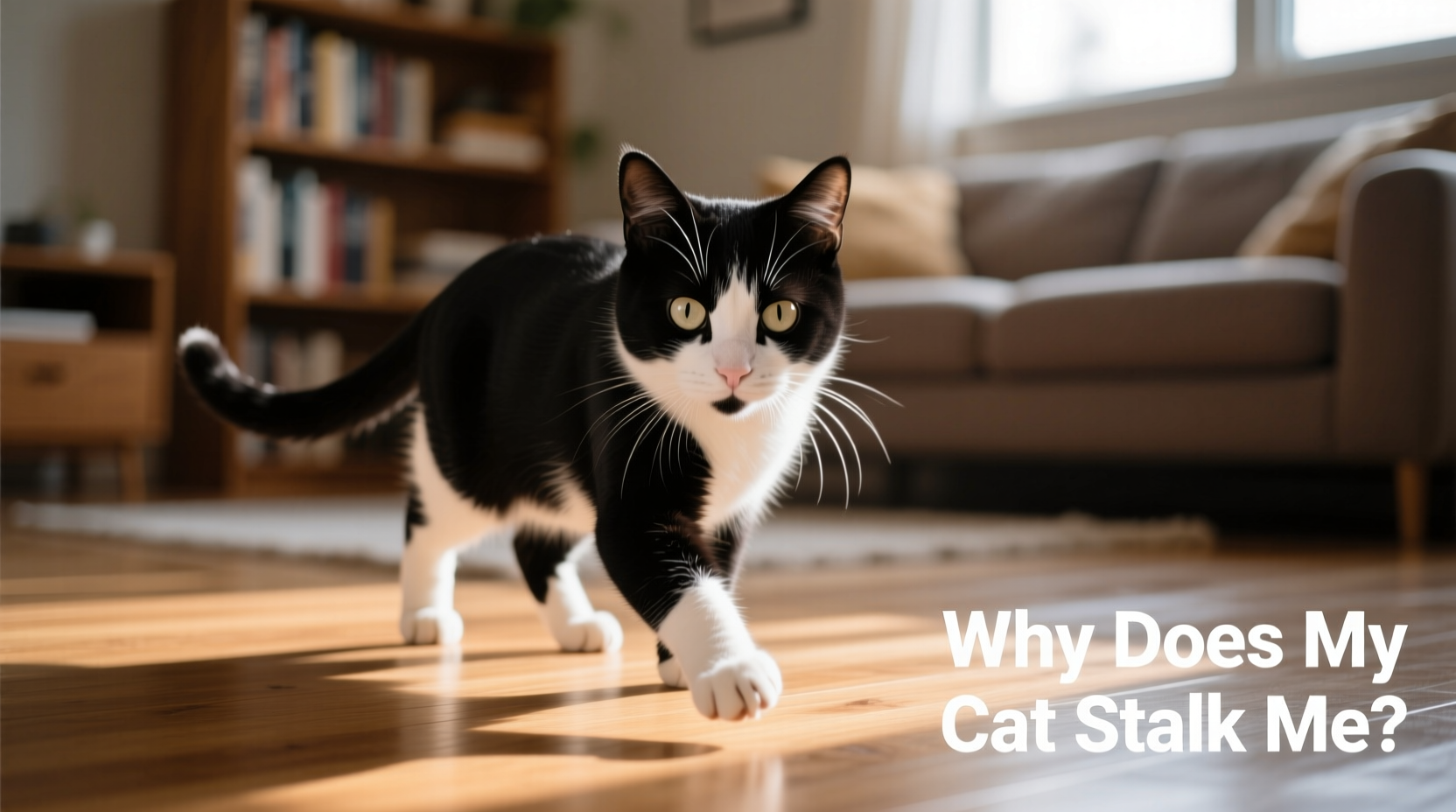
At its core, stalking is a survival mechanism hardwired into cats through evolution. Domestic cats may live in homes with food bowls and soft beds, but their genetic blueprint remains that of a skilled predator. In the wild, successful hunting relies on patience, precision, and stealth—all qualities embodied in the classic stalking posture: low body, twitching tail, focused gaze.
When your cat stalks you, they’re not necessarily planning to attack (though playful pounces do happen). Instead, they’re engaging in natural predatory sequences: orient, eye, approach, stalk, chase, pounce, bite, and kill. Most indoor cats never complete the full sequence, but the middle stages—especially stalking—are frequently practiced during everyday interactions.
This behavior isn’t limited to toys or birds outside the window. Humans, with our unpredictable movements and sudden gestures, become compelling subjects for observation and simulated hunts. Your cat isn’t plotting harm—they’re mentally rehearsing ancient skills in a safe environment.
Tip: Never punish your cat for stalking—it’s a natural behavior. Instead, redirect it toward appropriate outlets like interactive toys.Social Bonding Through Observation
Beyond instinct, stalking often reflects emotional attachment. Cats form strong social bonds with their humans, though they express affection differently than dogs. Following you around, watching your actions, and mimicking your routines are all signs of social engagement.
A 2019 study published in *Current Biology* found that kittens exhibit attachment styles toward caregivers similar to human infants. Securely attached cats were more likely to observe their owners closely and react when they moved away—behavior easily mistaken for stalking. In this context, your cat isn’t hunting you; they’re staying connected.
“Cats use visual monitoring as a way to maintain proximity and predict their caregiver’s behavior. What looks like stalking is often relational vigilance.” — Dr. Mikel Delgado, Feline Behavior Scientist
Some cats develop routines based on their owner’s schedule: waiting by the bedroom door in the morning, trailing them to the kitchen, or positioning themselves near the home office desk. These behaviors reinforce connection and provide mental stimulation.
Curiosity and Environmental Enrichment
Cats are naturally curious animals. Their survival once depended on assessing changes in their environment—new scents, sounds, movements—and reacting accordingly. When you walk across the room, open a drawer, or pick up your keys, your cat perceives these actions as potentially significant events worth investigating.
In homes lacking sufficient enrichment, stalking becomes a primary form of entertainment. A cat with limited toys, climbing structures, or sensory input may fixate on human movement simply because it’s the most dynamic thing happening in their world.
Signs Your Cat May Be Understimulated
- Excessive following throughout the day
- Stalking accompanied by vocalization or pawing
- Redirected aggression after prolonged observation
- Lack of interest in toys or solo play
When Stalking Signals Stress or Anxiety
While most stalking is harmless, it can occasionally indicate underlying stress. Cats experiencing anxiety—due to environmental changes, new pets, or inconsistent routines—may become hyper-vigilant. They stalk not out of play or curiosity, but as a coping mechanism to regain a sense of control.
Key warning signs include:
- Tail flicking or flattened ears during observation
- Dilated pupils without playfulness
- Sudden lunging or biting without provocation
- Vocalizing while stalking (meowing, growling)
If your cat exhibits these behaviors consistently, consider consulting a veterinary behaviorist. Stress-related stalking may require environmental adjustments, increased predictability, or behavioral therapy.
How to Respond: A Practical Guide
Understanding the cause of stalking allows you to respond effectively. Below is a step-by-step guide to managing and enriching this behavior:
- Assess the Context: Is your cat relaxed and playful, or tense and overstimulated? Body language tells you whether the stalk is predatory play or anxiety-driven.
- Provide Alternatives: Introduce wand toys, puzzle feeders, or motion-activated games to redirect focus.
- Engage Daily: Schedule two 10–15 minute interactive play sessions using toys that mimic prey (feathers, mice, strings).
- Enrich the Environment: Add vertical spaces (cat trees), window perches, and rotating toys to reduce dependency on human movement.
- Maintain Routine: Predictable feeding, play, and quiet times help anxious cats feel secure.
| Stalking Trigger | Likely Cause | Recommended Response |
|---|---|---|
| Following to the bathroom | Curiosity + social bonding | Accept as normal; close door if privacy needed |
| Pouncing after long stare | Playful hunting simulation | Redirect with toy; avoid hands as targets |
| Stalking at night | Nocturnal instincts + boredom | Evening play session to tire them out |
| Obsessive tracking with tension | Anxiety or overstimulation | Consult vet; assess environment |
Mini Case Study: Luna the Shadow Cat
Sarah adopted Luna, a three-year-old domestic shorthair, six months ago. While affectionate, Luna began following Sarah from room to room, hiding behind doors, and occasionally darting out to nip her ankles. Concerned, Sarah consulted a cat behavior consultant.
After evaluating Luna’s routine, the consultant noted several factors: minimal toy rotation, no cat tree, and Sarah working from home with frequent screen-based tasks (limited interaction). The stalking was a mix of under-stimulation and social attachment.
The solution included:
- Introducing a daily play routine with a feather wand
- Setting up a window perch overlooking a bird feeder
- Using treat puzzles during work hours
Within four weeks, Luna’s obsessive stalking decreased significantly. She still followed Sarah occasionally—but now paused to bat at a dangling toy instead of fixating on her feet.
Frequently Asked Questions
Is it normal for my cat to stalk me at night?
Yes. Cats are crepuscular, meaning they’re most active at dawn and dusk. Nighttime stalking often reflects natural alertness. To minimize disruptions, engage your cat in vigorous play before bedtime to encourage sleep.
Why does my cat stare at me without moving?
Staring is a form of nonverbal communication. It can signal trust (slow blinks), curiosity, or anticipation (waiting for food or attention). If the stare is intense and motionless, it may precede a playful pounce—especially if their hindquarters wiggle.
Should I be worried if my cat stalks children or other pets?
Monitor the situation closely. Playful stalking is common, but if it escalates to swatting, chasing, or fear responses, intervention is needed. Separate interactions initially and supervise all encounters. Redirect the cat’s energy with toys and create safe zones for vulnerable individuals.
Conclusion: Embrace the Stalk
Your cat’s tendency to stalk you isn’t a flaw—it’s a testament to their complex nature. Whether driven by instinct, affection, or curiosity, this behavior reveals a mind that’s engaged, observant, and emotionally invested in your presence. Rather than discouraging it entirely, aim to understand its roots and guide it positively.
By providing mental challenges, predictable routines, and opportunities for healthy play, you transform stalking from a quirk into a window into your cat’s inner world. The next time you catch those glowing eyes tracking you from the hallway, remember: you’re not being hunted. You’re being cherished—in the uniquely feline way.
💬 Has your cat ever stalked you in an unexpected or funny way? Share your story in the comments—your experience might help another cat owner feel less alone!








