Cats are creatures of habit, but some of their behaviors can seem downright bizarre—especially when they start carrying toys to their food bowls. You fill the dish with fresh kibble, only to find a crumpled mouse or jingle ball nestled beside it moments later. Is your cat trying to share a meal? Storing treasure? Or is there something deeper going on?
This seemingly odd ritual is more common than you might think, and while it may appear random, it often stems from deeply ingrained instincts, social signals, and emotional cues. Understanding why your cat engages in this behavior offers insight into their inner world—and can even improve your bond.
The Instinctual Roots of Toy-Burying Behavior
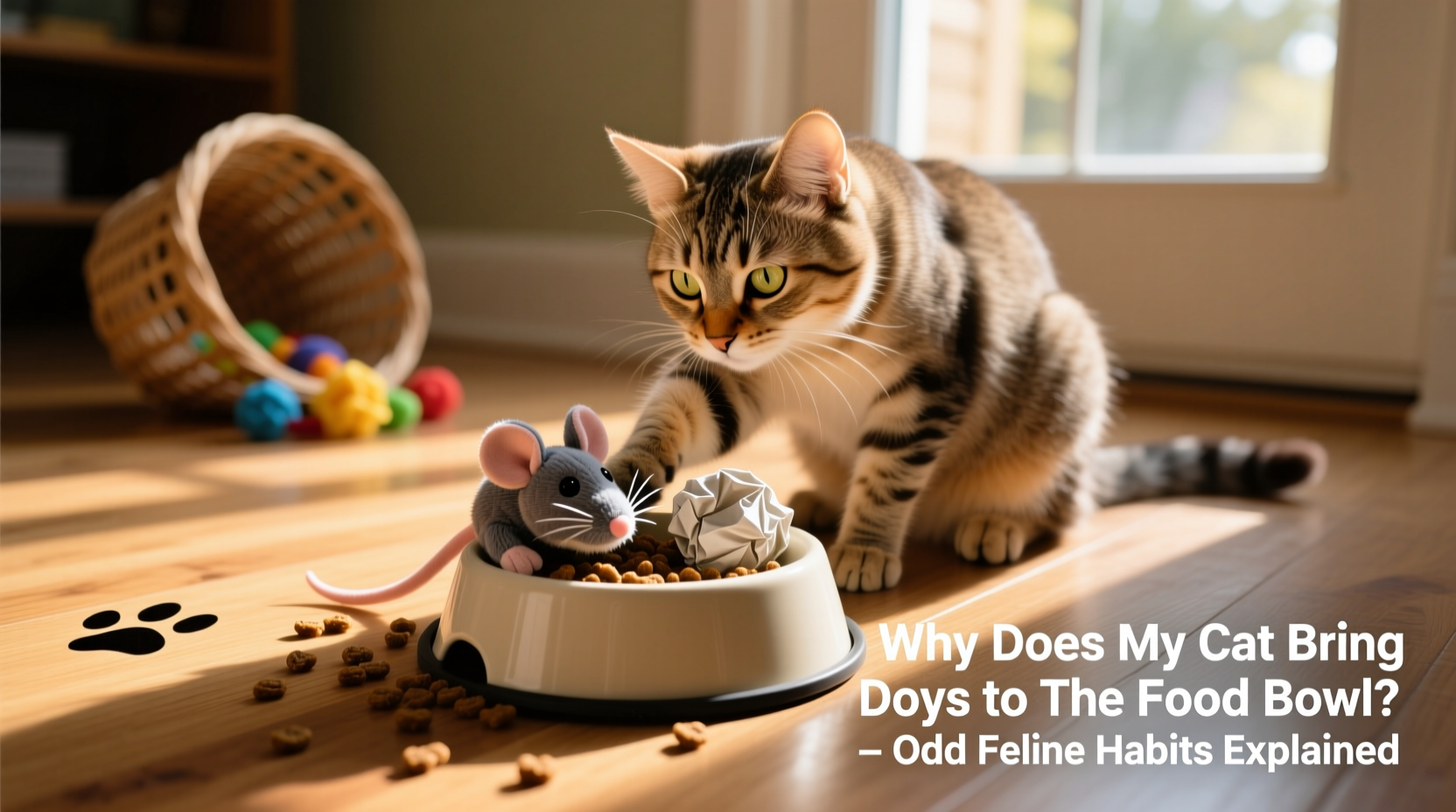
To understand toy transportation, we must first consider the evolutionary background of domestic cats. Though your tabby lounges on a velvet sofa today, its ancestors survived by hunting, hiding food, and protecting resources in unpredictable environments. Many modern cat behaviors are echoes of these survival strategies.
Bringing toys to the food bowl may be a form of \"caching\"—a natural impulse to store valued items in a safe place. In the wild, cats bury excess prey to consume later or protect it from scavengers. Your cat doesn’t need to save food, but the instinct remains. The food bowl becomes a symbolic “safe zone,” possibly because it's associated with nourishment, routine, and human presence.
Additionally, the food area is often one of the most secure spots in the home. It’s regularly visited by their caregiver (you), cleaned frequently, and located in low-traffic zones like kitchens or laundry rooms. To a cat, placing a prized toy here could be a way of safeguarding it.
Tip: Observe whether your cat covers or nudges the toy near the bowl—it may mimic burial behavior seen in wild felids.Social Signaling and Bonding Rituals
Beyond instinct, toy delivery can be a social gesture—one that reflects trust and attachment. Cats don’t always express affection through purring or cuddling; many communicate care through actions. When your cat brings a toy to the food bowl, especially if they look at you afterward or meow, they may be treating you as part of their social group.
In multicat households, cats have been observed sharing toys or leaving them in communal areas as a form of nonverbal communication. Translating this to human-cat dynamics, your pet might view the food bowl as a central meeting point—a place where bonds are reinforced daily through feeding. Placing a toy there could be an invitation to play, a gift offering, or even an attempt to “help” you prepare for a hunt.
“Cats often bring toys to resource-rich areas as a way of integrating objects of value into their core territory. When directed toward humans, it can reflect inclusion in their social circle.” — Dr. Sarah Thompson, Feline Behavioral Scientist, University of Edinburgh
This behavior is particularly common in cats who were hand-raised or highly socialized with people from a young age. These individuals are more likely to treat humans as fellow cats, complete with grooming gestures, slow blinks, and yes—even toy offerings.
Environmental Triggers and Stress Responses
Not all toy migrations are benign. Sometimes, relocating toys to the food bowl signals underlying stress or environmental imbalance. Cats are sensitive to changes in routine, household dynamics, or perceived threats (like new pets, loud noises, or rearranged furniture).
If your cat suddenly starts hoarding multiple toys around the food area—or begins vocalizing anxiously while doing so—it may indicate insecurity. The food bowl represents predictability. By clustering favorite items nearby, the cat attempts to create a controlled, comforting micro-environment.
Other signs of stress-related toy behavior include:
- Excessive grooming after placing the toy
- Hiding immediately after delivery
- Aggression when approached near the bowl
- Changes in appetite or litter box use
In multi-pet homes, competition for resources can also drive this habit. A subordinate cat might deposit toys near food not out of affection, but as a territorial marker: “This space is mine too.”
When Play Crosses Into Obsession
While occasional toy transport is normal, repetitive or compulsive behavior warrants attention. Some cats develop rituals around object placement, repeating the action dozens of times per day. This may stem from boredom, lack of stimulation, or undiagnosed medical conditions such as hyperesthesia syndrome or cognitive dysfunction in older cats.
Monitor for patterns:
- Does the behavior occur mostly at night?
- Is the cat fixated on one specific toy?
- Do they attempt to “feed” the toy or bite it aggressively?
If any of these apply, consult your veterinarian to rule out neurological or psychological causes.
Practical Tips for Managing the Habit
You don’t need to stop your cat from bringing toys to the food bowl unless it disrupts feeding, creates mess, or signals distress. In most cases, it’s harmless and even endearing. However, you can gently guide the behavior using environmental enrichment and positive reinforcement.
Tip: Place a small basket or mat near the feeding area labeled “Toy Zone” to redirect deposits without discouraging expression.Step-by-Step Guide: Redirecting Toy Placement
- Observe Timing: Note when your cat typically brings toys—after waking, before meals, during evening activity peaks.
- Create a Designated Spot: Set up a cozy corner with a soft bed and a shallow bin labeled with scent markers (e.g., a blanket with your smell).
- Use Positive Reinforcement: When your cat drops a toy in the new spot, offer praise or a treat. Avoid rewarding the food bowl behavior directly.
- Rotate Toys Regularly: Introduce novelty to reduce fixation on a single item. Use puzzle toys or hidden treats to stimulate mental engagement.
- Maintain Routine: Feed at consistent times and keep the feeding zone clean and calm to reinforce its primary purpose.
Over time, your cat may begin associating the new zone with toy storage instead of the food bowl.
Real-Life Example: Luna the Ginger Hunter
Luna, a three-year-old red tabby, lived with her owner Mia in a quiet apartment. Every morning, Mia would refill Luna’s food bowl—only to return minutes later and find a stuffed squirrel wedged between the ceramic dish and the wall.
At first, Mia thought it was cute. But when Luna began bringing three or four toys each day and refused to eat until they were “arranged,” concern grew. After consulting a veterinary behaviorist, Mia learned that Luna had been adopted at eight weeks—too young to fully develop independent coping skills.
The behavior wasn’t about food or dominance; it was ritualistic comfort-seeking. The solution wasn’t correction, but redirection. Mia placed a wicker basket beside the feeding station, added a few of Luna’s favorite toys, and sprinkled it with catnip. Within two weeks, 80% of toy deliveries went to the basket. Over time, the compulsion faded entirely.
Luna still occasionally brings a toy to the bowl—but now, she drops it briefly, looks at Mia, and trots off to eat. A ritual transformed into a moment of connection.
Do’s and Don’ts: Handling Toy-to-Bowl Behavior
| Do | Don’t |
|---|---|
| Respect the behavior as natural unless problematic | Punish or scold your cat for placing toys |
| Provide multiple safe zones for toy storage | Remove all toys abruptly or restrict access |
| Engage in interactive play to satisfy hunting urges | Ignore sudden increases in obsessive behavior |
| Keep feeding areas clean and distraction-free | Allow food and toys to mix if it deters eating |
| Consult a vet if behavior becomes compulsive | Assume it’s “just weird” without assessing context |
Frequently Asked Questions
Is it normal for cats to bring toys to their food bowl?
Yes, it’s relatively common. While not every cat does it, many exhibit similar caching or gifting behaviors. As long as your cat is eating normally and shows no signs of anxiety, it’s usually nothing to worry about.
Could this mean my cat thinks the toy is food?
Unlikely. Cats distinguish between food and toys based on texture, movement, and scent. However, kittens or cats with developmental delays might mouth toys near food out of curiosity. Adult cats typically understand the difference.
Should I remove toys from the feeding area?
If the toys interfere with eating or become contaminated by food residue, it’s wise to gently relocate them after meals. Use a consistent phrase or action (like tapping the basket) to signal where toys belong. Never yank them away during active play or feeding.
Conclusion: Embracing the Quirks of Cat Communication
Your cat’s habit of bringing toys to the food bowl isn’t just odd—it’s a window into their complex psychology. Whether driven by instinct, emotion, or environment, this behavior speaks volumes about how your cat perceives safety, relationships, and territory.
Rather than suppress these quirks, consider how you can respond with empathy and understanding. Small adjustments—like creating designated zones, increasing playtime, or simply acknowledging the gesture—can strengthen your bond and support your cat’s well-being.
Cats don’t come with instruction manuals, but they do communicate constantly. The next time your feline companion drops a feather wand beside their dinner, pause and appreciate the message: *This is my safe place. You are part of my world.*
💬 Have a story about your cat’s strange habits? Share your experience in the comments—we’d love to hear how your cat says “I love you” in their own unique way.








