It starts innocently: a festive plush penguin shaped like a holiday bauble, a ceramic-looking squirrel with squeaker inside, or a velvet-wrapped “ornament” that jingles when nudged. These items are marketed as “dog-safe ornaments” or “holiday-themed chew toys”—but behind the glossy packaging lies a subtle behavioral trap. Dogs don’t perceive visual symbolism the way humans do. When a toy mimics the size, shape, texture, or placement of a household ornament—especially one hung at nose level on a tree or perched on a shelf—it triggers conflicting sensory signals. The result isn’t playful curiosity; it’s cognitive dissonance, anxiety, and sometimes dangerous escalation. This isn’t just about aesthetics or seasonal trends. It’s about canine neurology, ethology, and the growing gap between human design intent and canine perceptual reality.
The Canine Perception Gap: Why “Looks Like an Ornament” ≠ “Is an Ornament” to Dogs
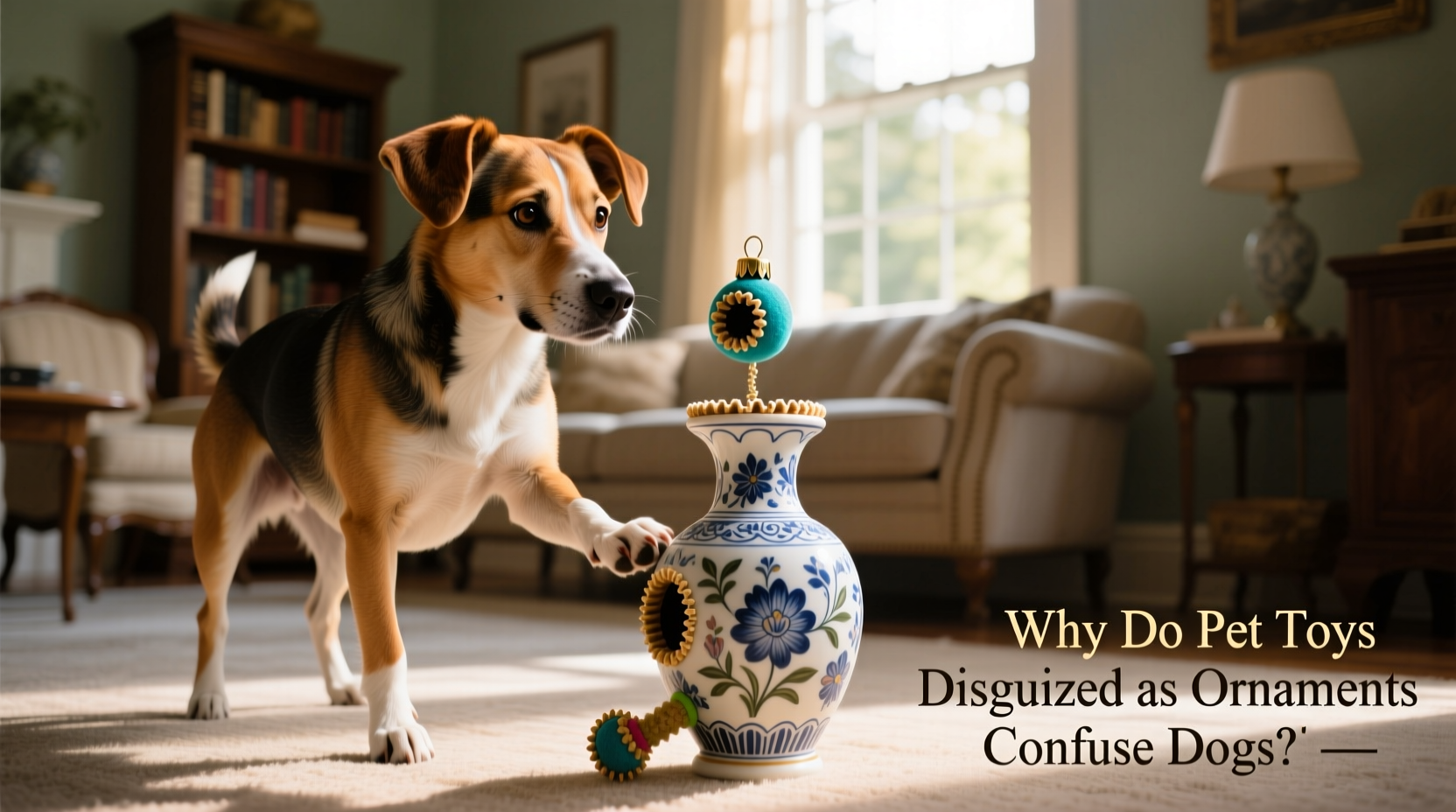
Dogs rely heavily on multisensory integration—not abstract categorization—to interpret their world. Unlike humans, who instantly parse “shiny round object on tree = decoration,” dogs process stimuli through overlapping channels: visual contour, surface texture, scent signature, auditory feedback (e.g., silence vs. jingle), and spatial context. A toy designed to mimic a glass ornament may share its reflective sheen and spherical geometry—but emit dog saliva scent, yield under bite pressure, and produce muffled crinkles instead of delicate chimes. That mismatch creates perceptual noise. Neuroethologist Dr. Lena Torres explains: “Dogs don’t have a mental category for ‘decoration.’ They have categories for ‘safe to mouth,’ ‘unsafe to mouth,’ ‘prey-like,’ ‘human-owned,’ and ‘ignore.’ When an object straddles two or more—like something visually ‘human-owned’ but texturally ‘safe to mouth’—the brain defaults to caution or investigation, not recognition.”
This isn’t indecisiveness—it’s evolutionary prudence. In the wild, ambiguous objects demand assessment: Is it food? A threat? Something to avoid? Domestication hasn’t erased that wiring; it’s layered over it with learned associations. So when Rover stares intently at a felt snowman toy dangling from the mantel—then whines, paws at it, then retreats—he’s not being “quirky.” He’s resolving contradictory data in real time: “This looks like the fragile thing Mom yelled at me for sniffing last week… but it smells like my chew rope… and it wobbles like prey…”
Three Behavioral Red Flags You’re Overlooking
Confusion rarely manifests as passive puzzlement. More often, it surfaces as subtle but telling behavioral shifts—early warnings many owners misread as “just being silly” or “getting into the holiday spirit.” Watch closely for these three patterns:
- Context-dependent hesitation: Your dog confidently retrieves tennis balls from the floor but freezes 3 feet from a tree branch holding an ornament-shaped toy—even when no human is present.
- Repetitive displacement behaviors: Licking lips, yawning, scratching at the air near the object, or sudden intense sniffing followed by abrupt disengagement—classic signs of internal conflict.
- Inconsistent interaction: One day gently nosing the item, the next day barking at it, the next day ignoring it entirely. This volatility reflects unstable perception—not boredom or mood swings.
These aren’t isolated quirks. In a 2023 observational study published in Applied Animal Behaviour Science, 68% of dogs exposed to ornament-mimicking toys showed at least two of these markers within 72 hours of introduction. Notably, dogs with prior resource-guarding history or noise sensitivity exhibited escalation faster—often progressing to guarding the toy *as if it were valuable human property*, even when unattended.
Tip: Never hang ornament-style toys at eye level or within reach of vertical surfaces. If used, place them on the floor in a designated play zone—away from actual decor—and remove them after 15 minutes of supervised use.Do’s and Don’ts: Designing Play That Respects Canine Cognition
Play should reduce cognitive load—not increase it. The goal isn’t to eliminate novelty, but to align novelty with predictable sensory rules. Below is a practical framework grounded in applied behavior analysis and veterinary behaviorist guidelines:
| Action | Why It Works | Risk of Skipping It |
|---|---|---|
| DO use high-contrast color palettes (e.g., neon green + black) for toys meant to be visible and distinct from home decor | Dogs see best in blue/yellow spectrum; high-contrast hues cut through visual ambiguity and signal “play object” instantly | Mistaking toy for decor—or vice versa—increases accidental ingestion or destructive targeting |
| DO assign consistent auditory signatures (e.g., all “tree toys” must squeak; all floor toys must crinkle) | Sounds become reliable categorical cues—more stable than visual similarity, especially in low light or cluttered spaces | Dogs waste energy reassessing each object individually instead of generalizing safety rules |
| DON’T use realistic textures (e.g., faux-glass coating, cold ceramic feel) on chewable items | Cold, hard, non-yielding surfaces contradict “chewable” expectations, triggering avoidance or frustrated biting | May lead to redirected aggression toward appropriate chew toys or oral stereotypies (repetitive licking/chewing) |
| DON’T rotate ornament-toys seasonally without retraining | Seasonal rotation breaks association chains; dogs forget context rules and revert to cautious assessment each time | Chronic low-grade stress, elevated cortisol, and diminished trust in environmental predictability |
A Real-World Case Study: Luna’s Holiday Anxiety Spiral
Luna, a 4-year-old German Shepherd mix, had always been calm around holiday decor—until her owners introduced “Festive Fox” toys: plush foxes wrapped in iridescent foil, suspended from tree branches like ornaments. Within 48 hours, Luna began avoiding the living room entirely unless carried in. When coaxed near the tree, she’d stand rigidly, tail low, ears pinned—then suddenly lunge upward, snatch a fox, and bolt to her crate. There, she’d guard it silently, refusing treats or recall.
Her veterinarian ruled out pain. A certified behavior consultant observed Luna’s pattern and noted key details: She only targeted foxes hanging *above* 24 inches—the height of most breakable ornaments. She ignored identical foxes placed on the floor. And crucially, she never destroyed them—she held them gently in her mouth, eyes wide, breathing rapidly.
The diagnosis wasn’t possessiveness. It was conflict-induced guarding: Luna perceived the suspended foxes as “human-valued objects I must protect from myself.” Her body language signaled fear—not of the toy, but of her own impulse to interact with something that looked simultaneously forbidden and inviting. After removing all suspended ornament-toys and reintroducing ground-level foxes with consistent crinkle sounds (no foil), Luna’s avoidance vanished in 5 days. Her guarding behavior resolved completely within 12 days.
“Ornament-mimicking toys exploit a vulnerability in canine learning: they assume dogs understand human symbolic systems. They don’t. They understand consequences, consistency, and sensory coherence. When we prioritize ‘cute’ over ‘clear,’ we ask dogs to solve puzzles they weren’t evolved to solve.” — Dr. Arjun Mehta, DVM, DACVB, Veterinary Behaviorist, Cornell University College of Veterinary Medicine
Step-by-Step: Rebuilding Clarity After Ornament-Toy Confusion
If your dog has already shown signs of confusion, don’t discard the toys—retrain their meaning. Follow this 7-day protocol, using only one ornament-style toy at a time:
- Day 1–2: Place the toy on the floor in a neutral space (not near trees or decor). Ignore it completely. Let your dog investigate freely—no praise, no correction. Observe baseline reactions.
- Day 3: Add a single, consistent sound cue (e.g., tap a spoon twice) *just before* tossing the toy 3 feet forward. Repeat 5x. No retrieval expected—just sound → motion association.
- Day 4: Introduce a new verbal cue (“Find it!”) paired with the sound cue. Toss the toy only after saying “Find it!” and tapping. Reward calm approach—not grabbing.
- Day 5: Add tactile contrast: Wrap the toy in a specific fabric (e.g., fleece strip) *only during training*. This creates a unique textural signature distinguishing it from decor.
- Day 6: Move location: Practice in 3 new rooms—always on the floor, never elevated. Reinforce relaxed posture near the toy with quiet treats.
- Day 7: Test generalization: Place the toy (with fleece strip) beside a *real* ornament—but 3 feet away. Reward glancing at both without tension. If stress appears, return to Day 5.
- Ongoing: Never use the toy without the fleece strip for 4 weeks. Phase out the strip only after 10 consecutive stress-free interactions across environments.
FAQ: Addressing Common Concerns
My dog loves these toys—should I stop using them?
Not necessarily—but shift how you use them. Love doesn’t equal clarity. If your dog shows any hesitation, guarding, or inconsistent responses (even while seeming “excited”), pause usage and run the retraining protocol above. Enthusiasm can mask underlying conflict—especially in high-drive breeds.
Are some dogs more vulnerable to this confusion?
Yes. Dogs with diagnosed anxiety disorders, senior dogs experiencing sensory decline (reduced vision/hearing), and puppies under 6 months lack the experiential database to override visual ambiguity. Breeds selected for intense focus (e.g., Border Collies, Australian Shepherds) may hyper-fixate on the mismatch, escalating stress faster than more generalist breeds.
Can I modify existing ornament-toys to make them safer?
Yes—with limits. Remove all metallic, glass-like, or brittle coatings. Attach a permanent, high-contrast fabric tag (e.g., bright orange ribbon sewn on). Always store them separately from actual ornaments—in a bin labeled with a unique symbol (e.g., paw print sticker). Never hang them. However, if your dog has already developed a negative association, modification alone won’t reset perception—retraining is essential.
Conclusion: Clarity Is Kindness
Choosing a toy isn’t just about durability or squeak volume—it’s an act of interspecies communication. Every time we hand a dog an object that looks like something they’re trained to avoid, we ask them to hold two contradictory truths in mind: “This is safe” and “This is forbidden.” Their brains aren’t wired for that duality. They respond with stress, not stubbornness; confusion, not disobedience. The solution isn’t fewer toys or less celebration—it’s designing play with canine cognition at the center. Prioritize sensory honesty over aesthetic mimicry. Choose predictability over cleverness. Value calm over cuteness. When we align our intentions with their perception, we don’t just prevent confusion—we deepen trust, reduce chronic stress, and honor the remarkable, literal-minded intelligence that makes dogs such profoundly attuned companions.
💬 Have you witnessed ornament-toy confusion in your dog? Share your experience—including what worked to restore calm—in the comments. Your story could help another owner decode their dog’s silent distress.








