Walk into any home with a pet, and you’ll likely hear it: a high-pitched voice, animated tone, and full sentences directed at a dog tilting its head, a cat blinking slowly, or a bird bobbing its beak. “Did you miss me, sweetie?” “Who’s the good boy?” “You’re not mad at Mommy, are you?” These aren’t just silly phrases—they reflect a deep-seated human tendency to speak to animals as if they comprehend language the way we do. But why? Is it genuine belief that pets understand us, or is it something deeper—bonding, emotional projection, or even a need for connection in a complex world?
The phenomenon of talking to pets as though they grasp every syllable is widespread, transcending cultures and species. It's not limited to new pet owners or those who live alone; even scientists and psychologists engage in this behavior. The answer lies at the intersection of neuroscience, evolutionary biology, and emotional psychology. This article explores the real reasons behind this universal habit, examining how bonding shapes communication, how projection fills emotional gaps, and what science says about animal comprehension.
The Psychology of Pet Communication
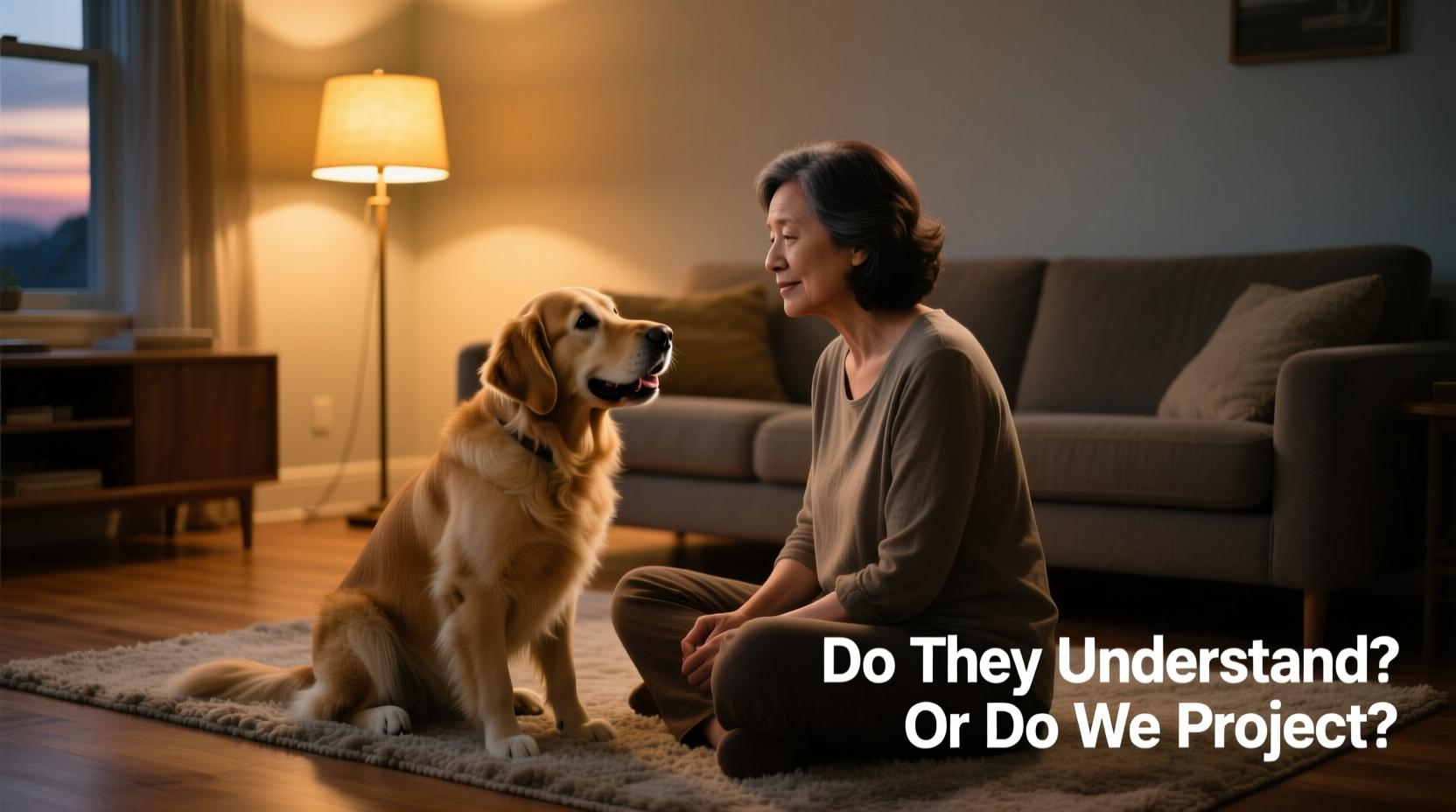
Humans are inherently social creatures. We are wired to communicate, express emotions, and seek reciprocal interaction. When we bring a pet into our lives, that instinct doesn’t disappear—it adapts. Pets become family members, confidants, and companions, often occupying roles once filled by children, partners, or friends. As such, our brains naturally extend social behaviors toward them, including verbal communication.
Research in social neuroscience shows that when people interact with their pets, the same brain regions activate as when they interact with human infants or loved ones. The release of oxytocin—the so-called \"bonding hormone\"—during petting, eye contact, or even just speaking to a pet reinforces attachment. This neurochemical response encourages nurturing behaviors, including speech.
But here’s the key: we don’t just talk *at* pets; we talk *to* them. The structure of our speech often shifts into what linguists call \"pet-directed speech\" (PDS), similar to \"parent-directed speech\" used with babies. PDS typically features higher pitch, exaggerated intonation, simplified vocabulary, and repetition—all strategies believed to enhance attention and emotional connection.
“Pet-directed speech isn’t about linguistic instruction. It’s an emotional signal—a way of saying, ‘I see you, I care for you, and I’m engaged with you.’” — Dr. Rebecca Sommers, Cognitive Ethologist, University of Edinburgh
Bonding Through Language: Why We Narrate Our Lives to Animals
One of the most powerful drivers behind talking to pets is emotional bonding. People who form strong attachments to their animals often report feeling emotionally supported, less lonely, and more grounded. In many cases, pets serve as non-judgmental listeners—safe recipients of thoughts, fears, and daily updates.
This dynamic fosters what psychologists call \"one-sided intimacy.\" Unlike human relationships, which require mutual effort, pets offer unconditional acceptance. There’s no risk of criticism, gossip, or emotional withdrawal. As a result, people feel freer to express themselves fully—even if the listener can’t respond in kind.
Consider someone returning home after a stressful workday. They might say, “Oh, you won’t believe what happened today,” and proceed to recount office politics to a golden retriever. The dog may not understand the words, but it responds with tail wags, attentive posture, and physical closeness—cues interpreted as empathy. This feedback loop strengthens the bond and validates the speaker’s emotional experience.
Tip: Talking to your pet in a calm, warm tone can reduce your own stress levels—regardless of whether they understand the words.Projection: Seeing Ourselves in Our Pets
If bonding explains the desire to connect, projection explains the illusion of understanding. Psychological projection is a defense mechanism where individuals attribute their own thoughts, feelings, or motivations to others. With pets, this often manifests as anthropomorphism—assigning human traits, emotions, and reasoning to animals.
We say a dog feels “guilty” when it lowers its head after chewing a shoe, or that a cat is “being spiteful” when it knocks over a glass. In reality, dogs don’t experience guilt in the human moral sense, and cats lack the cognitive framework for revenge. Yet we interpret their behavior through a human lens because it helps us make sense of unpredictable actions.
Projection becomes especially pronounced in solo pet owners, grieving individuals, or those with limited human interaction. A 2020 study published in Anthrozoös found that people who reported high levels of loneliness were significantly more likely to believe their pets understood complex sentences and emotional nuances. For them, the pet wasn’t just a companion—it was a psychological mirror.
This isn’t necessarily unhealthy. In moderation, projection can enhance empathy and deepen care. However, it can also lead to misinterpretation of needs. Assuming a cat is “angry” might delay recognizing signs of pain or illness. The challenge lies in balancing emotional connection with objective observation.
Signs of Healthy vs. Excessive Projection
| Healthy Projection | Excessive Projection |
|---|---|
| Assigning basic emotions (happy, scared, curious) | Believing pets understand abstract concepts (justice, betrayal) |
| Talking to pets as a form of emotional regulation | Avoiding human conversations in favor of pet dialogue |
| Recognizing limits in animal cognition | Interpreting random behavior as intentional communication |
| Using pet interaction to reduce anxiety | Feeling distressed when pet doesn’t “respond appropriately” |
Do Pets Actually Understand Us?
The question isn’t whether pets understand language like humans do—but how much they actually comprehend. The answer varies widely by species, breed, training, and individual intelligence.
Dogs, for instance, are remarkably adept at interpreting human cues. A border collie named Chaser learned over 1,000 words and could differentiate between nouns, verbs, and commands. Most dogs, however, recognize around 150 words on average, along with tone, body language, and context. They may not grasp grammar, but they learn associations: “walk” means leash, “vet” means car ride, “no” means stop.
Cats, though often seen as aloof, also pick up on patterns. Studies show they recognize their names and respond more to their owner’s voice than strangers’. However, they’re less motivated by praise and more by outcomes—so while they may understand “dinner time,” they’re unlikely to care about your work drama.
Birds like parrots can mimic and sometimes use words contextually. Alex, an African grey parrot studied by Dr. Irene Pepperberg, could identify colors, shapes, and quantities, and even ask questions like “What color?” This suggests a level of conceptual understanding beyond mere mimicry.
Still, none of these animals process language the way humans do. They rely on auditory patterns, emotional tone, and situational cues—not syntax or semantics. So when we say, “Are you hungry?” and our dog runs to the kitchen, it’s likely responding to the rising intonation and routine timing, not the meaning of the sentence.
Mini Case Study: Sarah and Max – A Story of Grief and Connection
Sarah, a 38-year-old graphic designer from Portland, adopted Max, a rescue beagle, six months after losing her mother. She found herself talking to him constantly—not just commands, but full monologues about her day, memories of her childhood, and unspoken regrets. “I’d say things like, ‘Mom would’ve loved your floppy ears,’ or ‘I think she’d be proud of me now,’” Sarah shared in a follow-up interview.
Over time, Sarah noticed that Max would nuzzle her hand during these moments, especially when her voice cracked. She began to believe he “knew” she was sad. While Max couldn’t understand the words, his responses—rooted in sensitivity to tone and body language—created a feedback loop of comfort. Therapy sessions later revealed that Sarah wasn’t projecting blindly; she was using Max as a transitional object to process grief.
Her story illustrates how talking to pets can serve a therapeutic function. The act of verbalizing emotions, even to a non-human listener, promotes clarity and emotional release. Max didn’t need to understand English—he just needed to be present.
Practical Tips for Mindful Pet Communication
While talking to pets is natural and often beneficial, being mindful enhances both your well-being and your pet’s. Here’s how to maintain a healthy balance:
Tip: Use consistent keywords for commands (e.g., “sit,” “stay”) while reserving emotional chatter for bonding moments.- Observe body language: If your pet walks away, yawns, or avoids eye contact during long talks, they may be signaling disinterest or stress.
- Vary your tone: Soft, melodic tones soothe; sharp, loud voices can alarm. Match your voice to the intended emotional message.
- Don’t assume intent: Before concluding your pet is “mad” or “jealous,” consider medical or environmental causes for behavior changes.
- Encourage two-way interaction: Pair verbal cues with touch, treats, or play to build clearer communication.
- Stay socially connected: If you find yourself relying solely on your pet for emotional support, consider expanding human connections too.
Checklist: Are You Communicating Effectively With Your Pet?
- Do I use clear, consistent words for commands?
- Do I pay attention to my pet’s body language in response?
- Am I aware of when I’m projecting my emotions onto them?
- Do I balance verbal interaction with physical care and enrichment?
- Do I seek veterinary advice before assuming behavioral issues are emotional?
FAQ
Can pets really understand human language?
Pets don’t understand language the way humans do. Dogs and some birds can learn to associate words with actions or objects, but they rely heavily on tone, context, and body language. True linguistic comprehension—grammar, syntax, abstract meaning—is beyond their cognitive capacity.
Is it bad to treat my pet like a person?
In moderation, anthropomorphism strengthens bonds and encourages compassionate care. However, over-anthropomorphizing can lead to unrealistic expectations, misreading health issues, or neglecting species-specific needs. Balance empathy with scientific understanding.
Why do I feel better after talking to my pet?
Verbalizing thoughts, even to a non-responsive listener, helps organize emotions and reduce stress. Combined with the oxytocin release from pet interaction, this creates a powerful psychological benefit—similar to journaling or talking to a trusted friend.
Conclusion: A Language Beyond Words
Talking to pets as if they understand every word isn’t foolishness or delusion—it’s a testament to the depth of human emotional life. Whether driven by bonding, projection, or the simple joy of companionship, this behavior reflects our innate need to connect, share, and be heard. Pets may not comprehend our sentences, but they respond to our presence, our tone, and our love.
The real magic isn’t in the words we speak, but in the silence that follows—the moment a dog rests its head on your lap, a cat purrs during a confession, or a bird mimics your laugh. In those instances, understanding transcends language. We don’t need translation; we need recognition. And in a world where connection can feel fleeting, pets offer something rare: a listener who never interrupts, judges, or forgets.
💬 Do you talk to your pet? What do you say, and how do they respond? Share your experiences in the comments—your story might help someone feel a little less alone.








