Dog owners often find themselves pausing mid-sentence when their pet suddenly tilts its head in response to a question or command. This seemingly curious gesture is more than just an adorable quirk—it's a complex behavior rooted in biology, communication, and emotional intelligence. While science hasn't uncovered every nuance, researchers and animal behaviorists have identified several compelling explanations for this phenomenon. Understanding why dogs tilt their heads when we speak can deepen our bond with them and improve how we communicate.
The Science Behind Canine Head Tilting
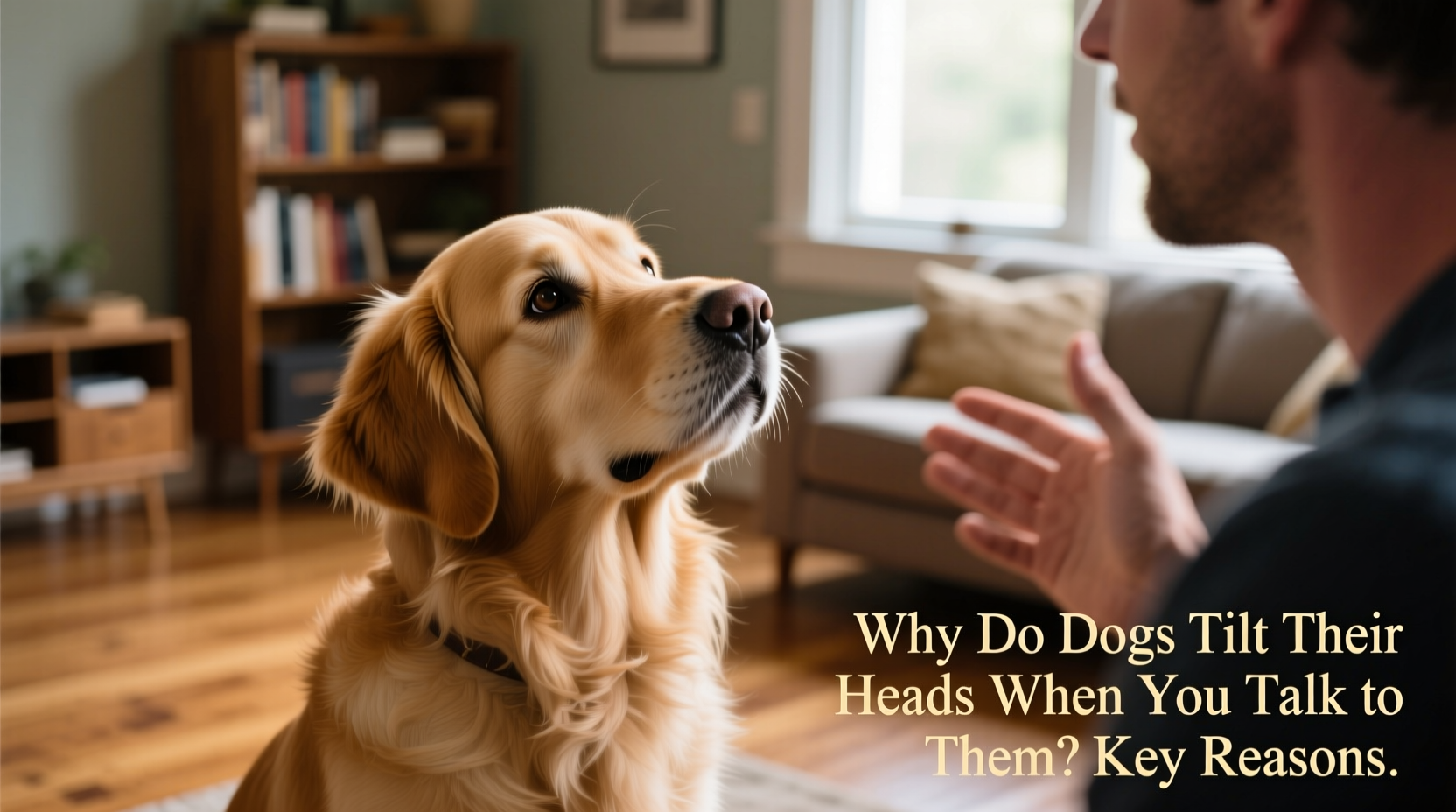
Dogs rely heavily on auditory cues to interpret their environment. Unlike humans, who process language primarily through syntax and vocabulary, dogs respond to tone, pitch, rhythm, and familiar words. When a dog hears an unfamiliar sound or word, it may tilt its head to better locate the source of the sound. This action adjusts the position of the ears and changes how sound waves enter the ear canal, potentially improving sound localization.
A 2019 study published in *Animal Cognition* observed that dogs were more likely to tilt their heads when they heard novel commands or unusual intonations. The researchers concluded that the behavior was linked to increased attention and information processing. In essence, the tilt appears to be a physical manifestation of mental engagement—a sign the dog is actively trying to understand what’s being said.
“Head tilting is not random. It correlates strongly with heightened auditory focus and social attentiveness in domestic dogs.” — Dr. Stanley Coren, Neuropsychologist and Canine Behavior Researcher
Hearing and Sound Localization
Dogs have highly sensitive hearing, capable of detecting frequencies far beyond the human range. However, their ability to pinpoint where a sound originates depends on subtle differences in timing and volume between each ear. By tilting their head, dogs may be adjusting the angle at which sound reaches their eardrums, helping them determine whether a noise came from above, below, or slightly off-center.
This is especially important for dogs with floppy ears or long muzzles, which can partially obstruct sound entry. Breeds like Basset Hounds or Cocker Spaniels tend to tilt more frequently, possibly because their ear structure limits passive sound reception. The tilt compensates by repositioning the outer ear flaps and aligning the ear canal more directly toward the sound source.
Tip: If your dog tilts its head excessively or seems disoriented, consult a veterinarian—persistent tilting could indicate an ear infection or vestibular disorder.Visual Compensation and Facial Recognition
While hearing plays a major role, vision also contributes to head tilting. A dog’s muzzle can obstruct its line of sight, particularly when looking up at a human face from a standing or sitting position. By tilting the head sideways, the dog shifts its eyes relative to the snout, gaining a clearer view of the speaker’s mouth and facial expressions.
Since dogs are adept at reading human emotions through visual cues, seeing the full shape of the lips during speech helps them interpret intent. For example, a smiling mouth might signal praise, while tightly pressed lips could suggest tension. This visual access enhances their understanding of both verbal and nonverbal communication.
Interestingly, dogs trained in obedience or service roles often exhibit less frequent head tilting. Their extensive exposure to human speech and gestures may reduce the need for physical adjustments to interpret commands.
Emotional Engagement and Social Bonding
Head tilting isn’t solely functional—it also serves as a social signal. Dogs are acutely aware of human reactions, and if a head tilt has previously been met with positive reinforcement (such as laughter, affection, or treats), the behavior may become reinforced through operant conditioning.
In other words, dogs learn that tilting their heads elicits a favorable response from their owners. Over time, they may deploy the gesture strategically, especially when seeking attention or attempting to diffuse tension. It functions much like a human raising eyebrows during conversation—to show interest, empathy, or curiosity.
This emotional dimension underscores the depth of the human-dog relationship. The head tilt becomes part of a broader repertoire of communicative behaviors, including tail wagging, eye contact, and paw lifting, all used to maintain connection and rapport.
| Behavior Trigger | Likely Cause of Head Tilt | Common Breeds Observed |
|---|---|---|
| Hearing a high-pitched voice | Improved sound localization | Border Collie, Poodle, German Shepherd |
| Seeing a person speak | Reduced muzzle obstruction | Golden Retriever, Labrador, Beagle |
| Receiving a new command | Cognitive processing effort | Shetland Sheepdog, Papillon, Dachshund |
| Seeking attention | Social reinforcement learning | Cavalier King Charles Spaniel, Maltese, Pomeranian |
Cognitive Processing and Word Association
Recent research suggests that some dogs possess a rudimentary understanding of human language. Border Collies like Chaser and Rico have demonstrated the ability to recognize over 1,000 words, retrieving specific objects on command. Even average household dogs typically learn dozens of words related to food, toys, walks, and routines.
When a dog hears a word it partially recognizes—or one that sounds similar to a known command—it may tilt its head as it searches its memory for context. This micro-adjustment could reflect internal cognitive activity, akin to a person squinting or cocking their head when trying to recall a name.
Moreover, dogs are highly attuned to prosody—the musical quality of speech. They distinguish between happy, angry, and neutral tones even without understanding the words. A sudden change in pitch or rhythm may prompt a head tilt as the dog assesses emotional content and predicts potential outcomes.
“Our data shows that dogs don’t just react to words—they analyze them in context, using both auditory and visual input. The head tilt is often the visible sign of that analysis.” — Dr. Juliane Kaminski, Comparative Psychologist, University of Portsmouth
Mini Case Study: Max the Mixed-Breed Rescue
Max, a three-year-old Australian Shepherd mix adopted from a rural shelter, initially showed little reaction to spoken language. His new owner, Sarah, used consistent commands paired with hand signals during training. After six weeks, Max began responding reliably to “sit,” “stay,” and “come.”
One evening, Sarah asked, “Do you want to go for a riiide?” stretching the last syllable playfully. Max immediately perked his ears, tilted his head to the left, and stared intently at her mouth. Within seconds, he dashed to grab his leash. The head tilt preceded recognition—it was the moment his brain connected the exaggerated tone with the concept of a car trip.
Over time, Sarah noticed Max tilted his head most often when she used ambiguous phrases (“Are you ready?”) or introduced new words. Once he learned them, the frequency decreased. This pattern supports the idea that head tilting occurs during moments of uncertainty or active learning.
Actionable Tips for Dog Owners
Tip: Use clear, consistent tone and vocabulary when teaching new commands. Pair words with gestures to support understanding and reduce confusion.- Observe patterns: Note when your dog tilts its head—is it always during certain types of speech? With specific people?
- Limit repetition: Avoid saying unclear or mixed messages repeatedly; this can increase confusion and overstimulate your dog.
- Check hearing health: If your dog stops responding to sounds or tilts its head constantly without stimulus, schedule a vet visit.
- Use positive reinforcement: Reward correct responses promptly so your dog associates clarity with success.
- Minimize background noise: Train in quiet environments first to help your dog focus on your voice.
Step-by-Step: Enhancing Communication with Your Dog
- Speak clearly: Use distinct words and moderate your tone. Avoid overly high-pitched baby talk unless bonding intentionally.
- Watch for cues: When your dog tilts its head, pause and observe. Are they confused? Focused? Waiting for a cue?
- Pair words with actions: Say “treat” while showing the container. Repeat consistently until association forms.
- Test comprehension: Randomly ask for known behaviors without gesturing. See if your dog responds correctly.
- Expand vocabulary gradually: Introduce one new word per week, using repetition and rewards.
- Monitor progress: Track how often head tilting decreases with familiarity—this indicates improved understanding.
Frequently Asked Questions
Is head tilting a sign of intelligence in dogs?
Not directly. While intelligent dogs may process language more quickly, head tilting reflects attentiveness and sensory adjustment rather than IQ. Some very smart dogs rarely tilt, while others do so frequently regardless of training level.
Should I be concerned if my dog tilts its head all the time?
Persistent or involuntary head tilting—especially accompanied by loss of balance, circling, or ear scratching—can indicate an ear infection, neurological issue, or vestibular disease. Consult a veterinarian if the behavior is constant or sudden.
Can I train my dog not to tilt its head?
You can discourage it using redirection, but there’s no need. Head tilting is harmless and often a sign of engagement. Suppressing natural behaviors may interfere with communication rather than improve it.
Final Thoughts: Listening Beyond Words
The head tilt is one of many ways dogs demonstrate their remarkable attunement to human life. Far from being a mere trick for affection, it represents a convergence of hearing, vision, cognition, and emotion. Each tilt is a silent question: “What are you saying? What do you mean? How should I respond?”
By recognizing the complexity behind this simple gesture, we become better listeners ourselves. We begin to see our dogs not just as pets, but as thoughtful companions navigating a world built for another species—one shaped by sounds, sights, and social rhythms they’ve worked hard to decode.
💬 Did your dog surprise you with a sudden head tilt today? Share your story in the comments—let’s celebrate the small moments that make canine communication so extraordinary.








