Anyone who’s ever scratched a dog’s belly knows the familiar scene: within seconds of touching that soft patch of fur, the dog’s hind leg starts kicking rhythmically, almost like a twitch. It’s endearing, amusing, and sometimes even startling. But what exactly is happening? Is your dog enjoying it? Are they trying to escape? Or is this some kind of involuntary reaction beyond their control?
The truth is, this leg-kicking behavior—commonly called the \"scratch reflex\"—is not a conscious response. It’s an automatic neurological reaction hardwired into a dog’s nervous system. While it may look like your pup is trying to scratch an itch themselves, they’re actually reacting to stimulation in much the same way humans jerk their knee during a doctor’s exam. Understanding this reflex reveals fascinating insights into canine neurology, communication, and even health.
The Science Behind the Scratch Reflex
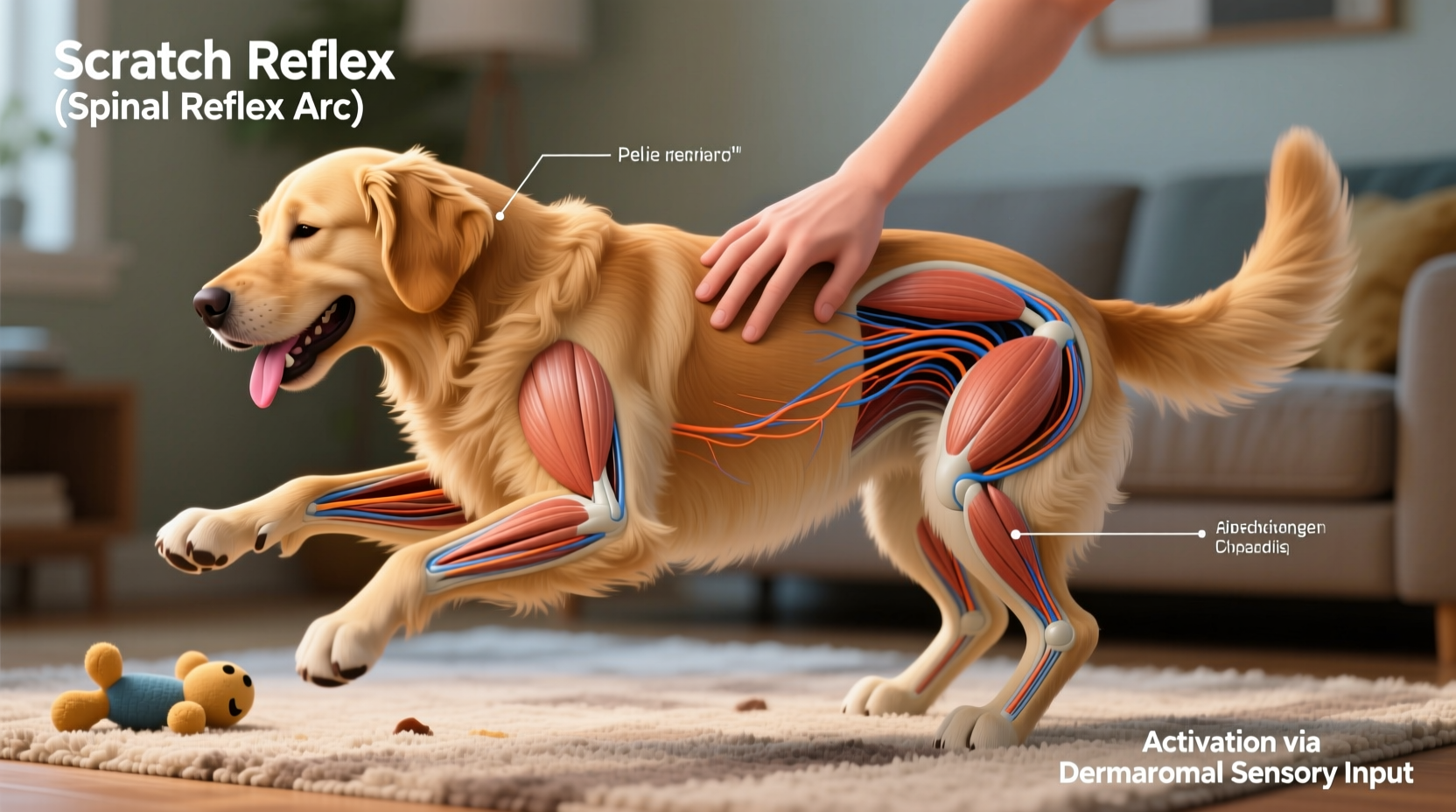
The scratch reflex is a spinal reflex arc—an automatic response that bypasses the brain. When certain areas of a dog’s body (especially the belly, flank, or side) are stimulated, sensory nerves send signals directly to the spinal cord. The spinal cord processes the signal and immediately triggers motor neurons to activate the leg muscles, resulting in the rapid kicking motion.
This reflex doesn’t require input from the brain to occur. That means even if a dog wanted to stop the movement, they couldn’t—at least not easily. It’s similar to how a human pulls their hand away from a hot stove before the brain even registers pain. The body acts first to protect itself, relying on fast, localized circuits.
In evolutionary terms, this reflex likely developed as a defense mechanism. Wild canines needed a quick way to dislodge irritants like insects, burrs, or parasites from hard-to-reach areas. A sudden kick could flick off a biting flea or tick before it caused harm. Even domesticated dogs retain this survival trait, though today it’s more often triggered by affectionate pets than actual threats.
“Dogs don’t think about scratching when their leg kicks—it happens at the spinal level. It’s one of the clearest examples of innate neural circuitry still functioning perfectly in modern pets.” — Dr. Lena Reyes, Veterinary Neurologist, UC Davis School of Veterinary Medicine
How the Reflex Works: A Step-by-Step Breakdown
To better understand the mechanics behind the scratch reflex, consider the sequence of events each time you rub your dog’s belly:
- Sensory Stimulation: Your fingers apply pressure or light friction to sensitive nerve endings under the skin, particularly around the abdomen, hips, or lower back.
- Signal Transmission: These nerves detect the touch and send electrical impulses through peripheral nerves toward the spinal cord.
- Spinal Processing: Instead of routing the signal all the way to the brain, the spinal cord interprets it locally via interneurons—specialized relay cells.
- Muscle Activation: Motor neurons are activated, instructing the muscles in the hind leg (especially the quadriceps and hamstrings) to contract rapidly.
- Leg Movement: The result is the characteristic fluttering or jerking motion—sometimes involving just one leg, sometimes both.
- Feedback Loop: If the stimulation continues, the cycle repeats until the stimulus stops or the dog moves away.
Interestingly, the reflex is usually ipsilateral—meaning the leg on the same side of the body as the touched area responds most strongly. However, in some cases, both legs may kick due to cross-spinal connections.
Tip: Not every dog exhibits a strong scratch reflex. Some breeds or individuals may show minimal response, which isn’t necessarily a cause for concern unless accompanied by other neurological symptoms.Distinguishing Reflex from Enjoyment
One common misconception is that leg-kicking always means a dog is enjoying the attention. While many dogs *do* enjoy belly rubs, the reflex itself is neutral—it doesn’t indicate pleasure or discomfort on its own. To truly assess how your dog feels, you need to observe their overall body language.
| Body Language Signaling Enjoyment | Body Language Suggesting Discomfort |
|---|---|
| Relaxed posture, loose muscles | Tense body, stiff limbs |
| Wagging tail (broad, relaxed sweeps) | Low or tucked tail |
| Soft eyes, open mouth with slight pant | Averted gaze, whale eye (visible whites) |
| Leaning into the touch | Pulling away or freezing |
| Vocalizations like happy grunts | Lip licking, yawning, growling |
If your dog kicks their leg but also leans in, wags enthusiastically, and keeps their face relaxed, they’re likely enjoying the interaction. Conversely, if they remain rigid, avoid eye contact, or try to get up, the belly rub might be unwelcome despite the reflex kicking in.
When the Scratch Reflex Signals a Health Issue
While the scratch reflex is normal, changes in its intensity or pattern can sometimes point to underlying medical conditions. Veterinarians often use reflex testing during neurological exams to evaluate spinal health and nerve function.
For example, an exaggerated or hyperactive scratch reflex might suggest irritation in the spinal cord or peripheral nerves. Conditions such as intervertebral disc disease (IVDD), nerve impingement, or dermatitis can heighten sensitivity in certain areas, making the reflex stronger or easier to trigger.
On the flip side, a diminished or absent reflex could indicate nerve damage, neuromuscular disorders, or degenerative conditions affecting motor pathways. In senior dogs or those recovering from injury, reduced reflex activity may warrant further investigation.
It’s important to note that occasional variation is normal. But if you notice any of the following, consult your veterinarian:
- Sudden increase in reflex sensitivity
- Kicking without obvious touch (spontaneous movements)
- Asymmetry—reflex present on one side but not the other
- Signs of pain when touching the belly or back
- Changes in coordination, gait, or bladder control
Mini Case Study: Max the Beagle and the Overactive Reflex
Max, a 5-year-old beagle, had always enjoyed belly rubs. His owners noticed, however, that over several weeks, his leg would start kicking violently—even when lightly touched near his ribs. He began avoiding being petted in certain spots and once snapped gently when his owner reached for his flank.
Concerned, they brought him to the vet. After a physical exam and reflex testing, the veterinarian observed an abnormally strong scratch response on the right side and mild muscle atrophy in the left hind leg. An MRI revealed a small herniated disc pressing on the spinal nerves.
With anti-inflammatory medication, restricted activity, and physical therapy, Max improved significantly within two months. His reflex returned to normal, and he resumed enjoying gentle pets. This case highlights how a routine behavior—often seen as purely behavioral—can actually serve as an early warning sign of neurological compromise.
Practical Tips for Interacting with Your Dog’s Reflex
Understanding the scratch reflex empowers you to interact more thoughtfully with your dog. Here are key tips to ensure positive, safe experiences:
Tip: Always start with light touches and watch your dog’s reaction. If they tense up or move away, stop—even if the leg starts kicking.- Respect Boundaries: Just because a dog shows the reflex doesn’t mean they want continued contact. Pay attention to subtle cues like lip licking or head turning.
- Avoid Sensitive Zones if Unwelcomed: Some dogs dislike having their belly, paws, or tail touched. Let them initiate contact instead of forcing it.
- Use the Reflex as a Diagnostic Tool: Regularly note how your dog responds to touch. Sudden changes may prompt earlier veterinary visits.
- Don’t Mistake Reflex for Invitation: A kicking leg isn’t a request for more rubbing. It’s a physiological echo, not a social signal.
- Monitor for Asymmetry: If one side reacts much more strongly than the other, mention it at your next vet checkup.
Frequently Asked Questions
Does a strong scratch reflex mean my dog has fleas?
Not necessarily. While fleas can cause itching and increased sensitivity, the scratch reflex occurs even in parasite-free dogs. However, if your dog is excessively grooming, biting at their skin, or has visible pests, consult your vet for treatment.
Can I train my dog to stop kicking their leg?
No—not directly. Since the reflex is involuntary, it can’t be suppressed through training. However, reducing the stimulus (e.g., gentler touch or shorter duration) will naturally lessen the response.
Do all animals have a scratch reflex?
Many mammals do, including cats, rabbits, and even primates. However, the location and strength vary. Cats, for instance, often exhibit a similar twitch when scratched along the back, while rodents display it in response to tail or foot stimulation.
Final Thoughts: Listening Beyond the Kick
The next time your dog’s leg starts thumping like a metronome during a belly rub, remember—you’re witnessing a remarkable piece of biological engineering. Millions of years of evolution have fine-tuned this automatic response to protect dogs from external threats. Today, it persists not as a survival tool, but as a quirky window into their nervous system.
But beyond the science, there’s a deeper lesson here: our pets communicate in ways we’re only beginning to understand. Their bodies react before their minds catch up. Our role as caregivers is to observe closely, interpret wisely, and respond with empathy. The scratch reflex isn’t just a funny quirk—it’s a reminder that even the smallest movements carry meaning.
💬 Have you noticed differences in your dog’s scratch reflex over time? Share your observations in the comments—your experience could help other pet owners recognize subtle signs of health and happiness.








