
When coral reefs bleach under environmental stress, one of the most striking phenomena divers and scientists observe is the sudden burst of vivid fluorescence—pinks, greens, and blues glowing across dying colonies. This isn't random beauty; it's a calculated biological response. Corals don’t glow merely as a death rattle—they're making a final, desperate effort to survive. Known as the \"last stand\" hypothesis, this fluorescence represents a complex defense mechanism triggered when corals face extreme heat, light, or pollution. Understanding this process reveals not only the resilience of these vital marine organisms but also their precarious position in a warming world.
The Science Behind Coral Fluorescence
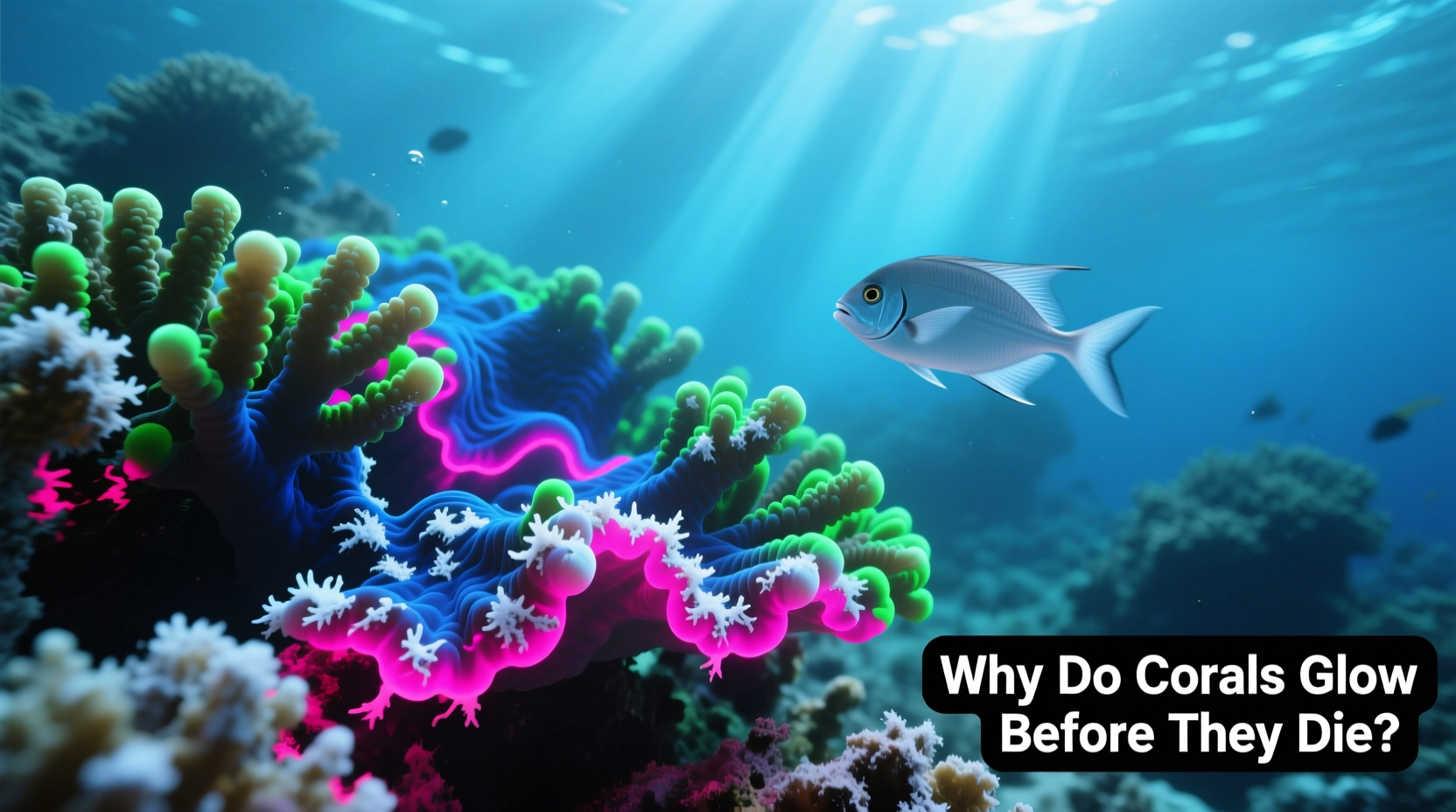
Corals are colonial animals that live in symbiosis with microscopic algae called Symbiodiniaceae. These algae reside within coral tissues and provide up to 90% of the coral’s energy through photosynthesis. In return, corals offer shelter and nutrients. When environmental conditions become stressful—particularly when water temperatures rise by just 1–2°C above seasonal norms—this partnership begins to break down.
The first sign of trouble is often coral bleaching: the coral expels its algal partners, revealing the white calcium carbonate skeleton beneath translucent tissue. But before this happens, some corals emit intense fluorescent colors. These hues come from specialized proteins known as Green Fluorescent Proteins (GFPs) and their variants, which absorb high-energy wavelengths of light (like ultraviolet and blue) and re-emit them as lower-energy green, red, or orange light.
This isn’t bioluminescence—the production of light via chemical reactions—but rather fluorescence, where light is absorbed and immediately re-emitted at a different wavelength.
Tip: Fluorescence in corals is not always a sign of imminent death—it can also be a protective adaptation in healthy reefs exposed to high light.The “Last Stand” Hypothesis Explained
The term “last stand” refers to the idea that corals increase fluorescence as a final attempt to stabilize their internal environment and retain their symbiotic algae. During thermal stress, excess sunlight—especially in shallow waters—can overwhelm the photosynthetic machinery of the algae, generating harmful reactive oxygen species (ROS). These molecules damage both the algae and coral host cells, accelerating expulsion and tissue degradation.
Fluorescent proteins act like internal sunscreens. By absorbing and transforming dangerous short-wavelength light into safer, longer wavelengths, they reduce photodamage. In essence, the coral is trying to dim the light inside its own tissue to give the algae—and itself—a better chance to endure the stress period.
“We’re seeing fluorescence not as a symptom of collapse, but as an active survival strategy. It’s the coral’s way of saying, ‘I’m not ready to give up yet.’” — Dr. Jörg Wiedenmann, Professor of Biological Oceanography, University of Southampton
Studies have shown that corals with higher baseline levels of fluorescent proteins tend to survive bleaching events better than those with lower expression. This suggests that fluorescence is more than cosmetic—it's functional and potentially life-saving.
Types of Fluorescent Responses and Their Roles
Not all fluorescence serves the same purpose. Scientists have categorized several types based on color, location, and timing:
- Green fluorescence: Most common; acts primarily as a photoprotective shield.
- Red fluorescence: Often seen in deeper-water corals; may help redistribute usable light for remaining algae.
- Non-fluorescent chromoproteins: Pigments that absorb light without re-emitting it, functioning like natural sunglasses.
The intensity and spread of fluorescence often correlate with the severity of stress. A moderate spike might indicate acclimatization, while widespread, bright fluorescence across a colony usually signals critical distress.
Fluorescence vs. Bleaching: Key Differences
| Feature | Fluorescence | Bleaching |
|---|---|---|
| Appearance | Vivid pinks, greens, blues | Pale or stark white |
| Biological Cause | Overexpression of fluorescent proteins | Expulsion of symbiotic algae |
| Stage of Stress | Early to mid-stress response | Late-stage collapse of symbiosis |
| Survival Potential | High if stress is reduced quickly | Low unless algae return within weeks |
| Function | Photoprotection, ROS reduction | Consequence of cellular damage |
Environmental Triggers of Fluorescent Stress Response
While temperature is the primary driver of coral stress, fluorescence can be triggered by multiple overlapping factors:
- Rising sea temperatures – Especially prolonged heatwaves linked to El Niño or climate change.
- Increased solar irradiance – Intense midday sun, particularly during low tides or clear water conditions.
- UV radiation exposure – Higher UV-B levels penetrate shallow reefs, damaging DNA and photosystems.
- Pollution and runoff – Sedimentation and nutrient influx reduce water clarity and stress coral physiology.
- Ocean acidification – Weakens coral skeletons and disrupts metabolic processes, compounding other stresses.
In some cases, researchers have observed corals fluorescing seasonally—even in the absence of acute threats—suggesting that fluorescence may also play a role in routine light management, not just emergency response.
Mini Case Study: The Great Barrier Reef 2020 Bleaching Event
During the mass bleaching event of 2020, aerial and underwater surveys revealed extensive fluorescent patches across the central and northern sections of Australia’s Great Barrier Reef. Divers documented entire stretches of Acropora colonies glowing neon green and pink days before full bleaching occurred.
Scientists from the Australian Institute of Marine Science collected samples and found that fluorescent protein gene expression spiked nearly 300% in stressed corals compared to control groups. Remarkably, some of these glowing colonies recovered after temperatures normalized, retaining partial algal populations due to reduced oxidative stress—evidence supporting the protective role of fluorescence.
This case illustrates that fluorescence isn’t just a passive marker—it’s part of an active physiological toolkit that determines whether a coral lives or dies during climate extremes.
Actionable Insights: Monitoring and Conservation Implications
The discovery of fluorescence as a pre-bleaching signal has practical applications for reef monitoring and conservation. Early detection of fluorescent spikes could serve as a real-time warning system, allowing managers to implement protective measures such as temporary fishing bans, tourism restrictions, or shading experiments.
📋 **Checklist: How Scientists Use Fluorescence to Protect Reefs**- Monitor fluorescence using underwater spectral sensors
- Deploy time-lapse cameras to track color changes over days
- Map hotspots of fluorescence to prioritize intervention zones
- Cross-reference with satellite sea surface temperature data
- Selectively breed or transplant naturally resilient, highly fluorescent genotypes
Frequently Asked Questions
Does fluorescence mean the coral is already dying?
Not necessarily. While intense fluorescence often precedes bleaching, it indicates active stress response—not certain death. If conditions improve quickly, fluorescent corals can recover fully.
Can artificial lighting cause coral fluorescence in aquariums?
Yes. Many reef aquarists use blue LED lights to enhance natural fluorescence. However, in captivity, excessive light without proper acclimation can still induce stress responses similar to those in the wild.
Are all corals capable of fluorescence?
No. Fluorescence varies widely between species and even among individuals within the same species. Some, like Montipora and Pocillopora, are highly fluorescent; others show little to no glow.
Conclusion: A Glowing Signal We Can’t Afford to Ignore
The fluorescent glow of stressed corals is more than a mesmerizing spectacle—it’s a cry for help encoded in light. As ocean temperatures continue to climb, these vivid displays will likely become more common, serving as both a warning and a testament to nature’s ingenuity. The fact that corals mount such a sophisticated biochemical defense underscores their value and vulnerability.
Protecting coral reefs means reducing global carbon emissions, improving coastal management, and supporting research into natural resilience mechanisms like fluorescence. Every neon patch on a reef is a story of struggle and survival. By paying attention to these glowing signals, we gain not only scientific insight but also moral urgency.
💬 What can you do? Share this knowledge, support marine conservation organizations, and advocate for climate action. The next time you hear about glowing corals, remember: it’s not just beauty—it’s a battle for life beneath the waves.








