Cats are masters of mystery. One moment they're sprinting across the room for no apparent reason; the next, they’re perched neatly inside a taped circle on the floor—despite there being no physical barrier. This peculiar habit of sitting in circles, whether drawn in tape, outlined by string, or simply imagined in an open space, has baffled pet owners and gone viral on social media. But behind the cuteness lies real behavioral science. Understanding why cats exhibit this behavior reveals insights into their instincts, cognition, and emotional needs.
The phenomenon gained widespread attention when videos began circulating online showing cats cautiously approaching and then settling inside two-dimensional circles made from duct tape on hardwood floors. No walls, no elevation—just a shape. Yet, time and again, cats step in and sit, as if obeying an invisible boundary. While it may seem whimsical, animal behaviorists see it as a window into how cats perceive safety, territory, and spatial boundaries.
The Psychology of Perceived Boundaries
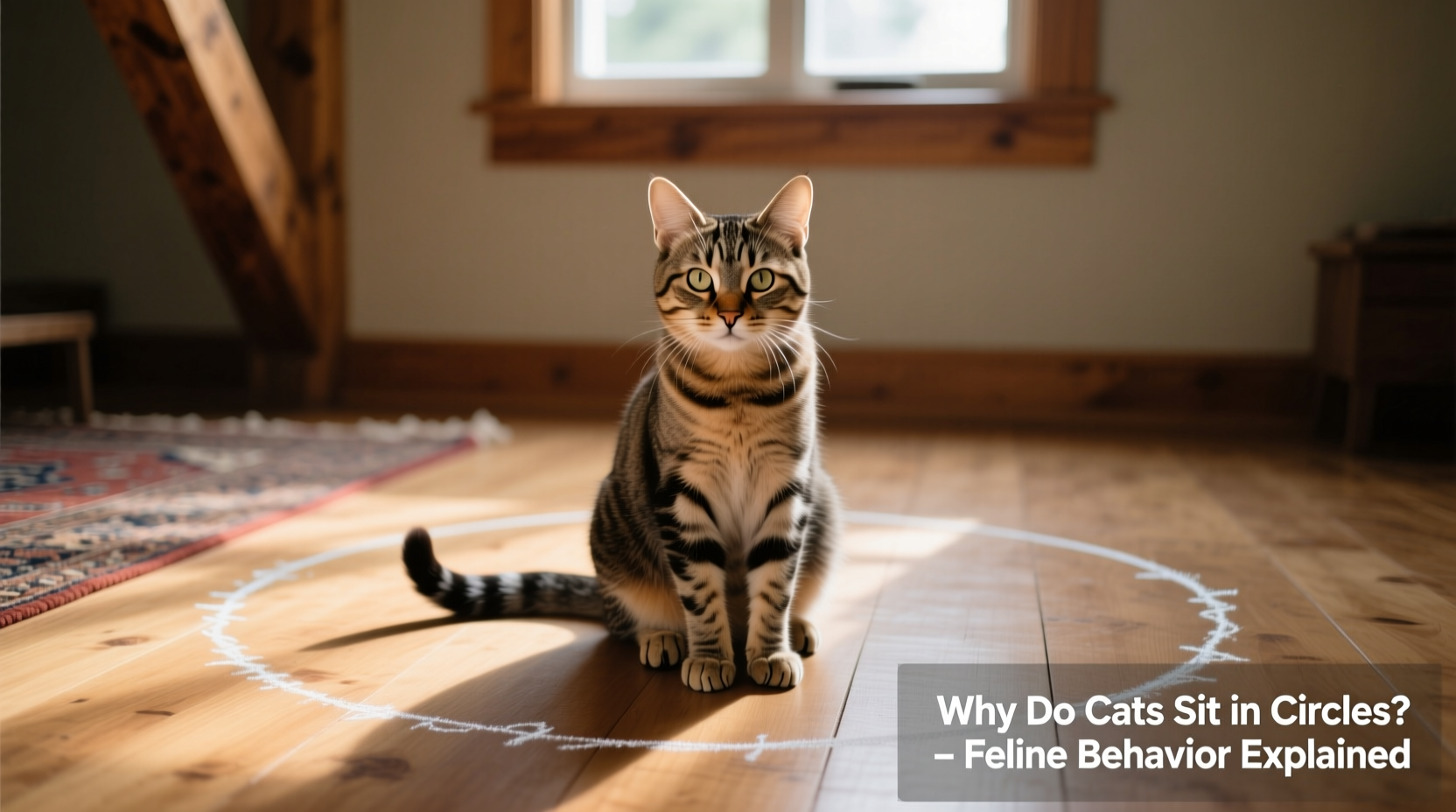
Cats are highly sensitive to spatial cues. Their survival in the wild depended on identifying secure spaces where they could observe without being seen and retreat quickly if threatened. A circle—whether real or implied—creates a visual enclosure. Even without physical walls, the contrast in color, texture, or pattern signals a defined area. To a cat, this can mimic the edges of a den, a burrow, or any sheltered zone that offers psychological protection.
Dr. Sarah Ellis, a feline behavior expert at the University of Lincoln, explains:
“Cats don’t need full enclosures to feel safe. A partial boundary can be enough to trigger their instinct to seek confined spaces. The brain interprets the outline as a container, which reduces anxiety and increases perceived security.”
This response is linked to a broader trait known as “edge detection,” where animals use visual contrasts to navigate environments. In domestic settings, this translates to cats preferring corners, cardboard boxes, and yes—even taped outlines—as resting spots.
Tip: If your cat seems anxious, try placing a circular rug or using tape to create a soft boundary in a quiet corner—it might encourage relaxation.Instinctual Behavior: From Wild Ancestors to Living Rooms
To understand the modern housecat’s attraction to circles, we must look back to its evolutionary roots. Wildcats spent much of their time hiding in dense brush, rocky crevices, or undergrowth—spaces that offered concealment and protection from predators. These natural shelters shared one key feature: enclosed or semi-enclosed borders.
Domestication hasn’t erased these instincts. Today’s cats still seek out small, bounded areas, even when no danger exists. Cardboard boxes are classic examples—they provide warmth, seclusion, and clear edges. A circle drawn on the floor, while not offering warmth or cover, satisfies the mental blueprint of a safe zone. It’s not about physical comfort alone; it’s about cognitive reassurance.
Interestingly, studies have shown that cats prefer enclosures with at least three defined sides. A circle, though round, functions similarly by creating a continuous border. This uninterrupted line gives the cat a 360-degree awareness of its limits, allowing it to relax without feeling exposed.
The Role of Illusion and Perception
One might assume that only tangible objects influence feline behavior. But research suggests cats interpret visual illusions more than previously believed. A 2020 study published in *Applied Animal Behaviour Science* tested cats’ reactions to optical patterns, including Kanizsa squares (illusory shapes formed by Pac-Man-like figures). Results showed that cats responded to the perceived square as if it were physically present—pausing at edges or adjusting their path around it.
This ability to process implied geometry helps explain why a simple ring of tape works. The high contrast between the tape and the floor creates a perceptual boundary. For a cat, stepping over it feels like crossing a threshold—much like entering a bed or crate. Once inside, the animal experiences a sense of containment, even if none exists.
| Visual Stimulus | Cat's Likely Reaction | Behavioral Reason |
|---|---|---|
| Cardboard box | Sits inside immediately | Physical enclosure with clear boundaries |
| Taped circle on floor | Hesitates, then enters and sits | Perceived boundary triggers safety instinct |
| Open floor space | Lies down occasionally, but less frequently | No defined edge = less psychological comfort |
| String loop on carpet | May sniff, paw, or sit inside | Contrast and shape mimic containment |
The strength of the illusion depends on contrast and context. A black tape circle on a light tile floor is far more effective than a faint chalk line on a patterned rug. Environmental lighting, surface reflectivity, and surrounding clutter also influence how clearly the cat perceives the boundary.
Environmental Enrichment and Mental Stimulation
Beyond instinct, sitting in circles can be a form of environmental enrichment. Cats thrive on novelty and subtle challenges. A new shape on the floor introduces a change in routine, prompting investigation. This curiosity-driven behavior keeps their minds active and reduces boredom—a common cause of stress in indoor cats.
When a cat approaches a taped circle, it often sniffs first, then paws at the edge, before finally stepping in. This sequence isn’t random; it’s a risk-assessment ritual. By engaging with the shape, the cat exercises decision-making skills and sensory processing. Over time, repeated exposure to such stimuli can improve confidence and reduce reactivity to changes in the home.
“Enrichment doesn’t always require toys or climbing trees. Simple visual puzzles, like shapes on the floor, engage a cat’s natural problem-solving instincts.” — Dr. Mikel Delgado, Certified Cat Behavior Consultant
Creating Safe Exploration Zones: A Step-by-Step Guide
You can use this knowledge to enhance your cat’s well-being through intentional design. Here’s how to set up effective perception-based zones:
- Choose a quiet area: Pick a low-traffic spot where your cat already spends time.
- Select high-contrast materials: Use black electrical tape on light floors or white chalk on dark surfaces.
- Create a perfect circle: Aim for a diameter of 18–24 inches—large enough to fit your cat comfortably.
- Observe initial reactions: Watch how your cat approaches. Do they hesitate? Sniff? Walk around?
- Reinforce with rewards: Place a treat or toy inside the circle to encourage entry.
- Vary the design: After a few days, try squares or triangles to test shape preference.
- Remove gently: Once interest fades, peel off tape carefully to avoid residue.
Real-Life Example: Luna and the Living Room Circle
Take the case of Luna, a 3-year-old rescue tabby living in a busy Chicago apartment. Her owner, Maria, noticed that Luna avoided the center of the living room, preferring tight spaces behind furniture. Concerned about her cat’s anxiety, Maria watched viral videos of cats in taped circles and decided to experiment.
She used black tape to outline a 20-inch circle on the hardwood floor near the window—a sunny spot Luna liked but never fully occupied. The first day, Luna circled the shape, sniffed the edge, and left. On day two, she placed one paw inside, then retreated. By day three, she sat fully within the circle, grooming herself calmly. Within a week, it became her preferred napping spot.
Maria observed a marked decrease in Luna’s stress behaviors: less hiding, reduced nighttime vocalization, and increased interaction with visitors. What started as a fun internet trend turned into a meaningful tool for improving her cat’s quality of life.
Do’s and Don’ts of Using Visual Boundaries
| Do | Don’t |
|---|---|
| Use non-toxic, removable tape | Leave tape on floors for extended periods |
| Place circles near windows or warm spots | Use sharp or rough materials that could injure paws |
| Rotate locations weekly to maintain interest | Force your cat into the shape |
| Pair with treats or toys initially | Use in high-stress situations (e.g., during thunderstorms) |
| Monitor for signs of fascination or fear | Assume all cats will respond the same way |
Frequently Asked Questions
Why does my cat sit in taped circles but ignore actual beds?
Cats often prefer self-selected spots over provided ones. A bed may be comfortable, but if it lacks clear boundaries or is in a high-traffic area, it won’t trigger the same sense of security. A taped circle, despite being flat, provides a defined edge that mimics a den-like space—something many commercial cat beds fail to offer.
Is this behavior a sign of intelligence?
Not necessarily intelligence in the human sense, but rather advanced spatial cognition and instinctual processing. Cats are adept at interpreting environmental cues, and their reaction to illusions shows a sophisticated visual system. It reflects adaptability, not IQ.
Should I be concerned if my cat doesn’t respond to circles?
No. Individual personalities vary widely. Some cats are bolder and less reliant on perceived boundaries. Others may be more neophobic (fearful of new things) and take longer to investigate. Lack of interest doesn’t indicate a problem—just preference.
Actionable Checklist: Enhance Your Cat’s Environment with Perception-Based Design
- ✅ Identify areas where your cat already seeks shelter (under furniture, in closets).
- ✅ Use painter’s tape to create a temporary circle in a frequented but open space.
- ✅ Observe your cat’s approach: note hesitation, sniffing, or immediate entry.
- ✅ Reinforce positive engagement with treats or gentle praise.
- ✅ Replace the circle every 5–7 days to maintain novelty.
- ✅ Experiment with different shapes (square, triangle) to compare responses.
- ✅ Combine with other enrichment tools like puzzle feeders or perches.
Conclusion: Respecting the Mind Behind the Mystery
The sight of a cat sitting in a taped circle may inspire laughter or disbelief, but it’s rooted in deep-seated instincts and perceptual intelligence. Far from a meaningless quirk, this behavior underscores how cats interact with their world—not just physically, but mentally and emotionally. They seek safety, predictability, and control, even in subtle forms.
By understanding why cats are drawn to circles, we gain a greater appreciation for their complex inner lives. More importantly, we can use this knowledge to create homes that support their psychological needs. Whether through thoughtfully placed boundaries, enriched environments, or simple observation, every small gesture deepens the bond between cat and caregiver.
💬 Have you tried the taped circle trick with your cat? Share your experience in the comments—your story could help others decode their feline’s mysterious habits!








