Cats are enigmatic companions. One moment they’re curled up in a sunbeam, purring softly; the next, they’ve sent your coffee mug crashing to the floor with a single swipe. If you’ve ever found yourself cleaning up shattered glass or rescuing your phone from near-miss destruction, you’ve likely asked: Why do cats knock things off tables? The answer lies deep within their evolutionary past—rooted in predator instincts that persist even in the safest of homes.
Domestication has softened many edges of the wild feline, but not their innate hunting behaviors. What may appear as mischief is often a manifestation of deeply ingrained survival mechanisms. Understanding this behavior isn’t just about protecting your belongings—it’s about appreciating the complex psychology of your pet and fostering a more harmonious living environment.
The Evolutionary Roots of Feline Behavior
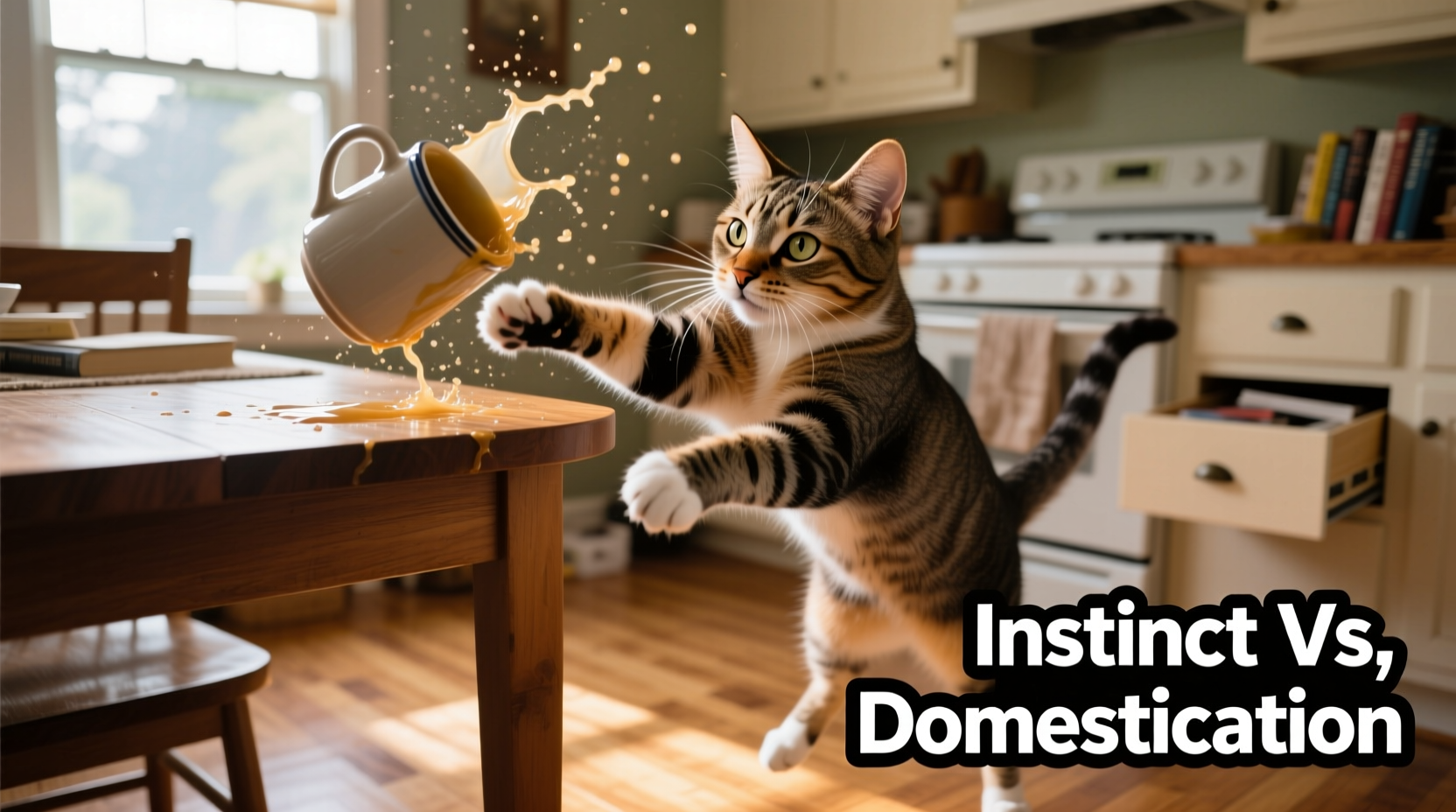
Cats have been domesticated for roughly 9,000 years, yet their genetic blueprint remains strikingly similar to that of their wild ancestors. Unlike dogs, which were selectively bred for specific tasks like herding or guarding, cats largely domesticated themselves by exploiting human agricultural settlements where rodents thrived. This means their natural instincts—especially those related to hunting and exploration—were never bred out.
In the wild, felines rely on stealth, precision, and environmental awareness to survive. They stalk prey through tall grass, pounce on movement, and use their paws to test, bat, and manipulate objects. These same actions manifest in household settings when a cat bats at a pen, nudges a cup, or deliberately knocks a vase off a shelf. To the cat, these aren’t random acts—they’re rehearsals for hunting, assessments of object properties, and tests of spatial boundaries.
“Cats don’t ‘misbehave’—they behave according to instinct. Knocking things over is not defiance; it’s data collection.” — Dr. Sarah Thompson, Feline Ethologist, University of Edinburgh
When a cat investigates an object on a table, it uses its paws because its vision is less effective at close range. By swatting, it gauges weight, texture, and movement—just as it would with potential prey. If the object falls and makes noise or rolls unpredictably, it triggers the cat’s chase response, reinforcing the action through sensory feedback.
Hunting Instincts in a Safe Environment
House cats live in environments devoid of real threats and abundant in food, yet their brains remain wired for predation. A well-fed cat doesn’t stop being a hunter—it simply lacks appropriate outlets. This creates what ethologists call “redirected behavior,” where natural impulses are expressed in ways that seem inappropriate to humans.
Consider the sequence of a typical predatory behavior:
- Orientation: The cat notices movement or an unfamiliar object.
- Stalking: It crouches and approaches slowly.
- Chasing: If the object moves, the cat gives pursuit.
- Pouncing and batting: Using its paws to immobilize or test the item.
- Kill bite (simulated): Often seen as gentle nibbling after capture.
When a cat knocks something off a table, it’s usually stuck between steps three and four. The falling object mimics fleeing prey, triggering excitement. The crash adds auditory stimulation, making the experience even more rewarding. Over time, the cat learns that certain items produce satisfying results—and repeats the behavior.
Tip: Rotate toys regularly to maintain novelty and reduce the appeal of household objects as playthings.Environmental Enrichment: Redirecting Natural Drives
Preventing destructive knocking isn’t about punishment—it’s about redirection. Cats need mental and physical stimulation to express their instincts appropriately. Without it, they’ll create their own entertainment, often at your expense.
A key strategy is environmental enrichment: modifying the home to support natural feline behaviors. This includes vertical spaces for climbing, hiding spots for security, and interactive toys that simulate prey movement.
Effective Enrichment Tools
- Interactive puzzle feeders: Encourage problem-solving and mimic the effort of capturing food.
- Feather wands and motorized toys: Provide erratic movement that triggers stalking and pouncing.
- Cat shelves and perches: Satisfy the need for elevated observation points.
- Scratching posts and tunnels: Offer tactile engagement and hiding opportunities.
One study conducted by the American Veterinary Medical Association found that cats provided with structured play sessions lasting 10–15 minutes twice daily showed a 67% reduction in unwanted object manipulation, including knocking items off surfaces.
Common Misconceptions About Cat Behavior
Many owners interpret object-knocking as spite, attention-seeking, or boredom. While attention can reinforce the behavior, the root cause is rarely emotional retaliation. Cats don’t act out of malice. Instead, they respond to stimuli based on instinct and learned outcomes.
Boredom can be a contributing factor, especially in under-stimulated environments, but it’s more accurate to frame the issue as “instinctual frustration” rather than lack of activity. Even active cats will knock things over if their predatory drives aren’t channeled properly.
| Misconception | Reality |
|---|---|
| Cats knock things over to annoy their owners. | No evidence supports intentional annoyance; behavior is instinct-driven. |
| Only mischievous cats do this. | Virtually all cats exhibit this to some degree, especially young ones. |
| Punishment will stop the behavior. | Punishment causes fear and damages trust; redirection works better. |
| This behavior means the cat is poorly trained. | Cats aren’t trainable like dogs; managing environment is more effective. |
Case Study: Reducing Table-Topping Incidents in a Multi-Cat Household
The Rivera family adopted two kittens, Milo and Luna, both highly energetic and curious. Within weeks, their coffee table became a casualty zone—remote controls, books, and decorative items were frequently knocked down, sometimes breaking. Concerned about safety and frustrated by constant cleanup, they consulted a feline behaviorist.
The assessment revealed several issues: limited vertical space, lack of scheduled play, and high-value objects placed within paw’s reach. The behaviorist recommended a three-phase plan:
- Secure the environment: Anchor fragile items, use putty to stabilize decor, and remove tempting objects from edges.
- Introduce structured play: Two 12-minute sessions daily using wand toys to simulate prey runs.
- Enrich the space: Install wall shelves, add a multi-level cat tree, and introduce rotating puzzle toys.
Within four weeks, incidents dropped by 80%. After eight weeks, only rare, accidental nudges occurred—usually during moments of overexcitement. The cats showed improved sleep patterns and reduced nighttime activity, indicating better mental fulfillment.
Practical Strategies to Minimize Object Knocking
While you can’t eliminate instinct, you can significantly reduce problematic behavior with smart, consistent strategies. Here’s a checklist to help protect your belongings while supporting your cat’s well-being.
Knock-Proofing Your Home: A Checklist
- ✅ Remove valuable or breakable items from table edges.
- ✅ Use museum putty or non-slip mats to secure decor.
- ✅ Install motion-activated deterrents (e.g., compressed air devices) on restricted surfaces.
- ✅ Provide multiple interactive toys that encourage batting and chasing.
- ✅ Schedule daily play sessions ending with a “kill” toy (e.g., a small plush mouse).
- ✅ Avoid reacting loudly when items are knocked over—this can reinforce the behavior as attention-getting.
- ✅ Use double-sided tape or aluminum foil on surfaces you want to discourage.
Frequently Asked Questions
Is it normal for my cat to knock things off tables?
Yes, it’s extremely common, especially in young, curious, or highly intelligent cats. It reflects natural investigative and predatory behaviors. As long as it’s not causing harm, it’s considered a normal part of feline expression.
Should I punish my cat for knocking things over?
No. Punishment creates fear and anxiety without addressing the underlying cause. Instead, focus on enriching your cat’s environment and removing temptations. Positive reinforcement for playing with appropriate toys is far more effective.
Could this behavior indicate a health problem?
Rarely, but sudden changes in behavior—such as increased compulsive knocking, disorientation, or aggression—should prompt a veterinary visit. Neurological issues, vision loss, or pain can alter behavior. However, routine object-batting is not a medical red flag.
Conclusion: Embracing the Wild Within
Cats will always carry the spirit of the hunter, even when their biggest challenge is deciding between tuna and chicken pâté. Knocking things off tables isn’t a flaw in your pet—it’s a testament to the resilience of nature. Rather than resisting these instincts, the most compassionate approach is to understand and redirect them.
By enriching your cat’s world with engaging activities, secure spaces, and meaningful play, you give them an outlet for their primal drives without sacrificing your peace of mind. The goal isn’t a perfectly obedient cat, but a fulfilled one—one who feels mentally stimulated, physically satisfied, and emotionally secure.
💬 Have a story about your cat’s most surprising knockdown? Share your experience in the comments and join a community of cat lovers learning to live harmoniously with their instinct-driven companions.








