Cats are creatures of habit, mystery, and subtle communication. One of the more endearing—and sometimes puzzling—behaviors many cat owners observe is their pet carrying a toy from across the house and depositing it directly into or beside the food bowl. At first glance, this might seem random or even comical. But behind this action lies a complex web of instinct, social signaling, and emotional expression. Understanding why cats engage in this behavior offers valuable insight into their inner world and strengthens the human-feline bond.
This seemingly odd ritual isn’t a sign of confusion or mischief. Instead, it reflects deeply rooted behaviors passed down from wild ancestors, adapted to fit life in a modern home. Whether your cat gently places a stuffed mouse next to their kibble or aggressively bats a crinkle ball into their water dish, each action carries meaning. By decoding these signals, you can better meet your cat’s needs and appreciate the richness of their natural instincts.
The Evolutionary Roots of Toy-Burying Behavior
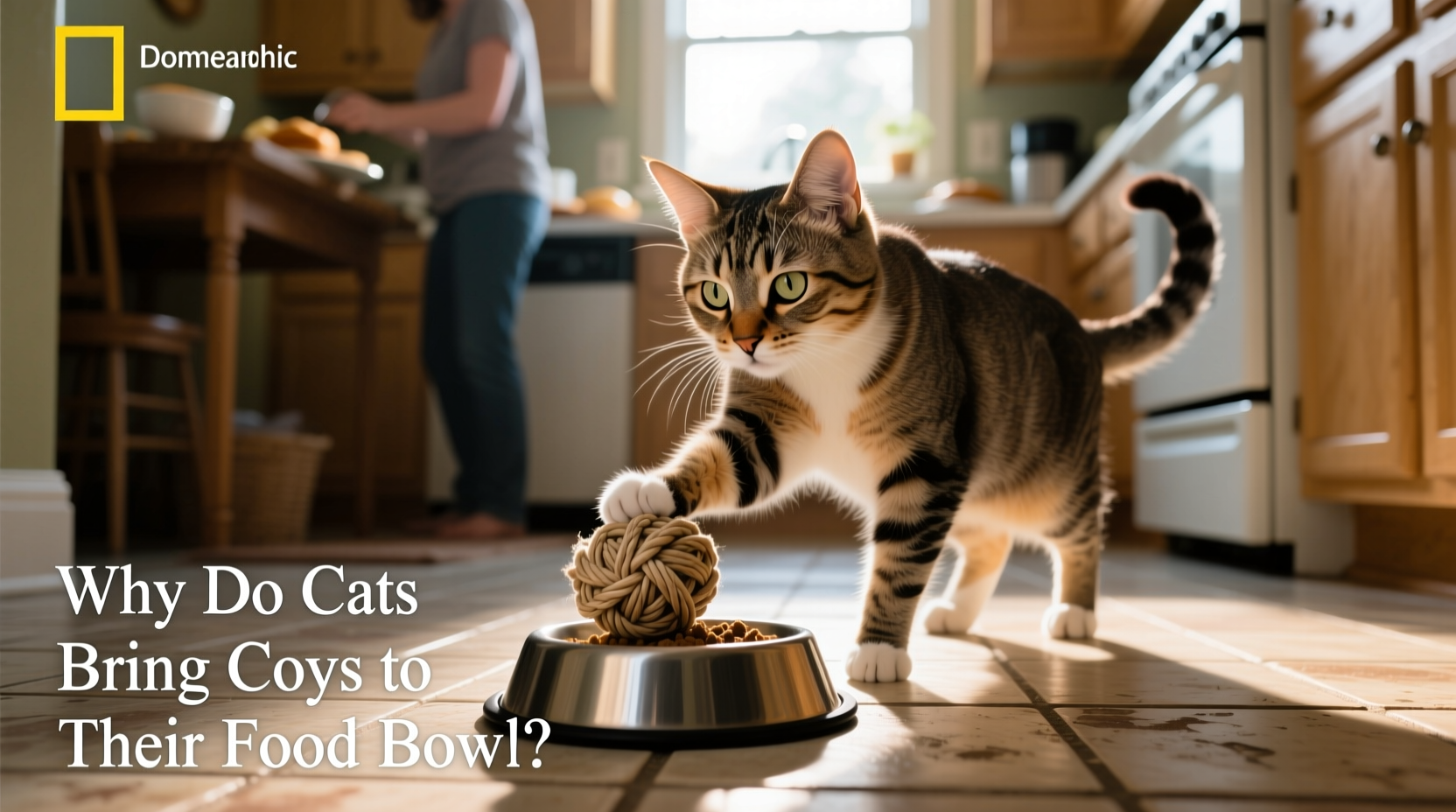
To understand why cats bring toys to their food bowls, we must first look at their evolutionary history. Domestic cats (Felis catus) evolved from solitary hunters who relied on stealth, precision, and territorial awareness for survival. In the wild, securing food meant catching prey, consuming it quickly, and often hiding any remains to avoid attracting predators or competitors.
Bringing toys to the food area may mimic ancestral caching behavior—where a predator hides surplus food for later consumption. While your cat doesn’t need to store meals for tomorrow, the instinct to “stash” valued items near a safe feeding zone persists. The food bowl becomes a central landmark in their territory: a place associated with safety, routine, and sustenance. Placing a prized toy there may be an unconscious effort to protect it, much like a wild cat would guard a kill.
Additionally, scent plays a crucial role. Cats have scent glands in their paws, cheeks, and mouths. When they carry and drop a toy, they’re marking it—and the surrounding area—with their personal aroma. Positioning this marked object near their food bowl reinforces ownership and creates a familiar, comforting environment.
Tip: Observe when your cat moves toys—before eating, after play, during quiet time—as timing can reveal whether the behavior is linked to hunger, excitement, or security-seeking.Social Bonding and Gift-Giving Instincts
Another compelling explanation ties back to cats’ social dynamics, particularly their relationship with humans. Despite their reputation for independence, cats form strong attachments to their caregivers. They often perceive their owners as part of their social group—even as surrogate parents or kittens.
When a mother cat catches prey, she brings it back to her den to feed her young or teach them how to hunt. Similarly, some experts believe that when cats leave toys near their food bowl in your presence, they may be attempting to “share the catch” or demonstrate care. If your cat watches you eat or follows you to the kitchen, they may associate food zones with nurturing moments and choose these spots to display offerings.
“Cats don’t see us as other cats, but they often apply feline social rules to their interactions with people. A toy left by the food bowl could be a symbolic gift, especially if the cat meows or rubs against you afterward.” — Dr. Sarah Thompson, Feline Behavioral Scientist, Cornell University College of Veterinary Medicine
This theory is supported by observations in multi-cat households. In homes with several cats, dominant individuals sometimes place toys near communal feeding areas as a way of asserting control or initiating interaction. Even in single-cat homes, placing a toy by the food dish may serve as a declaration: *This space is mine, and I want you to know I’ve contributed to it.*
Environmental Triggers and Routine Reinforcement
Environment plays a key role in shaping feline behavior. Cats thrive on predictability. Their daily routines—feeding times, play sessions, grooming—are mental anchors. The food bowl, typically refilled at consistent intervals, becomes a psychological focal point. It's not just where they eat; it's a symbol of reliability.
Bringing toys to this location may reinforce a sense of order. For example, a cat who receives attention immediately after being fed may learn to pair playtime with mealtime. Over time, they begin bringing toys to the bowl as a learned cue: *I’m ready to play now.* This behavior functions as a gentle request, similar to how dogs might drop a ball at your feet.
Stress or changes in the household can also amplify this behavior. During moves, renovations, or the introduction of new pets, cats may increase object-moving rituals as a coping mechanism. Returning a favorite toy to the food bowl—a known safe zone—can provide comfort amid uncertainty.
| Trigger | Behavioral Response | Possible Interpretation |
|---|---|---|
| Feeding Time Routine | Toy placed before or after eating | Association between food and play; anticipation of interaction |
| New Pet Introduction | Increased frequency of toy transport | Territorial reinforcement or anxiety relief |
| Lack of Stimulation | Repetitive dropping and retrieving | Unmet hunting drive or boredom |
| Owner Attention Patterns | Toy brought when owner enters kitchen | Learned behavior to solicit engagement |
Practical Steps to Support Healthy Expression of This Behavior
Rather than discouraging this natural behavior, consider ways to support it constructively. Suppressing instinctive actions can lead to stress, whereas guiding them appropriately enhances well-being.
- Create a designated “hunt zone” near feeding area: Place a small basket or mat beside the food bowl where toys can be stored. Encourage your cat to use it by placing treats or catnip inside occasionally.
- Rotate toys regularly: Boredom can intensify repetitive behaviors. Introduce new textures and movement-based toys (like feather wands or motorized mice) every few weeks to keep hunting instincts engaged.
- Engage in scheduled interactive play: Aim for two 10–15 minute sessions daily, ideally before meals. This mimics the natural hunt-eat-groom-sleep cycle and reduces excess energy that might otherwise fuel obsessive toy-moving.
- Avoid punishing or scolding: Never reprimand your cat for placing toys in the food bowl. This risks damaging trust and increasing anxiety.
- Monitor for compulsive patterns: If your cat obsessively carries toys, refuses to eat unless objects are arranged a certain way, or shows signs of distress, consult a veterinarian or certified animal behaviorist.
Mini Case Study: Bella and the Red Ball Ritual
Bella, a 3-year-old tabby living in a suburban apartment, began consistently placing her red rubber ball into her dry food bowl every evening around 6 PM—the exact time her owner, Mark, served dinner. Initially, Mark found it annoying and kept removing the ball, only for Bella to retrieve it minutes later.
After consulting a feline behavior consultant, Mark realized Bella wasn’t being defiant. She had learned that whenever she dropped the ball near her bowl, Mark would toss it down the hallway for her to chase—turning dinner prep into playtime. Her behavior was a learned invitation.
The solution? Mark introduced a short play session with the red ball immediately before feeding. Within a week, Bella stopped placing the ball in the bowl. Instead, she waited by the toy basket, tail twitching expectantly. The ritual hadn’t disappeared—it had simply shifted into a healthier, more predictable pattern.
FAQ: Common Questions About Cats and Toy Placement
Is it normal for my cat to put toys in their water bowl too?
Yes, though less ideal from a hygiene standpoint. Some cats generalize the behavior—any dish associated with resources (food or water) becomes a target. To discourage this, use weighted or covered water dispensers, or place water stations away from play zones.
Should I be concerned if my cat eats parts of their toys?
Yes. Ingesting non-food materials can cause intestinal blockages. Always supervise plush or string-based toys and remove any with loose threads or stuffing. Opt for durable, non-toxic materials labeled as “cat-safe.”
Do all cats exhibit this behavior?
No. Individual personality, early life experiences, and environmental enrichment influence whether a cat develops this habit. Kittens raised with littermates may show stronger social sharing tendencies, while solo-raised cats might be more possessive or indifferent.
Checklist: Supporting Your Cat’s Natural Instincts
- ✅ Provide daily interactive play sessions to satisfy hunting urges
- ✅ Offer a variety of toys (plush, crinkle, wand, electronic)
- ✅ Designate a specific spot near the feeding area for toy storage
- ✅ Avoid interrupting or punishing toy-carrying behavior
- ✅ Monitor changes in frequency or intensity—could signal stress
- ✅ Use food puzzles to blend feeding with mental stimulation
- ✅ Maintain a consistent daily routine for feeding and play
Conclusion: Embracing the Quirks of Feline Communication
The act of bringing toys to the food bowl is far more than a curious quirk—it’s a window into your cat’s mind. Rooted in ancient survival strategies and refined through domestication, this behavior speaks volumes about how cats perceive safety, ownership, and social bonds. Rather than seeing it as a nuisance, view it as a form of expression, one shaped by millions of years of evolution and fine-tuned by life in your home.
By responding with understanding instead of frustration, you honor your cat’s nature and deepen your connection. Small adjustments—like scheduling play before meals or creating a dedicated toy zone—can align their instincts with household harmony. Every time your cat drops a mouse at your feet or nudges a ball into their bowl, remember: they’re not confused. They’re communicating in the only language they know.
💬 Have a story about your cat’s toy habits? Share your experience in the comments—we’d love to hear how your feline expresses themselves!








