
Birds migrating across continents often travel thousands of miles with astonishing precision and endurance. One of the most iconic sights in nature is a flock of birds flying in a V-shaped formation across the sky. This behavior isn't random—it’s a sophisticated adaptation rooted in physics, biology, and social cooperation. The question of why birds fly in formation has intrigued scientists for decades, and modern research reveals that aerodynamics plays a central role in maximizing energy efficiency, reducing fatigue, and increasing navigation accuracy during long-distance migration.
Understanding this phenomenon requires exploring not only the mechanics of flight but also the evolutionary advantages that such formations provide. From geese to pelicans, many bird species adopt specific flight patterns to harness air currents, conserve energy, and maintain group cohesion. By studying these behaviors, researchers have gained insights into animal intelligence, collective decision-making, and even applications in human engineering and drone technology.
The Role of Aerodynamics in Flight Efficiency
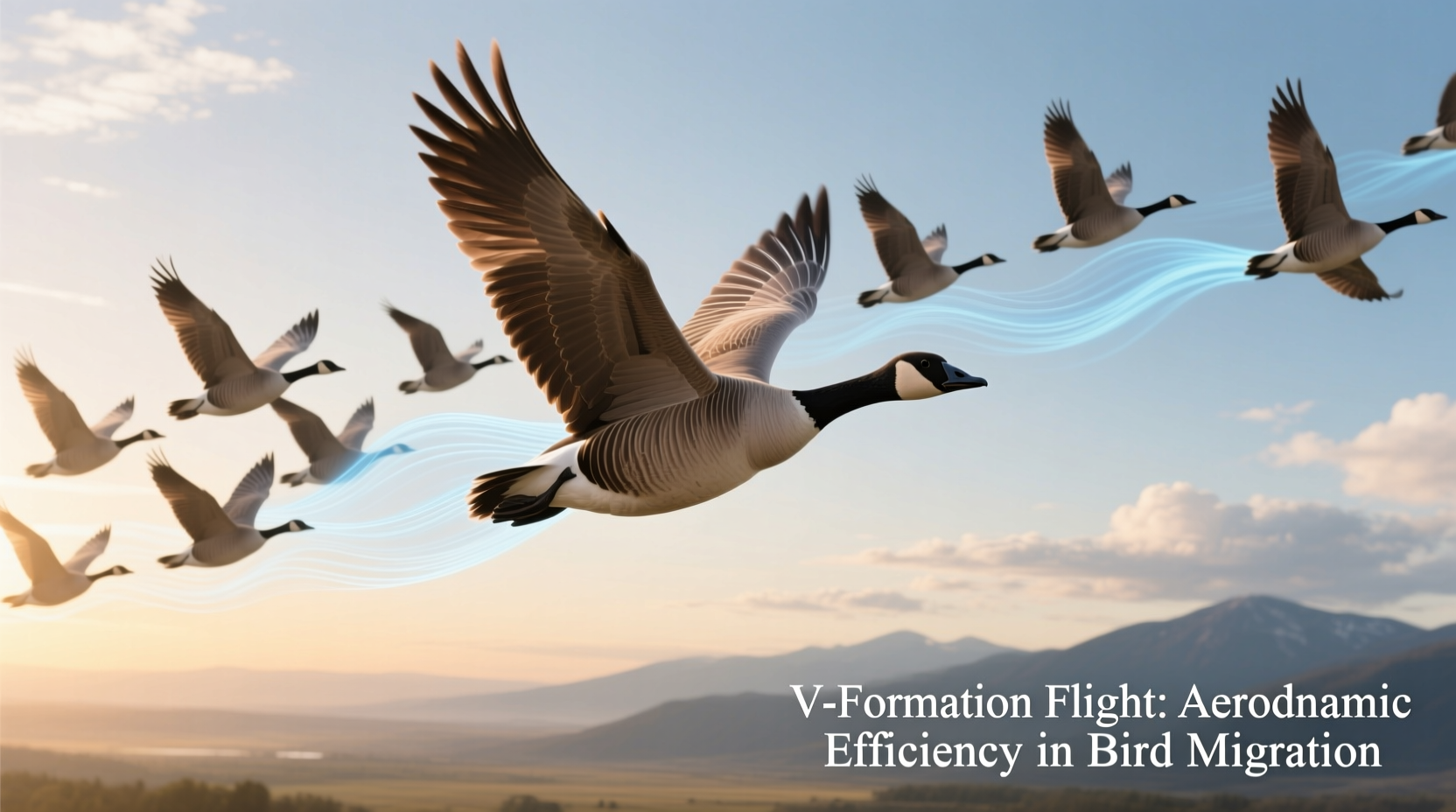
When a bird flaps its wings, it generates lift and thrust, but it also creates disturbances in the air—specifically, wingtip vortices. These are swirling masses of air that trail off the ends of the wings. As the wing moves down, it pushes air downward (downwash), but at the tips, the high-pressure air beneath the wing curls upward into the low-pressure zone above, forming rotating columns of air that spiral backward.
In isolation, these vortices represent wasted energy. However, when birds fly in formation, they can exploit these vortices to their advantage. Birds flying behind and slightly above another bird position themselves in the upwash portion of the vortex, where the air is moving upward. This provides additional lift with minimal effort, reducing the amount of energy each bird must expend to stay aloft.
Research conducted using GPS tracking devices on ibises has confirmed that birds in a V formation time their wingbeats to synchronize with the bird ahead. When one bird flaps, it creates an upward pulse of air that the following bird uses to gain lift. This precise coordination—known as phasing—can reduce induced drag by up to 20–30%, significantly lowering metabolic costs over long distances.
Tip: The optimal position in a V formation is just behind and slightly above the bird in front—any deviation reduces aerodynamic benefit.Social and Navigational Advantages of Formation Flying
Beyond aerodynamics, flying in formation offers critical social and navigational benefits. Migration routes can span thousands of miles, crossing deserts, oceans, and mountain ranges. Navigating these paths demands both physical stamina and cognitive skill. Flying in groups allows birds to share information about direction, weather conditions, and stopover sites.
Experienced individuals—often older birds who have completed previous migrations—tend to lead the formation. Their knowledge of favorable winds, feeding grounds, and safe resting areas increases the entire group's chances of survival. Younger or less experienced birds follow, learning the route while benefiting from reduced energy expenditure due to drafting.
Moreover, formation flying strengthens social bonds within flocks. Species like Canada geese maintain strong family units and lifelong pair bonds. Flying together reinforces group identity and ensures that no individual becomes isolated—a dangerous situation during migration, where predators and exhaustion pose constant threats.
“We’ve found that birds in formation adjust their positions dynamically—not just for aerodynamics, but also to communicate and maintain visual contact.” — Dr. Steven Portugal, Royal Holloway, University of London
Types of Migration Formations and Their Functions
While the V formation is the most widely recognized, birds use several different flight patterns depending on species, size, and environmental conditions. Each formation serves distinct purposes related to energy conservation, visibility, and maneuverability.
| Formation Type | Common Species | Primary Benefit |
|---|---|---|
| V Formation | Canada Geese, Northern Bald Ibis | Maximizes aerodynamic efficiency through upwash exploitation |
| Jagged Line (Slightly Off-V) | Tundra Swans, Whooper Swans | Allows flexibility in positioning while maintaining drafting benefits |
| Clustered Flock | Starlings, Blackbirds | Enhances predator evasion via murmuration dynamics |
| Line Abreast | Pelicans, Cormorants | Improves visibility and coordination during short coastal flights |
| Sparse Grouping | Raptors (e.g., Broad-winged Hawks) | Utilizes thermal updrafts without close proximity needs |
The choice of formation reflects a balance between energy savings and other survival priorities. For example, starlings form dense, swirling clouds known as murmurations not for aerodynamic gain, but to confuse predators like peregrine falcons. In contrast, large waterfowl prioritize sustained flight efficiency over agility, making the V formation ideal.
Step-by-Step: How a Bird Flock Establishes and Maintains Formation
Flying in coordinated formation is not instinctive from birth—it must be learned and refined through experience. Here's how a typical migratory flock develops and sustains its flight pattern:
- Pre-flight assembly: Before departure, birds gather at staging areas where they assess weather, food availability, and group composition. Dominant or experienced individuals begin positioning near the front.
- Takeoff coordination: Birds launch almost simultaneously, using ground speed and wing power to achieve altitude. Initial disarray gradually resolves as birds find optimal spacing.
- Position adjustment: Within minutes, individuals shift laterally and vertically to locate the upwash zones generated by others. GPS studies show birds make micro-adjustments every few seconds.
- Leadership rotation: Leading the formation is energetically costly because there’s no drafting benefit. Therefore, leadership rotates periodically, allowing all members to rest from the front position.
- Mid-flight communication: Vocalizations and subtle wing movements signal changes in speed, direction, or altitude. These cues help maintain cohesion, especially in poor visibility.
- Landing approach: As the flock nears its destination, the formation widens and slows. Birds descend in sequence, minimizing collision risk and ensuring access to landing zones.
This process demonstrates remarkable real-time problem-solving and spatial awareness. Each bird continuously monitors its neighbors’ positions and adjusts accordingly—an emergent behavior that resembles decentralized control systems used in robotics.
Real-World Example: Tracking Northern Bald Ibises
In a landmark study published in *Nature*, researchers fitted juvenile Northern Bald Ibises with lightweight GPS loggers to analyze their flight dynamics during migration from Austria to Italy. The birds were guided by ultralight aircraft as part of a conservation effort to re-establish migration routes lost due to habitat decline.
Data revealed that ibises maintained precise distances—approximately 1.2 meters apart—and aligned their wing flaps within 0.2 seconds of the bird ahead. They actively corrected their positions whenever turbulence or wind shifts disrupted optimal alignment. Most strikingly, younger birds rapidly learned correct placement, suggesting an innate sensitivity to airflow cues combined with observational learning.
This case illustrates how formation flying is not merely habitual but a finely tuned interaction between physiology, environment, and social structure. It also highlights the vulnerability of migratory species when traditional routes are disrupted by climate change or human development.
Checklist: Key Factors Enabling Efficient Formation Flight
- ✅ Proper wingtip spacing to capture upwash and avoid downwash
- ✅ Synchronized wingbeat timing (phasing) between adjacent birds
- ✅ Regular rotation of leadership roles to distribute energy costs
- ✅ Clear visual and auditory signals for mid-air communication
- ✅ Experience-based route knowledge shared among flock members
- ✅ Adaptability to changing wind, altitude, and weather conditions
- ✅ Strong social bonds that promote cooperation and cohesion
Applications Beyond Biology: Lessons for Human Technology
The principles observed in avian formation flight have inspired innovations in aviation and unmanned aerial vehicle (UAV) design. Military and commercial researchers are developing algorithms that allow drones to fly in coordinated swarms, mimicking bird flocks to improve fuel efficiency and mission resilience.
NASA has tested autonomous aircraft formations where trailing planes use sensors to detect and ride the upwash created by leaders, achieving fuel savings of up to 15%. Similar concepts are being explored for commercial airliners on parallel routes, potentially reducing carbon emissions across the aviation industry.
Additionally, swarm robotics draws heavily from bird flocking models. Algorithms based on “boids” (a computer model simulating flocking behavior) enable hundreds of robots to move in unison without centralized control—useful in search-and-rescue operations or planetary exploration.
FAQ
Why don’t all birds fly in V formations?
Not all species benefit equally from drafting. Smaller birds like sparrows or finches generate weaker vortices, so the aerodynamic gains are minimal. Additionally, some birds migrate solo or in loose groups due to territorial behavior or differing migration schedules.
Do birds get tired of leading the formation?
Yes. Leading requires more energy since the front bird receives no aerodynamic assistance. To prevent exhaustion, birds rotate leadership roles frequently. Studies show individuals may lead for only a few minutes before dropping back to recover.
How do birds avoid colliding in tight formations?
Birds rely on acute vision and rapid reflexes. They constantly monitor nearby wingtips and adjust position using small corrections in wing angle and tail orientation. Neural processing allows near-instantaneous responses to movement changes in neighbors.
Conclusion: Nature’s Masterclass in Efficiency and Cooperation
The sight of birds flying in formation is more than poetic—it’s a testament to millions of years of evolutionary refinement. Through the interplay of aerodynamics, social intelligence, and physiological adaptation, migratory birds achieve feats of endurance that continue to inspire science and engineering.
By understanding why birds fly in formation, we gain deeper appreciation not only for their journey but also for the universal principles of efficiency, collaboration, and resilience. Whether you're observing geese overhead or designing the next generation of autonomous vehicles, the lessons from avian flight remain profoundly relevant.
🚀 Next time you see a V-shaped flock, take a moment to appreciate the intricate dance of physics and instinct unfolding above you. Share your observations with others and spark curiosity about nature’s hidden mechanics!








