Corn snakes (Pantherophis guttatus) are among the most popular pet reptiles in the world, admired for their docile nature, vibrant patterns, and ease of care. But one question frequently puzzles new snake enthusiasts: Why are they called “corn” snakes? The name seems odd—especially since these reptiles have nothing to do with the crop we eat. The answer lies not in biology but in history, language, and a curious visual resemblance that dates back centuries.
The term “corn snake” doesn’t refer to diet or habitat, as many assume. Instead, it stems from early American agricultural life and colonial-era observations. Understanding the origin of this name reveals a fascinating intersection of natural history and cultural linguistics—one that continues to intrigue herpetologists and hobbyists alike.
The Visual Connection: Kernel-Like Markings
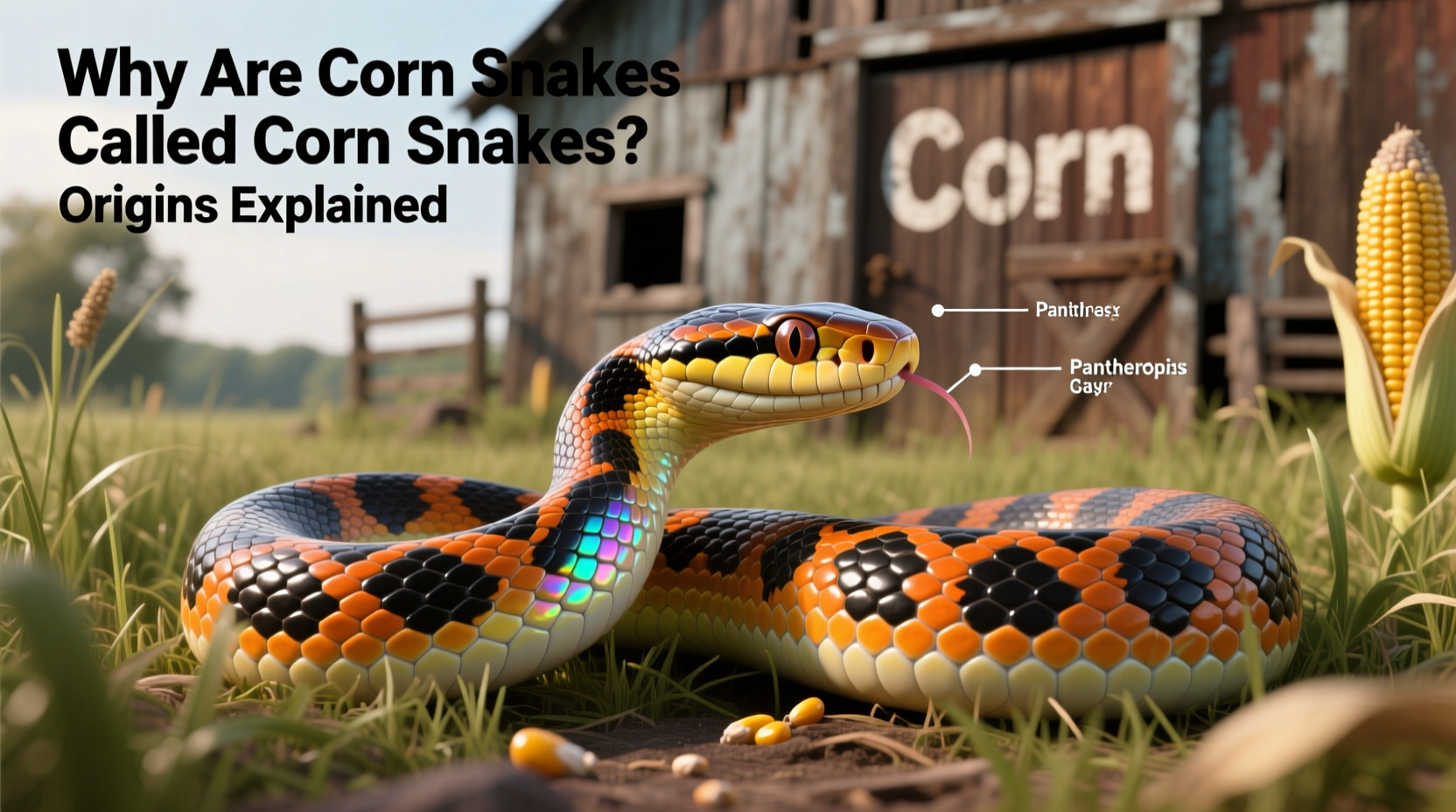
The most widely accepted explanation for the name “corn snake” is rooted in appearance. Corn snakes typically display large, checkered belly patterns composed of black-and-white squares. These markings closely resemble the kernels of Indian corn—or what’s historically known as maize—which was a staple crop in early American agriculture.
When viewed up close, especially on lighter-colored specimens, the ventral (belly) scales form a repeating geometric pattern that mimics dried corn kernels. Early farmers who encountered these snakes in grain storage areas may have made the visual association quickly, leading to the nickname “corn snake.” Over time, the name stuck—even though the snake does not eat corn.
Tip: If you're observing a corn snake in person, flip it gently (with proper handling technique) to see the distinctive belly pattern—it's one of the best ways to confirm its identity.Historical Habitat: Snakes in the Corn Cribs
Another compelling reason for the name ties into behavior and environment. In the 18th and 19th centuries, farmers stored harvested corn in wooden structures called corn cribs. These enclosures were elevated to deter rodents but often attracted mice and rats seeking food. Corn snakes, being skilled rodent hunters, followed their prey into these cribs.
Farmers regularly found corn snakes nestled among the ears of corn, hunting mice. Since the snakes were so commonly seen in corn storage areas, they became associated with the crop itself. This ecological niche reinforced the name, even if unintentionally. Rather than naming the snake after its predatory role, people named it after where they most often encountered it.
This habit also underscores an important ecological benefit: corn snakes helped control rodent populations, protecting valuable grain supplies. Their presence, though sometimes startling, was ultimately beneficial to farms.
Linguistic Evolution: From “Corn” to “Coronella”?
Some herpetologists propose an alternative theory involving linguistic corruption. The term may derive from the Latin word *coronella*, meaning “little crown,” which refers to the faint crown-like markings often visible on the snake’s head. Older scientific classifications placed corn snakes in the genus *Elaphe*, which includes Old World rat snakes sometimes referred to as \"coronellae.\"
It's possible that English-speaking settlers misheard or anglicized “coronella” into “corn snake” over time. While this theory is less supported by direct evidence, it remains plausible given the phonetic similarity and the presence of crown-like head patterns in many individuals.
However, most experts favor the visual and ecological explanations over the linguistic one. The consistency of the belly pattern across wild-type corn snakes, combined with their documented presence in corn storage facilities, makes the kernel-mimicry theory the strongest.
“Farmers didn’t need taxonomy—they named animals by what they saw and where they found them. A snake with a belly like corn kernels, living in the corn crib, was bound to be called a ‘corn snake.’” — Dr. Alan Henderson, Herpetologist, University of Georgia
Debunking Common Myths
Despite the clarity of historical evidence, several myths persist about the origin of the name:
- Myth: Corn snakes eat corn.
Reality: They are carnivores and feed exclusively on small mammals, birds, and eggs. They cannot digest plant matter. - Myth: “Corn” refers to their coloration resembling yellow corn.
Reality: While some corn snakes are orange or yellow, many come in shades of gray, brown, or even albino. The belly pattern—not overall body color—is the key link to corn kernels. - Myth: The name was invented by pet trade marketers.
Reality: Historical records from the 1700s reference “corn snakes,” long before the modern pet industry existed.
Evolution of the Name in Scientific Literature
The first formal mention of the corn snake in Western science appears in the work of Swedish botanist and zoologist Carl Linnaeus. In 1766, he classified the species as *Coluber guttatus*—later reclassified as *Pantherophis guttatus*. Though Linnaeus used a Latin descriptor (*guttatus*, meaning “spotted”), he noted its frequent presence near human dwellings and granaries.
By the 1800s, American field guides and agricultural manuals began using the common name “corn snake” consistently. Its association with farmland and grain stores cemented the term in regional dialects across the southeastern United States, where the species is native.
Timeline: How the Name Took Hold
- Pre-1700s: Native American tribes observe the snake but use different names based on local languages.
- 1766: Linnaeus formally describes the species as *Coluber guttatus*.
- Early 1800s: Farmers in Virginia, the Carolinas, and Georgia begin calling it the “corn snake” due to its presence in cribs.
- Mid-1800s: Naturalists adopt the common name in field journals and regional surveys.
- 20th Century: The name becomes standard in both scientific communication and pet trade literature.
Modern Implications for Pet Owners
Today, corn snakes are one of the most bred and morphologically diverse reptiles in captivity. Breeders have developed hundreds of color variations—amelanistic (albino), snow, caramel, and striped forms—many of which lack the traditional belly pattern. Yet, regardless of appearance, all remain *Pantherophis guttatus* and retain the name “corn snake.”
This continuity highlights how deeply embedded the name has become in both scientific and popular culture. Even when visual cues fade due to selective breeding, the historical legacy persists.
| Feature | Wild-Type Corn Snake | Common Captive Morph | Relevance to Name Origin |
|---|---|---|---|
| Belly Pattern | Distinct black-and-white checkerboard | May be faded or absent | Strong—directly resembles corn kernels |
| Habitat Association | Found in fields, forests, barns | Exclusively captive | Moderate—original name tied to farm settings |
| Diet | Rodents, birds, eggs | Rodents (frozen/thawed) | None—no connection to corn consumption |
Mini Case Study: The Farmer’s Observation
In 1823, a farmer in eastern Tennessee recorded in his journal: “Found another red-speckled serpent in the south crib this morning. It lay coiled beneath a stack of ears, nose deep in a dead mouse. Wife says it looks like the markings on Grandmother’s seed corn. We’ll call it the corn snake, then.”
This anecdote, preserved in a county historical archive, illustrates how ordinary observation led to lasting nomenclature. No scientific training was needed—just a sharp eye and a practical mind. Such firsthand accounts reinforce how folk taxonomy often precedes formal classification.
Frequently Asked Questions
Do corn snakes actually eat corn?
No, corn snakes are carnivorous and eat only animal-based foods such as mice, rats, and occasionally bird eggs. They lack the digestive system to process plant material like corn.
Are corn snakes related to rat snakes?
Yes. Corn snakes are a type of rat snake, belonging to the genus *Pantherophis*. They share behavioral and morphological traits with other North American rat snakes, including their climbing ability and rodent-hunting habits.
Why do some corn snakes look nothing like corn?
Decades of selective breeding in captivity have produced numerous color and pattern mutations (morphs). While albinos, snows, and stripes differ greatly from wild types, they are still genetically the same species and inherit the common name.
Final Thoughts: A Name Rooted in Observation
The name “corn snake” endures not because of scientific precision, but because of human observation and practical labeling. It reflects how early Americans interacted with nature—not through classification systems, but through daily experience. A snake with a belly like corn, found among harvested grain, earned a name that has lasted centuries.
Understanding the origin enriches our appreciation of this remarkable reptile. Whether you keep a wild-type corn snake with classic patterning or a vibrant lavender morph, you’re caring for a creature whose very name tells a story of farms, food, and folklore.
💬 Did you know the origin of the name before reading this? Share your thoughts or experiences with corn snakes in the comments below!








