
Calico cats—those striking felines with patchwork coats of orange, black, and white—are among the most visually distinctive cats in the world. Their bold coloration isn't just beautiful; it's deeply tied to genetics in a way that makes these cats almost exclusively female. The reason lies in the complex interplay between sex chromosomes and gene expression. Understanding this phenomenon reveals not only how coat color is inherited but also how biology shapes physical traits through mechanisms like X-chromosome inactivation.
The Genetics Behind Coat Color in Cats
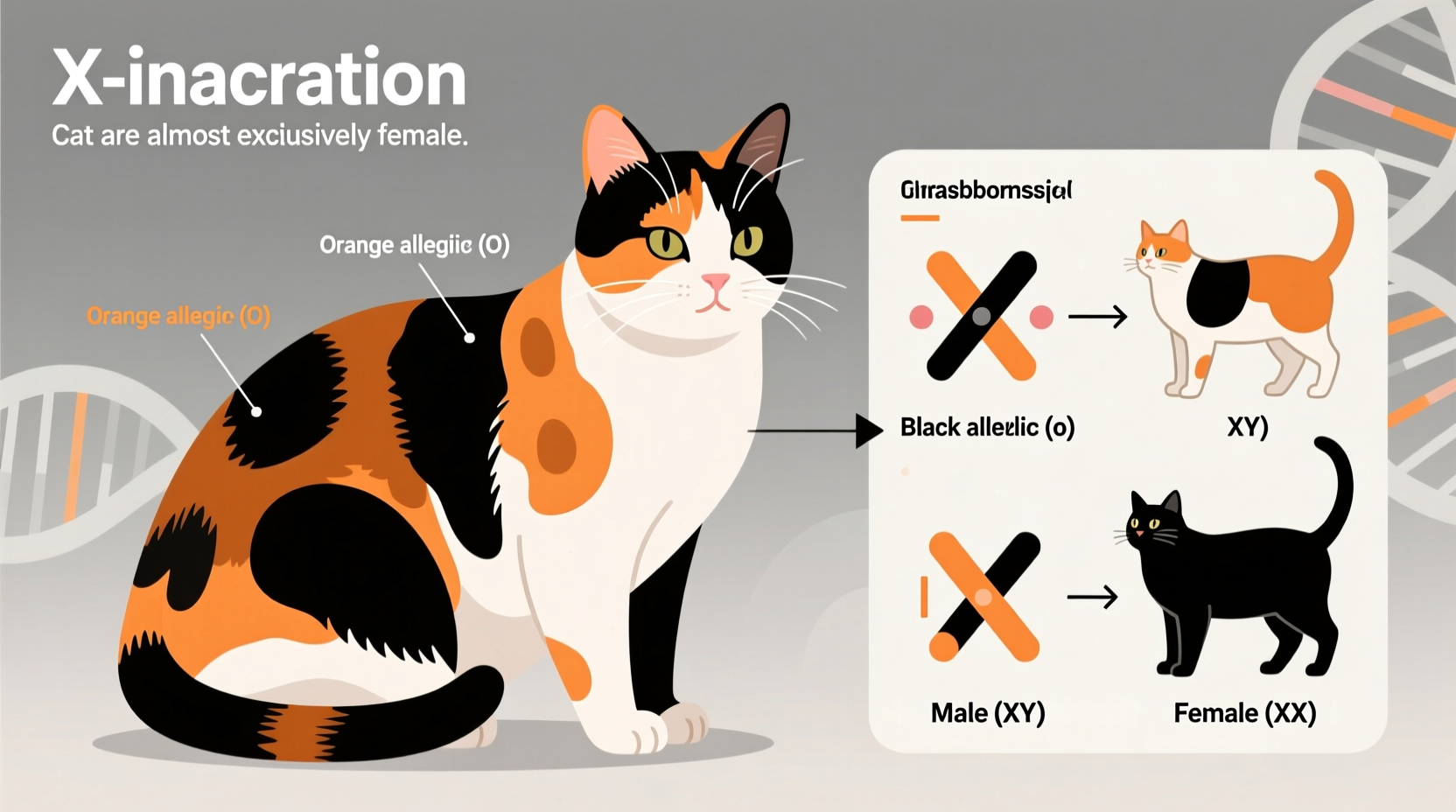
Cat coat color is influenced by several genes, but two key ones determine the orange and black patches seen in calico cats: the orange gene (O/o) and the white spotting gene (S/s). The orange gene is located on the X chromosome, making it a sex-linked trait. This means its inheritance pattern differs between males and females due to differences in their chromosomal makeup.
Female cats have two X chromosomes (XX), while males typically have one X and one Y chromosome (XY). Because the orange gene resides on the X chromosome, a female cat can carry two versions—one for orange and one for non-orange (black or brown)—on her paired X chromosomes. A male, with only one X chromosome, can express either orange or black, but not both—unless something unusual occurs.
The white in calico cats comes from a separate gene called the piebald or white spotting gene, which controls how much white appears on the coat. It’s autosomal, meaning it’s not linked to sex chromosomes, so both males and females can inherit it equally.
Tip: Calico is not a breed—it's a coat pattern found across many breeds, including domestic shorthairs, American Shorthairs, and Persians.X-Chromosome Inactivation: The Key to Patchwork Coats
In female mammals, including cats, one of the two X chromosomes is randomly inactivated in each cell during early embryonic development. This process, known as X-inactivation or Lyonization, ensures that females don’t produce twice as many X-linked gene products as males.
In the case of calico cats, if a female inherits one X chromosome with the orange allele (O) and another with the non-orange (black) allele (o), X-inactivation leads to a mosaic pattern. Some cells express the orange allele, others the black. As the embryo grows, these cells divide and form patches of fur color based on which X chromosome remains active in that lineage of cells.
This random inactivation results in the irregular, splotchy distribution of orange and black fur characteristic of calico cats. The white areas are determined independently by the white spotting gene, creating the full tri-color effect.
“X-inactivation is a remarkable example of epigenetic regulation—it doesn’t change the DNA sequence, but it dramatically affects how genes are expressed.” — Dr. Laura Mitchell, Molecular Geneticist at UC Davis School of Veterinary Medicine
Why Male Calico Cats Are So Rare
Male cats, having only one X chromosome, usually carry either the orange (O) or non-orange (o) allele—but not both. Therefore, they cannot naturally display both orange and black patches required for the calico pattern. A typical male cat will be either orange, black, gray, or a combination influenced by other genes, but never the distinct calico tri-color unless an exception occurs.
The rare male calico cats exist due to a genetic anomaly: Klinefelter syndrome (XXY). In these cases, the male cat has two X chromosomes and one Y chromosome. This gives him the potential to inherit both the orange and black alleles, allowing for the same X-inactivation mechanism seen in females. However, XXY males are almost always sterile and occur in approximately 1 in every 3,000 calico cats.
Another rare possibility is chimerism—when two embryos fuse early in development, resulting in a single cat with mixed cell lines. If one cell line carries the orange allele and another carries black, and the cat also expresses white spotting, a calico-like appearance may result—even in a genetically XY male.
Genetic Possibilities for Calico Expression
| Genotype | Sex | Can Be Calico? | Explanation |
|---|---|---|---|
| XX | Female | Yes | Can carry both O and o alleles; X-inactivation creates patches |
| XY | Male | No (typically) | Only one X chromosome—cannot express both colors |
| XXY | Male (Klinefelter) | Rarely Yes | Has two Xs, enabling dual color expression |
| Chimera (mixed cells) | Male or Female | Possibly | Fusion of embryos allows multiple color lines |
Mini Case Study: The $1,000 Male Calico
In 2021, a shelter in Portland, Oregon, took in a calico kitten believed to be female. During a routine health check, veterinarians discovered the cat was genetically male. Genetic testing confirmed Klinefelter syndrome (XXY). Word spread quickly, and local media dubbed the cat “the million-to-one kitty.” Though the shelter didn’t charge adoption fees, offers poured in—including one for $1,000 to keep the cat as a breeder (which was declined, as XXY males are sterile).
The case highlighted both public fascination with rare genetics and the importance of proper veterinary diagnostics. More importantly, it reminded animal lovers that behind every unusual trait lies a story written in DNA.
Step-by-Step: How Calico Patterns Develop in Embryos
- Fertilization: A female cat inherits one X chromosome from each parent. Suppose she gets XO (orange) from her father and Xo (black) from her mother.
- Early Development: Around the blastocyst stage, cells begin randomly silencing one X chromosome in each cell.
- Mosaicism Emerges: Cells with active XO will produce orange pigment (pheomelanin); those with active Xo produce black/brown (eumelanin).
- Cell Division: As skin and hair follicle cells multiply, they form clusters of the same color, creating visible patches.
- White Spotting: Separately, the white spotting gene limits pigment migration during development, leaving unpigmented (white) regions.
- Final Coat: By birth, the combination of X-inactivation mosaicism and white spotting produces the iconic calico pattern.
FAQ: Common Questions About Calico Cats
Are all calico cats female?
No, but over 99% are. The vast majority of calico cats are female because the genetics require two X chromosomes. Male calicos exist but are extremely rare and usually sterile due to genetic abnormalities like XXY syndrome.
What is the lifespan of a calico cat?
Calico refers only to coat color, not breed or health. Lifespan depends on genetics, care, and environment. Most live 12–18 years, similar to other domestic cats. There’s no evidence that being calico affects longevity.
Can calico cats have different eye colors?
Yes. Eye color is controlled by separate genes unrelated to coat color. Calico cats often have green, gold, or copper eyes. Some may even exhibit heterochromia (two different colored eyes), especially if they carry white-spotting or other pigment-distribution genes.
Conclusion: Celebrating the Science Behind Beauty
The near-exclusive femaleness of calico cats is more than a fun fact—it’s a vivid illustration of how genetics shapes life in unexpected ways. From X-chromosome inactivation to rare chromosomal variations, the story of the calico cat bridges basic biology and real-world wonder. These cats remind us that beauty often arises from complexity, and even something as simple as fur color can reveal deep truths about inheritance and cellular function.
💬 Did you know a male calico cat could be a sign of a genetic rarity? Share this article to spread the science behind one of nature’s most colorful mysteries.








