
In the United States, service animals are protected under the Americans with Disabilities Act (ADA), granting individuals with disabilities the right to be accompanied by trained service dogs in public spaces. Unlike emotional support animals or therapy dogs, service animals undergo specific task-based training to assist with a disability. While registration is not legally required, proper training and documentation can help ensure smooth access and avoid misunderstandings. This guide outlines the legitimate, step-by-step process to train and recognize your dog as a service animal under current federal regulations.
Understanding Service Animals Under the ADA
The ADA defines a service animal as a dog that is individually trained to do work or perform tasks for a person with a disability. These tasks must be directly related to the individual’s disability. Examples include guiding individuals who are blind, alerting those who are deaf, retrieving dropped items for someone with mobility limitations, interrupting anxiety attacks, or detecting oncoming seizures.
It's critical to distinguish between service animals, emotional support animals (ESAs), and therapy dogs:
| Type of Animal | Legal Protection | Public Access Rights | Training Required |
|---|---|---|---|
| Service Animal | ADA | Full public access | Yes – task-specific |
| Emotional Support Animal (ESA) | FHA, ACAA | Limited – no public access | No formal training required |
| Therapy Dog | None | No public access rights | Temperament training only |
Only dogs qualify as service animals under the ADA. Miniature horses may also be permitted in certain circumstances, but no other species—including cats, reptiles, or rodents—are recognized.
“Service animals are not pets—they are working partners trained to mitigate their handler’s disability. Their legitimacy comes from function, not certification.” — Dr. Rebecca Smith, Certified Applied Animal Behaviorist
Step-by-Step Process to Train Your Service Dog
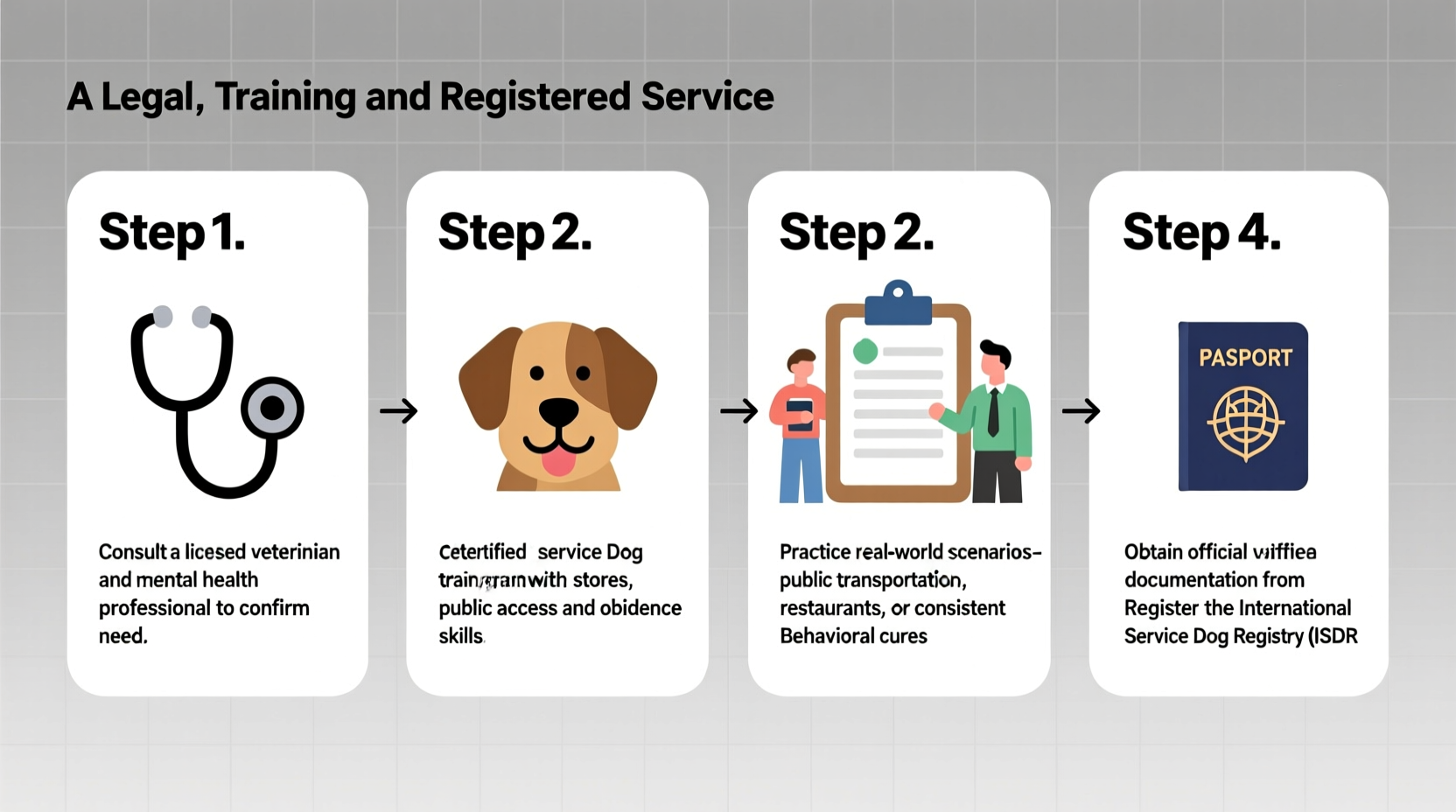
There is no federally mandated program for training a service dog; individuals may train their own dogs. However, the training must be thorough and focused on both obedience and disability-related tasks. Follow this timeline for effective results:
- Assess Suitability (Weeks 1–2): Evaluate your dog’s temperament, health, and focus. Ideal candidates are calm, responsive, and not easily distracted. Breeds like Labrador Retrievers, Golden Retrievers, and Standard Poodles are common, but any breed or mix can qualify if capable.
- Begin Basic Obedience (Weeks 3–12): Teach commands such as sit, stay, come, heel, down, and leave it. Use positive reinforcement methods consistently. The dog should respond reliably even in distracting environments.
- Introduce Public Access Skills (Months 4–6): Practice in real-world settings: sidewalks, stores, transit systems, and restaurants. The dog must remain under control, ignore distractions, and refrain from inappropriate behavior like barking or sniffing merchandise.
- Train Task-Specific Behaviors (Ongoing): Tailor tasks to your disability. For example:
- Psychiatric disability: Deep pressure therapy during panic attacks
- Mobility limitation: Opening doors, turning on lights, bracing for balance
- Diabetes: Alerting to blood sugar fluctuations
- Conduct Final Evaluation (Month 6+): Assess whether the dog performs all necessary tasks reliably and behaves appropriately in public. Consider using a third-party evaluator familiar with ADI (Assistance Dogs International) standards.
Registration, Certification, and Documentation
A common misconception is that service dogs must be registered or certified. In reality, the ADA does not require or recognize any official registry. Websites selling “service dog certification” or “ID cards” provide no legal standing. However, while not mandatory, some handlers choose to carry documentation for smoother interactions.
What you can do:
- Obtain a letter from a licensed mental health professional or physician confirming your disability and need for a service animal (especially useful for housing or travel).
- Purchase an ID badge or vest for your dog—not legally required, but signals to others that the dog is working.
- Use voluntary registries for personal reference or emergency contact purposes (e.g., microchip registration).
Landlords and airlines may request documentation under Fair Housing Act (FHA) or Air Carrier Access Act (ACAA) rules, but they cannot demand certification. Acceptable forms include:
- Medical provider letter on official letterhead
- Statement describing the dog’s trained tasks
- Proof of vaccinations and licensing
Real-Life Example: Training a PTSD Service Dog
Sarah, a veteran diagnosed with PTSD, decided to train her two-year-old rescue dog, Max, as a service animal. She began with basic obedience using online resources and local classes. Over six months, she trained Max to perform specific tasks: waking her from nightmares by pawing her shoulder, creating space in crowded areas by positioning himself beside her, and turning on lights during anxiety episodes.
To prepare for public access, Sarah practiced at quiet parks, then gradually moved to busier locations. She carried a training log and obtained a letter from her therapist supporting Max’s role. When moving into a new apartment complex, management initially refused to allow Max. After providing the therapist’s letter and explaining his trained tasks under FHA guidelines, the landlord granted approval.
Today, Max accompanies Sarah everywhere—from grocery stores to airports—without issue. Her preparation and understanding of the law made the difference.
Frequently Asked Questions
Do I need to register my service dog?
No. Registration is not required by federal law. Any website claiming to “certify” your dog as a service animal is selling a non-binding product. Your dog’s status is based on training and necessity, not paperwork.
Can any dog become a service animal?
Yes, regardless of breed or size, as long as the dog is capable of performing tasks related to your disability and can behave appropriately in public. Aggressive or overly anxious dogs are typically unsuitable.
Can businesses ask about my service dog?
Only two questions are permitted under the ADA: (1) Is the dog required because of a disability? and (2) What work or task has the dog been trained to perform? Staff cannot request documentation, a demonstration, or disclosure of the disability.
Final Checklist Before Going Public
Before relying on your dog in public settings, verify the following:
- ✅ The dog reliably performs at least one task directly related to your disability
- ✅ Demonstrates excellent obedience in noisy, busy environments
- ✅ Remains calm and focused without excessive barking, pulling, or sniffing
- ✅ Is housebroken and well-groomed
- ✅ You carry a medical letter if needed for housing or air travel
- ✅ You understand your rights and responsibilities under the ADA
Conclusion
Training and recognizing your dog as a service animal is a serious commitment that requires time, consistency, and a clear understanding of the law. Legal recognition comes not from purchased certificates, but from rigorous training and the dog’s ability to perform essential tasks. By following structured steps, documenting progress, and knowing your rights, you can successfully integrate your service dog into daily life with confidence and dignity.
💬 Have experience training a service dog? Share your journey or advice in the comments to help others navigate this important process.








