For owners of hyperactive dogs, mealtime often feels like a 30-second event followed by hours of bouncing off walls. You’ve tried walks, play sessions, and even obedience drills—yet your dog still seems wired. The real solution might not be more exercise, but smarter feeding. Two popular tools dominate this space: slow feeder bowls and puzzle toys. But which one truly wears down an overstimulated pup? The answer isn’t as simple as choosing between speed and complexity—it’s about understanding how each tool engages your dog’s body and mind.
Dogs don’t just burn energy through movement; they also deplete mental reserves when solving problems. Hyperactivity often stems from under-stimulation, not excess energy. That’s why the right feeding strategy can be more effective than another lap around the block. This article breaks down the mechanics, benefits, and limitations of slow feeder bowls versus puzzle toys, backed by behavioral science and real-world application.
How Slow Feeder Bowls Work—and What They Actually Do
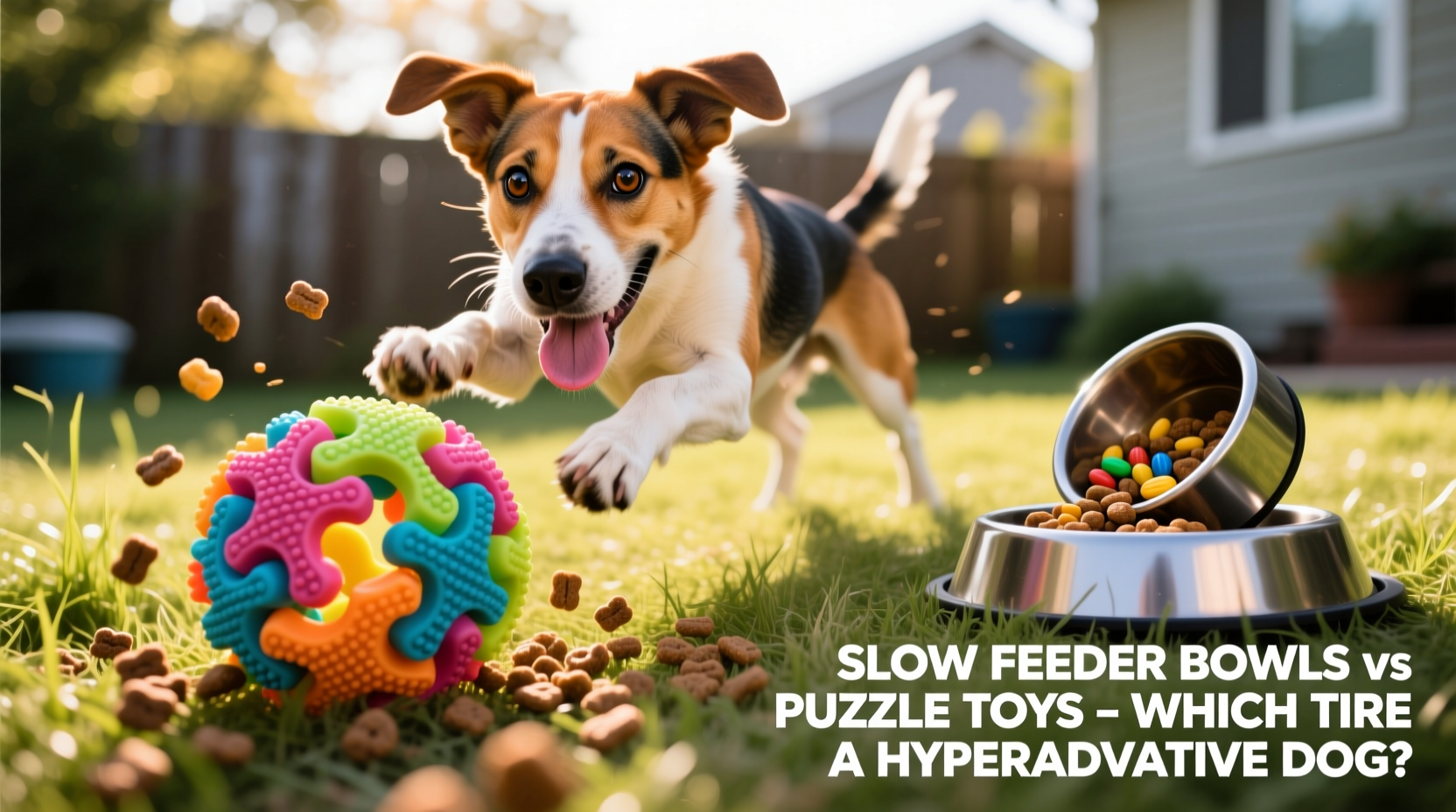
Slow feeder bowls are designed with ridges, barriers, or maze-like patterns that force dogs to eat around obstacles. Their primary function is to extend meal duration. Instead of gulping down food in under a minute, a dog may take 10–20 minutes to extract every kibble. This addresses a well-documented issue: rapid eating, which can lead to bloating, choking, and poor digestion.
But do they tire dogs out?
Not directly. Slow feeders engage minimal cognitive effort. Most dogs adapt quickly, learning the layout after a few uses. Once mastered, these bowls become routine—more like eating from a textured plate than solving a challenge. The benefit lies in physical pacing and digestive health, not mental fatigue.
Tip: Use a slow feeder bowl if your dog eats too fast or has a history of bloat. It won’t tire them mentally, but it supports long-term health.That said, some advanced models incorporate elevation or multi-chamber designs that require slight pawing or nudging. These add marginal engagement, but still fall short of true problem-solving. For a truly tired dog, you need more than resistance—you need mental investment.
Puzzle Toys: Where Mental Fatigue Begins
Puzzle toys demand active thinking. From sliding drawers to rotating compartments, they require dogs to manipulate parts using nose, paws, or mouth to access hidden food. Unlike slow feeders, puzzles vary in difficulty and rarely become automatic. Each time a dog encounters a new configuration, it must reassess and adapt.
This cognitive load is where exhaustion begins. Studies show that 20 minutes of focused problem-solving can be as tiring as 60 minutes of physical exercise. Dr. Brian Hare, canine cognition expert at Duke University, explains:
“Dogs are natural problem solvers. When you tap into that instinct, you’re not just feeding them—you’re engaging their evolutionary brain. That kind of work burns mental energy in a way walking doesn’t.” — Dr. Brian Hare, Canine Cognitive Researcher
Puzzle toys come in levels: beginner (e.g., treat-dispensing balls), intermediate (e.g., flip-top trays), and advanced (e.g., multi-step logic puzzles). The best ones require trial, error, memory, and persistence. For a hyperactive dog, this sustained focus redirects restless energy into productive channels.
Direct Comparison: Features, Benefits, and Limitations
| Feature | Slow Feeder Bowls | Puzzle Toys |
|---|---|---|
| Primary Purpose | Slow down eating speed | Stimulate problem-solving |
| Cognitive Demand | Low to moderate (after adaptation) | Moderate to high (especially advanced puzzles) |
| Time Spent Engaged | 5–20 minutes per meal | 10–45+ minutes depending on difficulty |
| Durability | High—simple design, fewer moving parts | Varies—plastic may crack under strong jaws |
| Cleaning Ease | Easy—most are dishwasher-safe | Harder—crevices trap food, require scrubbing |
| Best For | Dogs who gulp food or have digestive issues | Hyperactive, intelligent breeds needing mental work |
| Fatigue Level Produced | Minimal mental fatigue, slight physical delay | Significant mental fatigue, potential physical exertion |
The data shows a clear pattern: while both tools involve food, only puzzle toys consistently deliver the kind of engagement that leads to genuine tiredness. A Border Collie finishing a level-3 puzzle may lie down immediately afterward—not from boredom, but from mental satiation.
A Real Example: Managing a High-Energy Rescue
Consider Max, a 2-year-old Australian Shepherd rescue adopted by a family in Colorado. Despite two daily runs and frequent fetch sessions, Max paced at night, barked at shadows, and chewed baseboards. His vet ruled out medical causes and suggested environmental enrichment.
The family first introduced a rubber slow feeder bowl. Mealtime increased from 45 seconds to 12 minutes. While digestion improved, Max’s overall behavior didn’t change. Then they added a series of puzzle toys: starting with a Kong Wobbler, progressing to a Nina Ottosson Dog Tornado, and eventually introducing DIY cardboard mazes filled with kibble.
Within three weeks, Max’s nighttime activity dropped by 70%. He spent 20–30 minutes each morning working on his puzzle, often lying down afterward without prompting. His owner noted, “It’s not that he’s less energetic—he’s just no longer searching for things to do. The puzzle gives him a job.”
This case illustrates a key principle: hyperactivity is often purposelessness in motion. Puzzle toys provide purpose. Slow feeders merely delay gratification.
Step-by-Step Guide to Choosing and Using the Right Tool
Not every dog needs the same approach. Here’s how to build an effective feeding strategy based on your dog’s temperament and lifestyle:
- Assess Your Dog’s Behavior: Does your dog eat rapidly but settle easily afterward? A slow feeder may suffice. If they remain restless post-meal, mental stimulation is likely lacking.
- Start Simple: Introduce a basic puzzle toy (e.g., treat ball) during breakfast. Monitor interest and success rate. Avoid frustration—success should happen within a few minutes initially.
- Increase Difficulty Gradually: As your dog masters one level, move to more complex puzzles. Rotate toys weekly to prevent habituation.
- Use Meals as Enrichment: Replace one full meal per day with puzzle feeding. This ensures consistent engagement without over-relying on treats.
- Combine Tools Strategically: Use a slow feeder for dinner (to aid digestion) and a puzzle toy for breakfast (to stimulate early-day focus).
- Monitor Progress: Track changes in resting behavior, attention span, and destructive tendencies. True mental fatigue shows up as longer naps, calmer greetings, and reduced reactivity.
When to Use Both—And When to Skip One
The most effective routines often combine both tools—but not interchangeably. Think of slow feeders as health aids and puzzle toys as workout equipment.
- Use only a slow feeder if your dog has gastrointestinal sensitivities, is a senior, or simply eats too fast. Ideal for dogs with low-to-moderate energy.
- Use only puzzle toys if your dog is highly intelligent (e.g., herding, working breeds), prone to boredom, or exhibits obsessive behaviors like spinning or shadow-chasing.
- Use both for balanced dogs needing digestive support and mental engagement. Example: slow feeder at dinner, puzzle toy at breakfast.
- Skip both if your dog has vision impairments, severe anxiety, or joint pain that makes manipulation painful. In such cases, consult a vet or behaviorist for alternatives.
Frequently Asked Questions
Can puzzle toys replace walks for tiring out my dog?
Not entirely, but they can reduce the need for excessive physical exercise. A mentally exhausted dog often requires shorter or less intense walks. Combine both for optimal balance—mental work in the morning, physical activity later.
My dog loses interest in puzzle toys after a few days. What am I doing wrong?
Likely causes include insufficient reward value, overly difficult design, or lack of variety. Try using higher-value treats (e.g., peanut butter, cooked chicken), simplifying the puzzle, or rotating toys every 2–3 days to renew interest.
Are slow feeder bowls safe for all dogs?
Most are, but avoid deep or tall designs for brachycephalic breeds (e.g., Bulldogs, Pugs), as they can strain the neck. Always supervise initial use to ensure comfort and safety.
Final Checklist: Choosing the Right Tool for Your Dog
✅ Is your dog a fast eater? → Include a slow feeder ✅ Does your dog seem bored despite exercise? → Prioritize puzzle toys ✅ Do they solve problems quickly? → Invest in advanced-level puzzles ✅ Are they easily frustrated? → Start with easy puzzles and offer guidance ✅ Do they destroy toys? → Choose durable, non-toxic materials (e.g., rubber, stainless steel) ✅ Do you want long-term calm? → Make puzzle feeding a daily habit
Conclusion: Mental Work Wins Over Mechanical Delay
Slow feeder bowls serve an important role in canine health—they prevent choking and support digestion. But when it comes to genuinely tiring out a hyperactive dog, puzzle toys are the superior choice. They transform passive eating into active problem-solving, draining the mental reserves that drive restlessness.
The goal isn’t just to keep your dog busy. It’s to give them meaningful work. A dog that spends 20 minutes unlocking a puzzle isn’t just occupied—they’re fulfilled. And a fulfilled dog is a relaxed dog.
If you’ve been relying solely on walks and play to manage hyperactivity, consider shifting part of that effort to mealtimes. Replace one bowl a day with a puzzle. Watch how your dog changes—not just in energy level, but in focus, confidence, and peace.
💬 Have you tried puzzle toys or slow feeders? Share your experience below. Which one made your dog truly crash afterward?








