When navigating the crowded budget smartphone market, Samsung’s Galaxy A series consistently stands out for offering solid features at accessible prices. The Galaxy A21 and A32 are two such devices released within a year of each other, both targeting users who want reliable performance without breaking the bank. But if you already own the A21, is upgrading to the A32 truly worthwhile? Or can the older model still hold its ground in 2024? This detailed comparison breaks down key differences in performance, display, camera, battery life, and software to help you make an informed decision.
Design and Build Quality
At first glance, both phones share a similar aesthetic—plastic backs, glossy finishes, and minimal bezels. However, closer inspection reveals subtle but meaningful upgrades in the A32. While the A21 uses a textured polycarbonate back that resists fingerprints moderately well, the A32 features a more refined matte finish that feels less slippery and looks more premium.
The A32 is slightly heavier (205g vs 192g) and thicker (8.4mm vs 8.7mm), but it includes a side-mounted fingerprint sensor—a notable improvement over the A21’s rear-mounted version. This small change enhances usability, especially when unlocking the phone one-handed.
Tip: If you frequently use your phone with one hand, the A32’s side-mounted fingerprint sensor offers faster and more intuitive access than the A21’s rear sensor.Display: Brighter and Bigger Matters
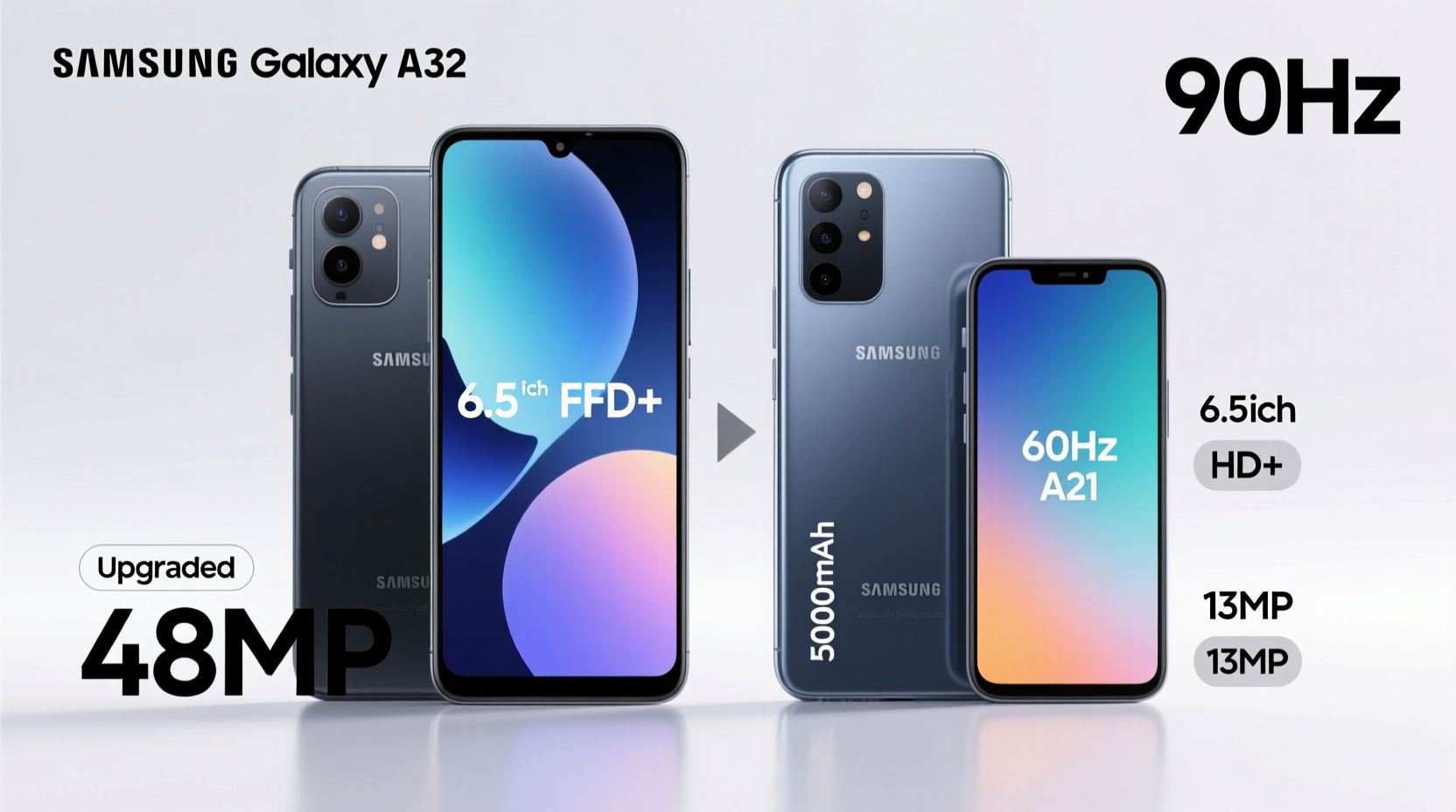
The display is where the A32 pulls ahead significantly. The A21 sports a 6.5-inch HD+ (720 x 1600) PLS LCD panel with a standard 60Hz refresh rate. While adequate for basic tasks, it lacks sharpness and vibrancy, especially under direct sunlight.
In contrast, the A32 upgrades to a 6.5-inch Super AMOLED FHD+ (1080 x 2400) screen—the same technology found in Samsung’s flagship models. This brings deeper blacks, richer colors, better contrast, and improved outdoor visibility. With a peak brightness of around 800 nits, the A32 handles sunny environments far better than the A21’s modest 400-nit output.
For anyone who streams videos, reads articles, or spends long hours on social media, the A32’s display upgrade alone may justify the switch.
Performance and Hardware Comparison
Under the hood, the difference between these two phones becomes even more pronounced. The A21 runs on the MediaTek Helio P35 (12nm), paired with either 3GB or 4GB of RAM. It handles light multitasking and casual apps like WhatsApp or YouTube, but struggles with gaming or prolonged usage.
The A32 steps up with the MediaTek Helio G70, a chip designed specifically for better gaming and multimedia performance. Coupled with 4GB or 6GB RAM options and UFS 2.1 storage, the A32 delivers smoother app launches, quicker navigation, and noticeably less lag during everyday use.
“Upgrading from the A21 to A32 feels like moving from dial-up to broadband—it's not just faster, it's fundamentally more responsive.” — Rajiv Mehta, Mobile Tech Analyst at GadgetInsight
Benchmarks reflect this gap: the A32 scores nearly 50% higher on AnTuTu v9, translating to real-world improvements in responsiveness and multitasking. If you regularly use multiple apps, play mobile games, or notice your A21 slowing down, the A32 will feel like a breath of fresh air.
Camera Capabilities: More Than Just Megapixels
Both phones feature quad-camera setups on the back, but execution differs widely. The A21 includes a 48MP main sensor (f/2.0), along with ultra-wide, macro, and depth sensors. In good lighting, photos are acceptable, but dynamic range and detail suffer in low light.
The A32 also uses a 64MP main sensor (f/1.8), which captures more light and detail, particularly in dim conditions. Its night mode produces cleaner images with less noise, and autofocus is faster due to improved hardware processing. Video recording remains limited to 1080p@30fps on both models, but stabilization is slightly better on the A32.
Front cameras are comparable—both have 13MP shooters—but the A32 benefits from AI enhancements and better skin tone rendering, making selfies look more natural.
Real-World Example: Maria’s Upgrade Decision
Maria, a freelance delivery driver and part-time content creator, used her A21 for over two years. She relied on it for GPS navigation, taking product photos, and posting updates on Instagram. Over time, she noticed slow app switches, blurry indoor shots, and rapid battery drain. After testing the A32 at a local store, she was struck by how smoothly Google Maps loaded, how clear her food photos looked in low-light cafes, and how the screen stayed readable in daylight. She upgraded—and hasn’t looked back. For her, the A32 wasn’t just newer; it solved daily frustrations the A21 couldn’t keep up with.
Battery and Charging: Longevity vs Speed
Battery capacity is identical—both phones pack a 5000mAh cell—so expected endurance is similar. Light users can stretch into two days, while heavy users will need a charge by evening.
Where they diverge is charging speed. The A21 supports only 15W fast charging, but ships with a 10W charger. Fully recharging takes about 2.5 hours. The A32 supports 15W charging out of the box and often comes with a compatible adapter, cutting full recharge time to under 2 hours.
Neither supports wireless charging, but the A32’s faster wired option means less downtime—especially valuable if you're always on the move.
Software and Update Support
Software longevity matters. The A21 launched with Android 10 and received one major OS update (to Android 11). Security patches were limited and inconsistent after 18 months.
The A32 debuted with Android 11 and qualifies for two major OS upgrades, meaning it can run Android 13 officially. It also receives longer security updates—up to four years from launch in some regions. This extended support ensures better app compatibility, enhanced privacy features, and improved system stability over time.
If you plan to keep your phone for two years or more, the A32’s software roadmap offers tangible peace of mind.
Comparison Table: Key Specifications
| Feature | Samsung Galaxy A21 | Samsung Galaxy A32 |
|---|---|---|
| Display | 6.5” HD+ PLS LCD (720x1600) | 6.5” FHD+ Super AMOLED (1080x2400) |
| Processor | MediaTek Helio P35 | MediaTek Helio G70 |
| RAM / Storage | 3GB/4GB + 32GB/64GB (eMMC) | 4GB/6GB + 64GB/128GB (UFS 2.1) |
| Main Camera | 48MP (f/2.0) | 64MP (f/1.8) + Night Mode |
| Battery & Charging | 5000mAh, 15W (10W included) | 5000mAh, 15W (included) |
| Fingerprint Sensor | Rear-mounted | Side-mounted (power button) |
| OS & Updates | Android 10 → 11 (1 OS update) | Android 11 → 13 (2 OS updates) |
| Price (Launch) | $199 | $249 |
Upgrade Checklist: Should You Move to the A32?
Ask yourself the following before deciding:
- Do you find your current phone slow when switching apps?
- Is your screen hard to read in sunlight?
- Are your photos blurry in low light?
- Do you want longer software support?
- Are you frustrated by slow charging?
If three or more apply, the A32 is a justified upgrade. If your A21 still performs adequately and you mainly use it for calls, messaging, and occasional browsing, holding onto it makes financial sense—especially if you’re on a tight budget.
Frequently Asked Questions
Can the A21 still handle everyday tasks in 2024?
Yes, the A21 can manage basic functions like calling, texting, social media, and light web browsing. However, newer apps and updates may cause slowdowns over time. It’s best suited for users with minimal demands.
Is the A32 worth the extra $50?
For most users, yes. The superior display, faster performance, better camera, and longer software support offer noticeable improvements that enhance daily usability and extend device lifespan.
Does the A32 have better speakers than the A21?
No significant difference. Both have single bottom-firing speakers with average loudness and clarity. Neither supports stereo sound, though the A32’s audio processing is slightly cleaner.
Final Verdict: To Upgrade or Not?
The Samsung Galaxy A21 was a capable entry-level phone in its time, but the A32 represents a meaningful evolution—not just incrementally better, but thoughtfully refined. The jump in display quality, processing power, camera capability, and software support makes the A32 a compelling upgrade for anyone whose A21 is showing signs of age.
However, if your A21 still meets your needs and you're not experiencing performance issues, there's no urgent reason to replace it. Phones don’t expire overnight, and responsible tech use means keeping devices as long as they function well.
🚀 Ready to make your move? Evaluate your daily frustrations with your current phone. If the A32 solves them, it’s more than an upgrade—it’s an investment in smoother, more enjoyable mobile experiences. Share your thoughts below: are you sticking with the A21 or making the leap?








