For newcomers to sake, the grading system can feel like deciphering ancient calligraphy: layered, nuanced, and quietly intimidating. Terms like Junmai, Ginjō, and Daiginjō appear on labels with little context—and worse, they’re often misused in marketing. Yet behind this terminology lies a powerful clue about flavor profile, texture, and, most importantly for first-time drinkers: finish. A “clean finish” means the sake leaves your palate refreshed—not cloying, not heavy, not metallic or sour—but bright, subtle, and quietly satisfying, like a cool sip of mountain spring water after a walk through cedar forest.
This clarity doesn’t come from alcohol content or price alone. It emerges from how the rice is milled, how slowly the yeast ferments, and how precisely the brewer controls temperature and timing. In practice, the cleanest finishes are consistently found in two grades—Ginjō and especially Daiginjō—but only when brewed with intention, not just compliance. This article cuts through the noise, explains what each grade *actually* means (not just what the law says), and shows you exactly how to identify—and reliably enjoy—the cleanest, most beginner-friendly sakes on the shelf.
What Sake Grades Really Measure (and What They Don’t)
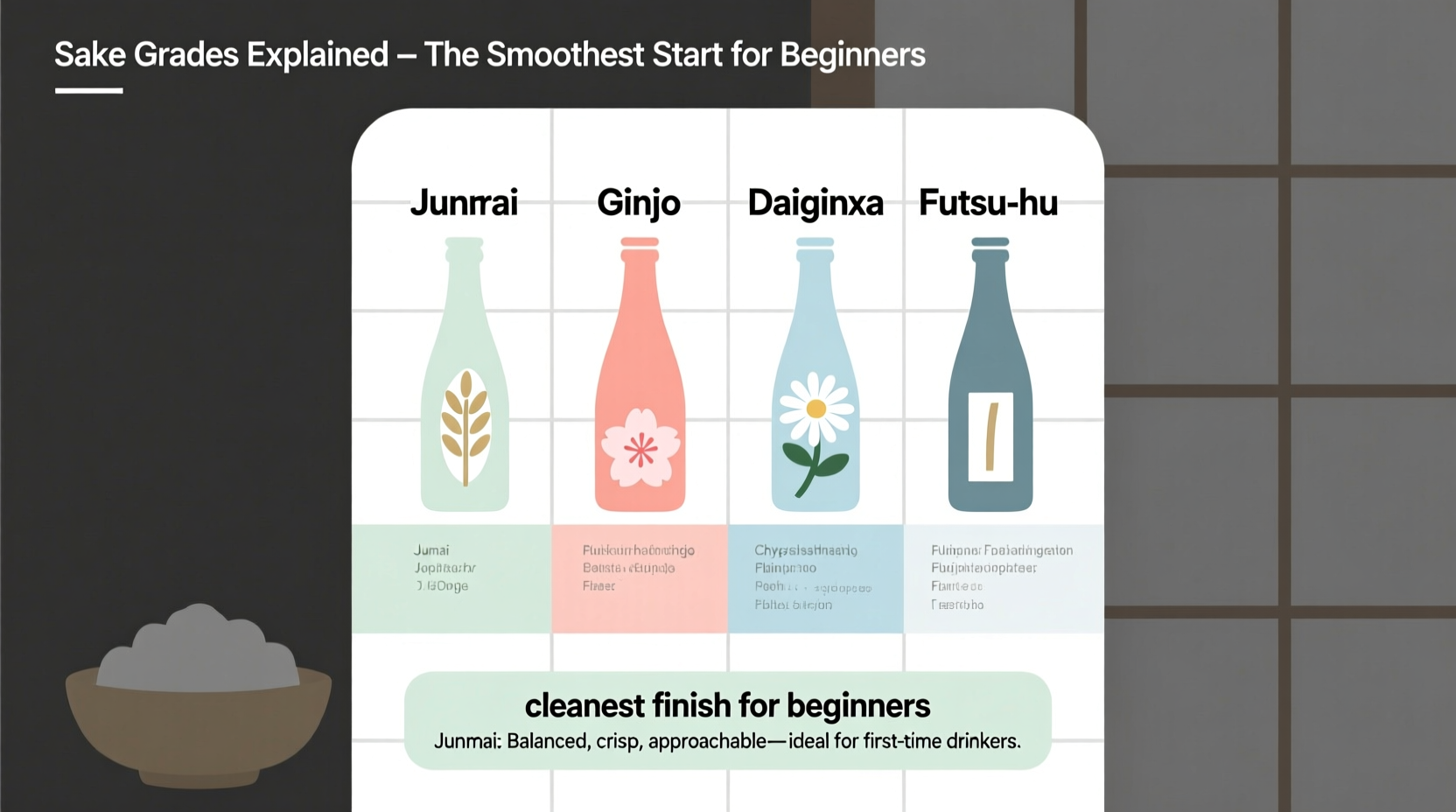
Sake grades in Japan are defined by Japan’s National Tax Agency under the Liquor Tax Act—not by quality, prestige, or even flavor—but by one technical criterion: the percentage of the rice grain remaining after polishing. The outer layers of the rice kernel contain fats, proteins, and minerals that contribute to heavier, more rustic, or sometimes harsh flavors. Removing them refines the base material, allowing delicate aromatic compounds—like ethyl caproate (apple) and isoamyl acetate (banana)—to emerge cleanly during fermentation.
Here’s the legal framework:
- Futsū-shu: No milling requirement. Up to 70% of the grain may remain (i.e., ≤30% polished away). Often blended with distilled alcohol and additives; broad spectrum of styles, many unrefined.
- Honjōzō: Rice milled to ≤70% remaining (≥30% polished away); small amount of brewing-grade alcohol added to enhance aroma and lighten body.
- Junmai: Rice milled to ≤70% remaining, with no added alcohol. Can range from earthy and full-bodied to surprisingly crisp—but finish depends heavily on brewing method, not just grade.
- Ginjō: Rice milled to ≤60% remaining (≥40% polished away). May be Honjōzō or Junmai. Fermented at low temperatures (often below 10°C) over 3–4 weeks for aromatic complexity and softness.
- Daiginjō: Rice milled to ≤50% remaining (≥50% polished away). The most refined legal category. Always fermented cold and slowly; alcohol addition is optional but common to lift fragrance and refine mouthfeel.
Crucially, grade does not guarantee style. A poorly made Daiginjō can taste thin or disjointed; a masterfully crafted Junmai can finish with startling purity. But statistically and experientially, the cleanest, most accessible finishes for beginners arise from the Ginjō and Daiginjō categories—not because they’re “better,” but because their production constraints naturally suppress roughness and amplify clarity.
Tip: When scanning a label, look for the seimaibuai (polishing ratio)—e.g., “50%” or “45%.” That number tells you more about potential finish than the grade name itself. Lower = finer milling = higher likelihood of clean, delicate expression.Why Daiginjō Delivers the Cleanest Finish—And When It Doesn’t
At its best, Daiginjō is sake’s equivalent of a perfectly tuned grand piano: resonant yet precise, rich yet weightless, complex yet effortlessly digestible. Its hallmark is a finish that lingers for just 3–5 seconds—not with bitterness or heat, but with a gentle, almost saline freshness and a whisper of white grape, pear skin, or steamed rice.
This isn’t magic. It’s physics and microbiology: milling to 50% or less removes nearly all bran-derived off-flavors. Cold fermentation slows yeast metabolism, reducing fusel alcohols (which cause warmth or sharpness) and encouraging ester formation—fragrant, fruity compounds that evaporate quickly, leaving no residue. Extended aging (even just 3–6 months in tank at near-freezing temps) further polishes texture, smoothing micro-tannins and volatile acidity.
But Daiginjō’s reputation for cleanliness has bred complacency. Some producers treat the grade as a checkbox: mill to 45%, add alcohol, ferment fast, and bottle early—yielding a sake that smells floral but tastes hollow or slightly alcoholic on the finish. True cleanliness requires patience: extended lees contact (kasu), minimal filtration, and careful temperature control during bottling.
“The cleanest Daiginjō isn’t the one with the lowest seimaibuai—it’s the one where every decision after milling serves harmony. If the finish doesn’t refresh, it’s not done.” — Kenji Kurosawa, Toji (Master Brewer) at Dassai Brewery, Yamaguchi Prefecture
For beginners, seek Daiginjō labeled nama-zume (unpasteurized, stored cold) or shiboritate (freshly pressed, released within 2–3 months). These emphasize vibrancy over preservation—and vibrancy, in this context, reads as brightness and clarity on the palate.
Ginjō: The Smart Starting Point for Most Beginners
If Daiginjō is the concert hall, Ginjō is the sunlit veranda—equally refined, slightly more grounded, and far more forgiving in both price and pairing. With rice milled to 60%, Ginjō retains a touch more umami and structure than Daiginjō, yet still achieves remarkable finesse when brewed well. Its finish is typically longer and more rounded than Futsū-shu or standard Junmai, but without the ethereal delicacy (and fragility) of top-tier Daiginjō.
What makes Ginjō uniquely beginner-friendly is its balance: enough aromatic lift to intrigue the nose (think yuzu zest, green apple, chamomile), enough body to feel substantial without heaviness, and a finish that cleanses rather than coats. It pairs effortlessly with everyday foods—grilled salmon, agedashi tofu, even mild cheeses—without demanding attention or special glassware.
Look for Ginjō-shu or Junmai Ginjō (the latter meaning no added alcohol). Avoid bottles labeled simply “Ginjō-style” or “Premium Ginjō”—these are unregulated terms. Legitimate Ginjō must display the seimaibuai and carry official certification.
| Grade | Min. Polishing | Typical Finish Profile | Beginner Friendliness | Price Range (720ml) |
|---|---|---|---|---|
| Futsū-shu | None required | Variable: often earthy, yeasty, or slightly sour; can be sharp or flat | Low—requires palate training | ¥800–¥1,500 |
| Honjōzō | ≤70% | Crisp and light; alcohol addition can lend dryness or slight heat | Moderate—best chilled and simple | ¥1,200–¥2,200 |
| Junmai | ≤70% | Full-bodied to medium; finish ranges from creamy to tangy—highly brewer-dependent | Medium—choose “Tokubetsu Junmai” for more consistency | ¥1,500–¥3,000 |
| Ginjō | ≤60% | Clean, aromatic, refreshing; lingering but non-sticky finish | High—ideal first serious step | ¥2,000–¥4,500 |
| Daiginjō | ≤50% | Exquisitely clean, delicate, and ephemeral; finish dissolves like mist | High—provided it’s well-made and served cold (6–8°C) | ¥3,500–¥8,000+ |
A Real-World Example: How One Tokyo Sake Bar Transformed Beginner Confidence
In Shinjuku, the tiny 12-seat bar Komorebi (meaning “sunlight filtering through leaves”) built its reputation on one principle: eliminate the barrier between curiosity and confidence. Owner Aiko Tanaka noticed that 70% of first-time customers ordered a flight of three sakes—and 60% left unsure which they’d actually enjoyed.
She redesigned her introductory flight around finish clarity, not prestige. Instead of leading with Daiginjō, she started with a crisp Junmai Ginjō from Niigata (milled to 55%, aged 4 months, unpasteurized), followed by a fruit-forward Ginjō from Hiroshima (60%, lightly carbonated), and capped it with a 45% Daiginjō from Kyoto—served at precisely 7°C in stemmed glassware.
“We don’t say ‘this is the best,’” Tanaka explains. “We say, ‘Notice how the first one feels gone in 4 seconds—no trace. The second lingers with citrus, then vanishes. The third? It’s like breathing cool air.’ We teach finish as sensation, not vocabulary.” Within six months, repeat visits from beginners rose 40%. More telling: 85% of those who tried the flight purchased a bottle to take home—most choosing the Ginjō.
The lesson? Clean finish isn’t abstract—it’s tactile, memorable, and deeply reassuring. When your palate isn’t fighting residual bitterness or alcohol burn, you begin to trust your own impressions.
Your Practical Starter Guide: Choosing & Serving for Maximum Cleanliness
Knowing the theory matters less than applying it correctly. Here’s how to translate grade knowledge into consistently clean-tasting experiences:
- Select wisely: Prioritize Ginjō or Daiginjō with stated seimaibuai ≤60% (ideally ≤55%). Look for “Nama-zume” (unpasteurized) or “Shiboritate” (freshly pressed) on the label—these indicate minimal processing and maximal vibrancy.
- Check the date: Sake is perishable. Look for bottling or “best by” dates. Consume Ginjō/ Daiginjō within 6–9 months of bottling if refrigerated; within 3 months once opened.
- Chill intentionally: Serve Ginjō at 6–8°C; Daiginjō at 5–7°C. Too warm, and alcohol and acidity dominate. Too cold, and aromas mute. Use a wine fridge or ice bucket with water and ice (not dry ice).
- Use proper glassware: A white wine glass or dedicated sake cup (like an ochoko with gentle curve) concentrates aroma without trapping alcohol vapors. Avoid wide tumblers or narrow shot glasses.
- Taste mindfully: Take a small sip. Let it coat your tongue. Swallow—or better, gently exhale through your nose while holding it. Then wait. Count how many seconds pass before the sensation fully clears. Under 5 seconds? That’s clean.
FAQ: Clearing Up Common Misconceptions
Does “Junmai Daiginjō” mean it’s cleaner than regular Daiginjō?
No—“Junmai” here only means no added alcohol was used. While some drinkers prefer the richer texture of Junmai Daiginjō, the absence of alcohol doesn’t inherently improve finish clarity. In fact, small amounts of brewing alcohol (within legal limits) can help volatilize off-notes and lift delicate aromas—enhancing, not obscuring, cleanliness. Focus on seimaibuai and producer reputation over the “Junmai” prefix alone.
Can I find clean-finish sake under ¥2,000?
Yes—but with nuance. Look for regional gems: a well-made Tokubetsu Ginjō (special designation, milled to ≤60%) from Akita or Yamagata often delivers exceptional purity at ¥1,800–¥2,300. Avoid budget “Ginjō-style” blends. Instead, seek reputable brands like Kubota, Dewazakura, or Chikurin’s entry-level Ginjō lines—these maintain rigorous standards even at mid-tier pricing.
Does sparkling sake offer a clean finish?
Often, yes—especially traditional-method sparkling sakes (shizuku-pressed, bottle-fermented). The effervescence physically scrubs the palate, amplifying perceived freshness. However, mass-produced carbonated sakes (with CO₂ injection) can taste artificially sharp. Stick to labels specifying “naturally sparkling” or “traditional method” for true, integrated cleanliness.
Conclusion: Clean Finish Is Your Compass—Not a Destination
“Clean finish” isn’t a trophy to collect or a benchmark to exhaust. It’s your most reliable compass as you explore sake—not because it’s the only valid experience, but because it’s the most honest one. When a sake finishes cleanly, it reveals its ingredients and intent without distraction. You taste the rice, the water, the yeast, and the brewer’s restraint—not masking agents, fermentation flaws, or rushed decisions.
Start with a 55% Ginjō from a respected brewery. Serve it cold, in the right glass, with quiet attention. Notice how it lifts, then releases. Let that sensation build your confidence—not to recite grades, but to recognize what feels true to you. From there, branch out: try a mineral-driven Junmai from Kochi, a smoky aged sake from Fukushima, or a vibrant Nama from Kyoto. But always return to that first clean note—the quiet signature of craftsmanship, clarity, and care.
💬 Found a sake with a stunningly clean finish? Share the name, brewery, and what made it sing for you in the comments—we’ll feature standout discoveries in our next seasonal roundup.








