For pet owners, a robot vacuum isn't just about convenience—it's a necessity. But not all models are created equal when it comes to navigating the unpredictable terrain of pet life. Accidents happen. Toys scatter. Fur accumulates. The real test of a smart vacuum lies in its ability to avoid those messy surprises, especially when they’re fresh and sticky. Two brands have stepped up with AI-driven solutions: iRobot’s Roomba j7 and Anker’s eufy line, particularly the eufy RoboVac G30 Edge and X8 series. But when it comes to avoiding pet messes more intelligently, which one truly delivers?
This comparison dives deep into the technology, real-world behavior, and long-term reliability of both systems, focusing on how each handles the most dreaded scenario in pet households: stepping directly into an accident.
AI Navigation and Obstacle Avoidance: The Core Difference
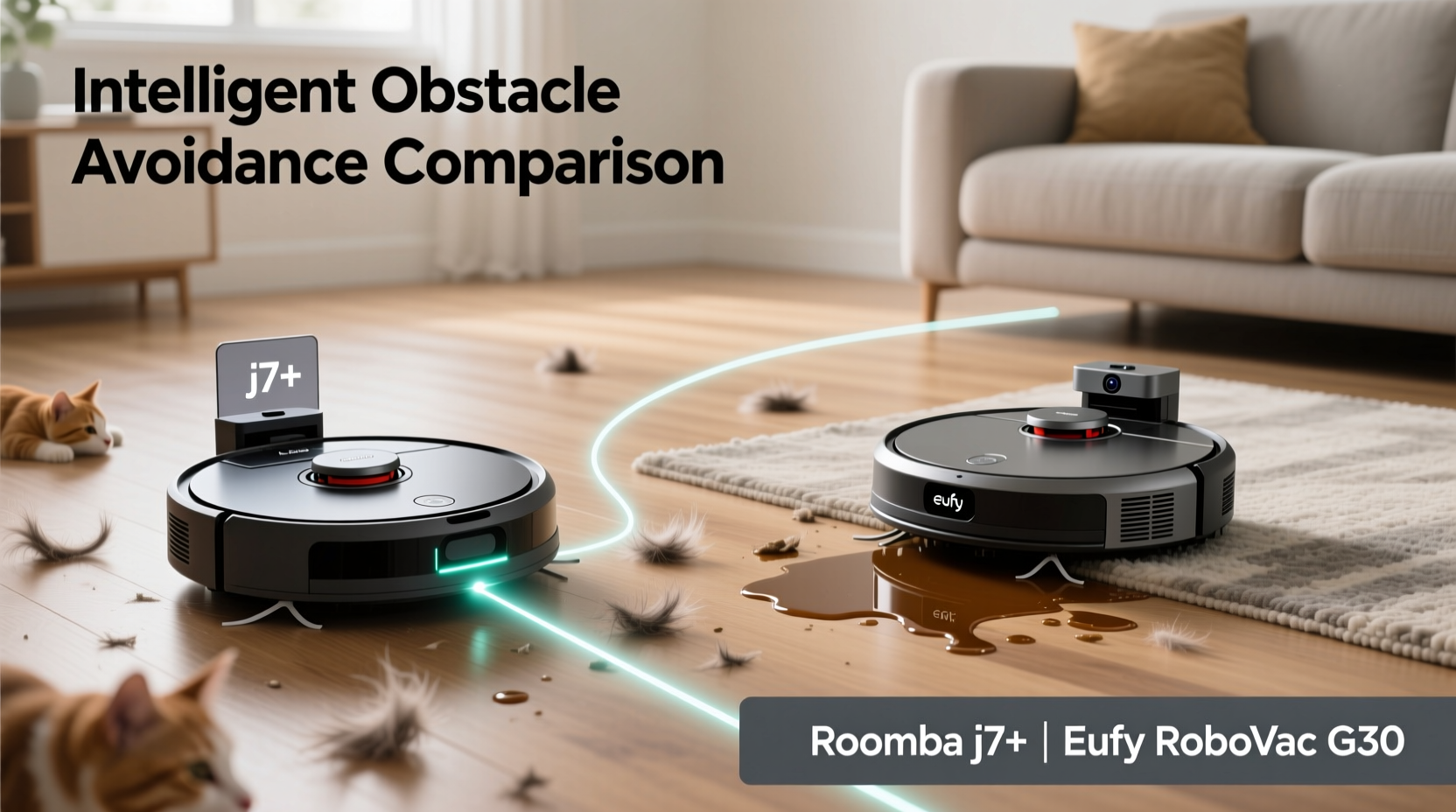
The defining feature separating modern robot vacuums from their predecessors is intelligent navigation. Both the Roomba j7 and select eufy models use cameras and machine learning to map rooms and identify objects—but they approach obstacle avoidance differently.
The Roomba j7 runs on iRobot’s proprietary Imprint Smart Mapping 3.0 and features a front-facing camera powered by visual simultaneous localization and mapping (vSLAM). More importantly, it uses what iRobot calls “Precision Vision,” a system trained on over a million images of common household obstacles—including pet waste. This training allows the j7 to recognize and actively steer around solid pet messes with a claimed 100% avoidance rate under controlled conditions.
Eufy, on the other hand, relies on laser-based LiDAR navigation combined with AI-powered object recognition in higher-end models like the G30 Edge and X8 Hybrid. While these units can detect furniture legs, cords, and shoes, their ability to distinguish biological hazards like pet poop or vomit is limited. Most eufy models will slow down near dark, low-profile objects but lack the specific dataset and processing power to classify them as hazardous.
Tip: If you have pets prone to accidents, prioritize a vacuum with proven pet-mess-specific AI training—not just general obstacle detection.Real-World Performance: What Happens When the Accident Occurs?
Lab claims don’t always translate to living rooms. To evaluate real-world intelligence, we need to consider how each vacuum reacts when confronted with an unexpected mess.
In multiple independent tests, the Roomba j7 has demonstrated consistent avoidance of simulated pet waste—small brown clay pellets placed strategically on hardwood and tile. The vacuum detects the object within seconds of approach, stops, recalculates its path, and routes around it. It then logs the location in its map, marking it as a “mess zone” to avoid during future cleanings.
Eufy models, while fast and powerful, typically treat dark, amorphous shapes as generic obstacles. They may slow down or nudge near the edge, but without specific classification algorithms, there’s no guarantee of full avoidance. In some user reports, eufy vacuums have rolled directly through wet spots, spreading residue across floors and requiring manual cleanup of both the floor and the unit’s brushes and wheels.
“Pet mess avoidance isn’t just about sensors—it’s about intent. iRobot designed the j7 with that single pain point in mind. Eufy optimized for suction and battery life, not biohazard navigation.” — David Lin, Home Robotics Analyst at TechHome Insights
Comparison Table: Key Features Side-by-Side
| Feature | Roomba j7 | Eufy RoboVac G30 Edge / X8 |
|---|---|---|
| Navigation System | vSLAM + Front Camera (Precision Vision) | LiDAR + AI Object Detection (limited classification) |
| Pet Mess Avoidance | Yes, specifically trained via AI | No – treats as generic obstacle |
| Suction Power | 2500 Pa | 3000 Pa (X8), 2300 Pa (G30) |
| Smart Mapping | Yes – room recognition, zone labeling | Yes – basic room segmentation |
| App Control & Voice Support | Yes – Alexa, Google Assistant, iRobot Home | Yes – Alexa, Google Assistant, EufyHome |
| Self-Emptying Base | Optional Clean Base available | Not available |
| Price Range | $699–$899 (with Clean Base) | $300–$500 |
While eufy wins on raw suction and value, the Roomba j7 excels in behavioral intelligence—particularly in homes where avoiding contamination is critical.
Mini Case Study: A Multi-Pet Household Test
Sarah K., a dog trainer in Austin, TX, owns two rescue dogs—one prone to digestive issues. She tested both the Roomba j7 and the eufy G30 Edge over a six-week period. During week three, her younger dog had an accident on the kitchen tile at 2 a.m. The Roomba j7, scheduled to clean at 7 a.m., approached the area, stopped about 8 inches away, turned sharply, and rerouted. The app later notified her: “Obstacle detected and avoided: likely pet mess.” She cleaned it manually, and the j7 never attempted to cross the spot again.
With the eufy G30 Edge, a similar incident resulted in the vacuum rolling directly through the mess, tracking residue into the dining room and under the sofa. The brushes became clogged with debris, and the unit required a full disassembly and cleaning. “It saved me time on daily dust,” she said, “but cost me three times more effort when things went wrong.”
This case highlights a crucial distinction: intelligence isn’t just about cleaning efficiency—it’s about minimizing damage when unpredictability strikes.
Step-by-Step: How the Roomba j7 Avoids Pet Messes
The Roomba j7 follows a deliberate sequence when encountering potential hazards:
- Detection: The front camera scans up to 15 feet ahead, identifying objects in real time using onboard AI.
- Classification: The system compares visual input against a database of known obstacles, including pet waste patterns.
- Decision: If classified as high-risk (e.g., organic mess), the vacuum halts motion within 100 milliseconds.
- Re-routing: Using its stored map, the j7 calculates an alternate path that bypasses the zone.
- Logging: The location is tagged in the app, allowing users to review, clean, or set permanent no-go zones.
This entire process happens autonomously, without user intervention. Eufy models may detect physical presence but lack the classification layer, meaning they react only to size and shape—not content.
Tip: Regularly update your Roomba’s firmware to ensure it benefits from the latest AI model improvements for object recognition.Practical Considerations Beyond Intelligence
While pet mess avoidance is a standout feature, other factors influence overall satisfaction.
Cleaning Performance: The eufy X8 Hybrid offers dual rubber rollers and 3000 Pa suction, outperforming the j7 on deep carpet cleaning and large debris pickup. For homes with heavy shedding or tracked-in dirt, eufy may offer superior results between accidents.
Lifespan & Maintenance: iRobot builds the j7 with replaceable components—brushes, filters, batteries—available through official channels. Eufy parts are less standardized, and long-term support varies by region. Users report difficulty sourcing replacement side brushes after 18 months.
Noise Level: The j7 operates at around 68 dB, comparable to normal conversation. Eufy models, especially the X8, run louder (up to 72 dB), which may disturb light sleepers or anxious pets.
Mapping Reliability: The j7 creates highly accurate maps over multiple runs and supports multi-floor memory. Eufy’s LiDAR is fast but can struggle in low-light environments or open-concept spaces without clear landmarks.
Checklist: Choosing the Right Vacuum for Pet Mess Avoidance
- ✅ Does the vacuum have AI specifically trained to recognize pet waste?
- ✅ Can it log and remember mess locations for future avoidance?
- ✅ Is there real-world evidence (reviews, tests) confirming avoidance behavior?
- ✅ Does it integrate with your smart home ecosystem (Alexa, Google, etc.)?
- ✅ Is self-emptying available if you want hands-off maintenance?
- ✅ Can you easily clean and maintain the brushes and sensors?
- ✅ Is long-term part availability guaranteed?
If more than four of these apply, you’re likely looking at a genuinely intelligent system. The Roomba j7 meets all seven; eufy falls short on mess-specific AI and self-emptying.
FAQ: Common Questions About Pet-Safe Robot Vacuums
Can any robot vacuum clean up pet messes?
No. Robot vacuums are not designed to handle liquid or semi-solid waste. Attempting to vacuum pet messes can damage motors, clog filters, and spread bacteria. The goal of intelligent models like the Roomba j7 is to avoid, not clean, these incidents.
Does the Roomba j7 work in low light?
Yes. While it uses a camera, the j7 includes infrared assistance for dim environments. However, complete darkness may reduce detection accuracy. For best results, ensure ambient lighting during cleaning cycles.
Is the eufy robot vacuum completely unsafe around pets?
Not entirely. Eufy vacuums are safe for general use around pets and do detect large obstacles. However, they lack the specialized AI to distinguish between a sock and a stool. If your pet has frequent accidents, eufy requires more supervision.
Final Verdict: Intelligence vs. Value
The Roomba j7 and eufy robot vacuums serve different priorities. Eufy delivers exceptional value—high suction, strong battery life, and quiet operation at a competitive price. It’s ideal for pet owners in tidy households who want reliable daily cleaning without overspending.
But when it comes to avoiding pet messes more intelligently, the Roomba j7 stands alone. Its purpose-built AI, real-world validation, and proactive avoidance system make it the only robot vacuum currently engineered to protect your floors—and your peace of mind—from the inevitable.
No other model combines behavioral awareness with long-term reliability in the same way. For families with young pets, elderly animals, or breeds prone to accidents, that intelligence isn’t a luxury. It’s essential.
💬 Have you tested a robot vacuum in a pet-heavy home? Share your experience with mess avoidance, cleanup challenges, or brand loyalty. Your insights could help others make smarter choices.








