In homes with dogs, one of the biggest cleaning challenges isn’t just fur or muddy paws—it’s the landmine field of chew toys scattered across the floor. As robot vacuums become more common, pet owners are asking: can these autonomous cleaners actually navigate around dog toys without knocking them over, getting stuck, or worse—sucking them up? Compared to the familiar cordless stick vacuum, which relies entirely on human control, the robot promises hands-free convenience. But does that intelligence hold up when faced with a living room full of squeaky bones and rubber fetch balls?
The short answer: yes, many modern robot vacuums are smart enough to avoid most dog toys—but with important caveats. Their success depends on sensor quality, software intelligence, and how cluttered your floors really are. Let’s break down how robots compare to cordless sticks in pet-heavy environments, what technology enables avoidance behavior, and whether you can trust a robot to clean safely around your dog’s favorite belongings.
Sensor Smarts: How Robots \"See\" Dog Toys
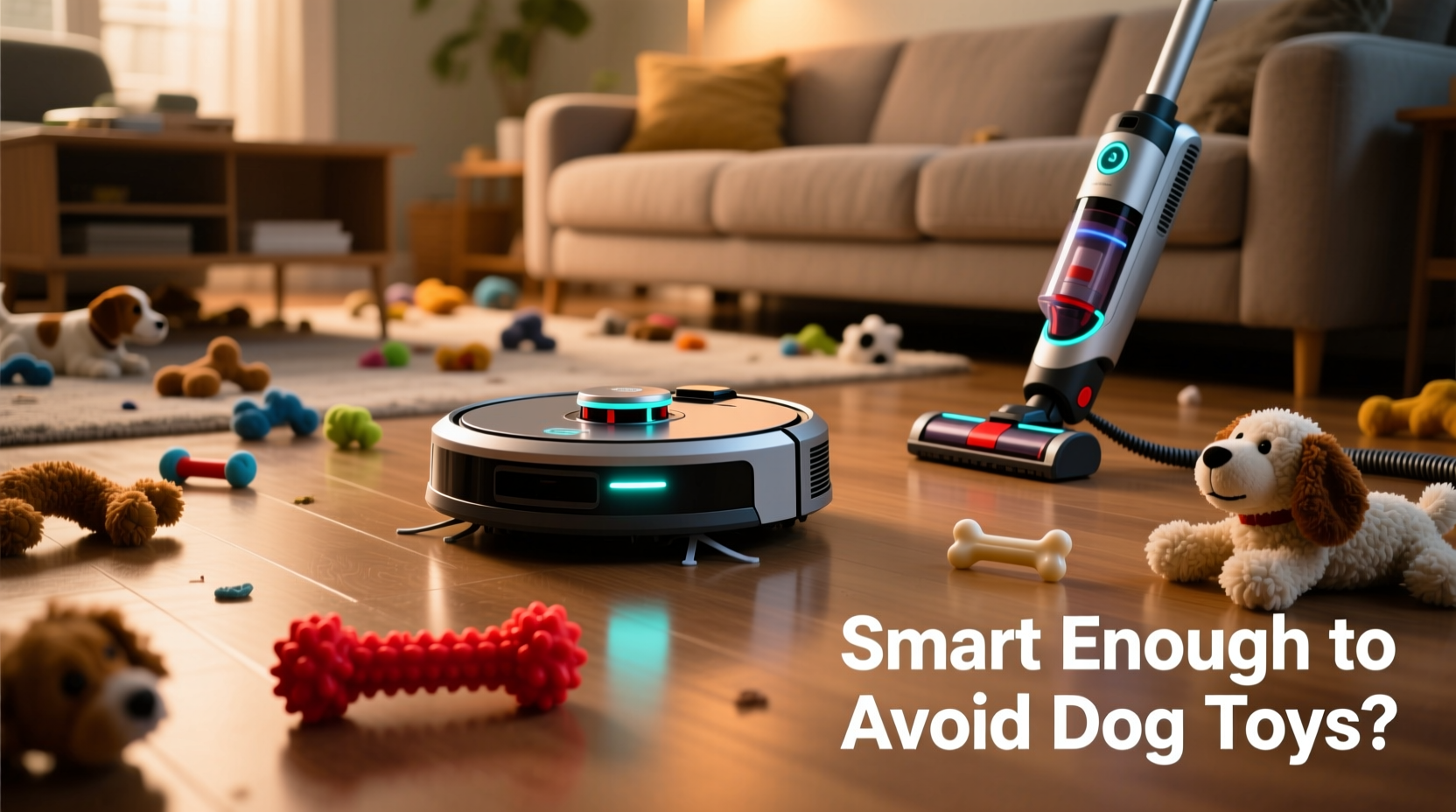
Unlike cordless stick vacuums, which depend on your eyes and reflexes to dodge obstacles, robot vacuums rely on a combination of sensors and mapping algorithms to detect and avoid objects. The effectiveness of this system varies significantly between models and price points.
Entry-level robots often use basic infrared (IR) bump sensors. These only register an obstacle after physical contact—meaning the robot gently taps a toy before changing direction. This might prevent major damage, but it doesn't stop the robot from nudging small items out of place or scattering lightweight toys across the floor.
Higher-end models integrate advanced systems:
- Lidar (Light Detection and Ranging): Spins a laser to create a precise 360-degree map of the room. Detects objects at a distance, allowing for proactive path adjustments.
- Camera-based vision (e.g., iRobot’s Precision Vision, Roborock’s 3D structured light): Uses visual recognition to identify specific objects like shoes, cords, or pet waste—and increasingly, dog toys.
- AI-powered object recognition: Some premium models can classify objects in real time and adjust behavior accordingly (e.g., slow down near a toy, route around it).
These technologies enable true avoidance—not just reaction. For example, a robot equipped with AI may recognize a plush toy on the carpet and steer clear, while a budget model might plow into it, mistaking it for a rug edge or shadow.
Tip: If you have multiple small dog toys, opt for a robot with LiDAR and AI object recognition—brands like Roborock, Ecovacs, and high-end iRobot models perform best in cluttered pet homes.Robot vs Cordless Stick: A Practical Comparison
To understand where each type excels, consider their core strengths and weaknesses in homes with pets.
| Feature | Robot Vacuum | Cordless Stick Vacuum |
|---|---|---|
| Obstacle Avoidance | Varies by model; high-end units avoid toys intelligently | Fully manual—depends on user awareness |
| Cleaning Frequency | Automated daily runs possible | Manual effort limits regularity |
| Dog Hair Pickup | Good on hard floors; struggles with deep-pile rugs | Superior suction and brushroll control |
| Toy Damage Risk | Low with smart models; higher with basic sensors | Negligible—user steers around toys |
| Hands-Free Operation | Yes—ideal for consistent maintenance | No—requires active use |
| Pet Accident Safety | Risk of spreading mess if not detected | User can avoid contaminated areas |
The data shows a clear trade-off: robots offer automation and consistency, but only the most advanced models can match the situational awareness of a human using a cordless stick. However, for daily upkeep between deeper cleans, a well-chosen robot can reduce the burden significantly—even in homes with playful dogs.
Real-World Test: Can It Handle a Pup’s Play Zone?
Consider Sarah, a Boston Terrier owner in Austin, Texas. Her living room doubles as her dog Benny’s play area, complete with a basket of toys that rarely stays closed. She used a mid-tier robot vacuum (with basic IR sensors) for six months and frequently found toys displaced, one even sucked partially into the brushroll. Frustrated, she upgraded to a Roborock S8 Pro Ultra with 3D structured light and AI object recognition.
After two months, the difference was stark. The new robot mapped the room accurately, identified plush toys and rubber balls as obstacles, and routed around them—even when they were placed in high-traffic zones. On several occasions, the app notified her: “Avoided plush toy near sofa.” While not perfect (a tiny rope toy was briefly nudged), there were no jams or damage.
Sarah still uses her cordless stick vacuum weekly for targeted cleaning—especially under furniture and on Benny’s favorite napping spot. But the robot handles five out of seven days with minimal intervention. “It’s not magic,” she says, “but it’s close. I don’t stress about leaving a toy out overnight anymore.”
“Modern robotics have crossed a threshold where they can coexist with pets—provided owners set realistic expectations and choose the right model.” — Dr. Lena Park, Robotics Integration Specialist, HomeTech Labs
When Robots Fail: Limitations You Should Know
No robot is infallible. Even the most advanced models struggle under certain conditions:
- Low-contrast or transparent objects: Clear plastic toys or glass bowls may not register on cameras or LiDAR.
- Small, flat items: Thin chew strips, bottle caps, or fabric scraps can be overlooked and ingested.
- Dynamic environments: If toys are moved frequently, maps become outdated, reducing navigation accuracy.
- Over-reliance on software: AI misclassifications happen—a sock might be mistaken for a toy, or vice versa.
Additionally, some robots prioritize coverage over caution. To ensure no spot is missed, they may attempt to squeeze beside a toy, risking entanglement. Tassels, long ribbons, or frayed edges on older toys are particularly hazardous.
One notable incident involved a Neato D7 that mistook a stuffed squirrel for a rug tassel and attempted to clean underneath it—dragging the toy three feet before disengaging. While harmless, it highlights the importance of supervision during initial runs and proper toy storage.
Step-by-Step: Setting Up a Robot in a Pet-Friendly Home
Maximizing success starts with setup and routine management. Follow this timeline to integrate a robot vacuum safely:
- Week 1: Clear and map
Remove all small objects, including dog toys. Run the robot to create an accurate floor plan. Use virtual walls or no-go zones in the app to block off pet feeding areas or toy baskets. - Week 2: Gradual reintroduction
Place one or two larger, solid-colored toys on the floor during cleaning cycles. Observe how the robot reacts. Does it stop, reroute, or bump? - Week 3: Realistic testing
Add a mix of toy types—plush, rubber, rope. Run the robot during the day to monitor behavior. Check the app for obstacle alerts. - Ongoing: Daily habits
Establish a rule: pick up tiny or string-like toys before starting the robot. Keep a “safe zone” basket elevated or behind a gate. - Monthly: Maintenance check
Inspect brushes and sensors. Pet hair can obscure sensors over time, reducing detection accuracy.
This phased approach builds confidence in the robot’s capabilities while minimizing risks. It also helps identify whether your specific model is truly pet-smart or merely pet-tolerant.
Checklist: Is Your Robot Ready for Dog Toys?
Before trusting your robot around scattered toys, verify the following:
- ✅ Equipped with LiDAR or camera-based navigation (not just bump sensors)
- ✅ Has AI-powered object recognition (check product specs)
- ✅ App supports no-go zones or selective obstacle avoidance
- ✅ Brushroll is tangle-resistant (rubber extractors preferred over bristle rolls)
- ✅ You’ve completed at least three successful mapping runs
- ✅ Small or stringy toys are stored away before cleaning
If any item is unchecked, proceed with caution. A robot without modern sensors should not be trusted around loose toys.
FAQ: Common Questions About Robots and Pet Toys
Can a robot vacuum pick up a dog toy?
It’s unlikely but possible. Most toys are too large for the dustbin, but small items like dental chews, kibble, or toy fragments can be sucked up. Robots with strong suction and wide intakes (like the Roomba j7+) have accidentally ingested ping-pong-sized rubber balls. Always remove small objects before starting a cycle.
Do robot vacuums scare dogs?
Some dogs are initially startled by the noise and movement, but most acclimate within a few days. Introduce the robot slowly—run it when the dog is in another room, then gradually allow supervised exposure. Positive reinforcement (treats during operation) speeds up acceptance.
Should I leave toys out for the robot to avoid?
Not regularly. While advanced models can avoid stationary toys, unpredictability increases risk. Treat the robot like an automated appliance—prepare the space just as you would before running a dishwasher or washing machine. Pick up loose items, including toys, for best results.
Conclusion: Smart Enough, But Not Foolproof
The latest generation of robot vacuums has made remarkable progress in navigating homes with pets. High-end models can reliably detect and avoid most dog toys, especially when those toys are medium to large and placed on open flooring. Technologies like LiDAR, 3D vision, and AI classification have transformed robots from clumsy bumpers into cautious navigators capable of coexisting with playful pups.
However, they are not replacements for thoughtful household habits. A robot vacuum complements—not replaces—the cordless stick. The stick remains superior for immediate spills, deep carpet cleaning, and precision work. But for daily maintenance in a pet home, a smart robot can dramatically reduce the chore load—if chosen wisely and used responsibly.
The key is alignment: match the robot’s capabilities to your home’s reality. If your dog leaves a trail of tiny rubber rings every evening, automation will always require some oversight. But if most toys stay in a bin and only a few escape, today’s best robots can handle it with impressive grace.
🚀 Ready to go hands-free? Evaluate your current cleaning routine, assess your pet’s habits, and consider upgrading to a robot with proven obstacle avoidance. Share your experience—what worked, what didn’t—and help other pet owners make smarter choices.








