Choosing between a powerhead and an air pump for your aquarium isn’t just about price—it’s about understanding what each device delivers in terms of water movement, oxygenation, and overall tank health. While air pumps have long been a staple in beginner setups, powerheads are increasingly popular among aquarists managing more complex or larger systems. But does the added expense of a powerhead justify its benefits? The answer depends on your tank’s needs, livestock, and goals.
Understanding the Core Functions
An air pump and a powerhead serve different primary purposes, even though both contribute to water quality.
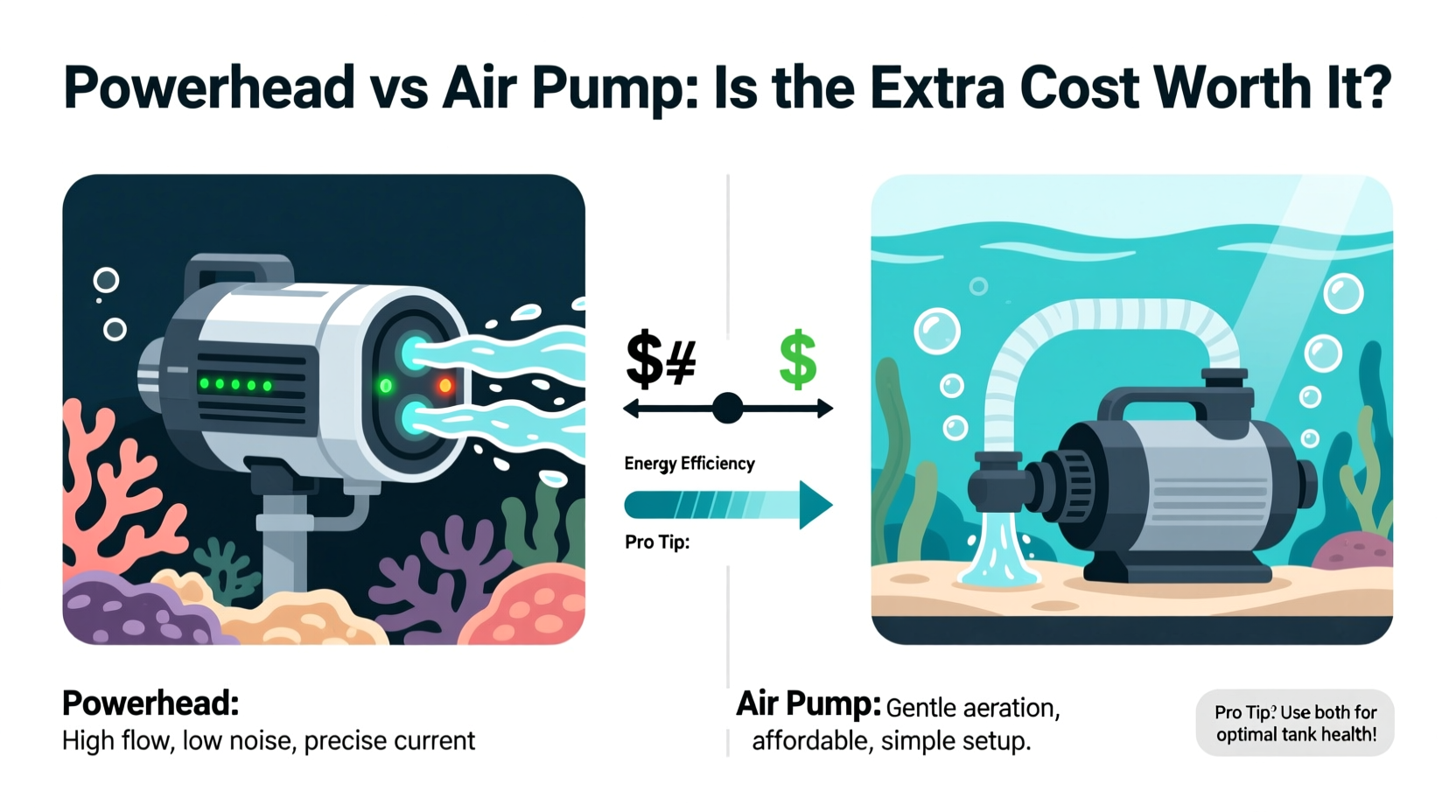
Air pumps push air through tubing into the aquarium, typically powering air stones, sponge filters, or decorative ornaments like bubbling treasure chests. Their main function is surface agitation, which increases gas exchange—allowing oxygen to dissolve into the water and carbon dioxide to escape. However, they don’t move large volumes of water across the tank.
Powerheads, on the other hand, are submersible water pumps designed to create strong directional flow. They circulate water throughout the tank, preventing dead spots where detritus accumulates and oxygen levels drop. Unlike air pumps, their impact is on water dynamics rather than direct aeration.
Tip: If you already have good filtration and surface agitation, a powerhead adds circulation—not oxygen. Don’t assume it replaces aeration needs.Performance Comparison: Flow, Aeration, and Efficiency
The key difference lies in how each device influences water movement and oxygen levels. Let’s break it down:
| Feature | Air Pump | Powerhead |
|---|---|---|
| Primary Function | Aeration and surface agitation | Water circulation and flow control |
| Oxygenation Effectiveness | High (via surface disruption) | Moderate (indirect via mixing) |
| Flow Strength | Low to moderate (bubbles only) | High and adjustable |
| Noise Level | Can be noisy (clicking, bubbling) | Generally quiet (motor hum) |
| Energy Use | Low | Moderate to high (depends on model) |
| Cost (Initial) | $10–$30 | $30–$100+ |
| Best For | Small tanks, low-flow species, budget setups | Planted tanks, reef tanks, large aquariums |
This comparison shows that while air pumps excel at basic aeration, powerheads offer superior hydrodynamic control—critical in environments where stagnant zones can lead to algae blooms, anaerobic pockets, or poor nutrient distribution.
When the Extra Cost of a Powerhead Makes Sense
The higher price tag of a powerhead comes with tangible benefits—but only if your aquarium demands them.
In planted freshwater tanks, for example, consistent water movement ensures that CO₂ and nutrients reach all plants evenly. Without adequate flow, some plants may starve while others get too much light and not enough resources. Similarly, in saltwater reef tanks, corals rely on laminar or turbulent flow to feed and expel waste. SPS (small polyp stony) corals require intense, random flow patterns that only advanced powerheads—or wavemakers—can replicate.
“Reef tanks without proper water movement fail not from poor chemistry, but from poor circulation. A good powerhead isn’t optional—it’s foundational.” — Dr. Mark Tran, Marine Life Systems Specialist
For larger tanks (75 gallons and above), air pumps alone cannot generate sufficient turnover. Even multiple airstones won’t prevent stratification—the layering of water with different temperatures and oxygen levels. A powerhead helps maintain uniform conditions by continuously mixing the water column.
Tip: Match flow rate to tank size. Aim for 10x–20x total tank volume in turnover per hour (e.g., 500–1000 GPH for a 50-gallon tank).Real-World Example: Two Tanks, Two Choices
Consider two aquarists: Sarah maintains a 20-gallon community tank with tetras, Corydoras, and live plants. She uses a hang-on-back filter and a small air pump with an airstone. Her fish thrive, surface agitation is adequate, and there are no dead spots. In her case, adding a powerhead would be unnecessary—and potentially harmful, as excessive flow could stress her slow-moving fish.
Meanwhile, James runs a 120-gallon reef system with mixed soft and stony corals. He initially used only air stones for aeration but noticed declining coral coloration and tissue recession. After testing parameters (all stable), he realized poor water movement was the culprit. He installed two adjustable powerheads set on timers to simulate surge patterns. Within weeks, coral polyps expanded more fully, detritus disappeared from rock crevices, and water clarity improved.
James’s investment—around $160 for two quality powerheads—was justified by measurable improvements in ecosystem health. Sarah’s simpler setup doesn’t require that level of intervention.
Step-by-Step: How to Decide Which You Need
- Evaluate your tank size and bioload. Larger tanks or those with high waste production benefit more from enhanced circulation.
- Assess current water movement. Are there visible dead zones? Does debris collect in corners? These suggest poor flow.
- Identify your livestock needs. Do you keep flow-sensitive species (e.g., bettas) or flow-dependent ones (e.g., torch corals)?
- Check existing equipment. Can your filter provide enough surface agitation? Is it creating ripples or just slight movement?
- Determine your goals. Are you aiming for a naturalistic flow pattern, breeding success, or coral growth? Each may require targeted circulation.
- Budget accordingly. If a powerhead improves long-term stability and reduces maintenance, it may save money over time by preventing issues.
Frequently Asked Questions
Can I use a powerhead instead of an air pump?
Not directly. While a powerhead improves gas exchange by moving water across the surface, it doesn’t inject air. If your tank lacks surface agitation, you may still need an air pump or must position the powerhead outlet at the surface to maximize ripple effect.
Do powerheads oxygenate water?
Indirectly, yes. By increasing surface turbulence, powerheads enhance oxygen diffusion. However, they are not substitutes for dedicated aeration in heavily stocked or warm-water tanks where oxygen solubility is naturally lower.
Are smart powerheads worth the extra cost?
If you want programmable flow patterns, night-time slowdowns, or storm simulations, then yes. Modern controllable powerheads (like Ecotech Vectra or Maxspect Gyre) integrate with aquarium controllers and can significantly improve ecological mimicry—especially in reef tanks.
Checklist: Choosing Between Powerhead and Air Pump
- ☐ Tank under 30 gallons? → Air pump likely sufficient
- ☐ Keeping delicate fish (e.g., bettas, gouramis)? → Avoid strong flow unless diffused
- ☐ Planted or reef tank? → Powerhead strongly recommended
- ☐ Notice dead spots or algae buildup in corners? → Consider adding circulation
- ☐ Already have good surface agitation? → Focus on flow, not aeration
- ☐ Budget flexible and seeking long-term stability? → Invest in adjustable powerhead
Final Verdict: Is the Extra Cost Worth It?
The decision hinges on your aquarium’s complexity, not just your budget. For simple setups with minimal flow requirements, an air pump remains a cost-effective solution that supports adequate oxygenation. But when you’re cultivating demanding ecosystems—planted tanks with CO₂ injection, African cichlid tanks needing high turnover, or reef aquariums requiring wave-like motion—a powerhead isn’t a luxury. It’s a necessity.
The extra cost pays off in better water quality, healthier livestock, reduced maintenance, and greater control over your aquatic environment. Like upgrading from basic lighting to full-spectrum LEDs, investing in proper water movement transforms your tank from functional to flourishing.
🚀 Ready to optimize your aquarium’s flow? Assess your current setup, identify weak points, and choose the tool that matches your tank’s true needs—not just its price point.