When it comes to mid-range smartphones, two names consistently spark debate: Google’s Pixel 4a and Samsung’s Galaxy M31s. The Pixel 4a carries the prestige of a pure Android experience and class-leading camera performance. Meanwhile, the Galaxy M31s counters with massive battery life, expandable storage, and a feature-rich design. But which one actually delivers more value in daily use? The answer isn’t as simple as specs suggest.
For many users, this decision boils down to philosophy: do you prioritize software purity and photographic excellence, or raw power, endurance, and versatility? Let’s break down both devices across key categories to see whether the Pixel’s reputation holds up—or if Samsung’s offering is the smarter long-term choice.
Design and Build Quality
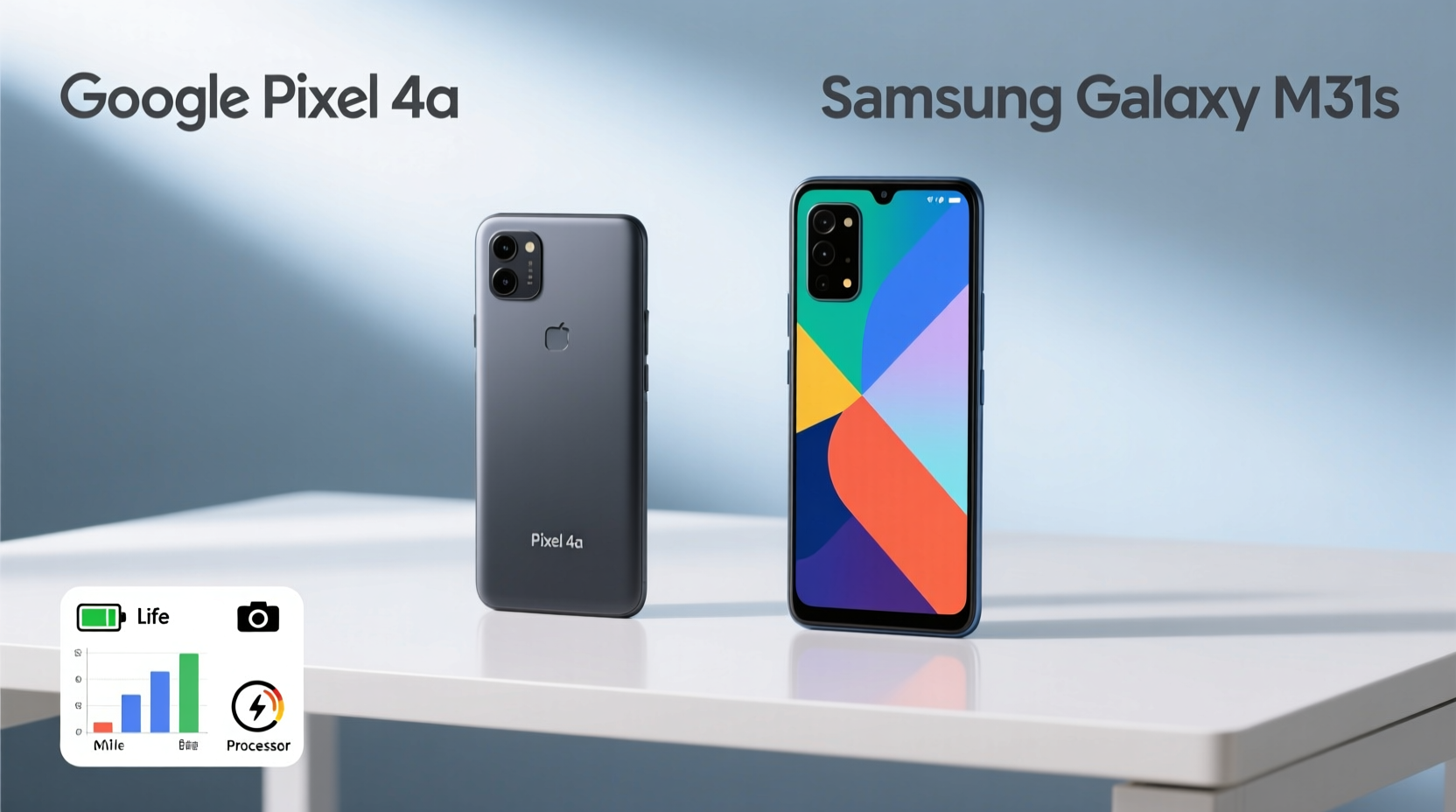
The Pixel 4a embraces minimalism. Its polycarbonate body feels sturdy, not cheap, and the matte finish resists fingerprints. At just 143 grams, it’s one of the lightest phones in its class, making one-handed use effortless. The centered punch-hole camera and flat display give it a clean, modern look. However, it lacks water resistance and has no headphone jack—two omissions that still surprise some users.
In contrast, the Galaxy M31s adopts a more conventional but bolder design. It’s larger and heavier (200g), which may deter compact phone enthusiasts, but the glossy back and gradient finishes offer visual flair. Samsung uses plastic throughout, but build quality is solid. The side-mounted fingerprint sensor integrates well, and unlike the Pixel, it retains a headphone jack—important for users who haven’t fully transitioned to wireless audio.
Tip: If portability and ease of handling matter most, the Pixel 4a’s lightweight frame gives it a clear edge.Display and User Experience
The Pixel 4a features a 5.8-inch OLED display with Full HD+ resolution. Colors are accurate, blacks are deep, and brightness is sufficient indoors. While it doesn’t reach the peak brightness of premium models, HDR content looks excellent. The 60Hz refresh rate feels standard—there’s no smooth scrolling like on higher-end phones, but it’s not a dealbreaker at this price.
The Galaxy M31s goes bigger with a 6.5-inch Super AMOLED panel, also Full HD+. It matches the Pixel in color vibrancy and viewing angles but wins on screen real estate. This makes it better suited for media consumption and multitasking. Like the Pixel, it runs at 60Hz, so neither device offers high-refresh fluidity. However, Samsung’s One UI adds customization options—themes, icon packs, and split-screen—that power users appreciate.
Google’s stock Android on the Pixel 4a remains the gold standard for simplicity. Updates arrive instantly, and there’s zero bloatware. Samsung’s One UI is feature-rich but can feel overwhelming. That said, it’s become significantly leaner over the years and now offers three generations of OS updates—a major improvement.
“Stock Android isn’t just cleaner—it’s faster to adapt to new features because there’s no manufacturer skin slowing things down.” — David Kim, Mobile Software Analyst
Camera Performance: Hype vs. Reality
This is where the Pixel 4a shines brightest. Despite having only a single 12.2MP rear sensor, it consistently outperforms competitors in photo quality. Google’s computational photography—HDR+, Night Sight, and Super Res Zoom—delivers stunning results in low light and high-contrast scenes. Portrait mode is natural, with accurate edge detection and pleasing depth effects.
The Galaxy M31s packs a quad-camera array: 64MP main, 12MP ultra-wide, 5MP macro, and 5MP depth. On paper, it looks superior. In practice, photos are good but inconsistent. The 64MP mode often oversharpenens, and the ultra-wide lens struggles with distortion and dynamic range. Low-light performance lags far behind the Pixel. Samsung’s processing tends to oversaturate colors, which some may like initially but quickly grows tiresome.
For video, both support 4K at 30fps, but the Pixel again wins with superior stabilization and exposure control. The M31s handles movement less gracefully, especially in dim lighting.
| Feature | Pixel 4a | Galaxy M31s |
|---|---|---|
| Main Camera | 12.2MP, f/1.7, Dual Pixel PDAF | 64MP, f/1.8 |
| Ultra-Wide | No | 12MP, f/2.2, 123° FoV |
| Night Mode | Excellent (HDR+ enhanced) | Moderate (noisy in dark) |
| Video Recording | 4K@30fps, stabilized | 4K@30fps, limited stabilization |
| Front Camera | 8MP, f/2.0 | 32MP, f/2.0 |
Battery Life and Performance
The Galaxy M31s dominates here. Its 6000mAh battery easily lasts two full days with moderate use. Even heavy users will make it through a full day without anxiety. Charging is 25W, allowing a 0–50% charge in about 30 minutes. The large capacity makes it ideal for travelers or those without easy access to outlets.
The Pixel 4a, with its 3140mAh battery, requires daily charging—and sometimes twice if you're streaming or using GPS heavily. It supports 18W charging, but no fast charger is included in the box. While efficient software helps extend usage, it simply can’t compete with Samsung’s marathon stamina.
Performance-wise, the Pixel uses the Qualcomm Snapdragon 730G, paired with 6GB RAM. It handles everyday tasks smoothly and gaming decently, though extended sessions cause mild throttling. The M31s uses Samsung’s Exynos 9611, which is slightly slower in benchmarks and app launches. However, with 6GB or 8GB RAM options and UFS 2.1 storage, real-world lag is rare. For most users, both feel snappy enough.
Mini Case Study: A Week with Both Phones
Sarah, a freelance photographer and traveler, tested both phones during a week-long trip across rural Thailand. She used the Pixel 4a primarily for capturing landscapes and street scenes. “The dynamic range amazed me,” she said. “Sunsets looked true-to-life, and night shots from temples were noise-free.” However, she carried a power bank because the battery drained by mid-afternoon.
Switching to the M31s the following week, she appreciated the longer battery and extra screen space for editing on the go. “I could shoot, review, and share all day without plugging in.” But she noticed her Instagram feed filled with overprocessed, oversaturated shots. “I had to manually tone them down in editing apps.”
Her verdict? “If I’m traveling for work, I’d take the Pixel. For leisure or long trips without reliable charging, the M31s wins.”
Software, Updates, and Longevity
Google guarantees three years of OS and security updates for the Pixel 4a. That means Android 13 was the final update, with security patches until 2023. While the phone is no longer supported, during its lifespan it received timely fixes and new features—like Call Screen and Live Translate—before other brands.
Samsung now promises four years of security updates and three OS upgrades for the M31s. Though launched with Android 10, it reached Android 12 and continues receiving monthly patches. This commitment marks a significant shift in Samsung’s approach to software longevity.
One area where Pixel still leads: immediacy. Features like Now Playing, Recorder with search, and seamless Google Assistant integration remain unmatched. Samsung offers Bixby and proprietary tools, but they lack the polish and usefulness of Google’s AI suite.
Checklist: Choosing Between Pixel 4a and Galaxy M31s
- Pick the Pixel 4a if:
- You prioritize photo quality above all else
- You prefer clean, bloat-free Android
- You value quick software updates
- You want a compact, lightweight phone
- Pick the Galaxy M31s if:
- You need all-day (or two-day) battery life
- You want a larger screen for videos and multitasking
- You use wired headphones regularly
- You want expandable storage via microSD
Frequently Asked Questions
Is the Pixel 4a still worth buying in 2024?
The Pixel 4a is no longer sold new and has reached end-of-support status. While it remains a capable device for light users, the lack of ongoing updates makes it a risk for security-conscious buyers. Refurbished units may offer value, but only if priced below $150.
Can the Galaxy M31s compete with flagship cameras?
No. While its 64MP sensor captures detail in ideal lighting, it lacks the processing intelligence of Google’s camera stack. In low light or complex scenes, the Pixel 4a produces more balanced, realistic images. The M31s is competent, not competitive.
Does the Pixel 4a have expandable storage?
No. The Pixel 4a comes only in a 128GB variant with no microSD slot. Samsung includes expandable storage on the M31s, supporting up to 512GB—ideal for media-heavy users.
Conclusion: Should You Stick With Samsung or Jump to Pixel?
The Pixel 4a’s hype is real—but conditional. If your top priorities are camera quality, clean software, and a compact form factor, it was—and in many ways still is—a benchmark for mid-range excellence. Its portrait and night photography remain impressive even years later.
However, the Galaxy M31s answers practical needs better. Two-day battery life, expandable storage, and a headphone jack cater to users who value convenience and longevity over photographic finesse. For students, travelers, or anyone tired of daily charging anxiety, it’s a compelling alternative.
In the end, the choice reflects lifestyle. The Pixel appeals to purists and photographers. The M31s serves realists and pragmatists. Neither is objectively better. But understanding what you actually need—not just what reviewers praise—will guide you to the right pick.
🚀 Ready to choose your next phone? Weigh your daily habits, not just specs. Share your experience—what matters most to you in a smartphone?








