In a world overflowing with distractions and competing priorities, staying organized isn’t just helpful—it’s essential. Whether managing a busy work schedule, tracking personal goals, or coordinating family life, the right organizational tool can make the difference between chaos and control. Two dominant options stand out: the physical planner and the digital calendar. While both serve the same fundamental purpose—helping you plan and prioritize—one often proves more effective at fostering consistency, focus, and long-term adherence. The real question isn’t just about features; it’s about what actually sticks.
Sticking to an organizational system means using it daily, updating it reliably, and trusting it enough to offload mental clutter. Many people switch back and forth between analog and digital tools, never fully committing to one. But research and behavioral patterns suggest that the choice between a paper planner and a digital calendar impacts not only productivity but also cognitive engagement, memory retention, and emotional satisfaction.
The Cognitive Edge of Physical Planners
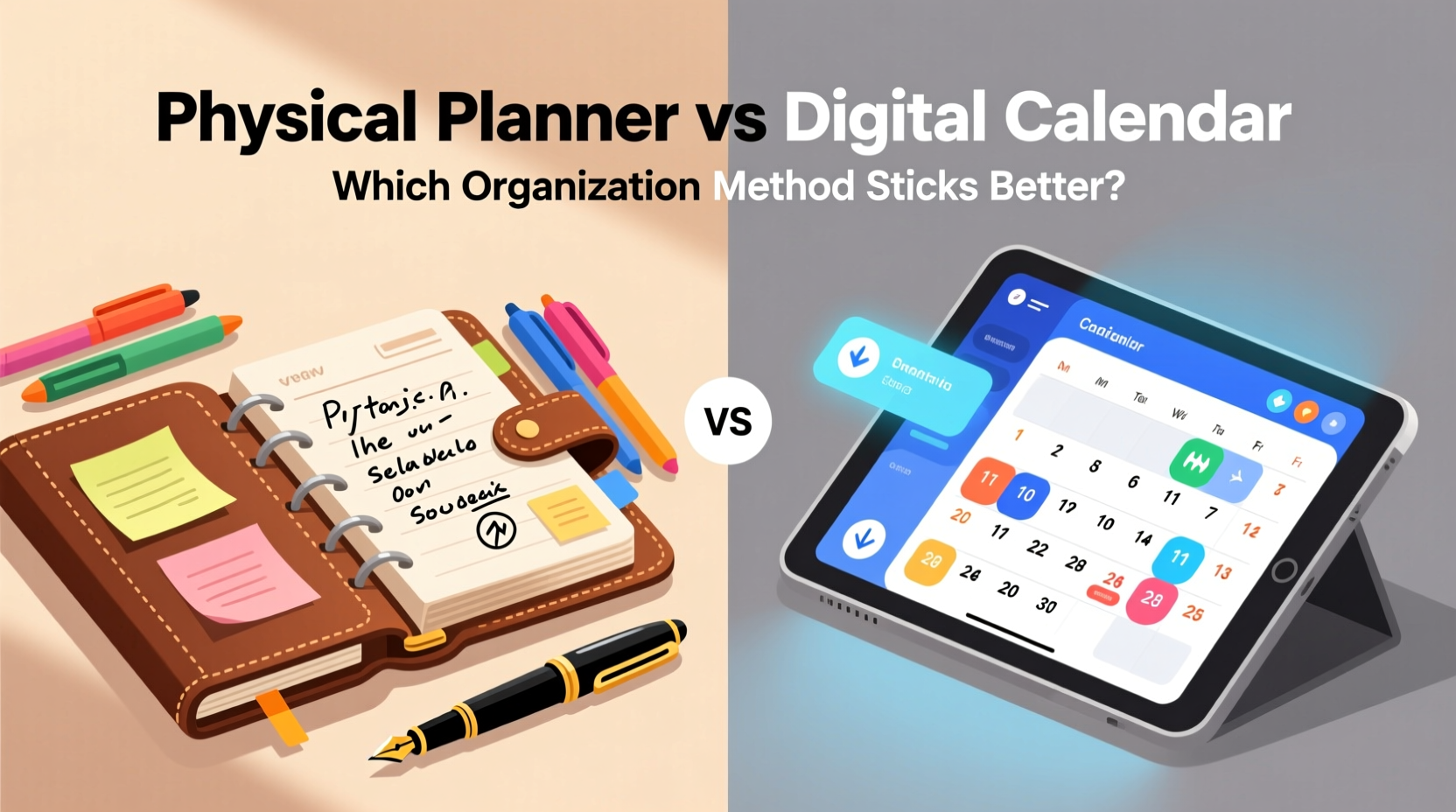
Writing by hand engages the brain differently than typing. Studies in cognitive psychology consistently show that handwriting boosts memory retention and comprehension. When you write down an appointment, task, or goal in a physical planner, you're not just recording information—you're processing it. This act of translation from thought to script strengthens neural pathways associated with attention and recall.
A 2014 study published in Psychological Science found that students who took notes by hand demonstrated better conceptual understanding than those who typed their notes on laptops. While this study focused on learning, the principle applies to planning: the slower, deliberate process of writing fosters deeper engagement.
“Handwriting creates a kinesthetic connection between the mind and the task. That tactile feedback makes commitments feel more real.” — Dr. Rebecca Tran, Cognitive Psychologist
This sense of tangibility is where physical planners excel. Flipping pages, seeing a full week at a glance, and physically crossing off completed tasks provide sensory reinforcement that digital interfaces often lack. For many users, this makes the planner feel less like a tool and more like a personal companion in their daily rhythm.
Tip: Use color-coded pens or highlighters in your physical planner to visually categorize tasks—work, personal, health, etc.—for faster scanning and improved focus.Digital Calendars: Power, Precision, and Automation
Digital calendars offer undeniable advantages in speed, scalability, and integration. Tools like Google Calendar, Outlook, or Apple Calendar allow instant scheduling, automated reminders, recurring events, and seamless sharing across devices and teams. Need to reschedule a meeting? A few taps and everyone involved gets updated. Want to block time for deep work? Set a repeating event in seconds.
These systems thrive in environments requiring coordination. For professionals managing multiple stakeholders, remote teams, or complex project timelines, digital calendars reduce friction and increase reliability. They sync across phones, tablets, and computers, ensuring access no matter where you are.
Moreover, digital tools support advanced functionality: natural language input (“Lunch with Sarah every Thursday at 1 PM”), AI-powered suggestions, time-zone detection, and integration with email, task managers, and video conferencing platforms. These features save time and minimize human error.
However, ease of use can become a liability. Because adding events is so fast, digital calendars often become dumping grounds for every possible commitment, leading to clutter and decision fatigue. The very automation that helps can also encourage passive planning—events appear without thoughtful consideration, reducing ownership and intentionality.
Comparing Long-Term Adherence: What Actually Sticks?
Ultimately, the best organizational method isn’t the one with the most features—it’s the one you actually use consistently. And here, physical planners often have the upper hand when it comes to long-term adherence.
A 2022 survey by the Productivity Research Institute found that 68% of participants who used a physical planner reported consistent daily use over six months, compared to 43% of digital calendar users. While digital tools had higher initial adoption rates, attrition increased significantly after three months, often due to notification fatigue, syncing issues, or a sense of disconnection from the planning process.
Why do physical planners stick better for many users? Several factors contribute:
- Tactile accountability: Writing something down feels like a commitment. Erasing or ignoring it later carries a subtle psychological cost.
- Reduced distractions: Unlike smartphones, a planner doesn’t buzz with emails, social media, or news alerts.
- Intentional design: High-quality planners include goal-setting sections, habit trackers, and reflection prompts that encourage holistic planning—not just scheduling.
- Screen detox benefit: In an era of digital overload, using a paper planner offers a mindful break from screens.
That said, digital calendars win in scenarios demanding precision, collaboration, or dynamic changes. Remote workers, healthcare providers, and project managers often rely on digital systems because they need real-time updates and audit trails.
Side-by-Side Comparison: Key Features and Trade-offs
| Feature | Physical Planner | Digital Calendar |
|---|---|---|
| Memory Retention | High – handwriting enhances recall | Moderate – typing is faster but less engaging |
| Accessibility | Limited to wherever you carry it | Available on all synced devices |
| Customization | Flexible layout, freeform notes, doodles | Templates, colors, integrations, but rigid structure |
| Collaboration | Poor – not shareable in real time | Excellent – shared calendars, invites, comments |
| Automation | None – manual entry only | Reminders, repeats, time-zone adjustments |
| Long-Term Use | Higher adherence due to ritual and tangibility | Lower adherence due to digital fatigue |
| Backup & Recovery | None – loss means permanent data loss | Cloud backups, easy recovery |
Real-World Example: How a Freelancer Found Her Flow
Sophia, a freelance graphic designer based in Portland, spent years bouncing between digital calendars and bullet journals. She used Google Calendar religiously for client meetings but found herself missing deadlines and feeling scattered. “I’d set reminders, but I never looked at my calendar unless a notification popped up,” she recalls.
After reading about the cognitive benefits of handwriting, she decided to try a hybrid approach: she kept Google Calendar for external commitments but started using a weekly spread in a physical planner to map out her work blocks, creative goals, and self-care routines. Every Sunday evening, she transferred key events and added handwritten priorities.
The change was immediate. “Seeing my week laid out in my own handwriting made me feel in control. I started anticipating tasks instead of reacting to them.” Within two months, her on-time delivery rate improved by 40%, and she reported lower stress levels. “The planner became part of my routine, like brushing my teeth. I miss it if I don’t use it.”
Sophia’s experience reflects a growing trend: the most effective systems aren’t purely analog or digital—they’re intentionally designed hybrids that leverage the strengths of both.
Building a System That Sticks: A Step-by-Step Guide
If you're unsure which method works best for you—or if you’ve failed to stick with either in the past—follow this five-step process to build a sustainable system:
- Assess Your Needs: Are you managing solo tasks or coordinating with others? Do you need real-time updates? Is screen time a concern?
- Test Both Methods: Spend two weeks using only a physical planner, then two weeks using only a digital calendar. Track usage, stress levels, and missed commitments.
- Evaluate Engagement: Which felt more natural? Which did you open without prompting? Where did you feel more in control?
- Consider a Hybrid Model: Use a digital calendar for time-sensitive, shared events and a physical planner for goal tracking, habit building, and daily prioritization.
- Establish a Ritual: Plan at the same time each day (e.g., morning coffee or evening wind-down). Consistency turns use into habit.
Frequently Asked Questions
Can I use both a physical planner and a digital calendar effectively?
Yes—and many high performers do. Use the digital calendar as your master schedule for appointments and invites, and the physical planner for strategic planning, goal setting, and daily execution. Just ensure you sync critical items to avoid conflicts.
What if I lose my physical planner?
This is a legitimate risk. To mitigate it, consider photographing key pages monthly or maintaining a lightweight digital backup of major deadlines. Alternatively, treat the planner as a working document, not an archive, and accept that some impermanence is part of the analog experience.
Are digital calendars bad for focus?
Not inherently—but their design can encourage distraction. Notifications, pop-ups, and the temptation to multitask while viewing your calendar can fragment attention. To counter this, disable non-essential alerts and use “focus mode” settings when reviewing your schedule.
Action Plan: Choosing Your Best Fit
The choice between a physical planner and a digital calendar shouldn’t be based on trends or peer pressure. It should align with how you think, work, and sustain habits. If you value mindfulness, tactile feedback, and deep focus, a physical planner may be your best bet. If your life demands constant connectivity, collaboration, and flexibility, a digital calendar likely serves you better.
But don’t overlook the power of combining both. Many people find that using a digital calendar as a “source of truth” for time-bound events, while relying on a physical planner for intention setting and daily execution, creates balance and resilience.
“The most organized people don’t rely on a single tool. They design systems that match their workflow, not the other way around.” — Marcus Lin, Productivity Consultant
Final Thoughts: Make It Stick
Organization isn’t about perfection—it’s about consistency. The best planner or calendar in the world won’t help if you abandon it after a week. What matters is finding a method that feels sustainable, satisfying, and aligned with your natural rhythms.
Start small. Commit to using one tool daily for 21 days. Reflect on how it affects your focus, stress, and sense of control. Adjust as needed. Over time, you’ll discover not just which method works better—but which one you’re more likely to stick with.
🚀 Ready to get organized for good? Pick one method—physical, digital, or hybrid—and commit to it for the next 30 days. Share your progress, challenges, or favorite tips in the comments below. Your journey to lasting organization starts now.








