As dogs age, their joints lose flexibility, muscle mass declines, and conditions like arthritis become increasingly common. For many senior dogs, simple actions such as jumping onto a bed or couch turn into painful struggles. Pet owners often respond by introducing assistive devices—primarily pet stairs or ramps—to help their companions navigate elevated surfaces safely. But which solution truly eases joint pain more effectively? The answer depends on biomechanics, breed-specific needs, home layout, and the dog’s physical condition. This article examines both options in depth, evaluates real-world use cases, and offers actionable guidance to ensure your senior dog maintains comfort, dignity, and mobility.
Understanding Joint Pain in Senior Dogs
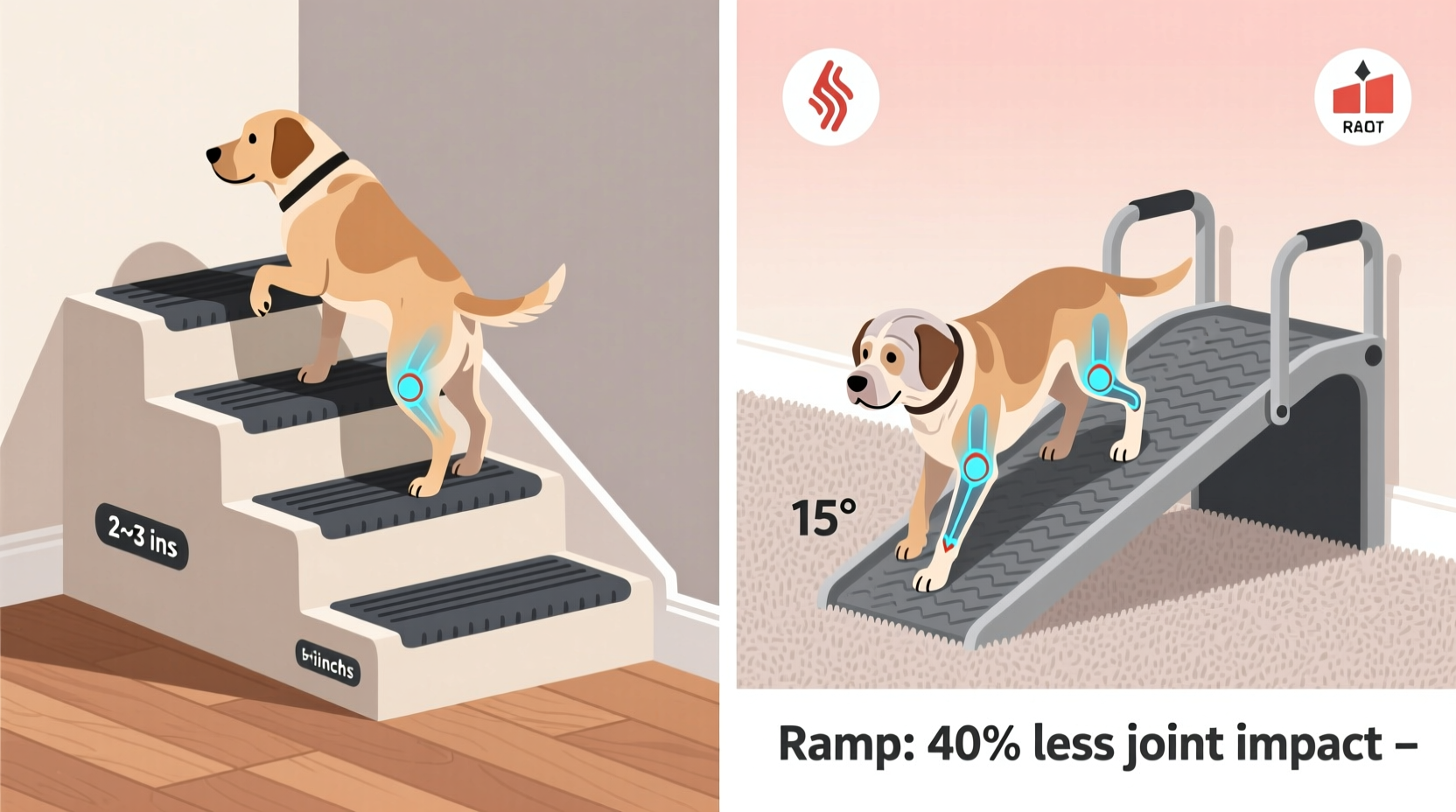
Joint pain in older dogs is most commonly caused by osteoarthritis, a degenerative disease affecting cartilage and synovial fluid. According to the American College of Veterinary Surgeons, approximately 80% of dogs over the age of eight show radiographic signs of arthritis. Even if not clinically diagnosed, subtle stiffness, reluctance to move, or hesitation before jumping are early indicators of discomfort.
The key to managing joint pain isn’t just medication—it’s reducing mechanical stress on joints during daily activities. Every time a senior dog leaps or climbs, impact forces travel through hips, knees, and spine. Assistive tools like stairs and ramps aim to minimize this strain by altering how the dog ascends or descends.
“Reducing high-impact movements is one of the most effective non-pharmaceutical strategies for managing canine osteoarthritis.” — Dr. Rebecca Taylor, DVM, Veterinary Rehabilitation Specialist
How Pet Stairs Work: Design and Impact on Joints
Pet stairs are compact, step-like structures that allow dogs to climb up incrementally. They typically feature multiple tiers with non-slip treads and are ideal for spaces where floor area is limited. While they reduce the need for jumping, they still require significant joint flexion, particularly in the hips and stifles (knee joints).
Each step demands controlled lifting of the hind legs and precise placement of paws. For dogs with moderate arthritis or weak rear limbs, this can be taxing. Shorter breeds with long backs (like Dachshunds) may also struggle due to spinal compression during upward motion.
Tip: Choose pet stairs with deep treads (at least 12 inches) and low rise per step (under 7 inches) to reduce joint strain.Stairs are generally steeper than ramps, increasing the angle at which the dog must lift its body. This places greater demand on quadriceps and gluteal muscles, which may already be weakened in senior dogs. Additionally, descending stairs often proves more difficult than ascending, as it requires eccentric muscle control—an area where arthritic dogs frequently fail.
How Pet Ramps Work: Advantages for Joint Preservation
Ramps provide a continuous, gradual incline from floor to elevated surface. When properly angled, they allow dogs to walk up and down with minimal deviation from natural gait patterns. The reduced slope decreases peak joint loading, especially in the hip and stifle joints.
A well-designed ramp enables weight distribution across all four limbs, minimizing pressure on any single joint. Unlike stairs, which force segmented movement, ramps support smooth, rhythmic strides—critical for dogs with compromised balance or neurological issues.
Studies in veterinary rehabilitation suggest that inclines under 25 degrees significantly reduce joint torque compared to steeper angles typical of most pet stairs. A 2020 study published in the *Journal of Small Animal Practice* found that dogs using appropriately sloped ramps exhibited 32% lower peak vertical forces on hind limbs than when using standard pet stairs.
Choosing the Right Ramp Angle
The effectiveness of a ramp hinges largely on its incline. As a rule of thumb:
- Dogs under 20 lbs: Maximum 20° incline
- Dogs 20–50 lbs: Maximum 22° incline
- Dogs over 50 lbs: Maximum 25° incline
Exceeding these angles increases shear force on joints and raises fall risk. Adjustable or modular ramps can help customize the slope based on your dog’s strength and confidence.
Comparative Analysis: Stairs vs Ramps for Joint Support
| Feature | Pet Stairs | Pet Ramps |
|---|---|---|
| Joint Load During Ascent | Moderate to high (due to repeated lifting) | Low to moderate (even weight distribution) |
| Joint Load During Descent | High (eccentric muscle strain) | Low (controlled, steady motion) |
| Floor Space Required | Compact footprint | Larger linear space needed |
| Ease of Use for Weak Hind Legs | Challenging | Easier with proper slope |
| Portability | Often lightweight and foldable | Variety available; some heavy |
| Suitability for Long-Back Breeds | Potentially harmful (arching motion) | Preferred (reduced spinal flexion) |
| Slip Resistance | Depends on tread quality | Generally superior with textured surfaces |
While stairs offer convenience in tight spaces, ramps consistently outperform them in reducing joint stress—especially during descent, when joint instability is most pronounced.
Real-World Case: Managing Arthritis in a 10-Year-Old Labrador
Bella, a 10-year-old yellow Labrador Retriever, began showing signs of hip dysplasia at age seven. Her owner, Mark, initially used foldable pet stairs to help her access the couch. Within months, however, Bella started refusing to descend, whimpering mid-step and favoring her left hind leg.
After a consultation with a veterinary physiotherapist, Mark replaced the stairs with a 6-foot aluminum ramp featuring a rubberized walking surface and side rails. The incline was measured at 23°, within safe limits for Bella’s weight (68 lbs). Within two weeks, Bella resumed using the couch independently, and her monthly pain medication dosage was reduced by half.
Mark noted: “The difference wasn’t just physical—it was emotional. She stopped dreading the couch. Now she jumps up—well, walks up—with confidence.”
This case illustrates how an appropriate ramp can restore mobility while actively reducing chronic joint stress, something stairs often fail to achieve for larger or arthritic dogs.
Step-by-Step Guide to Choosing the Right Aid for Your Dog
Selecting between stairs and ramps shouldn’t be arbitrary. Follow this sequence to make a decision aligned with your dog’s health and lifestyle:
- Assess your dog’s mobility: Observe how they rise from lying down, walk on slippery floors, and attempt to jump. Note any limping, swaying, or hesitation.
- Measure the height of the destination (bed, sofa, car trunk). This determines the minimum length required for a safe ramp or number of stair steps.
- Calculate the ideal ramp length: Multiply the height (in inches) by 4 to achieve a 14° incline, or by 3 for a 18° incline. Example: A 24-inch-high bed needs a 72- to 96-inch ramp.
- Evaluate your space: If you lack floor space for a long ramp, consider foldable models or wall-mounted options. Avoid forcing a steep ramp.
- Test stability and traction: Ensure the device won’t slide during use. Look for non-slip surfaces and rubberized feet.
- Introduce gradually: Use treats and positive reinforcement to guide your dog up and down. Never force them.
- Monitor usage: Watch for signs of discomfort, slipping, or avoidance. Adjust or replace the device if needed.
Expert Recommendations and Common Mistakes
Veterinary rehabilitation experts emphasize that the goal isn’t just accessibility—it’s joint preservation. Dr. Linda Chen, a certified canine rehabilitation practitioner, advises: “Many owners choose stairs because they’re cheaper or smaller. But if the dog has to lunge or wobble with each step, they’re doing more harm than good.”
Common mistakes include:
- Using stairs that are too tall per step (over 7 inches)
- Placing ramps on unstable or slick flooring
- Ignoring the descent—many dogs injure themselves going down
- Choosing overly narrow designs that compromise balance
- Delaying intervention until the dog completely refuses to jump
“The earlier you introduce mobility aids, the better the long-term outcome. Preventative support delays muscle atrophy and reduces pain flare-ups.” — Dr. Alan Perez, DACVSMR
FAQ: Addressing Common Concerns
Can small dogs benefit from ramps too?
Absolutely. Toy breeds like Shih Tzus and Pomeranians are prone to luxating patellas and intervertebral disc disease. Even short jumps can cause injury. A compact ramp with a gentle slope provides safer access than stairs or leaping.
Are there hybrid options available?
Yes. Some manufacturers offer “ramp-stair” hybrids—structures with a few shallow steps embedded into a low-angle ramp. These combine space efficiency with reduced joint strain. However, ensure the transition between ramp and steps is seamless to prevent tripping.
How do I clean and maintain the device?
For fabric-covered ramps or stairs, removable covers should be machine-washed monthly. Hard surfaces (plastic, metal) can be wiped with pet-safe disinfectant. Check for loose screws, worn treads, or bent rails every six weeks, especially if used outdoors.
Action Plan Checklist
Use this checklist to ensure you’re making the best choice for your senior dog:
- ✅ Evaluate your dog’s current mobility and pain level
- ✅ Measure the height of furniture or vehicle entry point
- ✅ Calculate minimum ramp length for safe incline
- ✅ Compare space availability in your home
- ✅ Choose non-slip, stable material with good side grip
- ✅ Select a width that allows comfortable passage (minimum 12 inches)
- ✅ Introduce the device slowly with treats and encouragement
- ✅ Monitor usage weekly for signs of discomfort or avoidance
- ✅ Consult your vet or rehab specialist if unsure
Final Thoughts: Prioritizing Comfort Over Convenience
When it comes to easing joint pain in senior dogs, the choice between pet stairs and ramps isn’t merely logistical—it’s medical. While stairs may seem like a simpler or more compact solution, ramps consistently prove superior in reducing joint stress, supporting natural gait, and preventing secondary injuries. For dogs already coping with arthritis, weakness, or spinal issues, minimizing mechanical strain is not a luxury; it’s essential care.
Your dog’s golden years should be defined by comfort, not compromise. By investing in the right mobility aid—one tailored to their size, condition, and environment—you’re not just helping them reach the couch. You’re preserving their independence, protecting their joints, and honoring the bond you share.
🚀 Take action today: Measure your furniture, assess your space, and choose a joint-friendly solution. Your senior dog will thank you with every confident, pain-free step.








