Every year, millions of pets go missing in the United States alone. Of those, only about 22% of lost dogs without identification are reunited with their owners. For dog owners, ensuring a lost pet can be quickly recovered is not just peace of mind—it’s responsibility. Two technologies dominate the conversation: pet microchips and GPS collars. Both aim to solve the same problem—finding a lost dog—but they work in fundamentally different ways. Understanding how each functions, their strengths, limitations, and real-world reliability is essential for making an informed decision.
How Pet Microchips Work
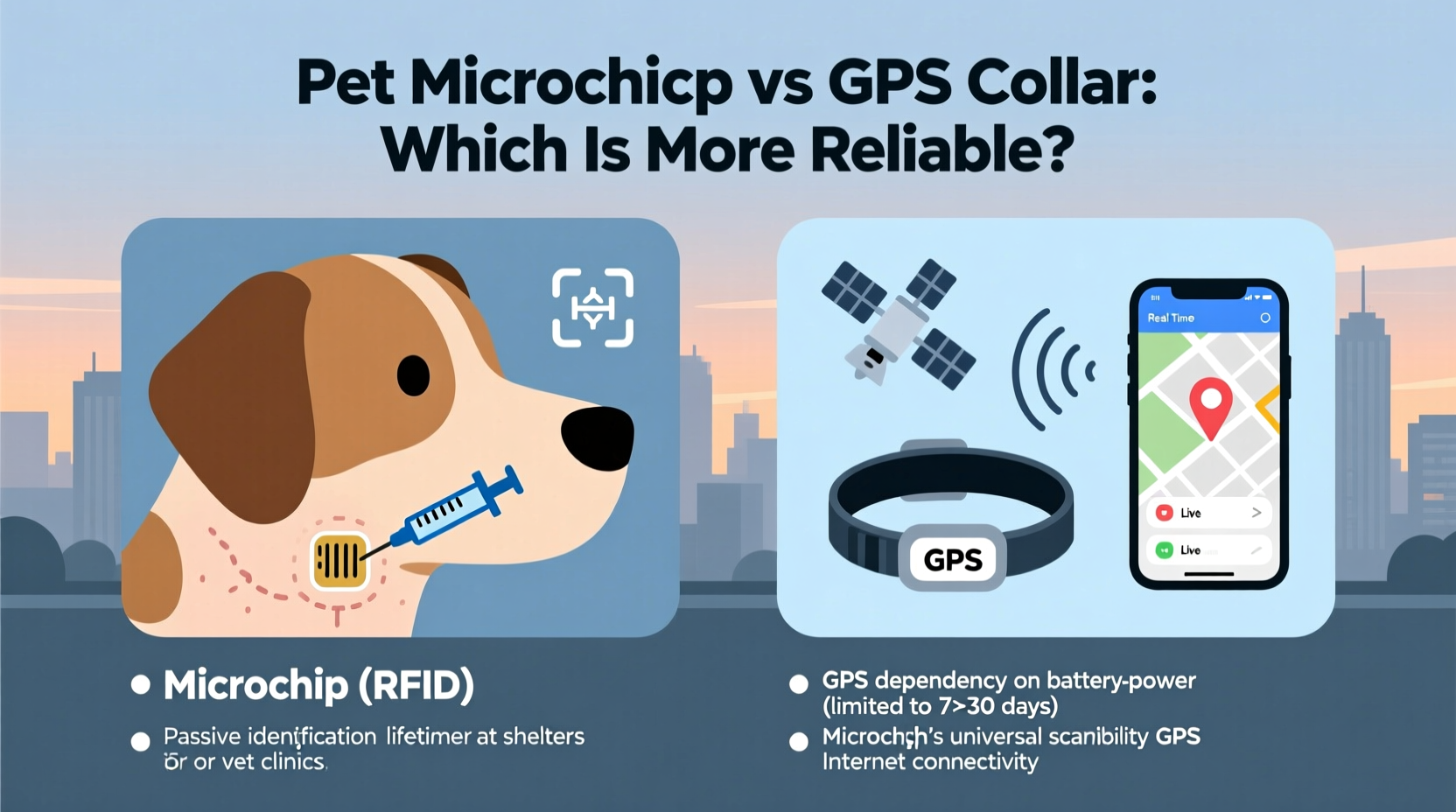
A pet microchip is a tiny electronic device, about the size of a grain of rice, implanted under the skin between a dog’s shoulder blades. It contains a unique identification number linked to a database with the owner’s contact information. The chip itself has no battery and does not transmit signals. Instead, it relies on radio-frequency identification (RFID) technology. When a lost dog is brought to a shelter or veterinary clinic, staff use a handheld scanner to detect the microchip. If scanned, the chip emits its ID number, which the finder uses to contact the registry and reach the owner.
Microchipping is a one-time procedure performed by a veterinarian or trained technician. It causes minimal discomfort, similar to a vaccination, and lasts the lifetime of the pet. Once implanted, the chip requires no maintenance. However, its effectiveness hinges entirely on three factors: proper registration, up-to-date contact details, and the likelihood that a finder will take the dog to a location with a scanner.
Tip: After microchipping, immediately register the chip with the manufacturer’s database and update your contact information if you move or change phone numbers.How GPS Collars Function
GPS collars, in contrast, are wearable devices powered by rechargeable batteries. They use Global Positioning System (GPS) satellites, cellular networks, or Bluetooth to provide real-time location tracking via a smartphone app. Owners can view their dog’s exact whereabouts on a map, set geofences (virtual boundaries), and receive alerts when the dog leaves a designated area. Some models also offer activity monitoring, health insights, and even bark detection.
Unlike microchips, GPS collars offer proactive tracking. You don’t have to wait for someone to find your dog—you can begin searching as soon as you realize they’re missing. However, their reliability depends on consistent power supply, signal strength, and physical attachment. If the collar falls off, runs out of battery, or enters a remote area with poor connectivity, tracking ceases.
“GPS collars give you immediate visibility into your dog’s location, but they’re only useful if the collar stays on and charged.” — Dr. Laura Bennett, Veterinary Behaviorist and Pet Safety Advocate
Comparative Analysis: Microchip vs GPS Collar
To evaluate which solution is more reliable, we must consider multiple dimensions: longevity, ease of use, recovery success rates, cost, and dependency on external factors.
| Feature | Pet Microchip | GPS Collar |
|---|---|---|
| Lifespan | Permanent (lifetime) | 1–5 years (device-dependent) |
| Power Source | None (passive RFID) | Battery (requires charging) |
| Tracking Capability | None (only ID after scanning) | Real-time GPS tracking |
| Recovery Method | Depends on third party scanning | Owner-led search using app |
| Initial Cost | $25–$50 (one-time) | $50–$300 + monthly service fee |
| Durability | High (internal, tamper-proof) | Moderate (can fall off, break, or get wet) |
| Success Rate (if found) | Over 75% chance of return if registered | Nearly 100% if active and online |
The data shows a clear trade-off: microchips are passive but permanent; GPS collars are active but fragile. A 2023 study by the American Veterinary Medical Association (AVMA) found that microchipped dogs were over 2.5 times more likely to be returned to their owners than non-microchipped dogs. Yet, GPS collars enable faster recoveries—often within hours—when used correctly.
Real-World Scenarios: What Actually Happens When Dogs Go Missing?
In rural areas, a dog might wander miles into wooded terrain. A GPS collar allows the owner to follow the trail in real time, potentially recovering the dog before nightfall. In contrast, a microchipped dog found days later by a farmer may only be identified after being transported to a distant vet clinic with a scanner.
Conversely, in urban environments, dogs often get picked up by Good Samaritans and taken directly to shelters. These facilities routinely scan every incoming animal. A properly registered microchip ensures a swift reunion, even if the dog traveled across town. A GPS collar might have been removed during transit or died mid-journey, rendering it useless.
Mini Case Study: Bella the Beagle
Bella, a 3-year-old beagle from Austin, Texas, slipped her leash during a thunderstorm and vanished. Her owner, Sarah, had invested in a high-end GPS collar with LTE connectivity. Within minutes, she opened the app and saw Bella moving rapidly down a drainage ditch. Using live tracking, Sarah and two neighbors followed the signal through heavy rain and dense brush. They found Bella half a mile away, trapped in a culvert, within 45 minutes.
The collar’s battery lasted just long enough. Had it died earlier, or had Bella entered a tunnel with no signal, the outcome might have been different. Still, the GPS collar enabled a rapid, life-saving recovery. Bella was unharmed, and Sarah credits the technology with preventing a tragedy.
Mini Case Study: Max the Maltese
Max, a senior Maltese in Chicago, escaped his yard during a snowstorm. He was found shivering by a passerby two days later and taken to a city animal control center. The staff scanned him immediately and found a microchip. Despite Max’s owner having moved six months prior, she had updated her information in the registry. Within an hour, she was notified and reunited with Max.
He had no collar—likely lost during his escape. Without the microchip, Max would have been labeled “stray” and possibly euthanized after the holding period. The microchip, though passive, proved decisive in a delayed recovery scenario.
Which Is More Reliable? A Balanced Answer
Neither technology is universally superior. Reliability depends on context:
- For immediate response and active tracking, GPS collars are unmatched. They empower owners to act swiftly and reduce search time dramatically.
- For long-term, fail-safe identification, microchips are more dependable. They cannot be removed accidentally and remain functional regardless of battery or network issues.
Experts agree: the most reliable approach is not choosing one over the other, but using both. A 2022 survey by the Humane Society found that dogs equipped with both a microchip and a GPS collar had a 94% recovery rate—significantly higher than either method alone.
Tip: Treat the microchip as your dog’s permanent ID and the GPS collar as a real-time safety tool. Use them together for maximum protection.Action Plan: How to Maximize Your Dog’s Safety
Follow this step-by-step guide to ensure your dog has the best possible chance of being recovered if lost.
- Get your dog microchipped by a licensed veterinarian. Confirm the chip is ISO-compliant (15-digit standard) for international travel compatibility.
- Register the microchip with the provider’s database. Include multiple contact methods: home, mobile, and an emergency contact.
- Update your information whenever you move or change phone numbers. Many owners forget this critical step.
- Choose a durable GPS collar suited to your dog’s size and lifestyle. Look for waterproof models with long battery life and strong signal coverage.
- Test the GPS collar weekly. Check battery levels, app functionality, and accuracy in your neighborhood.
- Use a physical ID tag as a third layer. Even low-tech solutions help people who don’t own smartphones or scanners.
- Educate family members on what to do if the dog goes missing: check the GPS app first, then call local shelters to report and ask for a scan.
Frequently Asked Questions
Can a microchip track my dog in real time?
No. Microchips do not have GPS capabilities. They store static ID data and require scanning to retrieve information. They cannot show location or movement.
Do GPS collars work everywhere?
Most rely on cellular networks or Wi-Fi. In remote areas, forests, or underground locations, signal loss can disable tracking. Satellite-based models exist but are expensive and less common.
Is microchipping painful or risky?
The implantation process is quick and causes brief discomfort, similar to a shot. Complications are extremely rare. The benefits far outweigh the minimal risk.
Final Recommendation: Layered Security Wins
Thinking in binaries—microchip versus GPS collar—misses the point. The most effective strategy is layered security. Think of it like home protection: locks, alarms, and cameras each serve different purposes. Similarly, a microchip acts as permanent ID, a GPS collar enables active tracking, and a physical tag offers instant visibility.
No single solution covers every scenario. A dog lost in the wilderness benefits from GPS. One found weeks later in another state needs a microchip. A collar can break, a battery can die, a registry can go outdated. But when all systems are in place, the odds shift dramatically in your favor.
“The safest dog is not the one with the fanciest tech, but the one whose owner has prepared for every possibility.” — National Council on Pet Safety
Conclusion: Take Action Today
Your dog’s safety shouldn’t depend on luck. Whether you rely on a microchip, a GPS collar, or both, the key is taking action now—not after your pet goes missing. Schedule a microchipping appointment with your vet. Research and invest in a reliable GPS collar. Register, test, and maintain both systems diligently.
🚀 Don’t wait for an emergency. Equip your dog with both a microchip and a GPS collar today, and significantly increase the chances of a swift, happy reunion—no matter where they wander.








