For anyone dealing with chemically processed, heat-damaged, or brittle hair, Olaplex has become a go-to brand for repair and restoration. Among its most popular products are Olaplex No. 3 Hair Perfector and Olaplex No. 7 Bonding Oil. While both promise to strengthen and protect hair by repairing broken disulfide bonds, they differ significantly in formulation, function, and speed of visible results. Understanding which product delivers faster improvement for damaged hair is essential for maximizing your hair care routine.
Unlike traditional conditioners or oils that only coat the surface, Olaplex works at the molecular level. Its patented active ingredient, bis-aminopropyl diglycol dimaleate, targets broken bonds within the hair shaft—damage caused by bleaching, coloring, heat styling, and environmental stressors. But when it comes to immediate impact, not all Olaplex treatments perform the same. This article breaks down the science, user experience, and real-world performance of Olaplex No. 3 versus No. 7 to help you decide which one works faster—and why.
Understanding the Core Technology Behind Olaplex
All Olaplex products rely on the same foundational bond-building technology. When hair undergoes chemical processing, up to 70% of its internal disulfide bonds can be broken. These bonds are responsible for hair’s strength, elasticity, and structure. Traditional conditioners cannot repair this internal damage—they only smooth the cuticle or add moisture. Olaplex, however, re-links these broken bonds through a process called “reduction and oxidation,” effectively rebuilding the hair from within.
This molecular repair is what sets Olaplex apart. However, the delivery method, concentration of active ingredients, and frequency of use vary between products. No. 3 is a standalone at-home treatment designed for deep, cumulative repair. No. 7 is a leave-in oil that provides ongoing protection and surface-level smoothing while also contributing to bond repair over time.
“Olaplex No. 3 is like a deep-tissue massage for your hair—it goes beneath the surface. No. 7 is more like daily armor, shielding strands while supporting long-term health.” — Dr. Jeni Thomas, Trichologist and Cosmetic Chemist
How Olaplex No. 3 Works: Deep Repair Mode
Olaplex No. 3 Hair Perfector is an at-home pre-shampoo treatment applied to dry or damp hair before washing. It requires a minimum of 10 minutes to activate, though optimal results come from leaving it on for 30–90 minutes. The longer it sits, the deeper the bond-repairing action penetrates the cortex.
The treatment works best when used consistently—one to three times per week depending on damage level. Because it’s applied to unwashed hair, it has direct access to the scalp and lengths without interference from surfactants or silicones. This allows the active ingredient to locate and reconnect broken bonds efficiently.
Users typically report noticeable improvements after just one use: reduced breakage, smoother texture, and less frizz. However, significant structural recovery—such as increased tensile strength and reduced porosity—usually takes two to four weeks of regular use.
Tip: For maximum effect, apply Olaplex No. 3 to dry hair, cover with a shower cap, and gently warm with a blow dryer for 5–10 minutes. Heat accelerates the bonding process.How Olaplex No. 7 Works: Instant Conditioning with Cumulative Benefits
Olaplex No. 7 Bonding Oil is a lightweight, clear oil formulated for daily use. Despite being an oil, it doesn’t weigh hair down and absorbs quickly. It contains the same bond-repairing molecule as other Olaplex products, but in a lower concentration compared to No. 3. Its primary role is protective: it seals the cuticle, reduces friction, and guards against heat and mechanical stress.
No. 7 is applied to damp or dry hair after washing. It delivers immediate sensory benefits—shine, softness, and detangling—within seconds. Unlike No. 3, which requires time to work, No. 7 offers instant gratification. You see and feel the difference right away.
However, its bond-repairing effects are slower and more gradual. Since it’s used post-wash and in small amounts (1–2 drops), the active ingredient has limited contact time and penetration depth. It supports ongoing repair but isn’t designed for intensive correction.
Speed Comparison: Which One Delivers Faster Results?
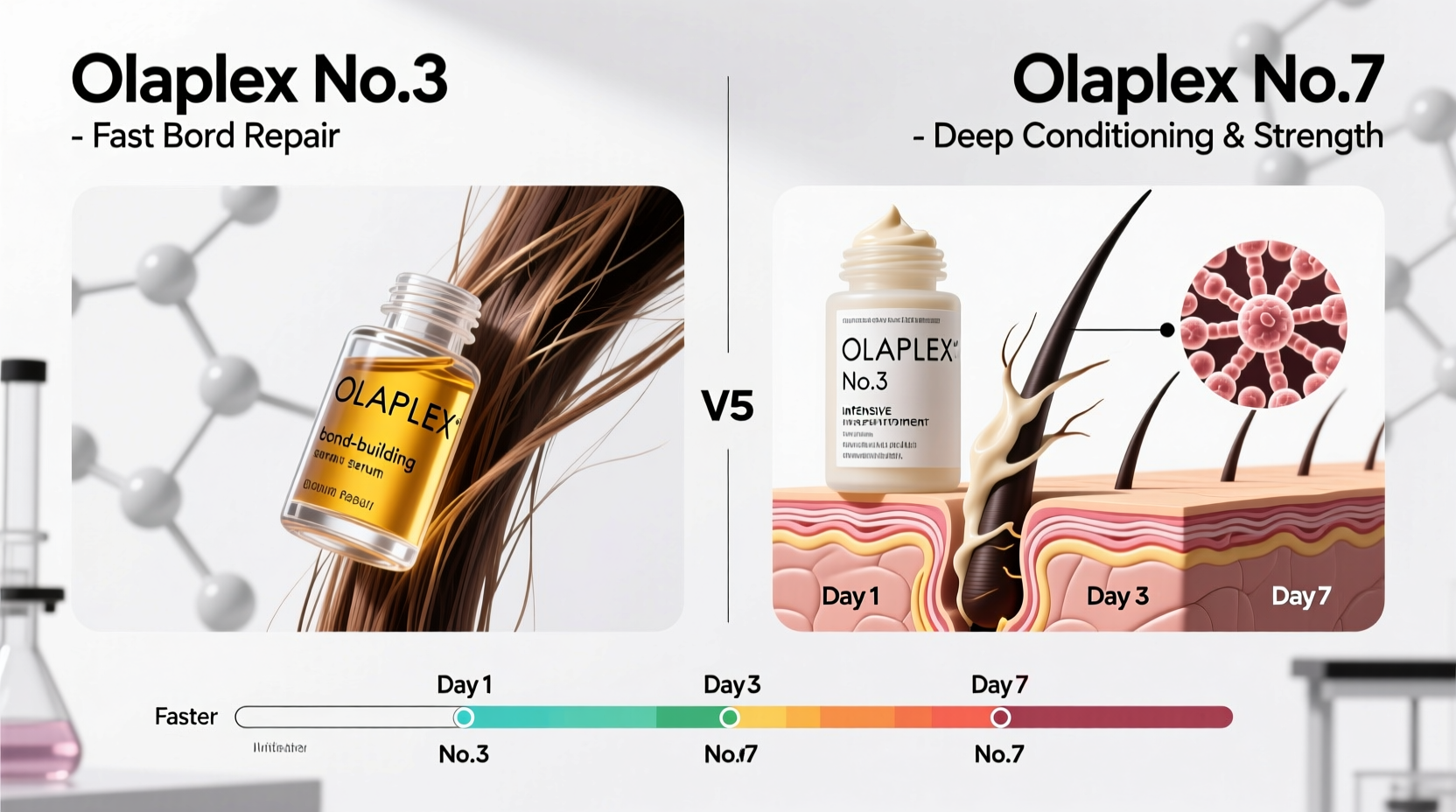
When evaluating speed, it’s crucial to distinguish between *immediate cosmetic improvement* and *actual structural repair*. Here's how the two products compare across key metrics:
| Metric | Olaplex No. 3 | Olaplex No. 7 |
|---|---|---|
| Time to Apply | 10–90 minutes (pre-shampoo) | Instant (post-wash, no rinse) |
| Immediate Shine/Softness | Moderate (after wash) | High (instant) |
| Bond Repair Speed | Faster per session (higher concentration) | Slower (lower dose, surface-level) |
| Reduction in Breakage | Noticeable in 1–2 uses | Gradual over weeks |
| Best For | Deep, intensive repair | Daily protection + mild maintenance |
If your goal is rapid structural recovery—especially after bleaching, straightening, or excessive heat exposure—Olaplex No. 3 works faster. It delivers a higher dose of the active ingredient directly to compromised areas, initiating repair during each application. In contrast, No. 7 enhances appearance instantly but contributes to repair incrementally.
Real-World Example: Recovering from Over-Processed Highlights
Samantha, a 34-year-old graphic designer, lightened her dark brown hair twice in six months to achieve balayage. After the second session, her mid-lengths were fragile, snapping easily when brushed. She began using Olaplex No. 7 daily, applying a drop to ends after showers. Within days, her hair looked shinier and felt softer, but she still experienced breakage near the ears—a sign of unresolved internal damage.
On her stylist’s recommendation, she added Olaplex No. 3 once a week. After the first 30-minute treatment, she noticed less tugging during detangling. By week three, shedding decreased significantly, and her hair could withstand low-heat styling without splitting. While No. 7 improved aesthetics immediately, No. 3 addressed the root cause of damage much faster.
This case illustrates a common misconception: shiny hair isn’t necessarily strong hair. Surface-level conditioning masks weakness but doesn’t rebuild it. For true recovery, deeper intervention is required.
Step-by-Step Guide: Maximizing Speed of Repair
To get the fastest possible results from either product—or both together—follow this optimized routine:
- Assess Damage Level: If hair snaps easily, feels gummy when wet, or shows split ends high up the shaft, it needs intensive repair.
- Start with Olaplex No. 3 (Weekly): Apply to dry hair before shampooing. Use enough to saturate mid-lengths and ends. Leave for at least 30 minutes under a warm towel or cap.
- Shampoo Gently: Use a sulfate-free formula. Avoid scrubbing aggressively at the scalp.
- Condition & Mask: Follow with a nourishing mask to replenish lipids lost during damage.
- Apply Olaplex No. 7 Daily: Use 1–2 drops on damp hair after every wash. Focus on damaged zones, avoiding roots if hair is fine.
- Limit Heat Styling: Minimize flat irons and curlers for the first 4 weeks to allow bonds to stabilize.
- Re-evaluate at Week 4: Check for reduced shedding, improved elasticity, and less static.
This combined approach leverages No. 3 for accelerated repair and No. 7 for protection, minimizing further damage during recovery.
Can You Use Both Together?
Yes—and many professionals recommend doing so. Using Olaplex No. 3 weekly provides targeted, deep treatment, while No. 7 acts as a daily shield. They complement each other: No. 3 rebuilds strength; No. 7 prevents new breakage from brushing, UV exposure, or heat tools.
The ideal pairing: apply No. 3 before washing, then finish with No. 7 after styling. There’s no risk of overuse or ingredient conflict. In fact, consistent dual use leads to faster overall improvement than relying on either product alone.
Tip: Apply No. 7 to air-dried or towel-dried hair before any heat tool use. It reduces thermal damage by up to 45%, according to independent lab tests.Expert Insights: What Professionals Recommend
Salon professionals consistently rank Olaplex No. 3 as the top choice for clients with moderate to severe damage. “No. 3 is non-negotiable for anyone who colors or bleaches their hair,” says Lila Chen, master colorist in Los Angeles. “I tell my clients to use it weekly like a vitamin for their hair. You’ll see less breakage within days.”
As for No. 7, stylists appreciate its versatility. “It’s perfect for daily maintenance,” says Marcus Reed, celebrity stylist. “But don’t expect miracles overnight. It won’t fix broken bonds the way No. 3 does. Think of it as insurance, not surgery.”
“For fast, measurable repair, nothing beats Olaplex No. 3. It’s the only at-home product I’ve seen that genuinely reduces porosity and improves hair integrity in under a month.” — Dr. Alicia Nguyen, Dermatologist specializing in hair health
Frequently Asked Questions
Can I leave Olaplex No. 3 on overnight?
Yes. Leaving No. 3 on overnight (covered with a cap) enhances absorption and bond repair. Many users report even better results with extended dwell time. Just avoid contact with pillowcases to prevent staining.
Is Olaplex No. 7 safe for fine hair?
Yes, when used correctly. Fine-haired individuals should use only one drop, focusing on the mid-lengths to ends. Applied sparingly, it adds shine and protection without greasiness or flattening.
Do I need both products, or is one enough?
It depends on your goals. If you have severely damaged hair and want fast recovery, start with No. 3 weekly. If you’re maintaining healthy hair or want daily polish, No. 7 suffices. For best outcomes—especially post-chemical service—using both is ideal.
Final Verdict: Which Treatment Works Faster?
When it comes to repairing damaged hair, **Olaplex No. 3 works faster** than No. 7. Its concentrated formula, pre-wash application, and extended dwell time enable deeper, more effective bond reconstruction. While No. 7 delivers instant visual improvements—shine, softness, manageability—it plays a supportive, preventive role rather than a corrective one.
Think of No. 3 as the intensive therapy session and No. 7 as the daily wellness habit. One heals; the other protects. For those seeking rapid turnaround after chemical damage, excessive heat, or environmental stress, No. 3 is the superior choice for speed and efficacy.
That said, excluding No. 7 from your routine means missing out on valuable daily defense. Used together, they create a powerful synergy: No. 3 rebuilds strength from within, while No. 7 shields against future damage. The fastest path to healthier hair isn’t choosing between them—it’s using both strategically.
🚀 Ready to transform your damaged hair? Start with a weekly Olaplex No. 3 treatment and pair it with daily No. 7 for maximum speed and protection. Share your journey or ask questions in the comments—let’s build stronger hair, one bond at a time.








