Hosting a wine tasting is an act of hospitality, education, and sensory stewardship. It’s not merely about pouring glasses—it’s about curating an environment where aroma, nuance, and authenticity can be perceived without interference. While no law or regulatory body mandates fragrance-free personal care for hosts, the expectation is deeply embedded in professional wine culture, sensory science, and decades of collective experience. This article examines why fragrance-free grooming isn’t optional for serious hosts—not because of rules, but because of respect: for the wine, for the guests’ ability to perceive it accurately, and for the integrity of the tasting itself.
The Science of Olfaction: Why Scent Interference Is Real and Measurable
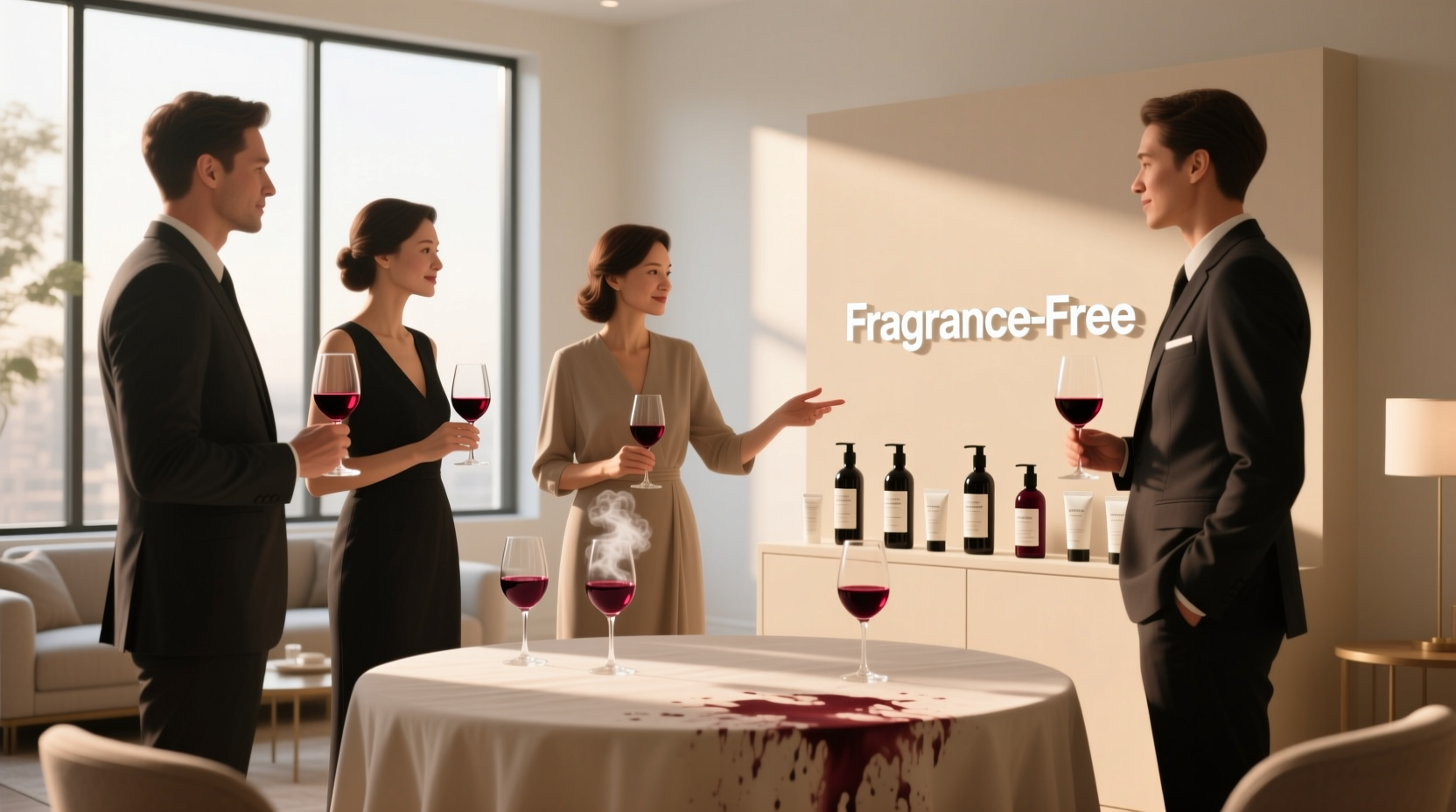
Human olfaction is astonishingly sensitive—capable of distinguishing over one trillion odor molecules—and critically, it operates on relative perception. When volatile aromatic compounds from wine (like linalool in Riesling or rotundone in Syrah) enter the nasal cavity, they bind to receptors that interpret them as specific notes: citrus zest, black pepper, wet stone. But those same receptors are easily saturated or masked by competing volatiles—especially strong, synthetic fragrances found in many deodorants, hair sprays, perfumes, and even scented hand soaps.
Research published in the Journal of Sensory Studies confirms that ambient background odors—even at sub-threshold concentrations—can suppress detection thresholds for target aromas by up to 40%. In practical terms: a guest standing near a host wearing jasmine-scented lotion may miss the delicate violet note in a Côte-Rôtie or misinterpret the subtle petrol character in an aged Riesling as “off” rather than varietal.
This isn’t subjective preference. It’s neurochemistry. The olfactory bulb processes all incoming odor signals simultaneously; there is no “mute button” for extraneous scents. Unlike vision, which can be redirected with a glance, smell is ambient, involuntary, and cumulative.
Industry Standards: From Master Sommeliers to Boutique Wineries
No governing body issues fines for wearing cologne at a tasting—but professional norms are unequivocal. The Court of Master Sommeliers explicitly advises candidates during service exams to avoid all scented products. Similarly, the Wine & Spirit Education Trust (WSET) includes scent neutrality in its “best practices” for educators delivering Level 3 and Diploma tastings.
“An untrained nose might not realize why a wine tastes ‘flat’—but if the host smells like vanilla body mist, that’s likely why. We ask our team to use unscented deodorant, shampoo, and even laundry detergent. It’s not about austerity—it’s about fidelity to the wine.” — Dr. Laura Chen, Director of Tasting Programs at Napa Valley Vintners Association
At wineries like Ridge Vineyards and Domaine Tempier, staff undergo “scent hygiene onboarding”: a half-day workshop covering volatile organic compounds (VOCs), cross-contamination pathways (e.g., perfume lingering on sleeves, hair, or coat collars), and substitution strategies. Their internal policy document states plainly: “All personnel interacting directly with guests during formal tastings must use fragrance-free personal care products. Exceptions require documented medical necessity and prior approval.”
This isn’t elitism—it’s operational necessity. A $120 Barolo deserves the same olfactory clarity as a $25 Pinot Noir. Neutral presentation ensures equity across price points and styles.
What “Fragrance-Free” Actually Means (and What It Doesn’t)
Not all “unscented” products are safe for wine tastings—and not all “fragrance-free” labels tell the full story. The U.S. FDA does not regulate the term “unscented,” and manufacturers may add masking fragrances to cover chemical odors, resulting in products labeled “unscented” that still emit detectable volatiles.
True fragrance-free means: no added synthetic or natural aromatic compounds intended to impart scent—including essential oils, isolates (e.g., limonene, eugenol), and botanical extracts marketed for “aromatherapy” benefits. These compounds are chemically identical to wine aromas and will interfere.
Tip: Check ingredient lists for “parfum,” “fragrance,” “essential oil blend,” “citrus extract,” “lavandula angustifolia,” or “limonene.” If any appear—even in “natural” or “organic” products—skip it. Opt instead for products certified by the National Eczema Association (NEA) or labeled “fragrance-free” *and* “no masking fragrances.”Also critical: consider secondary scent vectors. Your sweater worn yesterday may retain residual fragrance from laundry detergent. Your phone case may off-gas plasticizers. Even “clean” hand sanitizer gels often contain denatured alcohol blended with bitterants and trace aromatics that linger on skin for hours. For tastings, rinse hands with unscented soap and lukewarm water 15 minutes before guests arrive—and avoid touching your hair or clothing afterward.
Fragrance-Free Grooming: A Practical Implementation Guide
Adopting fragrance-free grooming doesn’t mean sacrificing hygiene or professionalism. It means choosing efficacy without olfactory intrusion. Below is a step-by-step protocol used by top-tier tasting room managers and sommelier educators.
- Assess your current routine: Audit every product applied within 12 hours of a tasting—shower gel, deodorant, moisturizer, lip balm, hair styling cream, even dental floss (some mint varieties contain strong menthol derivatives).
- Replace in order of volatility: Prioritize items with highest evaporation rates first—deodorant, hair spray, and hand lotion—since these release the most airborne compounds during interaction.
- Test for neutrality: Apply new products 24 hours before your first tasting. Spend time in a quiet room with a glass of neutral water. Sniff your wrists, collar, and hair. If you detect *any* scent—even faintly sweet, herbal, or “clean”—it’s not neutral enough.
- Create a tasting-day kit: Keep dedicated, fragrance-free versions of essentials in your tasting bag: aluminum-free unscented deodorant (e.g., Certain Dri Clinical or Vanicream), glycerin-based hand cream, and pH-balanced unscented facial wipe (for quick refreshes between pours).
- Maintain consistency: Use the same products daily—not just on tasting days—to avoid accidental carryover and to train your own sensory awareness.
Do’s and Don’ts for Wine Tasting Hosts
| Action | Do | Don’t |
|---|---|---|
| Deodorant | Aluminum-based clinical strength, fragrance-free (e.g., Dove Sensitive Skin Antiperspirant) | Fragranced “natural” deodorants—even charcoal or tea tree varieties |
| Hand Care | Wash with unscented castile soap; dry thoroughly; apply fragrance-free ointment (e.g., Aquaphor Healing Ointment) | Use scented hand sanitizers, lotions, or antibacterial wipes pre-tasting |
| Hair & Scalp | Shampoo with NEA-certified formulas (e.g., Free & Clear Shampoo); air-dry or use unscented dryer sheets | Apply scented dry shampoos, hairsprays, or leave-in conditioners |
| Clothing | Wash with fragrance-free detergent (e.g., All Free & Clear); store tasting attire separately in cotton garment bags | Wear freshly dried clothes washed with “fresh breeze” or “linen mist” detergents |
| Pre-Tasting Prep | Rinse mouth with plain water; avoid coffee, garlic, or strongly flavored gum 90+ minutes before | Chew mint gum, sip espresso, or apply scented lip balm immediately before greeting guests |
A Real-World Scenario: How One Misstep Altered a Critical Tasting
In spring 2022, a regional wine educator hosted a comparative tasting of six Chardonnays—from Chablis to Sonoma Coast—for a group of trade buyers. She’d prepared meticulously: calibrated glasses, controlled lighting, precise pour volumes, temperature-regulated flights. But she’d overlooked her new “lavender-vanilla” hand cream—a gift from a friend, applied that morning before leaving home.
Within minutes, guests began commenting: “This Meursault seems oddly floral,” “Is that oak or something else?” “The acidity feels muddled.” By flight three, two buyers excused themselves, citing “nasal fatigue.” Only after the session did a colleague gently mention the lavender note clinging to her sleeve. She re-ran the tasting the next day using strictly fragrance-free protocols. The feedback shifted dramatically: “Crystalline minerality in the Chablis,” “Pristine apple core in the Russian River,” “That saline finish is textbook.”
The wines hadn’t changed. The context had. Her well-intentioned gesture had unintentionally overwritten the very characteristics she sought to highlight. That experience led her to co-author the “Scent Neutrality Pledge” now adopted by 47 tasting rooms across California and Oregon.
FAQ: Clarifying Common Concerns
Isn’t “unscented” good enough? Why go full fragrance-free?
“Unscented” only means the product has no *discernible* odor to most people—but it may still contain masking fragrances that affect highly trained or sensitive noses. Fragrance-free eliminates all aromatic additives, ensuring zero olfactory competition. In professional settings, “good enough” risks perceptual distortion; fragrance-free ensures fidelity.
What if I have sensitive skin and need medicated products?
Many dermatologist-recommended lines—such as Vanicream, CeraVe, and Aveeno Calm + Restore—are formulated fragrance-free *and* hypoallergenic. Look for the NEA Seal of Acceptance. If your prescribed topical contains fragrance, discuss alternatives with your dermatologist; compounded fragrance-free versions are often available.
Do guests need to follow the same rule?
While hosts bear primary responsibility for environmental control, it’s courteous—and increasingly common—to include a gentle note in your invitation: “To ensure everyone experiences the wines as intended, we kindly ask guests to refrain from wearing fragrances.” Most appreciate the transparency, and it reinforces shared commitment to the tasting’s purpose.
Conclusion: Beyond Compliance—Toward Sensory Stewardship
Wearing fragrance-free grooming products isn’t about restriction. It’s about precision. It’s the equivalent of dimming the lights before a film screening, silencing phones before a symphony, or serving Champagne in flutes instead of tumblers—not because rules demand it, but because doing so honors the medium and deepens collective understanding. Every wine carries intention: from vineyard decisions to barrel selection to bottling timing. To obscure that intention with extraneous scent is to diminish the storyteller’s voice.
This practice reflects a broader ethic in wine culture: humility before complexity. It asks hosts to step back—not to disappear, but to recede just enough so the wine steps forward, unmediated and true. You don’t need certification to begin. You need only one change: swap your scented deodorant today. Then notice how much more clearly the next glass speaks.
💬 Your experience matters. Have you hosted or attended a tasting where scent interference affected perception? Share your story—and your favorite fragrance-free finds—in the comments below. Let’s build a more aromatic-accurate community, one neutral sleeve at a time.








